An Entry-level Guide to Religion
by Roger Watson (January 2026)
In referring to this as an entry-level guide I am not being derogatory about Taking Religion Seriously by Charles Murray (2025, Encounter Books, New York & London). I will return to this theme later.
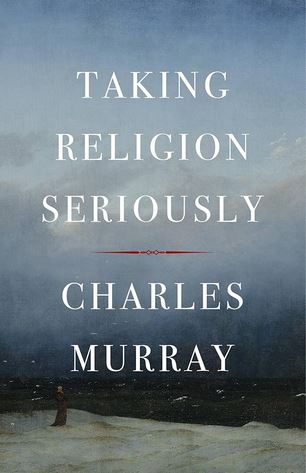 The first thing to note about Murray’s latest book, his first on religion, is its sheer readability. This is mainly accounted for by the author’s lucid style of writing but also by the fact that the book is short with only around 150 pages in the main text. The style is also modest, self-deprecating even. Murray comes across as a thoroughly likeable person. A far cry from the person who was demonised for his co-authorship with Richard J. Herrnstein in 1996 of The Bell Curve which controversially and unapologetically examined intelligence and investigated whether it had any influence on human achievement. As if that alone was not sinful enough, they were lambasted, in discussing the heritability of intelligence, for mentioning the possibility of a link between race and intelligence. In a volume of slightly less than 900 pages, the issue of race and intelligence did not even occupy a full paragraph and was raised only speculatively.
Taking Religion Seriously is restricted to one topic: religion. Controversial areas such as individual differences play no part in the arguments proposed here. Of course, both atheists and Christians may find the concept of religion, especially if it is being considered by a political scientist such as Murray, controversial. For the atheist, religion itself may be a scandal. For some Christians, Murray’s approach may be too syncretistic or insufficiently developed to impress or for them to identify with him. Murray’s is not a faith-based approach. In fact, he has doubts whether he has what could be recognised as a faith. Nevertheless, he is convinced about some fundamental issues that point to the probability that God exists, and this has moved him a long way from his former atheism, fashionable among the intellectual classes, to a belief that is even open to the possibility of an afterlife.
Murray is often at pains to indicate that he is not an expert on any of the topics covered in Taking Religion Seriously. However, with copious reference to a wide range of sources, he has achieved considerable mastery of some arguments that are fundamental to the origins of the universe, the historical nature of the gospels and the potential implications of near-death experiences.
Mere Christianity
The book that made an initial impression on Murray was C. S. Lewis’s Mere Christianity. He was, and remains, intrigued by Lewis’s challenge to decide whether Jesus was a lunatic, a liar or the son of God. He must be one of those three. My impression, while Murray discounts the first two possibilities is that he has not fully plumped for Jesus, the Son of God. If he has, he does not state it unambiguously.
Since Jesus, to the best of our knowledge, never wrote a book Murray depends on the words of those who did. He is convinced of the historicity of the gospels because of the detail and, in some instances, the lack of detail they contain. Some of the details, for example around the miracles and the resurrection, could only have been given to the four writers of the gospels by people who were eyewitnesses. And why would so many of these eyewitnesses proceed to perpetuate their accounts up to and including martyrdom, often painful and prolonged, if they knew that they had concocted a lie? This argument is a familiar one to Christians.
The missing details are equally interesting and, certainly to a Christian like me, this approach was new. Why does Luke’s account of Paul’s travels, evangelisation and imprisonment end just there, in prison? Why is his martyrdom, a matter of historical record, not recorded? Why in the gospels is the destruction of the temple in around 90 A.D. not recorded. These points indicate the immediacy of the gospels and limit the period within which they were written and published. Moreover, and this is my reflection, nobody returned to the scripts to alter them to make them more convincing. As comedian and Roman Catholic Frank Skinner once observed, there are minor inconsistencies between the gospel accounts which nobody took the trouble to reconcile. There is something disarmingly honest and almost naïve about them.
Shrouded in Mystery
Specifically, in terms of the resurrection of Jesus, Murray explains how unlikely it could be that the event was fabricated. If the gospel accounts are correct, the tomb was heavily guarded and for good reason by the authorities. The last thing they wanted was rumours that the alleged criminal they had executed had come back to life. Moreover, there is no record of anyone saying that the tomb was not empty or a record of the body of Jesus being located. Piers Paul Read’s 1990 novel, On the Third Day, was premised on the discovery of the body of Jesus in the catacombs of Jerusalem but that the threat this posed to Christianity was so great that the fact was kept hidden by church leaders. The story is complex and highly unlikely. It should be borne in mind that Read is a practicing Roman Catholic, he was not out to change minds, merely to entertain.
In considering the resurrection of Jesus, Murray takes a diversion into the story of the Shroud of Turin, a topic that has recently and increasingly fascinated me. Treatment of the Shroud is short but, in a remarkably short space, Murray covers all the main controversies and the increasing evidence that the Shroud may be dated and geographically located to the time and place of the crucifixion of Jesus. Given that fact, the intriguing possibility that the Shroud is the cloth in which Jesus was wrapped for burial seems more likely. As for the pattern on the shroud and the intactness of the linen from which it is made, these defy scientific explanation. Murray does not posit what process led to the formation of the pattern, but it is now considered to be consistent with a burst of radiation emanating from within the body it contained. It is certainly an authentic representation of a crucified man who was both scourged and crowned with thorns. If it was not Jesus in the Shroud, then who was it? For a full account I highly recommend Shroud Studies on Dr John Campbell’s YouTube channel.
The Singularity
The most strongly held of Murray’s beliefs is that the universe was initiated at the Big Bang, that nothing existed previously and that this was the result of a force which, against incredibly high odds, intended there to be life. He can no longer conceive of a better explanation and is totally at odds, for example, with arch-atheist and author of The Selfish Gene and other atheistic works such as The God Delusion who sees no grand design to the universe and no purpose to life. Given the fine minds represented by these antagonists, I would like to see them debate.
Near-death experiences and the observable phenomenon of terminal lucidity, something I have observed in dying patients in my days of general nursing, clearly fascinate Murray. The sheer consistency between stories of people who have apparently died on the operating table or in accidents, with no discernible signs of life but who have been successfully resuscitated is impressive. As for terminal lucidity, it can offer no conceivable evolutionary advantage. While not universal, its purpose can only be hypothesised. Is it, perhaps, a final opportunity for repentance?
Home Truths
Catherine, Murray’s wife, is frequently referred to throughout the book and he often compares, and contrasts, their respective approaches to religion. Catherine Murray came to religion earlier than Charles and she worships with the Society of Friends, more commonly known as The Quakers. Murray had gone along to meetings occasionally, finding them a pleasant experience, but now frequents them and accompanies his wife. It is clear, therefore, that his approach to religion is not doctrinaire. The Quakers do not require people to join their society and, to do so, no declaration of faith is required. To Murray, I presume, this seems like an ideal compromise between his residual doubts and his rudimentary faith.
I identify with him insofar as his early steps towards being religious go. Like Murray, I went to Sunday School. I cannot recall if I ever had a faith but my later school years and time at university, studying biology, cemented my atheism. When the first adult stirrings of faith began, I was reluctant to go to church having been inoculated against Roman Catholicism in my formative years and having no pleasant recollections of my native presbyterian Church of Scotland. I was married in a Quaker meeting house. But, having been attracted by the lack of doctrine and liturgy to the Quakers, the lack of both was what drew me back to church as I explored the history of Christianity. Ultimately, I was received into the Roman Catholic Church where I have remained for nearly 40 years.
Therefore, my conception of and practice of religion could not be further from Murray’s. Nevertheless, we agree on some fundamental points about the existence of God and the likelihood that death is not the end of consciousness. He also skirts the fringes of syncretism in his concluding chapter where he sees the same vital spark in all the major religions such as the non-theistic religions of Buddhism and Taoism and in polytheistic Hinduism and monotheistic Judaism and Christianity. The Prophet Muhammed and Islam are not mentioned. Murray’s approach to religion is closely aligned to the Quakerism which, to some extent, he practices. The Quakers are very accommodating of the views of the other world religions such as those mentioned by Murray. Some Christians baulk at this accommodation, emphasising the uniqueness and superiority of Christianity over other religions. Even within Christianity, there are considerable disagreements, mainly around Catholicism. Murray, wisely and conveniently does not enter that fray.
No Arguments
In fact, in writing Taking Religion Seriously, Murray has entered no frays. He is not polemical, he does not exhort others to believe what he believes, and he is not dismissive of any belief system, including atheism. He sets out to explain his own views and has been enabled in that task by his lengthy and considered contemplation of his own changing beliefs. As such, and refreshingly, Murray’s book is not aimed at anyone or any group. His aim is not to convince and in so doing, he will probably engage a great many more people who are curious about faith than the bookshelves of tub-thumping doorstoppers written by theologians and evangelists.
Naturally, there is no mention of salvation. Clearly, Murray does not consider himself to be saved. He only strays into eschatology briefly when he proposes that Hell may not be eternal banishment from God’s presence, rather it could be a full and frank realisation of one’s sins. Thus, Murray does acknowledge the existence of sin and says that he increasingly refers to his own failings as such. However, from a conventional Christian and Catholic perspective, he may be sorely disappointed in the afterlife if he does not fully account for his sins this side of the grave and seek forgiveness. Of course, from the Protestant perspective, fully accepting Jesus as his saviour would free him from his sins before death. Noticeably, the concepts of evil and judgement after death are absent from the book.
I’d recommend this book to anyone seeking answers about the universe and life’s purpose. It may not convince atheists, and some Christians might find it provocative, but it offers thoughtful insights. As a Roman Catholic, I found it informative and sparked new discussion points with others. Most of all, it gave me a deeper understanding of Charles Murray
–
Table of Contents
Roger Watson is a British academic and Honorary Professor at the University of Hull, Professor of Nursing at Saint Francis University, Hong Kong, the editor-in-chief of Nurse Education in Practice, and an Editorial Board Member of the WikiJournal of Medicine. Roger was also the Founding Chair of the Lancet Commission on Nursing and a founding member of the Global Advisory Group for the Future of Nursing.