Ghostlier Demarcations: Strand and Stevens at the World-Edge of Discovery
by Christopher Carson (March 2026)

The voyage from the Philippine Islands to America can be called the longest and most terrible of all in the world, because of the immense ocean to cross, which is almost half the globe, with the wind always against it, and the incredible and terrible storms that occur there. —Giovanni Francesco Gemelli Careri, Italian adventurer, 1698
The Black Ship enters Manila Bay in 1565, sails blackened by the Pacific crossing. My confessor, the Augustinian friar, Father Alonzo, stands at the prow, transfixed. The noon sun is merciless, stroking the brows of sailors with a freakish heat that feels less like warmth than like a fever-dream. On the pier, a pretty native woman stands, a crucifix hanging against her breast. She converses with a local Spanish trader but glances toward me, her eyes carrying both recognition and distraction. I later learned her name—Isabel. East and West, desire and faith, mingled in one vision under the blinding noon.
I begin here not because I am writing history but because poetry, like seafaring, is always about arrivals: often late, always freighted. Ships bring relics of the past and cargoes of the future. Poems do the same. Wallace Stevens and Mark Strand are voyagers of this kind, and their vessels sail the same seas: flux, appearance, discovery, and the desperate human impulse to impose order upon what cannot be mastered.

Morning: Strand’s Ruins, Stevens’s Song
Strand’s Morning, Noon, and Night begins with no dawn promise but wreckage. The speaker lies in bed, not rising to greet the day but waiting it out:
…the shadow of the future fell, and on the liquid ruins
Of the sea outside, and on the shells of buildings at the water’s edge.
A rapid overcast blew in, bending trees and flattening fields.
I stayed in bed, hoping it would pass. What might have been still waited for its chance.
Morning here is already aftermath. The sea “liquid ruins.” The shoreline is made of “shells of buildings.” Even the weather is hostile, flattening fields, bending trees. The one hopeful note, “what might have been still waited for its chance”, feels deferred, spectral. Strand actually begins his voyage after the wreck, with the sailor still in bed.
Wallace Stevens, by contrast, begins The Idea of Order at Key West with transformation. A woman’s voice imposes coherence upon the chaos of sea and sky:
It was her voice that made
The sky acutest at its vanishing.
She was the single artificer of the world
In which she sang.
If Strand’s morning is shadow and ruin, Stevens’s dawn is song and creation. The singer does not describe the sea but re-creates it, transforming it into a new world of sound. Where Strand’s speaker watches the shadow of the future fall, Stevens’s speaker hears a voice that makes the sky “acutest at its vanishing.” The difference could not be sharper: one poem begins in collapse, the other in construction.
Noon: Star Charts and Fishing Lights
In Strand’s second movement, the imagery of navigation comes to the fore:
Whatever the star charts told us to watch for or the maps
Said we would find, nothing prepared us for what we discovered.
We toiled away in the shadowless depths of noon,
While an alien wind slept in the branches, and dead leaves
Turned to dust in the streets.
The promise of discovery collapses here. Star charts and maps, the very tools of explorers, are useless against “shadowless depths” where nothing can be grasped. The explorers discover only belatedness:
…for to come as we had, long after it mattered, to live among tombs, great as they are,
Was to be no nearer the end, no farther from where we began.
This is the heart of Strand’s anti-epic. Exploration becomes an arrival among ruins, the voyage itself nullified. Tombs take the place of continents; discovery is a synonym for futility.
Stevens’s poem, too, turns at its midpoint toward explanation. After the singer’s voice ceases, the speaker appeals to the mysterious Ramón Fernández:
Tell me, if you know,
Why, when the singing ended and we turned toward the town,
Tell why the glassy lights, the lights of the fishing boats at anchor,
Mastered the night and portioned out the sea.
Here is epistemology within the poem itself. Ramon Fernández is the proto-critic, summoned to rationalize what the imagination has wrought. The fishing boats’ lights, modest and human, take up the role the singer’s voice had momentarily held: they “mastered the night and portioned out the sea.” Stevens is still willing to believe in order —whether through song or light, the world can be portioned, demarcated, known.
The contrast with Strand is stark. Stevens still turns to Fernández with the hope of explanation. Strand insists that even maps and charts are bankrupt, that discovery comes “long after it mattered.” One poet believes in order; the other in belatedness.
Night: Freakish Heat and Ghostlier Sounds
Strand’s final movement plunges into a gorgeously oppressive nocturne:
These nights of pinks and purples vanishing, of freakish heat
That strokes our skin until we fall asleep and stray to places
We hoped would always be beyond our reach — the deeps
Where nothing flourishes, where everything that happens seems
To be for keeps. We sweat, and plead to be released
Into the coming day on time, and panic at the thought
Of never getting there and being forced to drift forgotten
On a midnight sea where every thousand years a ship is sighted, or a swan,
Or a drowned swimmer whose imagination has outlived his fate.
Night here is suffocation. The heat is freakish, the dreams disorienting, the deeps barren. The midnight sea is spectral, visited by ships only once in a millennium. The drowned swimmer, still imagining beyond his own death, is a terrifying emblem of persistence without purpose. It is the ghost of exploration, not its fulfillment.
Stevens’s night is different, though it also ends in ghostliness. His final stanza invokes order once more:
Oh! Blessed rage for order, pale Ramon,
The maker’s rage to order words of the sea,
Words of the fragrant portals, dimly-starred,
And of ourselves and of our origins,
In ghostlier demarcations, keener sounds.
Stevens’s night is not freakish heat but fragrant portals. The midnight silences of his sea are actually words that can be ordered: the language, indeed the poem, is the thing. Yet even he acknowledges the tenuousness: the demarcations are “ghostlier,” the sounds only “keener” by a hair. Song grants order, but the order is spectral, provisional.
Voyages in Sound
Both poets work as much by sound as by image. Strand’s “freakish heat” stretches its vowels until the phrase itself feels oppressive. “We sweat, and plead to be released” breathes in sibilants and plosives, enacting the panting struggle. “Shadowless depths of noon” paradoxically darkens the moment of maximum light, vowels tolling like a bell. These are the sonic equivalents of wreckage, belatedness, and futility.
Stevens’s music is different but no less central. His “rage for order” pulses through his lines; the repetition of “Tell me, if you know” insists upon explanation. And his final phrase— “ghostlier demarcations, keener sounds” —is itself a compressed manifesto for poetry: language as the chart of the sea, spectral but sharper than silence.
Both poets, then, turn the sea into a phonological field. One maps wreckage in sound, the other portions order in song.
Ports of Call
Placed together, Strand and Stevens mark two stages of the modern voyage. Stevens, in the 1930s, still believed in imagination’s power to master appearances. Strand, in the disillusioned 1990s, no longer could. Stevens calls for Fernández to explain the lights on the water; Strand insists that star charts deceive and maps lead only to tombs. Stevens’s singer is the artificer of the world; Strand’s drowned swimmer is the imagination persisting beyond its own death.
Both, however, are voyagers of language. Both turn the sea into metaphor and medium. Both leave us not with certainty but with ghostlier demarcations—spectral lines that shimmer on the horizon, vanishing as soon as we approach.
And so we return to Manila Bay. Friar Alonzo at the prow, the crucifix glinting, Isabel on the pier with her distracted glance. Figures of mingling times and traditions, arrivals too early or too late. They are emblems of poetry itself: ships docking in ruined harbors, carrying not gold but ghostlier demarcations, keener sounds. And I am the demarcations. I am Ramon Fernandez.
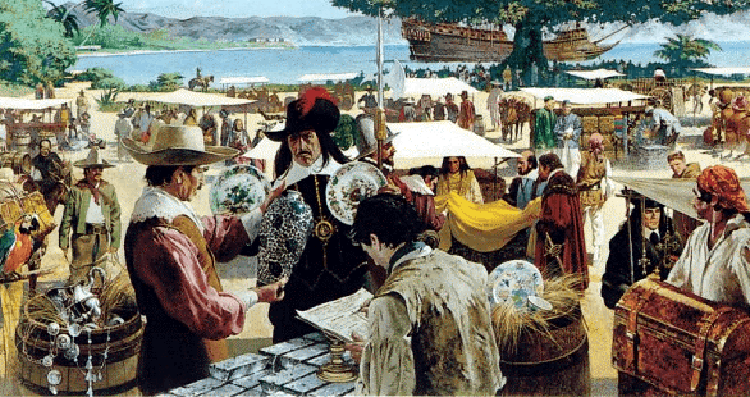

Table of Contents
Christopher S. Carson, J.D., M.A., formerly of the American Enterprise Institute, is a criminal defense attorney in private practice in Milwaukee.