Globalism, Postmodernism, Wokeism, Communism, Islam: Can the Catholic Church Lead a Revolt Against Them All?
by Guido Mina di Sospiro (October 2025)
Last weekend I was invited to the Tavole di Assisi, a think-tank for conservatives, to speak about America. The choice of Assisi, St. Francis’s hometown, was not casual, as all attendees and speakers were Catholic (to be precise, I am a neo-pagan Marianist, which can coexist with a broader understanding of Catholicism, as will be illustrated).
The organizer of the event, a lawyer and former senator, was the first to speak, welcoming the audience with an eloquent and rousing speech in which he touched upon the Battle of Lepanto and the Holy League, the Siege of Vienna and the role the Catholic Church played in it, and other such events in which Europe coalesced and united against the Ottoman, i.e., Islamic threat. That set the tone. I was reminded of a poster I found from 1947, which reads, verbatim:
Following the decree of the Holy Office
It is a grave sin:
- To join the Communist Party.
- To support it in any way, especially by voting for it.
- To read communist publications.
- To distribute communist publications.
Therefore, absolution cannot be granted unless one repents and formally agrees not to commit such a sin again. Anyone, whether or not they are a member of the Communist Party, who adheres to Marxist, atheist, and anti-Christian doctrine and propagates it, is an
APOSTATE OF THE FAITH AND EXCOMMUNICATED.
They can only be absolved by the Holy See.
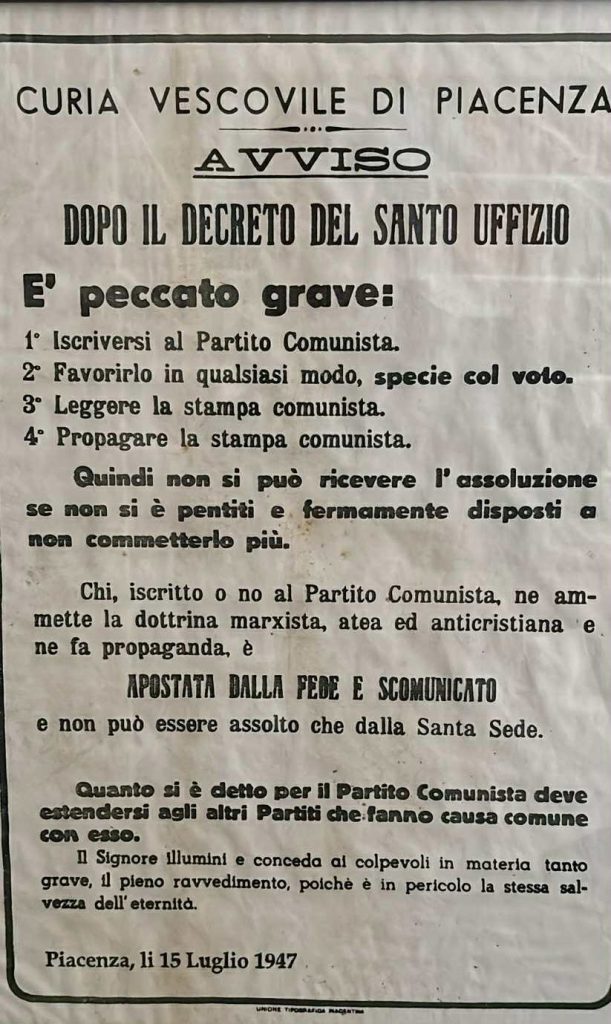
After decades of the cheesiest and most unapologetic do-goodery, was the Catholic Church going back to its past?
Eventually, a seventy-eight-year old bishop climbed on stage. He had been living for the last five years in Morocco, he told us. I wondered in my mind, has he been converting the… infedels? (as, technically, Muslims ought to be seen by Christians, since Christianity predates Islam by several centuries). Think again, Guido! Inter alia, the bishop said, “In the United Kingdom, this year for the first time the most popular name for a newborn has been Mohamed; let us resign ourselves—Europe will be Islamic.”
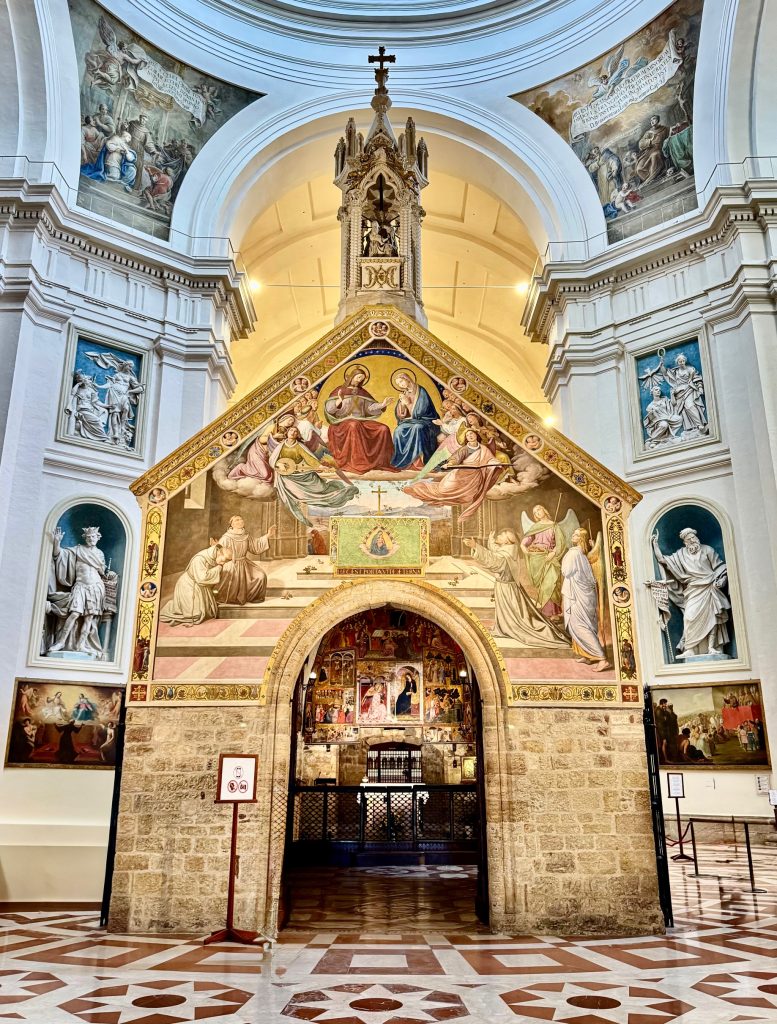
The next day began with a mass at the nearby Basilica of Our Lady of the Angels, which was built on top of the Porziuncola, the tiny church St. Francis of Assisi built with his own hands to answer God’s summons, and near which he eventually died. Incidentally, most Americans think Los Angeles is the city of the angels, but in fact the Franciscans, who founded it, called it: Nuestra Señora de los Angeles de la Porciuncola; it is, then, the city of Our Lady of the Angels of the Porziuncola. (“Porziuncola” is the Italian spelling; “Porciuncola” is the Spanish one; phonetically, the two words are alike.)
By then I wasn’t expecting much from the same Bishop, but I must say he managed to stoop lower. During mass, the liturgy of the word is comprised of two readings and the Gospel. Invariably one of the readings is a letter by Saint Paul. Paul of Tarsus was a violent persecutor, and even murderer, of Christians, but one day on the way to Damascus a blinding light appeared to him, as well as the voice of the risen Jesus, ordering him to halt the persecution of Christians. Paul was blinded but then healed by one Ananias. After that he was baptized and became an apostle, though he had never known Christ. So a former persecutor and killer of Christians and, as it transpired, a misogynist became the second most influential voice in the Catholic doctrine, with all the obnoxious zeal typical of the convert, the penitent and the miraculously-healed.
Going back to the Bishop’s mass: then came the Gospel, from Luke. Luke was, by all accounts, a physician. A shortish and not particularly clever piece of information was nevertheless overanalyzed during the homily, as it has been analyzed to death over many centuries as all canonical gospels. (I’ll point out something the reader would probably not expect from me, but I am familiar with Sufi story-telling, including the stories of Mullah Nasrudin, and find them far more worth analyzing than the Canonical Gospels, as they are mind-bending and difficult to interpret.) The bishop concluded his exegesis by speaking about Jesus with the compulsion of the obsessed, and saying that nothing else mattered but to receive Jesus inside oneself.
Just two days before, a terrorist attack had been foiled by the Italian Police in Viterbo, about an hour and a half south of Santa Maria degli Angeli: two Turkish Muslims with an arsenal of weapons were behind a window ready to open fire on a procession of thousands of Catholics in honor of Santa Rosa.
Mainstream media barely mentioned the incident, of course. The bishop two days later spoke about receiving Jesus inside oneself but these days it seems more likely for Catholics to receive bullets inside themselves.
And there is more. Famiglia Cristiana is Italy’s bestselling periodical; some years ago the magazine conducted a survey: Whom Do Italians Pray To? The results: Padre Pio in first place. And who might that be? An Italian Capuchin friar, priest, stigmatist, mystic, miracle worker, and saint who died in 1968. Then other saints, male and female, and of course the Virgin Mary. Jesus got 1% of the preferences; God, 0%. And the bishop blabbers on about Jesus, Jesus, Jesus as if he were a protestant (protestants greatly diminished the importance of the Virgin Mary and essentially abolished saints).
Incidentally, why do Italians, and many more folk Catholics around the world, pray not to Jesus? For two reasons: for most of the Gospels Jesus reproaches just about everyone; and, the Virgin Mary, or the saint of your choice, will always listen to your petition, and then intercede with her son, or with the lord, on your behalf. If the boon is not granted, Our Lady did what she could, it’s not her fault; the saint did what he or she could; it’s not his or her fault.
Between the Islamic threat and the Italians’ praying proclivities, could that champion of unawareness, the bishop, be more detached from reality? I don’t mean to attack him personally, because today the vast majority of the Catholic Clergy in the developed world is equally misguided, cowardly and out of touch from the needs and realities of the faithful. The Spaniards have a fitting adjective for such human specimens: inutil, i.e., useless.
And to top it all, it was the day of the Nativity of the Virgin, we were in a huge and world-famous basilica dedicated to her, yet did the bishop spend a single word about her? Jesus, Jesus, Jesus…
My wife and I were appalled and decided to go, that very day, to another famous Basilica, the one of the Holy House, in Loreto, a couple of hours away.
Pious legends say that the House in which the Holy Virgin lived was flown over by angels from Nazareth to what is now Trsat, in Croatia, then across the Adriatic on to Recanati and finally, in 1294, to the current site of Loreto, about four miles away. Do I believe that? Of course! If I am to believe that God created the entire universe from scratch, flying a brick house over the Mediterranean and then the Adriatic is a small feat indeed.
The Basilica of the Holy House is one of the most popular sites of Marian pilgrimages, and has been so for centuries. Among many others, Descartes visited it, in 1620, and some maintain that he drew inspiration for his mathematical work.
What did we find in Loreto on Our Lady’s birthday? A festival of folk Catholicism.
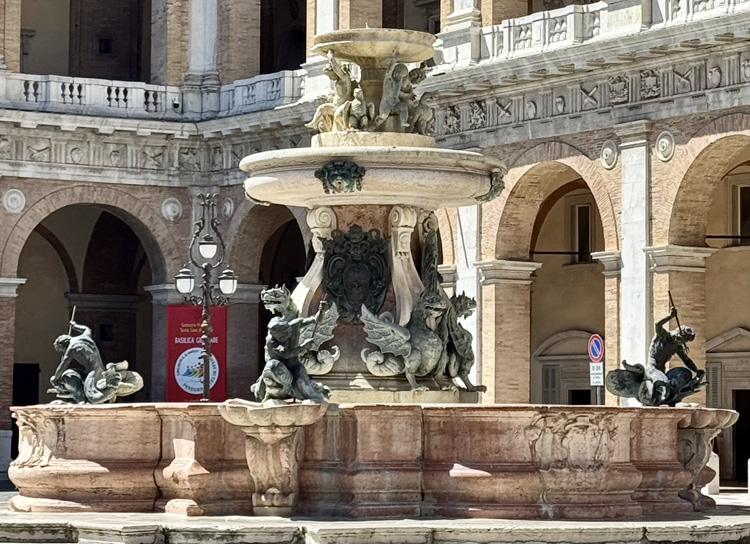
In the beautiful Renaissance square, around the exquisitely pagan fountain (above) (Joscelyn Godwin has written the ultimate book about the syncretism between paganism and Christianity, The Pagan Dream of the Renaissance) were some folk musicians dressed in traditional garb
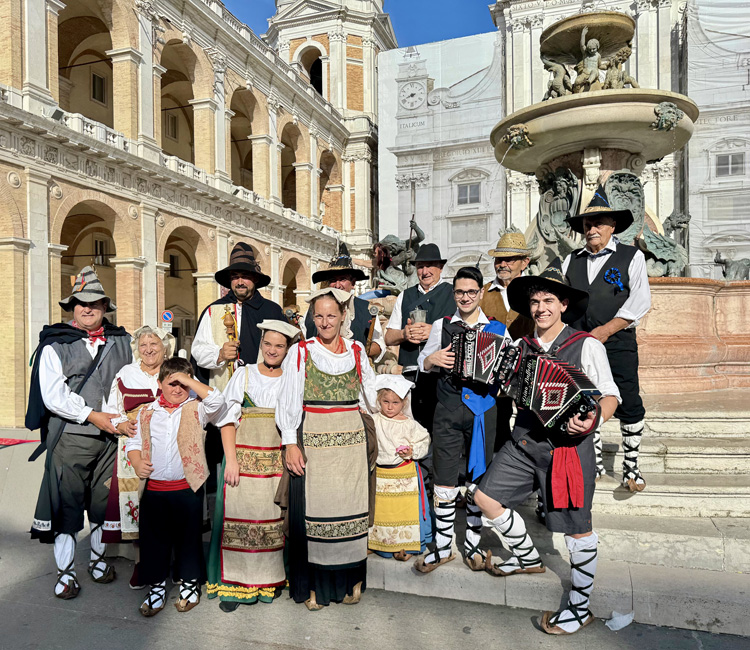
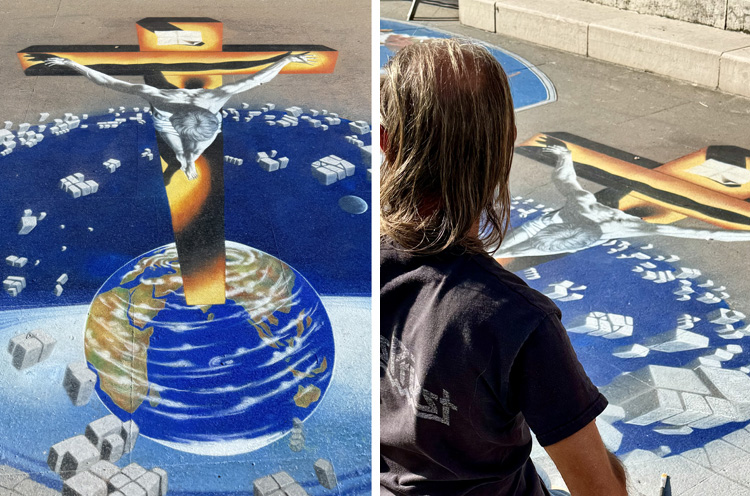
playing cheerful waltzes on their accordions. Indeed, the best accordions in the world come from Le Marche, that very region, and a town nearby, Castelfidardo, is known as “the accordion capital of the world.” A street artist of uncommon talent and technique had created three paintings on the floor, the central one with Jesus on the cross observing from outer space how we are destroying this beautiful planet, breathable, drinkable and edible, piece by piece. I asked the artist his name: “Angelo.”
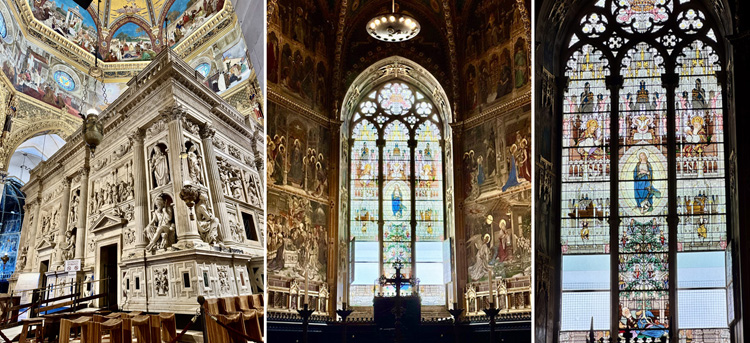
Inside the magnificent basilica overflowing with stunning architecture, frescoes, statues and paintings, is the Holy House (above). Whether you are a believer or not, I suspect it is difficult for anyone to stand inside its ancient and humble walls and feel nothing. Throngs of people were flowing in and out of the Holy House, either to thank the Virgin or to ask for a grace, or both. Nearby, a monk was blessing religious items for a small fee, and had I had my rosary with me, I would have gladly had it blessed.
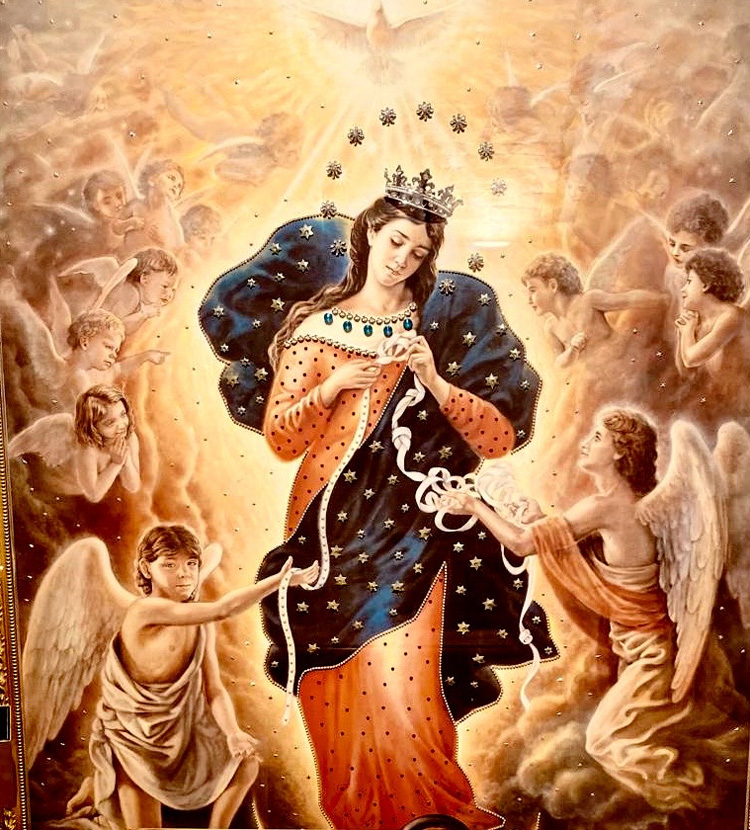
Before getting to the Basilica, through a lateral door in its basement, was a large room dedicated to Our Lady, the Undoer of Knots. (photo) This particular devotion finds its origins in the Baroque painting by Johann Georg Melchior Schmidtner entitled “Mary, Untier of Knots,” from around 1700. The painting depicts Mary patiently untangling the knots of a ribbon with the help of some angels. The concept is strikingly analogous to that of Ganesha, one of the most revered and worshipped deities in the Hindu pantheon, who is known as “the remover of obstacles.”
Later, in the evening, the traditional torchlight procession would take place along the streets of the historic center, with the recitation of the Holy Rosary, in the presence of pilgrims from the diocese dressed in traditional Ciociaria costumes and the participation of the various districts of Loreto donning historical costumes.
Our Lady, Mother of God, is one, of course, but she is worshiped in multiple ways, chiefly, but not only, according to her apparitions in different places and times. The first, and only one while she was still alive, happened in Zaragoza, Spain, where she appeared to the apostle James on January 2, 40 AD, asking him to build a temple in her honor. She came to be known as la Virgen del Pilar.
Since then, through many other apparitions, her cult grew and grew. From being Christotokos, Mother of Christ, she was declared Theotokos (“God-bearer” or “Mother of God”) in 431 A.D. at the Council of Ephesus, near Our Lady’s house of birth, which can still be visited today. There was a crowd of faithful outside the council stomping their feet and shouting, “Minerva, Minerva, we want Minerva.”
Yes, Marianism was born out of a grassroots movement; the Gospels spend very little time with the Virgin Mary, and her son Jesus is not particularly nice to her. But over the centuries her importance has grown exponentially. There are far more churches in the contemporary Catholic universe dedicated to her than to Jesus. Over seven centuries ago, between 1316 and 1321, Dante codified the role of Our Lady with some of the most beautiful verses ever written, at the very beginning of the last Canto in the Paradiso:
Vergine Madre, figlia del tuo figlio,
umile e alta più che creatura,
termine fisso d’etterno consiglio,
tu se’ colei che l’umana natura
nobilitasti sì, che ’l suo fattore
non disdegnò di farsi sua fattura.
Virgin Mother, daughter of your son,
humble and high above all creatures,
fixed term of the eternal counsel,
you are the one who ennobled human nature
so much that its creator
did not disdain to become its creation.
And anyone with a modicum of sense would realize, then and since, that Our Lady had risen to the very zenith of the Catholic Church’s hierarchy. Down the centuries she has incarnated all sorts of goddesses: Athena, Cybele, Minerva, Diana—it’s a long list.
For example, the Feast of the Assumption of the Virgin into Heaven, celebrated on August 15, is called Ferragosto in Italy. It is a holiday as relevant as Christmas and Easter. Yet its very name, Ferragosto, betrays its pagan origin: Feriae Augusti, the festivity that Emperor Augustus established in 18 BC to celebrate the harvest and in honor of the goddess Diana.
And what of Christmas, the Christian festivity par excellence? In ancient Rome, December 25 was celebrated as the Feast of Mithras and of the Natalis Solis Invicti, or the Birth of the Unconquered Sun, the rebirth of light and warmth after the winter solstice. The Mithraic mysteries were a Roman mystery religion inspired by the Iranian worship of the Zoroastrian divinity Mithra. When Emperor Constantine converted to Christianity, December 25 also became the date of Jesus’s birth, leading to the celebration of Natalis Christi. Nota Bene, Christmas in Italian has retained the same word: Natale.
Coopting and incorporating earlier deities, religions, mysteries, rituals and festivities is the strength, not the weakness, of the Catholic Faith, as it becomes increasingly clear that its origins are far more ancient and deeply rooted than commonly understood. In fact, in Greek “Catholic” means “universal.”
There are many more examples of preexisting feasts and deities expediently coopted by Catholicism. And then there are the saints, scores of them. How many? Well over ten thousand, according to some estimates close to twelve thousand, male and female alike, who preside over all possible human activities and troubles. Saint Barbara, for example, is the patron saint of artillerymen, miners, and firefighters; those at risk of sudden death, fire, or explosions. The territory is so vast, one is reminded of the thousands of Hindu deities, though they have millions—the Catholic saints need to catch up! Luckily, the list keeps growing every time a new saint is canonized.
Going to mass in Písac, in Peru’s Sacred Valley of the Incas, or in Chichicastenango, in Guatemala, as I have, is a very different experience—an exercise in syncretism between Catholicism and local religions, beliefs, superstitions, deities, festivities, rituals.
Folk Catholicism, by resorting to beliefs that are local and grounded in the territory’s history, at times dating back to the dawn of history, or even of time, escapes the abstract arbitrariness of the canonical doctrine, and makes religion come, and stay, alive.
In Italy and in the rest of Europe, the US, Canada, Australia and New Zealand, orthodox Catholicism is so out of touch with the people that they either have lost any interest in it or, here and there, they adhere to folk Catholicism, which, one could say, in the developed world is a sort of shadow Catholicism. Of course they higher classes in such countries frown upon it.
There is hope in some quarters that the new Pope, Leo XIV, will revitalize the Catholic Church. Decades of pre-wokeism have turned it into a weak, unwarlike institution incapable of opposing just about anything. Secularism, atheism, irreligiosity have prospered. Islam is attempting yet again to conquer Europe (that centuries-old obsession), and there is no Holy League organizing a counter-offensive. It’s an immense waste of human resources: one billion and three hundred million Catholics, if suitably led by a Pope engaged in the defense of religion and of western culture, would be a formidable force. But most of the clergy would have to be replaced by another one with an entirely different mindset, and I’m not holding my breath on that.
Table of Contents
Guido Mina di Sospiro was born in Buenos Aires, Argentina, into an ancient Italian family. He was raised in Milan, Italy and was educated at the University of Pavia as well as the USC School of Cinema-Television, now known as USC School of Cinematic Arts. He has been living in the United States since the 1980s, currently near Washington, D.C. He is the author of several books including, The Story of Yew, The Forbidden Book, The Metaphysics of Ping Pong, and Forbidden Fruits.
Follow NER on Twitter @NERIconoclast