How America Learned to Let Art Happen
The Forking River of Nineteenth-Century American Painting
by Christopher Carson (July 2026)
Wandering the American galleries of the Art Institute of Chicago, I found myself following an internal guide in place of chronological obedience or the scholarly discipline of the wall labels. Certain paintings drew me forward, others repelled me gently, and a few exerted a gravitational pull strong enough to reorder everything I thought I was seeing around them.
Museums, especially encyclopedic ones, are architectures of memory, and walking through them is always an encounter between the order imposed by history and the order imposed by temperament. What struck me, moving from the great American landscapes of the nineteenth century through genre scenes, Homer’s unsparing moral clarity, Inness’s hazy interiors of mood, and eventually toward the cosmopolitan confidence that would culminate in Sargent, was an ambitious and elusive story about American self-trust.
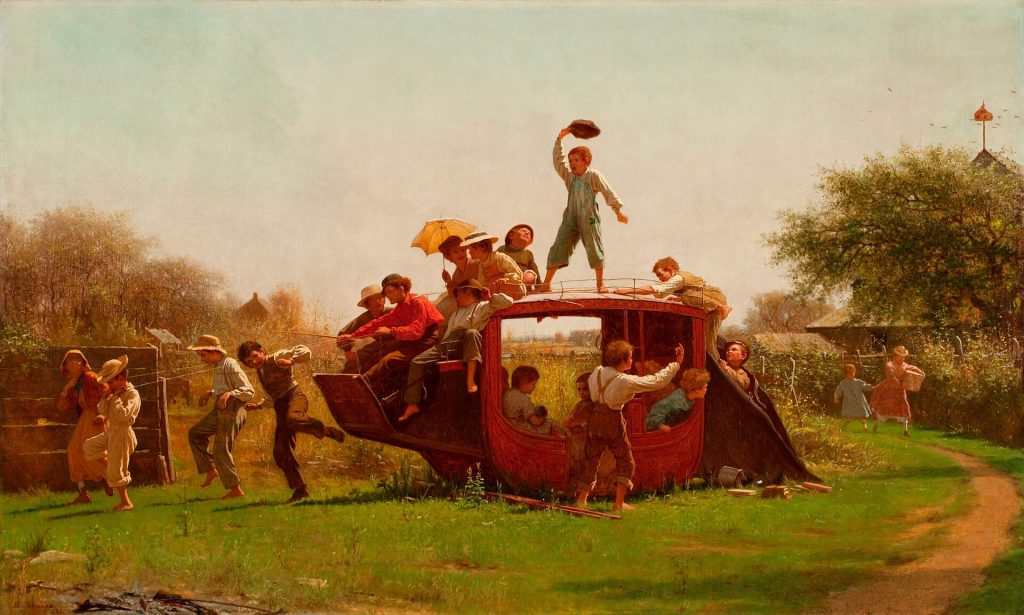
At a certain point in the gallery, my mind drifted from Chicago to my own town, Milwaukee. Specifically, to Eastman Johnson’s The Old Stagecoach at the Milwaukee Art Museum, a painting I have known for years and returned to often. It depicts children clambering over a dilapidated stagecoach in full daylight, playing with a relic of national transit and myth that no longer moves. The coach is obsolete, its former purpose exhausted, and yet the scene is neither mournful nor ironic. The painting radiates a quiet assurance that history can be handled without being worshipped.
That memory began to refract everything I was seeing in Chicago. The great landscapes of the Hudson River School no longer appeared simply as beautiful scenery or Romantic excess; they had become early acts of confidence building. Homer’s solitary figures called to mind another painting I knew well from the Metropolitan, The Veteran in a New Field, which read as an instruction, as if the canvas itself were teaching a country how to put its weapons down without going slack. Inness’s hazy tonal fields were reparative, an attempt to metabolize historical noise into inner equilibrium. And Whistler’s audacious insistence on arrangement, tone, and allusion rather than explanation began to feel like the decisive release of American painting from the need to justify itself at all.
Nineteenth-century American painting, it seemed to me, functioned as a system of national psychology, a series of aesthetic answers to changing conditions of confidence, rupture, and legitimacy, repeatedly asking how much faith a civilization could place in itself, and answering that question differently at each stage of its development.
The Hudson River School is often described as America’s first native art movement, but that formulation understates its psychological ambition. These painters were doing more than depicting American scenery. They were constructing a moral architecture for a young republic acutely aware of what it lacked.
The United States in the early nineteenth century possessed no ruins, no medieval cities, no layers of sedimented cultural authority that could reassure a people of their historical depth. At the same time, it was already experiencing the pressures of urban growth, market acceleration, and early industrialization. The question went beyond what America looked like to what entitled it to endurance.
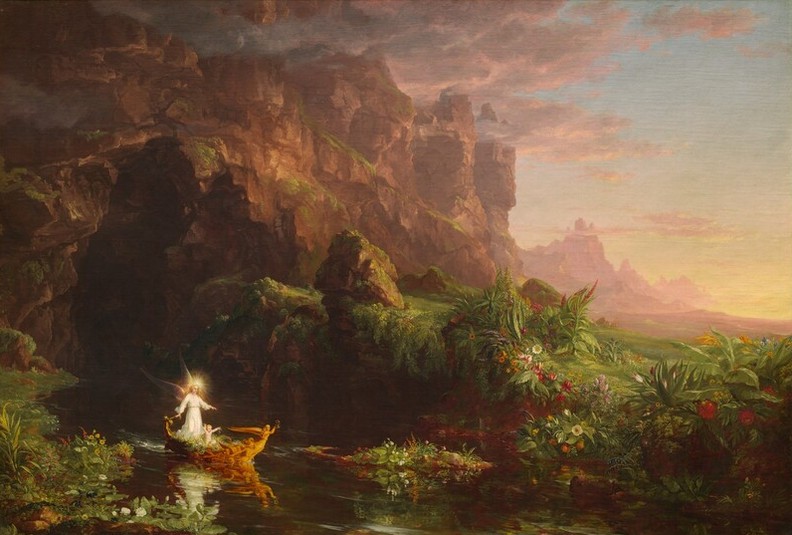
Consider Cole’s The Voyage of Life: Childhood from 1842. A gilded barque emerges from a dark cavern at the edge of a river, an infant standing in its prow with arms upraised, an angel at the tiller, the stream ahead opening into a meadow lit by a clear, untroubled sun. Cole gives the child no oar, no map, and no companion other than the celestial pilot, and yet the river flows in a single confident direction toward the light. Nothing in the picture suggests that the journey might fail. The viewer is asked to accept that the American beginning is a guaranteed passage out of darkness, supervised by a benign and unspoken authority.
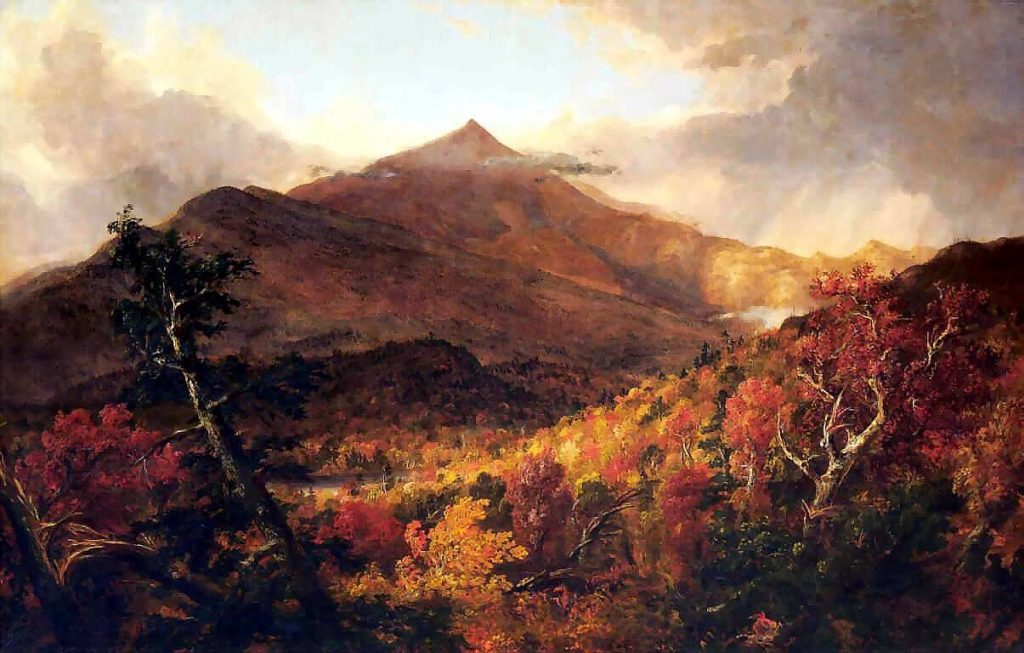
The answer, proposed with remarkable consistency by Cole and his contemporaries, was landscape as providence. American nature was painted as vast but ordered, sublime but legible, powerful yet receptive to moral habituation. Rivers guided the eye toward distance and destiny. Valleys opened into futures that seemed expansive and sanctioned at once. Churches and farms nestled within overwhelming terrain were proofs of compatibility between human settlement and natural grandeur.
The Hudson River School offered reassurance that modern life, with all its speed and abstraction, had not severed the nation from a deeper moral ground. Nature functioned as a guarantor, a silent but eloquent witness that the American experiment was an unfolding design of its people.
Psychologically, these paintings perform an act of substitution: where Europe could appeal to cathedrals, ruins, and dynasties to underwrite its sense of legitimacy, America was asked to trust its mountains and rivers in their place.
From this psychological starting point, everything that follows becomes intelligible. The intensification of the sublime, the turn toward genre and ordinary life, the hard moral clarity of Homer, the inward retreat of Inness, and the radical confidence of Whistler amount to successive renegotiations of the same underlying problem the Hudson River School had posed. How much can a nation trust itself as a discrete moral identity, and what must art do in order to sustain that trust?
Art historians have long argued that nineteenth-century American landscape painting had always been a cultural instrument that manufactured legitimacy, metaphysics, and national self-recognition through the rhetoric of nature. Barbara Novak’s classic account treats the genre as a fusion of “nature” and “culture” in which landscape becomes an ideological form, a visual idiom for the republic’s moral self-explanation and aspirational order. In that light, the Hudson River School’s composure, and later the operatic escalation of the western sublime, can be read as pictorial statecraft: a repertoire of images that substitutes geography for antiquity and turns the continent into a civic credential.
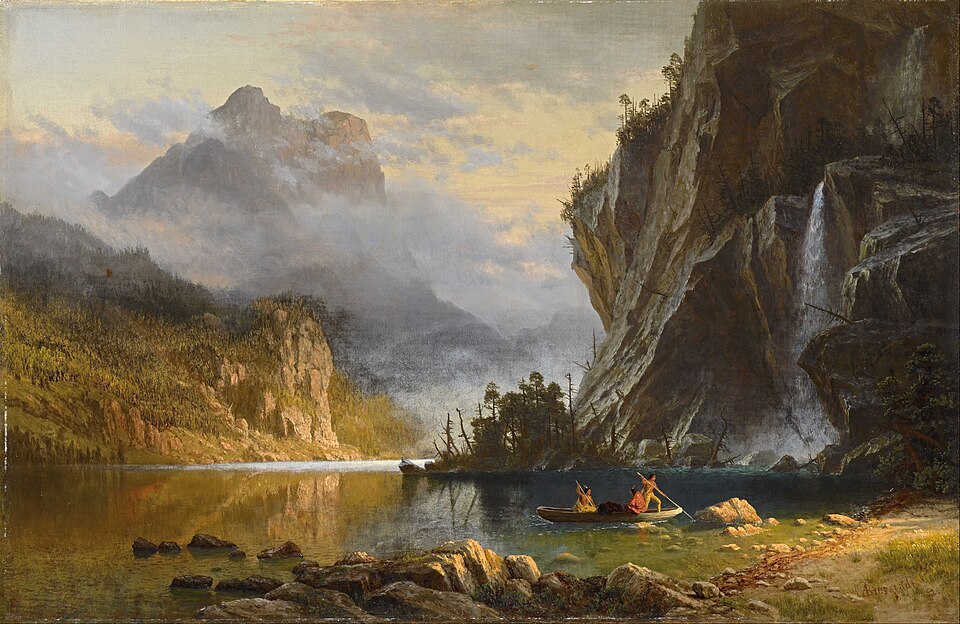
In the hands of painters such as Albert Bierstadt, the continent becomes a pure theatre of immensity, the providential text all but forgotten. Light becomes operatic, distance imperial. The horizon is a promise of domination. Even when the subject is seemingly modest, the sensibility is expansionist. Nature is rendered as inexhaustible capital, aesthetic and symbolic, a reservoir of meaning vast enough to absorb every anxiety the nation was not yet willing to name directly.
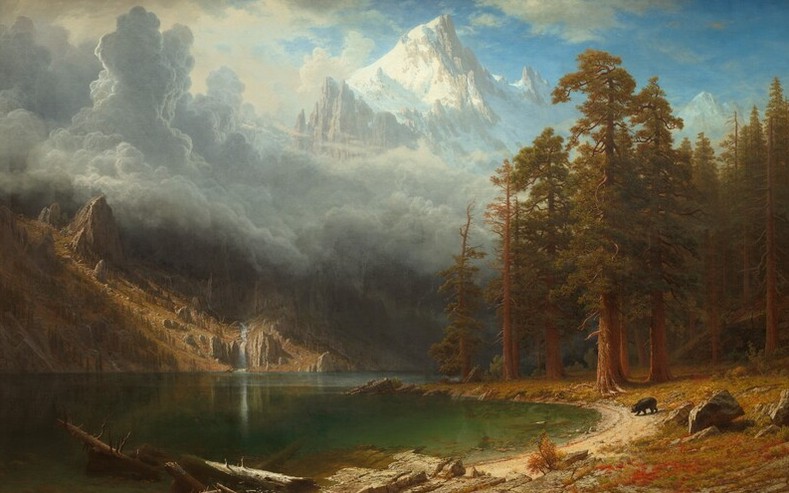
This goes deeper than bigger canvases or more dazzling effects. It is a shift in the moral posture of the gaze. The Hudson River painters often look upon nature as one might look upon a sanctified space. The later monumentalists look upon it as one might look upon a prize. The landscape becomes an asset, collected by vision and converted into ownership through spectacle.
The irony, of course, is that this escalation occurred alongside the nation’s gravest internal crisis. While the painter’s eye ranged outward, the republic approached a moment when it would be forced to look inward.
That contradiction is what gives mid-century sublimity its faintly compensatory quality; it offers the consoling idea that the country’s future lies in its distance, that greatness can be achieved by moving forward, that expansion can outpace fracture.
It is not difficult to see why such images appealed to an audience increasingly crowded into cities and towns, increasingly subject to the abstractions of industrial and market life. The more daily existence becomes rhythmic, mechanical, and enclosed, the more the imagination craves boundless spaces. The landscape becomes a form of relief, though never the restful kind of a pastoral afternoon. It is relief as intoxication, relief as radiant excess. The eye is permitted to breathe in a world that seems too large to be owned by any single grief.
Yet this very radiance hints at a limit. Confidence, when it must be constantly reaffirmed through spectacle, begins to resemble anxiety in costume. The monumental sublime carries within it the possibility that the nation, sensing its own instability, sought to drown moral complexity in light.
Other painters of the period register the same transitional pressure more quietly. A work like Jasper Francis Cropsey’s Blasted Tree offers a single, wounded emblem. The tree stands as an interruption of pastoral ease, a reminder that nature is mortal, susceptible to rupture for all its serenity.
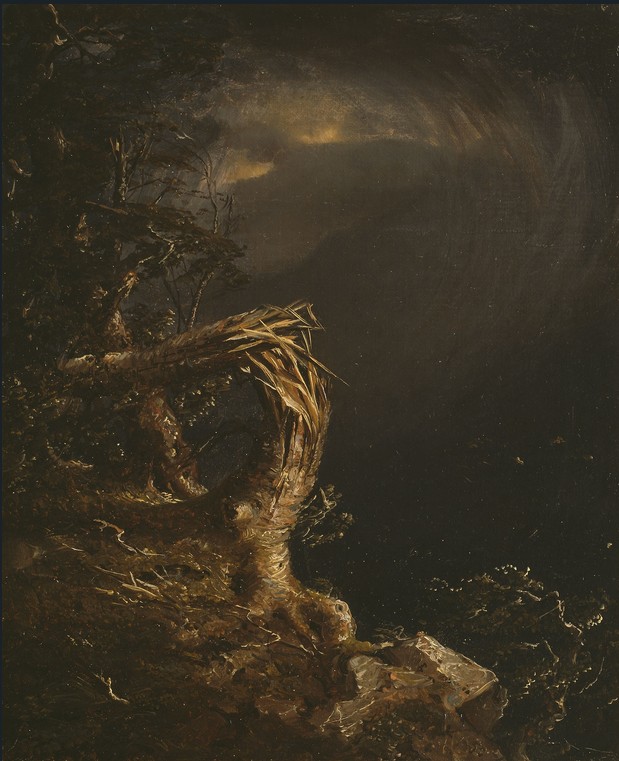
In earlier Romantic idioms, such imagery can function as a conventional memento mori, a theatrical punctuation mark. But in the American context of the 1850s and early 1860s, it can feel like foreshadowing. The country’s sublime is not immune to savage violence. The landscape itself begins to carry premonitions of damage.
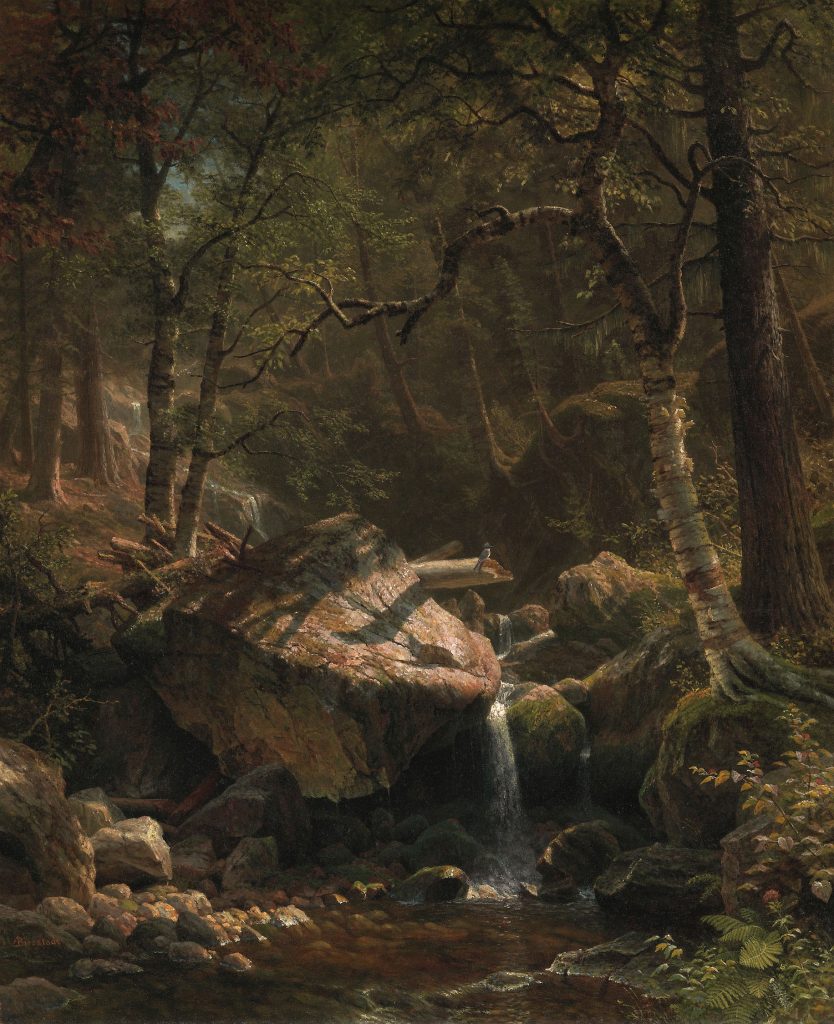
And this is where the outward gaze begins to fail. The western sublime can promise magnitude, and by itself nothing of moral coherence. It cannot explain the coming ruptures. It can only offer, in the language of light and distance, the hope that a nation can survive its contradictions by outrunning them.
That hope did not survive unchanged. The war, when it arrived fully, altered politics and demography, and changed the conditions of meaning beneath them. After it, America could no longer plausibly treat the land as untouched guarantee, nor treat magnitude as redemption. The republic would need a different kind of confidence.
Art historian Angela Miller presses the argument further by insisting that these paintings actively participate in American cultural politics, shaping the national conversation about expansion, authority, and belonging through a disciplined regime of looking.
The next turn, then, was toward smaller paintings or quieter scenes, driven by moral necessity more than aesthetic preference. Once the nation discovered that it could bleed, the symbols of destiny had to either harden into propaganda or evolve into something more honest, by which I mean a picture-making that records the texture of common life rather than the metaphysics of national destiny.
After the escalations of the sublime, after the continent had been painted large enough to make the viewer forget his own century, Eastman Johnson (American, 1824–1906), a New England-born genre painter trained in Düsseldorf and at The Hague, who built his reputation on intimate domestic interiors and quiet rural scenes, feels at first like a narrowing. The horizon comes closer. The air is less theatrical. The moral temperature drops from prophecy to habit. But this is a transfer of authority. Johnson quietly insists that a nation is finally made by its people, their customs, their work, their play, their rooms, their silences, and their forms of shared life, and only secondarily by the mountains it loves.
Johnson stands as a rival center of gravity, and never a mere bridge figure or connective tissue between grander styles; he proposes a different foundation for American confidence. Instead of asking the land to guarantee national meaning, he asks the ordinary day to bear it.
That move changes what counts as seriousness. In the Hudson River tradition, seriousness is earned through sublimity, through the large moral metaphors of light, distance, and providential scale. In the monumental western sublime, seriousness is earned through magnitude and spectacle. Johnson earns seriousness by refusing to leave the human world behind. His realism is the national project brought indoors.
A society under stress often seeks symbols that are larger than life. Sublime landscape is one such symbol. But a society that intends to endure must eventually return to the scale at which endurance actually occurs: kitchens, porches, schoolrooms, fields, fences, barns, thresholds, the ordinary. Johnson paints that scale with a confidence that the careless eye takes for anecdote and the patient one for an argument about national continuity.
Johnson paints a dilapidated coach in full daylight, and then commits an act of quiet audacity. He populates it with children, exuberant and unselfconscious, climbing over it and into it, transforming a relic into a playground. The stagecoach is the old conveyance of national movement and national myth, a vehicle from a former America, and it no longer moves. It has been retired by history. But the scene is not tragic. The painting’s mood is neither bitter nor elegiac. It is practical, almost serenely American in its refusal to panic.
While nostalgia worships what it cannot repeat, Johnson’s children improvise. What good is the old stagecoach now? If the nation is to continue after rupture, this is one possible answer: America’s capacity to repurpose old forms into new uses.
The light is essential to the psychological claim. Johnson tends to paint in midday. There is no flattering chiaroscuro to make the scene mythic. There is no poetic fog to soften the moral facts. He presents the republic continuing in full illumination, continuing through ordinary pleasure and ordinary play. It is optimism, but it is optimism without illusions. The broken vehicle remains broken. The children simply find life around it, and within it.
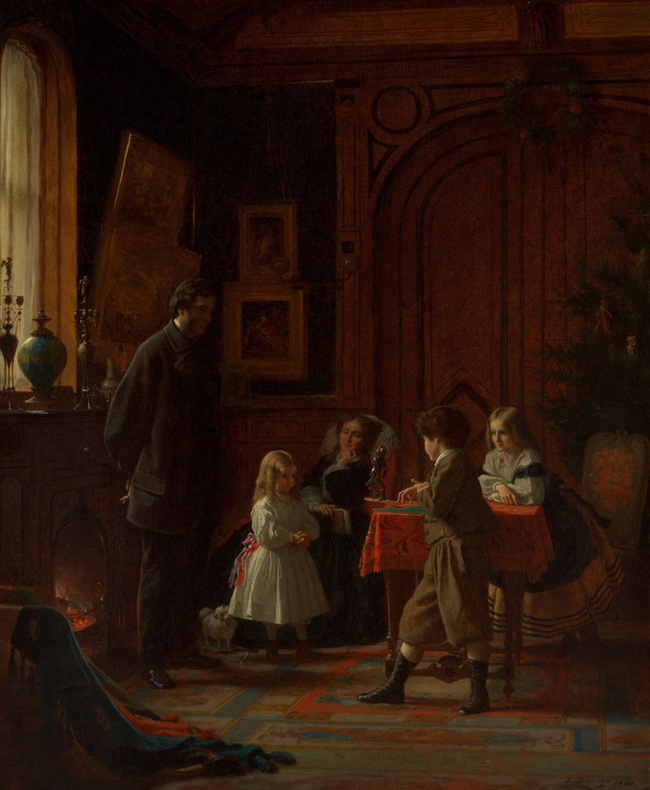
The earlier landscape tradition asks the viewer to believe in the nation by contemplating a scene. Johnson asks the viewer to believe in the nation by recognizing a way of living. His confidence is the confidence of continuity.
Johnson’s The Old Stagecoach offers continuity through ordinary life, suggesting that one way a society survives is by letting the future take possession of the ruins without collapsing under them. But Johnson’s answer is not the only possible answer, and in the immediate aftermath of the war it would not be the dominant one. War demanded a more severe conversion, a reorientation of the self away from violence and toward labor, away from collective martial intoxication and toward solitary discipline.
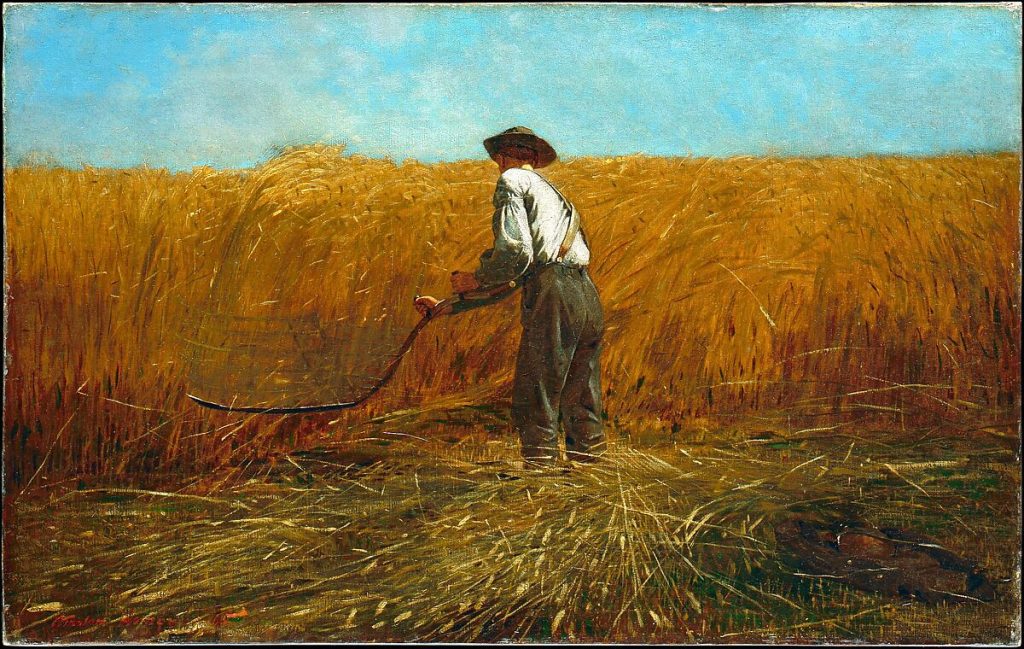
That is the register Homer inhabited with a kind of unblinking authority. Homer painted The Veteran in a New Field in 1865, at the very moment of raw transition, when the national question was still the immediate problem of demobilization, long before the slow management of inheritance. What would happen to the energies trained for destruction? Could they be redirected before they metastasized into bitterness, disorder, or renewed violence? Could a republic retool itself quickly enough to survive its own trauma?
The Veteran in a New Field begins with what it refuses: ceremony. It refuses the comfort of an identifiable face, the easy moral sweetness of reunion. Instead, it gives the viewer a single figure, monumental but anonymous, turned away, absorbed into work. This works as a moral proposition more than a portrait, holding that national continuation is a discipline, and perhaps, even a forgetting.
The veteran stands in a field of ripe wheat and swings a scythe. The gesture is simple, repeated, almost mechanical. And yet the painting carries the war in its margins. A discarded Union jacket and a canteen lie in the lower right foreground, half-lost among the cut stalks. The war is made peripheral because it must be left behind if the work ahead is to proceed, and never because it is denied. Homer makes the war visible as residue, the way trauma remains visible in a life that continues.
The painting offers a moral instruction about how a nation survives. It suggests that peace is an action, practiced repeatedly, almost monotonously, until it becomes the new habit of the body. The biblical resonance of beating swords into plowshares becomes here a practical ethic, the rhetorical flourish burned off. Homer’s veteran performs peace.
Yet there is no cheer in the performance. Homer’s confidence is not Johnson’s confidence. The viewer sees the man from behind, a posture that blocks intimacy and refuses emotional negotiation. The moral burden is carried privately. If the republic is to recover, the painting implies, it will do so through the discipline of individuals willing to resume the world without being guaranteed that the world is meaningful.
What the veteran carries privately, Homer would spend the rest of his life enlarging into a subject. The scythe in the wheat is already the first statement of the only theme that would finally hold him, the human figure set against a creation indifferent to whether he survives. In the late marines, the lone man in a dory on a heaving sea, the surf breaking on rock with no witness but the painter, that theme reaches its full and terrible clarity, and the consolations the rest of the century had reached for, providence, magnitude, the social day, fall away one by one. Homer offers no way out, only the dignity of a man who keeps working, or keeps afloat, on a sea that will not answer him, and he insists that this dignity is enough because it is all there is. That refusal to console is the deepest seriousness American painting had yet attempted, and it is why his confidence, alone among his contemporaries, never curdles into propaganda or into charm.
Homer was not the only realist the war made. The same refusal of the sublime, the same insistence that an American picture earn its seriousness in the daylight world rather than borrow it from providence or spectacle, took a wholly different temperament in Thomas Eakins (American, 1844–1916), a Philadelphian who had learned paint in Gérôme’s Paris atelier and the human body in the dissecting rooms of Jefferson Medical College, and who carried home a conviction stranger and in its way more exacting than Homer’s. Where Homer faced a creation that could not be known and would not console, Eakins faced a creation that could be known exactly, and he made the knowing itself the ground of American confidence.
Consider Max Schmitt in a Single Scull of 1871. The Schuylkill lies under a thin autumn light like a sheet of glass, and Eakins doubles the world in it with an exactness that is almost a moral position, the bare tree, the iron and stone of the railway bridges, the hull and its trailing oars all reconstructed in the water with the same rigor as the things above it. He had worked out the perspective and the geometry of the reflections on paper before he touched the canvas, and one feels it. This is a river that has been solved. The sculler is Max Schmitt, a champion oarsman and Eakins’s friend, and Eakins has caught him in the spent quiet after the race, turning toward us with the tired face of a man who has won and is too emptied to celebrate. The heroism Eakins finds in him is the heroism of exhaustion, of the disciplined body at the moment its discipline has been paid out in full. In the scull behind, smaller, rowing his own boat with his own name lettered on the hull, Eakins has placed himself, a craftsman among craftsmen, claiming the water as his element too.
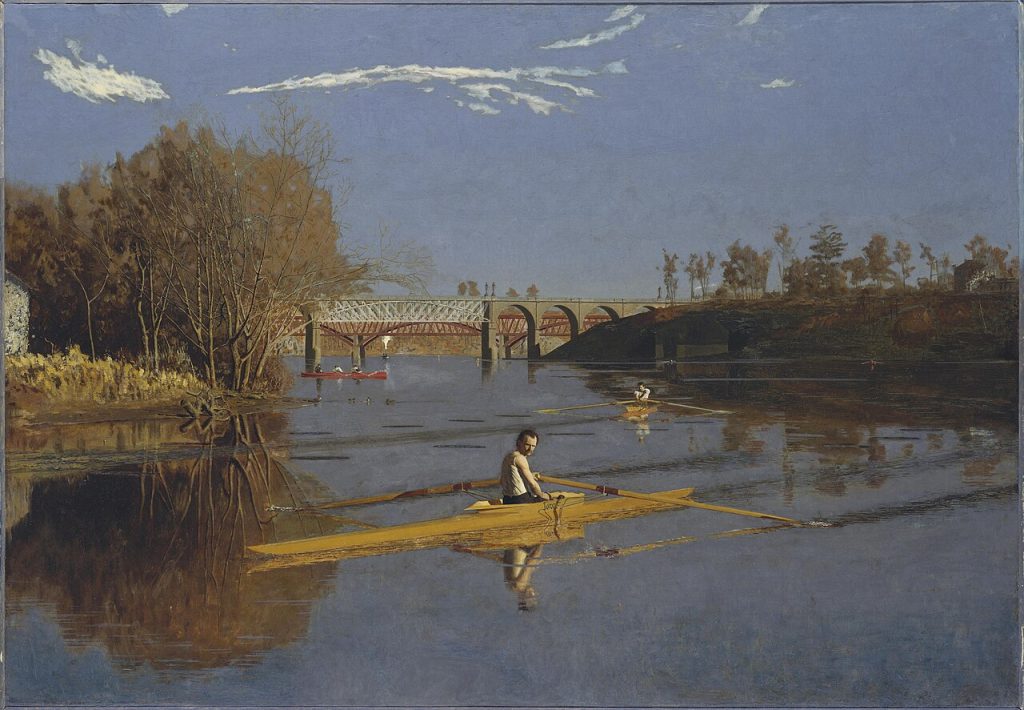
The bridges receive the same devotion as the men. The iron truss and the older stone arches are given the dignity Eakins gives the oarsman’s body, with no condescension to their modernity and no nostalgia set against them, because to him the engineer’s work and the athlete’s are the same achievement, the world mastered by measurement and labor. The light is even and secular, the full Philadelphia afternoon, with none of the flattering fog that had once made American scenery mythic. Like Johnson before him, Eakins paints in the honest daylight; but where Johnson painted play, Eakins paints competence, and asks us to see competence as a mode of the heroic.
The same faith, carried into the operating theater, becomes a thing the nation could not bear to look at. In The Gross Clinic of 1875, Eakins floods light onto two things and abandons the rest to a brown amphitheater murk, the domed and silvered head of the surgeon, and the bloodied hands at work in the open wound. He has built an altarpiece, the dark pyramid rising to the lit head of the master, and he plainly knew whose Anatomy Lesson he was answering across two centuries and an ocean. But Eakins has Americanized Rembrandt’s Dr. Tulp in one decisive stroke. Gross has stepped back from the table, the scalpel loose and bloody in his hand, and turned from the cutting to the lecture. The student bent over his ledger at the left is recording the lesson, and the authority that fills the canvas is the authority of method handed down, knowledge made transmissible, a competence that will not die with the man who holds it.
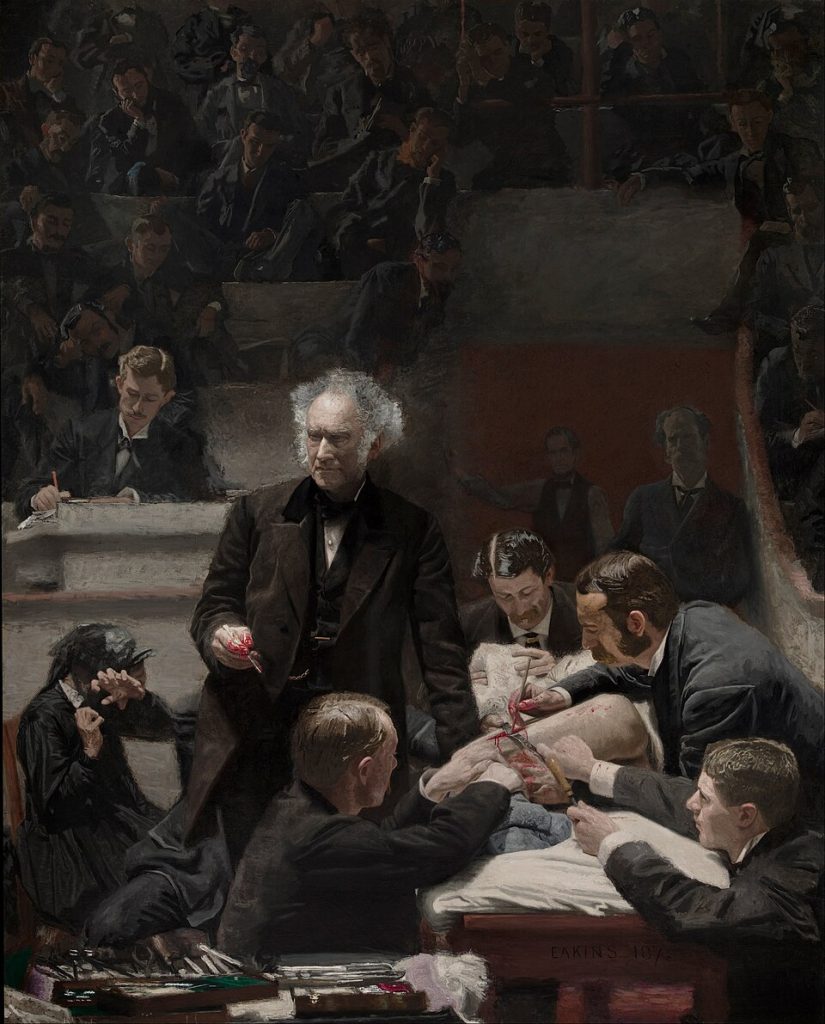
Eakins pays for that authority honestly. The patient has been reduced almost to the operative field itself, a thigh, an incision, a cluster of working hands, the human person dissolved into the object of study, which is the cold price of the empirical gaze and one Eakins refuses to disguise. In the lower left, in shadow, a woman long taken for the patient’s mother shields her eyes with a clawed hand, the single figure in the room who cannot bear to see. She is the flinch, the old recoil from the body’s truth, set at the very margin while the men of knowledge work calmly in the light. The surgeon’s composure rests on the oldest definition of truth we have, the adaequatio rei et intellectus, and the mother’s averted eyes are the measure of what that conformity costs a squeamish heart.
Set the two realists the war produced side by side and you have the answer of one whole road, the road that keeps faith with the world. Homer grounds American confidence in tragic endurance, Eakins in earned knowledge, and between them they exhaust the honest replies a nation can give once it has ceased to believe its mountains will save it. Both demand something of the viewer. Both decline to flatter. But there was another road out of the war, one that would learn by slow degrees to ask nothing of the world at all, and it opens in the quietest way imaginable, in the soft grey weather of a painter who had stopped expecting the century to make sense.
Inness’s late landscapes often appear, at first glance, evasive, insubstantial, and atmospheric. But this softness is the visual analogue of a nation that has ceased to expect moral clarity from wartime spectacle and now seeks equilibrium through interior calibration.
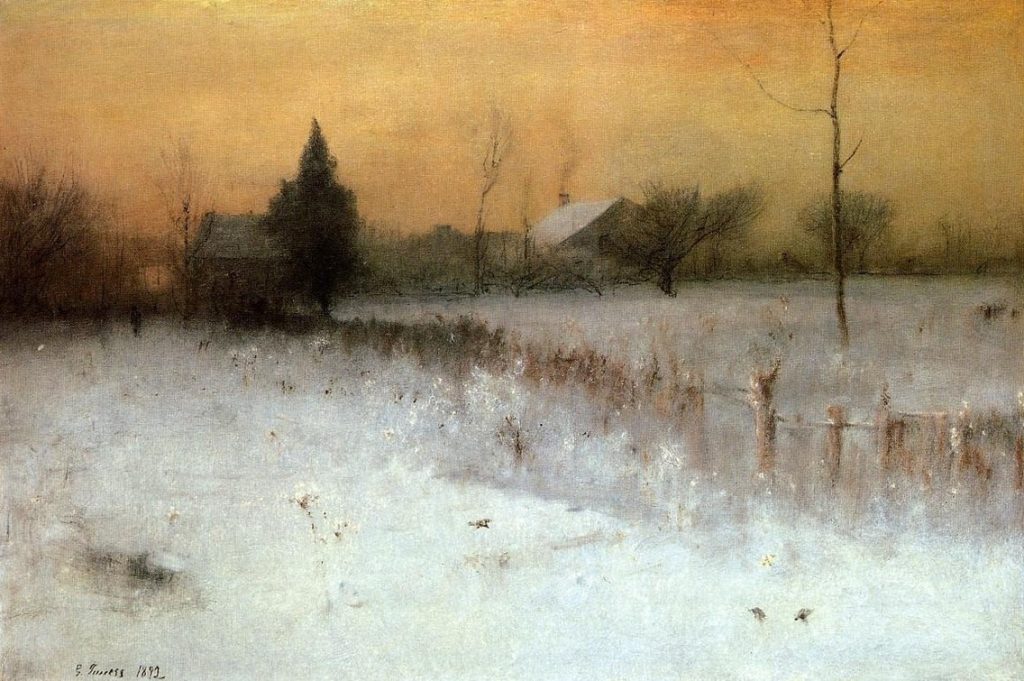
Look for a moment at Home at Montclair from 1892. A grey-green field opens toward a house half-dissolved in mist, a single bare tree on the right holding the composition together, the colors all of one family. There is no drama and no incident. The picture asks nothing of its viewer except a slower breath. Where Cole’s earlier Voyage had supplied the republic with a destination, Inness now supplies it with a habit of dwelling, an interior climate suitable for a nation that has stopped having to be persuaded of itself.
Where Johnson humanizes and Homer hardens and Inness internalizes, Whistler liberates. His confidence reaches past a nation, its labors, even psychological healing, toward something more radical and more dangerous.
James McNeill Whistler (American, 1834–1903), an expatriate trained in Paris and London whose tonal compositions and musical titling helped found the Aesthetic Movement on both sides of the Atlantic, insisted on calling his paintings things like Symphonies, Arrangements, and Nocturnes as a painterly declaration of independence. By naming paintings after musical forms, he detached them from narrative obligation. He refused the demand that a painting explain itself socially, morally, or nationally. Meaning, in Whistler, is made oblique. It happens, rather than being delivered.
In Whistler’s nocturnes and sea paintings, this autonomy becomes even clearer. Atmosphere remains, but it is no longer reparative as it was in Inness; it is only aesthetic. Water, fog, and light are asked to exist beautifully, on their own terms.
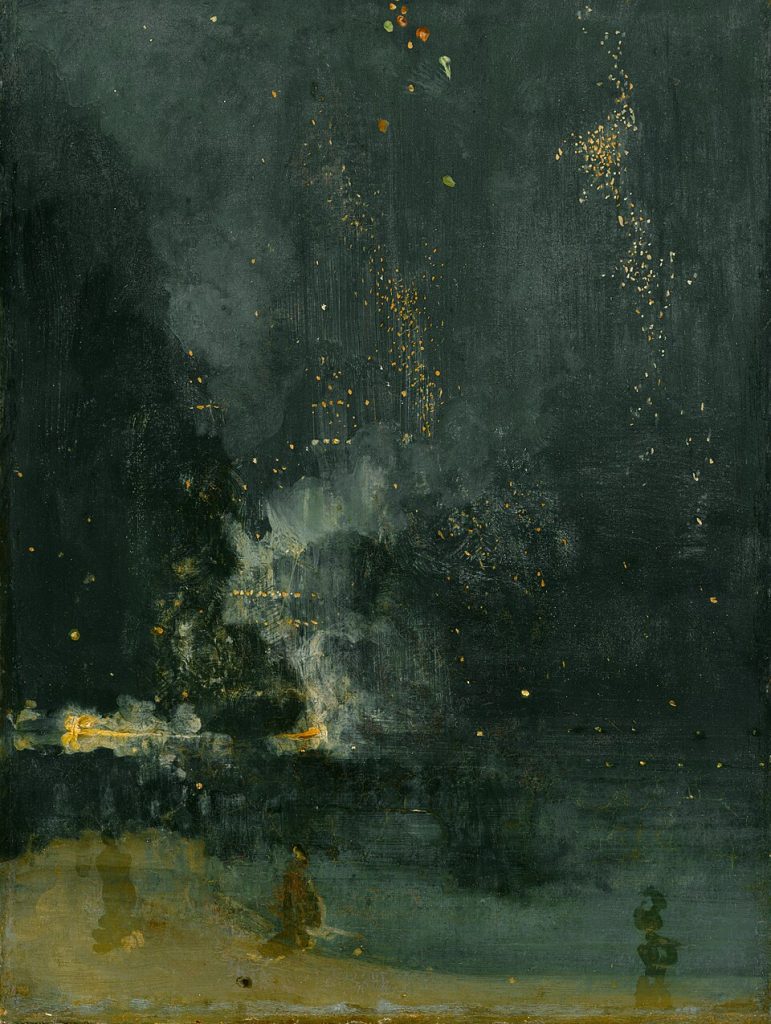
Consider Nocturne in Black and Gold: The Falling Rocket from 1875, the painting Ruskin compared to a pot of paint flung in the public’s face and which Whistler sued him over. A dark sky, a few sparks descending against the blackness, the river barely indicated below, the human figures at the lower edge reduced to flecks of pigment. The picture refuses to say what it is of. It refuses the moral and the narrative obligations a nineteenth-century viewer expected. Whistler’s oft-quoted remark that “art happens” abandons the American habit of asking art to justify the nation’s existence.
By the time John Singer Sargent emerged, one whole road of the century had reached its end. Inness had shown that the American eye could withdraw into its own weather, Whistler had cut the last cord binding a picture to explanation, and Sargent inherited from them a freedom so complete that he no longer had to think about it. He is the summit of the road that runs through atmosphere into autonomy, the road that learned, stage by stage, to stop answering for itself.
Stand for a moment in front of The Wyndham Sisters, Sargent’s 1899 portrait of the three daughters of the Hon. Percy Wyndham. Three women in white silk are arranged on a divan in a London drawing room, lit by a soft mid-evening light that gives the satin its quiet weight. The composition is musical. The three figures form an almost triangular chord, gazes scattered at slightly different angles so that the canvas seems to hum rather than declare. Behind them, on the panelled wall, a darker portrait of the sisters’ mother by G. F. Watts presides without competing, the older generation reduced to background harmony for the younger. There is no narrative incident. There is no moral commentary. There is no apology for the wealth on display, no editorial nervousness about the world Sargent’s sitters inhabit, no reference whatever to the American frontier from which the painter himself, the son of expatriate Bostonians, had so thoroughly departed. The picture is sublimely indifferent to whether it has been earned. It simply is.
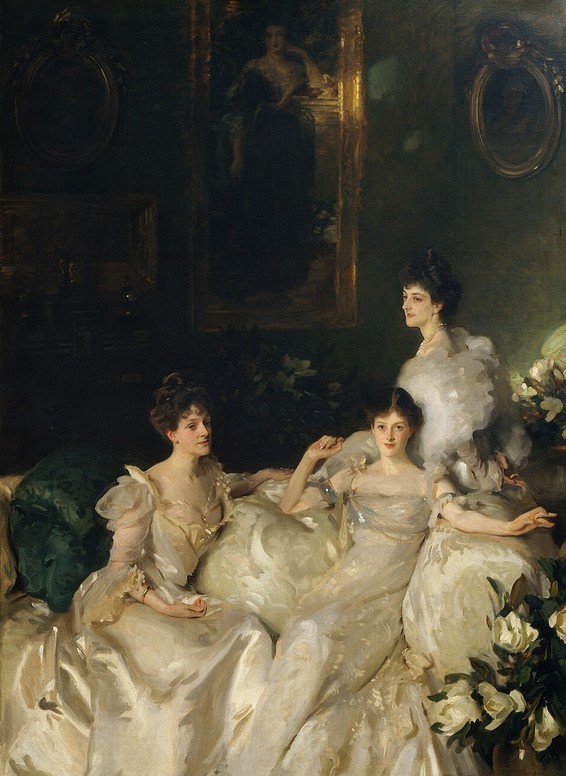
That indifference is the height of one kind of American confidence, and it is a genuine height. Sargent paints English aristocracy with an assurance no English painter of his generation could match, and he does it as an American whose Americanness has stopped being the subject of the picture. The argument the century had been mounting, that an American art might one day stand without apology, is here no longer argued. It is assumed. The confidence that radiates from The Wyndham Sisters, from Lord Ribblesdale, from the Venetian oils and watercolors, is the confidence of a hand that can do anything and a culture that no longer remembers being afraid. He glides past the questions that held his predecessors, and the American spirit he carried became, for a season, indistinguishable from the spirit of European painting at its most accomplished.
It is one of the two great heights the century reached. The other lies behind us in the gallery, and it was won by the opposite road.
So the century summits twice, by two roads, and they part at the war. One road keeps faith with the world. Johnson holds to the ordinary day, Homer to the discipline of grief, Eakins to the body laid open and known, and the art on this road never stops owing something to what is outside it, to the dead, to the labor, to the fact. The other road learns to let the debt go. Inness withdraws into weather, Whistler declares that a picture owes the world no account of itself, and Sargent inherits a freedom so total that the question of what a painting is for no longer arises. Two roads, two summits, Homer at the head of the one and Sargent at the head of the other, and between them no possibility of choice, because they were never climbing the same mountain.
Recall how the century opened. Cole gave the republic a single river flowing in one confident direction toward the light, an infant in the prow, an angel at the tiller, the destination guaranteed and the way unbranched. That was the first and simplest form of American confidence, the faith that the nation moved as one thing toward one end. The achievement of the century, and the quiet grief folded into it, is that the river divided. By the time we reach Sargent’s drawing room and Homer’s grey Atlantic the single stream has become two, and a civilization that began by trusting it was one thing discovers, at its very height, that it has become two things at once and can no longer say which it is.
We are not asked to choose between them, and we could not if we were, because they answer to different gods. Homer is the summit of an art that still believes it owes the truth a debt. Sargent is the summit of an art that has discharged every debt and stands free. Hold them side by side and you have the whole of what American painting at its height was able to be, the tragic and the masterly, the answerable and the autonomous, neither reducible to the other and neither since surpassed.
Neither since surpassed, because what came after did not climb past them. It took one of the two roads and let the other fall quiet. Whistler’s remark that art simply happens, harmless enough as a painter’s quip, hardened in the next century into a doctrine, and the line of autonomy ran on through it into an art that answered to nothing at all, not the world, not the figure, not the fact, only to itself. The age that called this its triumph had in truth chosen a single road and forgotten there had ever been two.
And yet Homer’s road did not vanish, and I will not pretend it did. It ran on into the new century in Robert Henri and the painters he gathered, in the street fact of Sloan and the raw force of Bellows, and in Hopper above all, who kept American light answerable to a diner, a doorway, an empty room while the doctrine of pure paint rose around him; and it surfaced again at mid-century in Wyeth’s tempera and in the Regionalists’ loyalty to a particular ground. The road kept its life; it lost the center. Where Homer and Eakins had once stood at the undisputed summit of the age, the painters who kept their faith now worked off to one side of a century that had given its allegiance elsewhere, honored less, taught less, hung less often in the rooms where the age explained itself to itself. Homer’s road, which held the picture answerable to grief and to truth, and Eakins’s beside it, the road whose greatest canvas was exiled from the galleries of art to keep company with the surgical saws, became the road taken less often, a smaller grief than abandonment and a real one still.
And so we return to where I began, wandering the gallery, drawn forward by certain paintings and held back from others. What drew me, I think, was more than the brilliance. It was the rumor of a moment before the river forked, when an American picture could still be true and free at once and had not yet been made to choose. Sargent let art happen. Homer would not let it happen at a price the truth could not afford. That a single century produced both, and set them at the same unsurpassed height, is the glory of American painting. That it could not keep them on one river is the elegy folded inside the glory. The light at the end of Cole’s stream was always real. No one told the child in the prow that the river would divide before it arrived, and that he would have to become two men to follow it.
Table of Contents
Christopher S. Carson, J.D., M.A., is a practicing attorney of 34 years in Milwaukee, Wisconsin, and holds a masters degree in International Security Studies from Georgetown. Formerly with the American Enterprise Institute, his essays on sacred music, Thomistic aesthetics, and cultural criticism have also appeared in The Hedgehog Review, National Review, among others, along with two essays now accepted for publication in the Athenaeum Review.