Is God Dead? Critiquing New Atheism with the Truth of Christian Society
by Wyatt Arthur (May 2026)
“Is God Dead?” was the headline on the cover of Time magazine dated April 8, 1966. This was not a new question, not even close. Nietzsche made his mournful proclamation that ‘God is dead’ in 1882. Even before that, French writer Gérard de Nerval popularized similar language in his 1854 poem Le Christ aux oliviers, “God is dead! Heaven is empty…”
The question posed by Time magazine was a purposefully shocking cover to bring up a semi-nuanced, but unmistakably anti-religious, discussion drawn from the book Radical Theology and the Death of God by William Hamilton and Thomas Altizer. Just as Nietzsche had before them, the authors argue that humans had outgrown the need for God. God was irrelevant. It is worth noting that the ideas of Nietzsche were later used by the Nazis to justify many of their horrendous actions. Although Nietzsche himself would have likely opposed such misuse. René Girard may have said it best, “Nietzsche shared with many intellectuals of his time and our own passion for irresponsible rhetoric in the attempt to get one up on opponents. But philosophers, for their misfortune, are not the only people in the world. Genuinely mad and frantic people are all around them and do them the worst turn of all: they take them at their word.”[1]
The statements of God’s death prior to this Time article often carried a tone of mourning. Science had killed God, but there is sorrow because it means those in the know, those smart enough to realize that not only is God dead but He was never alive, must give themselves over to nihilism. It is the logical alternative.
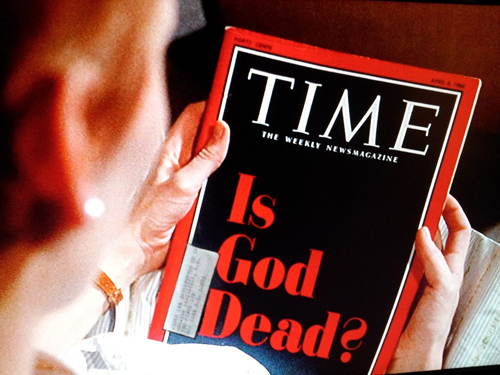 The Time article brings up a new type of atheism (at least they thought it was new[2]). One where humanity’s morals are better than God’s. Instead of mourning the death of God, we should celebrate the death of God.
“The God of myth, fear and superstition is dead. The God in whose name many have been tortured and killed is dead. The God who serves as the father figure watching over man is dead. The multiple Gods, representing the multiple religions with their multiple distorted views, are dead. Let secular evolutionary humanism with its love and faith in man, his wisdom and courage, be born and live.” Maurice S. Cerul of the Western Psychiatric Institute & Clinic Pittsburgh wrote in a Time article following up on the controversial cover story.
This version of atheism became popular. Five years later, John Lennon wrote what essentially became the anthem of this movement:
Imagine there’s no heaven
It’s easy if you try
No hell below us
Above us, only sky
Imagine all the people, living for today (ah)
Imagine there’s no countries
It isn’t hard to do
Nothing to kill or die for
And no religion too
Imagine all the people, living life in peace (yoo-hoo)
You may say I’m a dreamer
But I’m not the only one
I hope someday you’ll join us
And the world will be as one
Imagine no possessions
I wonder if you can
No need for greed or hunger
A brotherhood of man
Imagine all the people, sharing all the world (yoo-hoo) —John Lennon
This is the belief of the New Atheist movement. Religion is the reason people kill, the reason for greed, the reason there is no peace or unity. It could be somewhat accurate to speak this way about certain worldviews, but for some reason the people who hold these thoughts often ignore the most violent religions.
In our western society, the society of Time magazine and John Lennon, the religion they are speaking of is Christianity. If only we could move to a post-Christian world, then life would be so much better. But what would a post-Christian world look like?
These new atheists are still informed by a Judeo-Christian framework that has shaped the world they have grown up in. Richard Dawkins, a key figure in the modern New Atheist movement, still refers to himself as a “cultural Christian[3].” To truly know what a post-Christian society would look like, we must look back to pre-Christian societies rather than relying on secular optimism.
Things were not great. People forget that it was the Judeo-Christian worldview that ended slavery in the West and gave women legal and social equality. Remember, it was Aristotle, a pre-Christian thinker who denied the Greek pantheon, who said “The female is as it were a deformed male.”
The preferred execution method of the Romans was crucifixion, the Aztecs used ritual heart removal, early Germanic tribes, among others, used dismemberment, Norse and Anglo-Saxon traditions included impalement. Among Plains Indian tribes such as the Apache, rape and disfigurement of women was common. It turns out killing, greed, war, and all other horrible things did not come about because of Christianity. In fact, the Christian ethics took these practices out of the commonplace.
The argument from the Rousseauean or the new atheist would be that these cultures were also religious. That is true. And we haven’t had an example of a society denying traditional religiosity until modern times. Those who believed in the ‘noble savage’ or any other non-theistic ideology were in the minority. Therefore, says the atheist, we must try to rid ourselves of religion because there is no proof irreligion is worse.
But what makes them think a post-Christian society would be any less religious? The Christians worship God, the pagans worship idols of gold, the avaricious worship coins of gold, and the narcissistic worship themselves. Everyone follows and serves something, whether it is religion, political ideology, or something else entirely.
Even secular thinkers, if they are honest, acknowledge the benevolent influence Christianity has had on the world. Voltaire, famed critic of Christianity and organized religion as a whole, is quoted saying, “I want my lawyer, my tailor, my servants, even my wife to believe in God, because it means that I shall be cheated and robbed and cuckolded less often. … If God did not exist, it would be necessary to invent him.”
Richard Dawkins, who I mentioned earlier, stated that he, “would not be happy if, for example, we lost all our cathedrals and our beautiful parish churches.” Going even further, Dawkins criticized Islam for being, “fundamentally hostile to women and hostile to gays,” tacitly admitting that Christianity is not as hostile a religion. Dawkins went on, saying he saw it as a problem that there was a decline in Church attendance in England and an increase in the construction of mosques. Dawkins says he likes living in a Christian country even though he does “not believe a word of the Christian faith.” And if forced to choose between Christianity and Islam, he would “choose Christianity every single time.”
Even with their honest, or at least sympathetic, portrayal of Christian culture, the views of Voltaire and Dawkins reveal deeper inconsistencies within their thought process. They acknowledge that Christianity has made a good culture, even the greatest the world has ever seen, and one worth preserving. Dawkins, however, still says it is a good thing that people are less religious. The problem is, you cannot have a Christian culture without Christian people. They seem to believe you can have a culture totally separate from the thing that animates that culture and gives it credence. That is not the case. The fewer Christians there are, the less Christian the culture becomes. We can see that in Europe and Western world today and make no mistake, it is a problem.
The views of those like Voltaire and Dawkins, as flawed as they are, at least give a lip service to the underlying truth that Christian society is not the problem. However, their arguments seem to be overlooked by so many in the atheist community, including other prominent members. Valerie Tarico speaks of the psychological harms of Bible-believing Christianity[4], and ran a story in Salon magazine of why religion does more harm than good, all religion not just radicals. Harvard published a piece in 2007[5] decrying religious violence. Charles Kimball makes the claim “It is somewhat trite, but nevertheless sadly true, to say that more wars have been waged, more people killed, and these days more evil perpetrated in the name of religion than by any other institutional force in human history.”[6]
This claim completely ignores the estimated over one hundred million[7] killed in the name of secular humanism through totalitarian regimes in China, Germany, Russia, and Cambodia among other nations in the 20th century alone. All under explicitly atheistic or anti-religious ideologies. (That number also does not include the estimated 336 million abortions during China’s one child policy) Ignoring secular violence in favor of religious does not make it go away. There is presently a rise in political violence not religious violence, and certainly not Christian violence. Much of that political violence comes from the anti-religious against Christians. Such as violence driven by individuals of the radical sexual and gender ideologies. More violence against Christians has also sprung up in Canada, where 463 churches were burned from 2016-2023[8]. 238 in the years of 2021-2023 alone, showing a continued rise in this form of violence.
God is not dead, even if the secular humanists have already written His eulogy. The most productive, generous, benevolent, and peaceful society ever seen is the modern Western civilization built on Christianity. It is a society and an inheritance worth defending. Truth and virtue are worth fighting for. The intensity with which some seek to dismantle Christian society reveals an unintentional truth: it is very much alive. There would be no point in trying to kill something that is already dead. God is alive, Christendom is alive, Western civilization is alive and we ought to act like it.
[1] René Girard, I See Satan Fall Like Lightning, trans. James G Williams (New York: Orbis, 2001), 175.
[2] Anthony Ashley Cooper Shaftesbury, Third Earl of Shaftsbury, Inquiry Concerning Virtue, or Merit, 1699.
[3] Interview with Rachel Johnson, BBC, 31 March 2024.
[4] Valerie Tarico, Trusting Doubt: A Former Evangelical Looks at Old Beliefs in a New Light (2007).
[5]William T. Cavanaugh, “Does Religion Cause Violence?”, Harvard Divinity Bulletin 35, no. 2/3 (Spring/Summer 2007).
[6] Charles Kimball, When Religion Becomes Evil: Five Warning Signs (New York: HarperOne, 2002), 1.
[7] R. J. Rummel, Death by Government (New Brunswick, NJ: Transaction Publishers, 1994).
[8] Source: StatCan
Table of Contents
Wyatt Arthur is a writer based in Dayton, Ohio with an interest in philosophy, faith, and society.