The Blood on the Snow: Duels, Masquerades, and the Solitude of Misbegotten Passion
by Christopher Carson (January 2026)
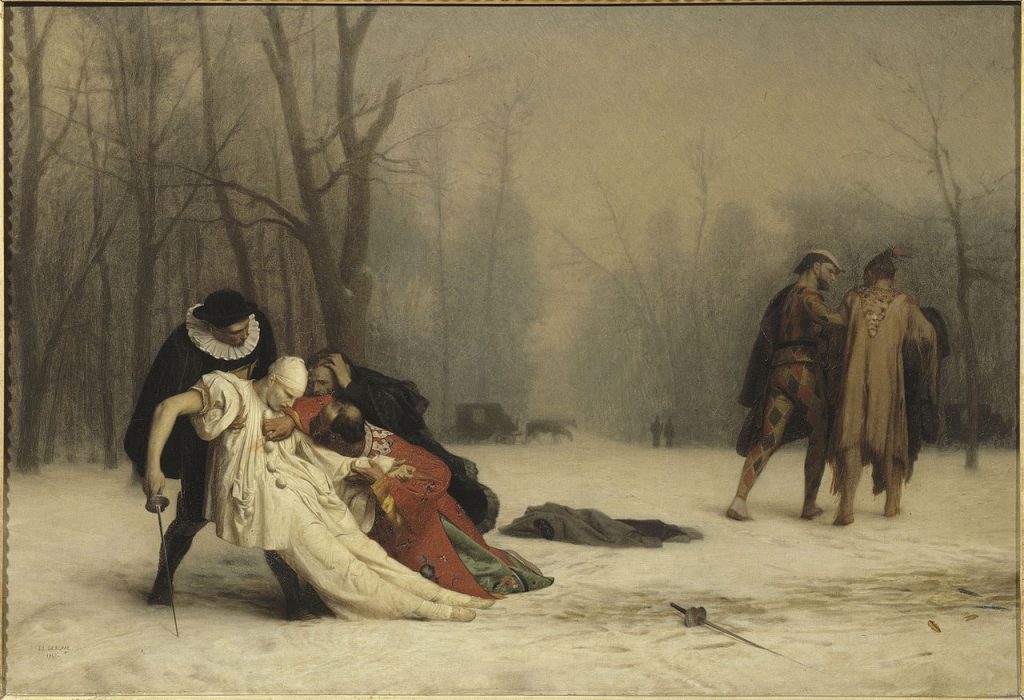
You stand in Chicago, in front of Gérôme’s Duel after the Masquerade, and you realize you have seen this man die before.
He is sprawled in white on the snow, head lolling, a smear of red at the chest. His companions huddle around him in horror. The victors retreat into the frozen trees. A sword lies abandoned in the foreground, like a sentence that has reached its full stop. Step out of the Art Institute and into a darkened cinema, and you find almost the same image waiting at the end of Stephen Frears’s Dangerous Liaisons: Valmont gut-stabbed on a winter morning at the edge of Paris, Keanu Reeves’s Danceny staring down at the man he has killed, the seconds receding into the grey.
That echo is not an accident of your memory. It belongs to a small genealogy of images, a chain that runs from Laclos’s novel, through a real duel between men dressed as clowns, into Gérôme’s academic snow, then into Georges Barbier’s Art Deco print of Valmont’s duel, and finally into Frears and Philippe Rousselot’s wintry cinema. Across a century and a half, the same scene keeps returning: pleasure seekers who have treated love as a costume ball discover, too late, that blood stains snow very easily and does not wash out.
I. Laclos and the duel that freezes the game
Pierre Choderlos de Laclos published Les Liaisons Dangereuses in 1782, a book he intended, in his own words, to “make a noise” and to survive him.
The plot, told entirely in letters, is simple beneath its rococo intricacies. The Marquise de Merteuil and the Vicomte de Valmont treat seduction as competitive sport. They corrupt the schoolgirl Cécile, they ruin the virtuous Madame de Tourvel, they weaponise other people’s emotions as pieces in a private contest. The game ends only when the pieces revolt.
Near the close of the novel, the young Chevalier Danceny challenges Valmont to a duel. Danceny has finally seen, through a blizzard of leaked letters, that this older man has seduced Cécile, betrayed confidences, and treated love as a series of amusing experiments. On a cold winter morning in the Bois de Vincennes, the libertine is fatally wounded. Before he dies he gives Danceny the correspondence that will destroy Merteuil’s reputation and leave her disfigured and socially ruined.
Laclos does not give us much weather reportage. Yet the duel exists in a kind of moral winter. The society that has warmed Valmont’s vanity suddenly withholds its heat. His style, his charm, his talent at gaming the affections of others, prove useless in the one encounter that matters. The duel operates as an unmasking. No more epistolary performances, no more careful phrasing, only a sword point and the discovery that the body is not a theory.
The later images, from Gérôme to Frears, take Laclos’s moral winter and literalise it as snow.
II. Two Harlequins in the Bois de Boulogne
Almost eighty years after Laclos, Paris produced a duel that looked as if it had escaped from a satirical novel. In the winter of 1856 to 1857, Symphorien Boittelle, a former police commissioner who would become the powerful Prefect of Police, quarrelled at a masked ball with another minor political figure, Deluns-Montaud. Instead of changing into sober clothes, the men drove out at dawn to the Bois de Boulogne and fought a serious duel while still wearing their costumes, one as Pierrot, the other as Harlequin.
The Bois was already a traditional duelling ground for aristocrats and officers, a landscape with a built-in script: a clearing among bare trees, a handful of carriages, a few chosen witnesses, a doctor, then either a quick reconciliation or a body on the turf. To add commedia dell’arte outfits to this choreography was to turn the whole affair into a vicious joke. Boittelle was run through the chest and for a time thought dead, yet he survived and went on to a prosperous political career. Newspapers and anecdote-collectors feasted on the episode. Coleman Parsons, writing a century later, christened it “The Wintry Duel” and argued that it sparked a minor vogue for such scenes in painting and illustration.
This is already the world of Dangerous Liaisons: powerful people who treat their own lives as theatre until the curtain unexpectedly fails to go up again.
III. Gérôme paints the aftermath
Jean-Léon Gérôme seized on this morbid farce and turned it into one of the most famous Salon pictures of the Second Empire. Suite d’un bal masqué (better known in English as The Duel after the Masquerade) was first exhibited in 1857. It shows a grey winter morning in the Bois de Boulogne, snow on the ground, the trees like bars of charcoal behind the figures. A man dressed as Pierrot collapses into the arms of a Duc de Guise; a Venetian doge presses his hands on the wound, trying to stanch the blood; a black-cloaked domino buries his face in his hands. In the right distance the victor in an “American Indian” costume walks away toward a waiting carriage, accompanied by Harlequin. A sword and a few fallen feathers lie in the trampled snow.
Contemporaries understood at once that Gérôme was not inventing an entirely imaginary anecdote. Critics linked the painting to the reports of duels in carnival costume that had recently amused and scandalised the city, and later writers like Edmond About and Parsons tied it quite specifically to the Boittelle duel. Scholars are careful to note that Gérôme may have conflated several such episodes, or used the famous one as an atmospheric seed rather than a literal documentary source. What matters, though, is that the painting is rooted in an actual morning when vanity, resentment and wounded pride sent real men out into real snow.
The key to Gérôme’s composition is that he shows nothing of the fight itself. He was fascinated by aftermaths. In The Death of Caesar the conspirators have already left the chamber and only the body and the empty curule chair remain; in The Execution of Marshal Ney the firing squad is marching away, leaving the corpse against the wall. Here, too, the violence is over. What fills the canvas is the long few seconds when the full consequences of a gesture finally land on the participants. The duelists’ world has gone quiet. Snow, fog and the white costume fuse the victim with the landscape.
If you visit the Walters Art Museum in Baltimore or the Musée Condé in Chantilly, you see Gérôme’s own replicas of this scene. In Chicago you meet another variant, painted for Ali Pasha and inscribed to him, which has drifted across continents into your field of vision. The repetition itself is fitting. The subject is the sort of mistake human beings make over and over: mistaking a night of flirtatious play for a world without real consequences.
IV. Barbier’s Art Deco Valmont
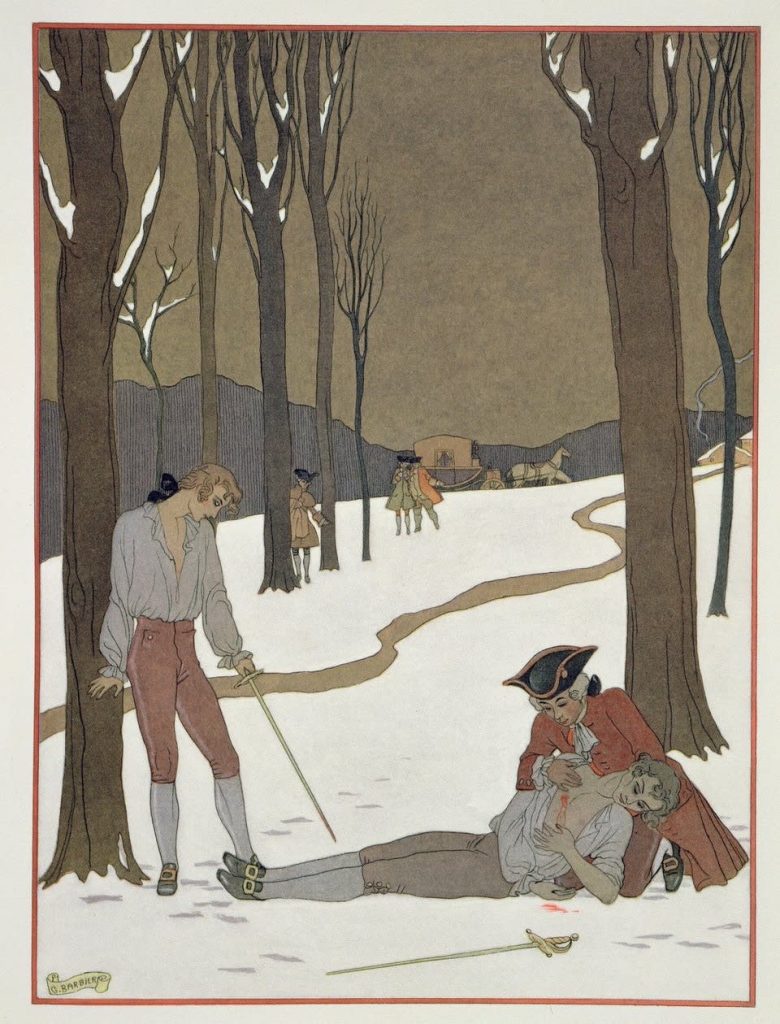
Some seventy years later, Les Liaisons Dangereuses acquired a new set of images when Georges Barbier produced a suite of pochoir prints illustrating the novel. Barbier’s work is all sharp silhouettes and pastel surfaces, flattened trees and elegant costumes, the eighteenth century refracted through the prism of the twenties. Among these plates is The Duel between Valmont and Danceny: two slim figures with rapiers cross blades in a winter landscape, accompanied by horse and seconds, the trees skeletal against a pale sky.
Barbier is explicitly illustrating Laclos, not Gérôme, yet the visual rhyme is unmistakable. The duel is again placed in a white and grey emptiness. The protagonists are still overdressed for frivolity, not for war. His image reads like a translation of Gérôme’s aftermath back into the moment of action, much as Thomas Couture’s Duel after the Masked Ball had painted the same subject at the stage of preparation rather than collapse.
Through Barbier the chain tightens: Laclos’s textual duel, Gérôme’s painterly aftermath of a real duel, Barbier’s stylised duel explicitly labelled “Valmont and Danceny.” The snow becomes a convention, a stage property that announces a certain kind of death.
V. Frears, Rousselot, and the cinematic snowfield
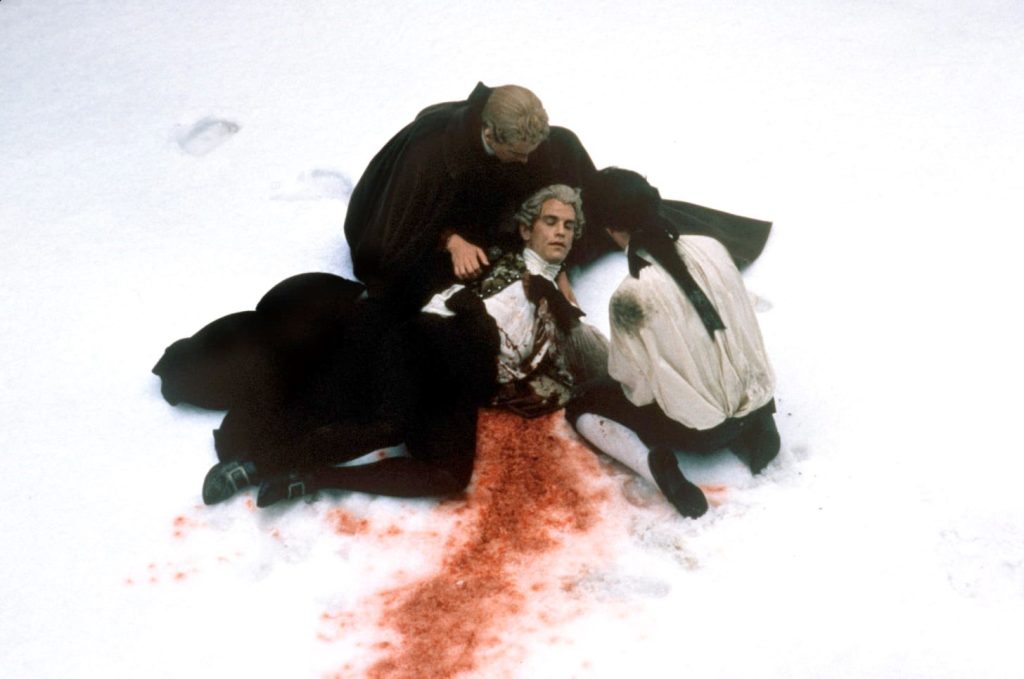
Stephen Frears’s 1988 film Dangerous Liaisons arrives at the end of this lineage almost without saying so. The film is adapted from Christopher Hampton’s stage play, which in turn reworks Laclos’s novel for late twentieth-century audiences, trimming the epistolary apparatus and sharpening the emotional knife fights between Glenn Close’s Merteuil and John Malkovich’s Valmont.
Near the end, Keanu Reeves’s Danceny confronts Valmont. The seconds fuss with cloaks and pistols. The city is far off. Bare branches and cold air surround them. Rousselot shoots the encounter with drained colour and a kind of resigned calm. There is some swordplay, yet the scene is curiously stripped of swashbuckling flourish. When Valmont is run through, he collapses in a near diagonal across the screen, pale garments quickly red. The friends hover; the adversary recedes; a sword lies on the frozen ground.
You could frame a still from that sequence and hang it near Gérôme’s painting without much visual discord. The differences involve period detail rather than structure. Gérôme’s Pierrot is foolish and helpless, a man literally dressed as a clown who has paid for his poor judgement. Frears’s Valmont is something colder, a man who has destroyed several lives and suddenly confronts the non-negotiability of his own mortality. Yet in both cases the point is that there is no witty line that can be spoken, no letter that can be written, to undo the trajectory of the blade.
Cinema, in other words, eventually discovered the frame Gérôme had already perfected: the duel not as kinetic spectacle but as brief punctuation in a larger sentence that ends alone on the ground.
VI. Misbegotten passion and the solitude of the snowfield
What ties these four, or really five, items together is not simply the fact of duelling. Duels happen in ballrooms, in damp fields at dawn, outside taverns; they can be comic, ritualistic, tragic. The particular constellation here is more specific. Each work hinges on a core idea: romantic or erotic passion treated as game, bet, masquerade, or test of cleverness, finally betrayed by the body’s vulnerability and the world’s cold indifference.
In Laclos, Valmont and Merteuil believe that their intelligence will shield them. Passion is material to be manipulated, not something that can strike them in return. By the time Valmont realises that he actually loves Madame de Tourvel, he has already engineered a situation that demands her ruin. The duel with Danceny is less about honour in the old chivalric sense and more about the belated arrival of moral causality. The libertine who treated other people’s lives as experiments becomes a specimen on the table.
The Boittelle duel exposes the same childish hubris in grotesque form. Two grown men, dressed as Harlequin and Pierrot, cannot resist carrying their masked-ball quarrel into the real woods. They trust that the code of honour will dramatise their outrage without requiring real sacrifice. Instead they end with a sword through the chest and national gossip columns pitying and mocking them in equal measure.
Gérôme, with his taste for aftermath, strips away the narrative excuses and leaves us only with consequences. There is no letter explaining motives, no extended sword fight to flatter martial skill. There is only a man whose costume looks ridiculous once you realise that he is dying. The snow is important. It makes the ground at once beautiful and indifferent. Blood does not sink into snow the way it does into earth; it sits on the surface, a reminder that something has gone wrong in a world that refuses to react.
Barbier’s Art Deco duel makes the figures even slimmer, more pristine, almost decorative. Yet the same logic applies. His Valmont and Danceny cut a perfect silhouette against the whiteness. Passion, jealousy, and outrage are stylised into movements of the wrist. It is easy to forget that one of them must fall and that, when he does, the snow will not care.
Frears completes the loop by giving Valmont a face, a voice, a history and then placing him in a Gérôme-like field of winter light. The film spends two hours luxuriating in interiors: silk, candlelight, rococo panelling, the erotic glow of manipulation. The duel moves outside, into the cold, into a space where strategy no longer works. When Valmont slides to the ground, the crowded social world of the hôtel particulier does not follow him. No one comes running from the opera. Merteuil is not there. The anonymous urban world continues untouched. The man who has done such damage dies almost alone, attended only by those who had to be there.
That is the real subject of the chain you have noticed in Chicago. It is not romance as such, nor even erotic transgression. It is the way misbegotten passion isolates its author. Whether the mask took the form of libertine ideology, carnival costume, or witty letters, the end is the same. At some point you step out of the ballroom into the dark wood, and if you have treated other people’s hearts as props, the last thing you will see is the sky above a white field and the faces of a few witnesses who cannot help you.
When you look again at Gérôme’s Pierrot in the Art Institute frame, or at a still of Valmont in the Frears film, it is hard not to feel that chill. The snow is not only meteorology. It is the visual form of social and spiritual solitude. The ball is over. The letters have stopped. The costume no longer matters. All that remains is a wound in the chest and a landscape that will forget your name by morning.
Table of Contents
Christopher S. Carson, J.D., M.A., formerly of the American Enterprise Institute, is a criminal defense attorney in private practice in Milwaukee.