The Monkey on Our Back
by William Huhn (December 2025)
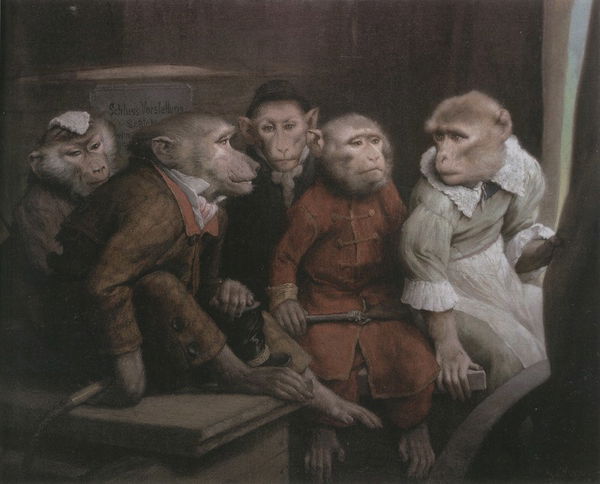
Most science writing is dry. That’s because we generally keep our reading materials under roofs and behind walls—unlike the chimpanzees, say, in the Congo during monsoon season, that seek out heavily canopied jungle during storms. They keep to the trees. We, too, might find safety in branches, except our feet aren’t hands—for tree-climbing. In fact, as author Jonathan Leaf explains in his new book, The Primate Myth: Why the Latest Science Leads Us to a New Theory of Human Nature (Bombardier Books, 321 pages), primates don’t possess in great measure any of humanity’s defining strengths. For example, we have language, which, it turns out, primates don’t actually have much capacity for, not compared to our true kindred animal spirits: dolphins and dogs and some species of whales. To build waterproof shelters, animals need cooperation and the ability to teach and plan, none of which primates possess. After absorbing Leaf’s seismic conclusions, you won’t be able to sit through the latest 20th Century Studio’s ape-franchise feature Kingdom of the Planet of the Apes (2024). Almost everything about the primates in the movie, from the way they look into each other’s eyes to their earth-bound encampments, rings jarringly false.
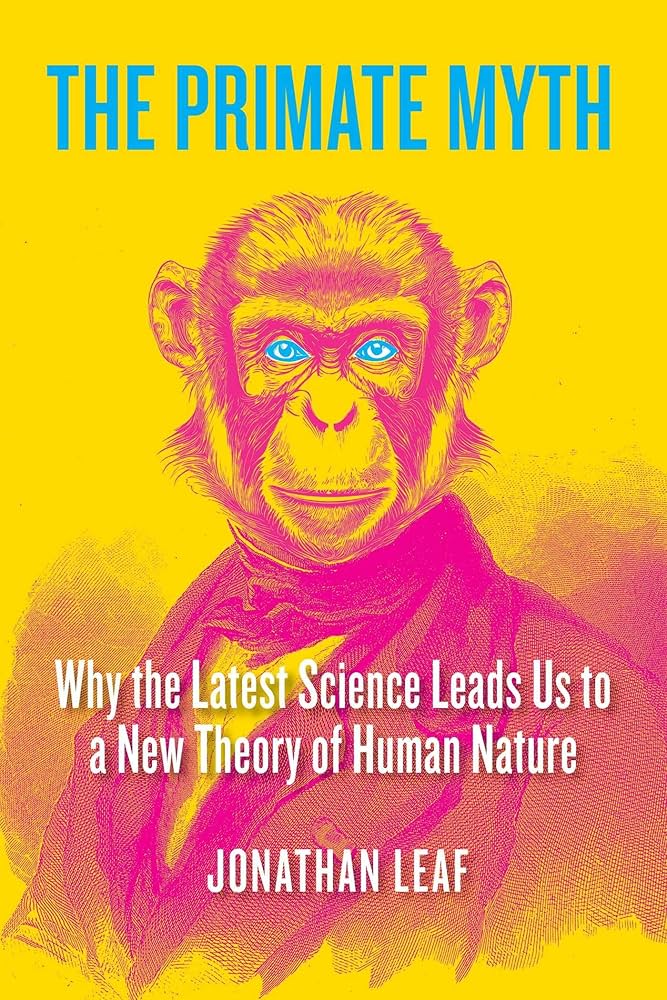 In a fluid and lively prose style, Leaf dismantles the theory that we’re evolutionary kin to tree-dwellers. His writing is the opposite of dry. His elucidations feel like a force majeure whose “pacific purpose”—to quote Poe from “The Murders of the Rue Morgue”—brings welcome news: we aren’t innately savage, homicidal beasts, like baboons. Nor do we resemble the orangutang in the Poe story when “[t]he sight of blood inflamed its anger into a frenzy.” Even the good orangutan, among the most docile of apes and primates, lacks calretinin, a brain chemical that, as The Primate Myth tells it, “acts as a stop button for when its excitatory nerves are overstimulated.” With plenty of calretinin regulating our nervous system, humans usually know when to quit. Primates are an altogether different animal. Relying on modern behavioral research and advances in our understanding of human and primate brain chemistry, cerebral mapping, and now-known differences between ours and primate’s genomes, Leaf bases many of his conclusions on knowledge collected by modern scientific instrumentation, unavailable when, for instance, Carl Linnaeus first stuck us with the primate classification in his volume “Systema Naturae” in1758.
Over 250 years later, Myth points out that only broken maniacs, the very damaged among us, the rarity not the rule, resemble the primatial order. Primates aren’t and, by a long shot, we are herd animals. Our very herd instinct, our yearning to get along, has kept us blind to the truth: that we never were primates.
The late Jane Goodall’s name shows up 35 times in The Primate Myth, like a worthy, highly respected foil (Leaf has said of Goodall, “Her research was impeccable. And brave.”) He draws attention to her book In the Shadow of Man, in which, he says, “…there’s a picture showing her reaching out her hand to an infant chimp.” The photo reinforces the dogma that primates are deep down good-natured, an illusion that has informed current theory, ontology, pop culture, and what passed for common sense, but no more, now that Leaf enters the fray. Primatologists naturally love studying primates, as all their friends do, their herd does, and Goodall represented the apex researcher in the field where no one dare, Leaf suggests, step outside the group think lest the high fives and grant money dry up. Truth is, that infant chimpanzee in the Goodall photo would have eventually attacked her. Michael Jackson had to give up his famous chimp, Bubbles, before the day it looked at him and thought “Beat It.”
Accepted theory is always hard to let go of by scientists or anybody, and cracks have appeared before in the credos of human evolution. Myth is a chasm not a crack, but I once read Elaine Morgan’s The Decent of Woman, a book I’ve never forgotten because she seemed to be onto something. Her work, too, sought to fill in the kind of holes The Primate Myth aims its spotlight into. Morgan’s book expanded on Alister Hardy’s “aquatic ape” theory. While not closing the loop, her assertions ran counter to the orthodoxy. She, too, was the outsider looking in on the community of evolutionary biologists and researchers, who largely dismissed her notions and theories as quaint. Those invested in maintaining the “we are primates” status quo, I expect, will similarly slap Leaf with the charge of amateurism and not take his work as seriously as they ought. That’s a bit like dismissing Wallace Stevens’s poems since he was an insurance lawyer and never earned an MFA in poetry writing.
Leaf’s an ideas man, and this his first foray into nonfiction scientific writing. Meanwhile, his oeuvre includes a history book, novels, and award-winning plays in verse. As a chemist whose livelihood involves continual data analysis, I found the data gathered in Myth solid, nothing cherry-picked, or otherwise fallible. It’s fully digested, and the author exhibits fluency in his subject and in the science behind his contentions. He hasn’t spent much time in jungles or the neuroscience lab, but his book is no amateur job. A random quote of any passage that’s heavy on the science and technical vocabulary suffices as proof: “This didn’t involve the loss or addition of even one gene. Rather, it was the deletion of just two base nucleotide pairs among the more than 100,000 within what’s referred to as the LOXL2 gene. This small removal is what is known as a microindel or microdeletion. In other words, the most important evolutionary change—the critical switch in our design that led to our species’ emergence—resulted from the most minute of indels…” Few scientists attain such clarity. History is peppered with the interlopers it took to see what’s really going on, the rest perhaps being too “in it,” or as another “Jonathan,” Jonathan Swift, put it in “A Tritical Essay” (in 1707) “…although the Truth may be difficult to find … I hope, I may be allowed, among so many learned Men, to offer my Mite, since a Stander-by sometimes, perhaps, see more of the Game than he that Playeth it.”
If we want to be persnickety, we might highlight a few spots in The Primate Myth where the author bends the sweep of his narrative to float an opinion or touch on politics in a way that, don’t get me wrong, fits perfectly, but might come off as a follicle wide of the program. You may or may not notice them. Meanwhile, Leaf convinces that his grand theory could help rein in wars. Firmly backed by statistics and observations sourced from leading scientists and other ideas people, whom Leaf pulls together here (and fully, honorably credits), his revolutionary convictions could help build an alternate view of humanity, one in which we recognize our true selves as, at root, gentle and self-sacrificing. He suggests there’s no savage killer instinct inside us, itching to erupt, and that we mustn’t excuse violent behavior as acceptable because, you know, that’s just who we are. Nor should we let psychotic leaders corral us onto the killing fields. The apex evil-doers aren’t tapping into some core bloodlust of ours, which, as “Myth” demonstrates, isn’t really in our DNA. They’re exploiting our herd instinct. Mr. Leaf stands before us as the Ambassador of Human Harmony.
When in 1968, Mick Jagger sang, “I’m a monkey man…,” he wasn’t kidding. It’s reported that this particular rock god has slept with some 4,000 women. Like the vast majority of primate species, monkeys are generally not monogamous. But humans are. Our monogamy, among other things, has strengthened our herds and herd and helped us fully dominate the animal kingdom. I love the Stones, and “Monkey Man” is a great song, but its appeal lies partly in its implication that we’re something we’re not. It makes us feel wild and primitive, like Mick, for four minutes, but we aren’t really those things and, as Myth advocates, it’s time we shake off the lie, stop believing in our incivility, and give up our addiction to thinking we’re base and violent—like chimpanzees. “Don’t be such a chimp,” we should say to ourself at the next call to soldier up and fight to the death for some lunatic. The Primate Myth ought to be a required text in schools the world over, so the next generations don’t fall for the lie. The truth is we’re not monkeys, not limited to reaching for branches, not brutal, erratic, or uncharitable. Embrace it.
Table of Contents
William Huhn is a Vassar graduate in chemistry and the East Coast Regional Laboratory Manager of a global Testing, Inspection and Certification (TIC) company. The Carolina Quarterly, Verse Daily, 34th Parallel, and other venues have featured Huhn’s poems; and his first full-length collection, Bachelor Holiday, was a finalist in American Book Fest’s 2024 Best Book Award for Poetry. His narrative essays have appeared in Pembroke, Rosebud, American Literary Review and elsewhere and have been listed eight times as a “Notable Essay” in The Best American Essays series.