The Watercolor Chronicles: Aquarela Carlos Comes Into His Own
by Pedro Blas González (January 2026)
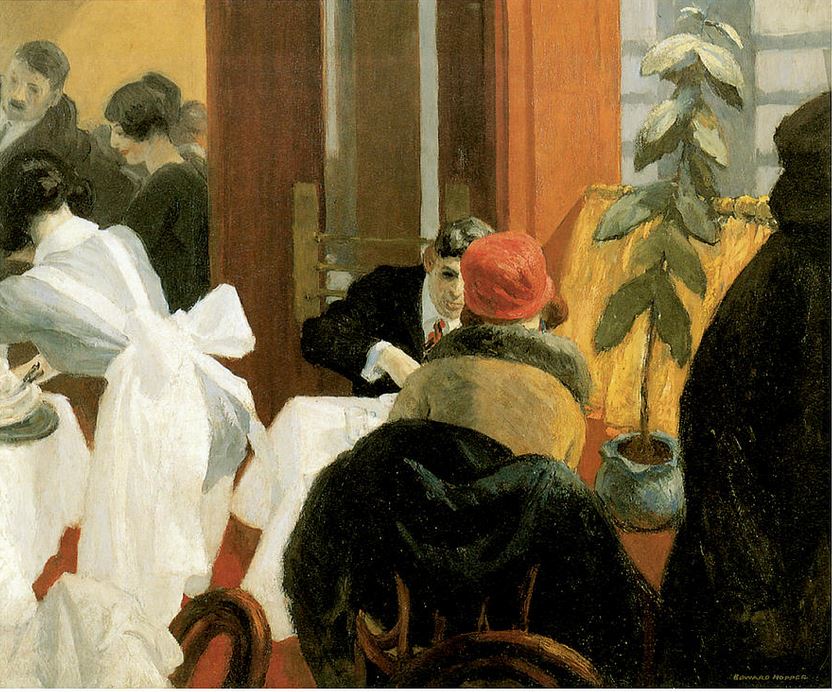
I came into my own as a young teenager. That’s early.
I knew who I was and what I wanted from myself and life. A tall order, no doubt, but I let my convictions drive my actions, my behavior. I embraced values that reflected my vision of life, always rejecting and shunning away chic self destruction.
I was my own man.
Painting was my lens on the world. Aquarela Carlos, Carlito to my friends, I let painting be the motivator of my life, what I imagined my life to be and could become.
I remember my father tell me often that we become what we already are. Only after graduating from high school did that truly begin to make sense to me.
The summer after high school graduation, my inner circle of friends and I continued playing baseball and basketball in local neighborhood parks. I picked up the pace of my painting regimen, trying out new techniques, though watercolor remained my preferred medium.
My friends began to busy themselves with interests other than just hanging around with each other. I lamented this, but father told me that is the natural cycle of growing older. We still got together often, but every one of us embraced new responsibilities.
Sticky Fingers Frank and I enrolled at Saint John’s University. Linguine Mario Alvarez began working with his father in a warehouse in Queens. Fish-Face Luis went to work in an automobile dealership, selling Lincolns and Fords. That boy loved cars and all kinds of machines. He got himself a girlfriend. She took a lot of his time. The rest of us joked about it.
Sticky Fingers Frank and I took the train up to Queens. Our class schedules were similar, and on most days, returned home together in the afternoon. We met for lunch daily, taking turns treating each other. Frank was into computers, programming they called it back then. I loved the arts and sciences, but decided to pursue a finance major. Not only was I comfortable with numbers, I had the crazy idea that one day I would own an art gallery, hopefully filling it up with my own paintings.
During lunch with Frank one day, a couple weeks into the fall semester, he told me that his mother, Gladys, mentioned Amalia von Fritsch, the Manhattan woman who bought my first paintings. I was delighted to hear that.
“I spoke with her on the telephone a week ago,” I said. “She wants to know how my college experience is going.”
“Mom tells me she really likes looking at your paintings in her house. You’re lucky, Carlito.”
“Yeah. I know. I owe it to your mother.”
“It’s your talent. Mother just put you in contact with a person who appreciates your talent. Rarely do we come in contact with people who want to help us get ahead in life. We can’t forget that.”
“No, no. I don’t take it for granted,” I said.
Because we were in college together, Frank and I spent more time with each than with the other guys. Through Frank, Gladys kept me informed about Mrs. von Fritsch, the first person to show interest in my paintings. I was surprised to hear that Mrs. von Fritsch was interested in getting together with me to discuss my paintings and how my starting college was going. I was forever grateful to her for her generous appreciation of my paintings. I would get together with her soon.
Frank and his mother were instrumental to me in helping sell my first paintings to Mrs. von Fritsch. They have helped me immensely. Good people.
***
My painting regimen was fluid. I never waited to paint only while inspired. I painted throughout the day, as time became available. I discovered that inspiration is overrated. The thing to do, I thought, is to work through the vision of the work that I have in mind, no matter what.
Painting is vision, the ability to bring pigment to a canvass with conviction. That first summer after graduating from high school I did a lot of reading about the interesting life of the American painter Edward Hopper. I discovered that Hopper was a loner, a man who kept to himself and shunned the fake and affected limelight of the art world. Essentially a homely family man, Hopper did his own thing, as people used to say back then.
In the 1950s, when the fashionable art world was turning further away from representational art, Hopper stayed his course and painted topics and places that interested him; he continued painting his brand of American realism. One thing I really found interesting in Hopper’s work is how his wife, Josephine, introduced him to watercolor. Being a fan of watercolor, I found that exciting. Looking up his paintings in art books, I became very excited and began visiting the Whitney Museum of American Art, in what used to be the Meatpacking District on the west side of Lower Manhattan, to witness his paintings firsthand.
Almost immediately, I took a great liking to his painting Cape Cod Bay, which resounded with the style of painting that I was doing at the time. I enjoyed his wide vista of the ocean blanketed by sky and wispy clouds. His depictions of lonely and desolate New York City urban scenes sparked my imagination. In Hopper’s paintings, I saw a form of existential surrealism that mingled with realism, or so I imagined.
At that time, the Hopper painting that truly lit my fire for his art was his 1949 Stairway. That work depicts the stairway and front door of his childhood home in Nyack, New York. At that time I didn’t realize this was one of his early works. The door is open to nondescript woods. The darkness in the small foyer is broken by a small measure of light coming from the sky. There is mystery in this painting, which at the time, I likened to Giorgio de Chirico’s mysterious metaphysical paintings.
***
Gyrating, my mind turning in place like a dynamo, I painted as if my life depended on it. Who knows? Maybe it did. The ideas flowed. I was living to paint; painting was happiness.
 I was loving my free time. High school was fast becoming a fading memory. Yes, my college courses required work. I had great discipline. The trick was for me to not fall behind, which meant that I could employ very productive time painting.
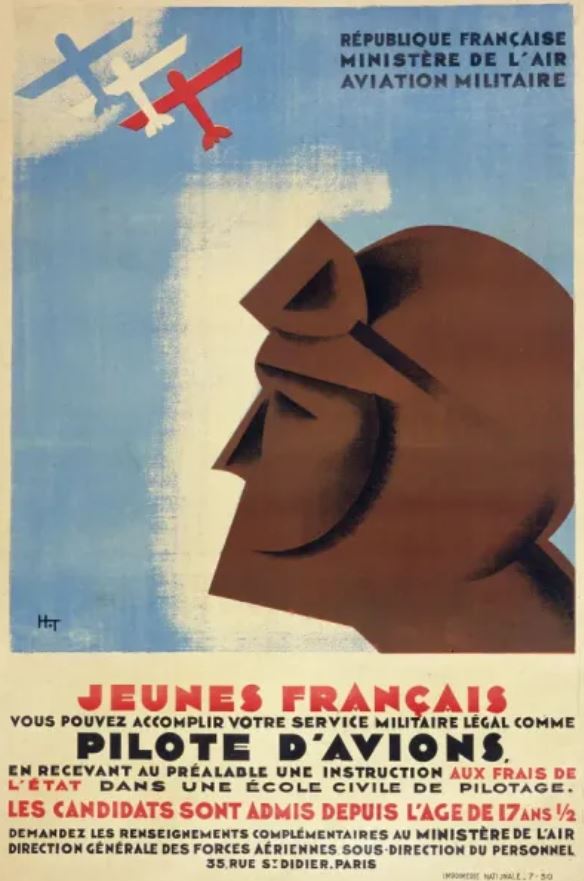
One day I was in a museum store, where I found a really interesting Art Deco postcard from 1930. It was the head of an aviator wearing flying goggles and leather helmet. The postcard was from the French Ministry of Flight. It read: “Jeunes Français vous pouvez accomplir votre service militaire légal comme pilot d’avions.” The pilot in the postcard is looking up at three airplanes, a blue, white and red one. I was moved by the postcard, which I bought and took home. I used it as a model for my watercolor painting Young Men Take to the Skies. My painting was a tribute to early airmail pilot and writer Antoine de Saint-Exupéry, and his friend, Jean Mermoz.
Grappling between painting, managing my college classes, and keeping a part-time job, I found my days going by fast, faster than during any time before in my life. This business of passing time brought to mind ideas about the nature of time that I wanted to capture in my art. But how to do this? Abstract themes—as some foolish critics like to call these metaphysical ideas that I had about the world, man and society—are difficult to pinpoint, often difficult to paint on a canvass.
I thought a lot about de Chirico and his metaphysical paintings. Truly admirable works, I thought then and still continue to do so today. The man broke away from the surrealism art mafia, Breton and company, the cartel of the surrealism of his day. De Chirico took refuge in his own style. Bravo to de Chirico.
***
What is style? Well, it is temperament captured by an artist, whether in art or writing. Hooray for de Chirico. Turning away from the artist mob, the collectivism of one mind fits all; de Chirico created a world of his own through painting.
Anyhow, the idea of passing time began to dominate my art. Yet I found it difficult to express. What a challenge it is to make people see the passage of time in a painting. Only the great ones can achieve that.
What’s new under the stars? Thinkers and artist trying to express something worth saying? I mean, I saw family members getting older. My friends were no longer the young boys I remembered from my youth. We had grown up.
I know I have said before that I was not very good at writing.
Somehow, beginning in my mid-twenties, I found it important to express myself in writing, in addition to my paintings. I wanted to express myself, if only through my memoirs that I kept to myself. I never had any intention of publishing anything I wrote. It was strictly for my own amusement. I was concerned with the passage of time and immortality from an early age. I envisioned time as cyclical, spinning like a toy top before my eyes. I realized that writing was a more efficient way to depict the passage of time than painting.
I purchased a Silver Reed 750 typewriter, a made-in-Japan machine that I used throughout my college years, which I still own. That lovely baby has served me loyally. I could not have been more grateful for that wonderful machine. That typewriter enabled me to organize my thoughts, like I never imagined possible. I began to think of my writing as the template for my paintings.
Well, while I am on the subject of the passage of time, I found that the days got shorter. No, really, the more I became involved with my particular brand of awe and wonder, time appeared to slow down. It was as if time was talking to me. But if time was talking to me, what was it saying? One thing it said is to be cognizant of what happens when we ignore time. Ah, a sneaky Catch-22, I thought.
I discovered that if I paid too much attention to time, I forget the immediate present—the moment that I am living. Who wants that? However, if I don’t pay much attention to time, I risk losing time, as it flees from me unnoticed. To waste time is one of the greatest crimes that man can commit against himself. A conundrum, no doubt. The hell with all that, I thought, and began to live my days of youth like they, and I, will one day parish. That’s what I did. I lived like every day was accounted for. That’s how I lived during my twenties.
I wanted more life. More than life, I called it then. I realized that just taking in the moment was what I wanted most from life. I was satisfied with just being alive.
Looking back, I realize I attended my college classes with the hope that someone, a professor or someone else would enlighten me about life and living. That was not to be the case. A short lived romanticism that was. Perhaps I paid too much attention to what I imagine other people know about life and death. I eased back my expectations, gradually.
I was eighteen.
I realized that the corrosive, late postmodern state of secular thought had hit a dead end. The proponents of that theoretical world are hapless and sophomoric children. Even at eighteen, I figured that out. This was a life-saving move on my part, for it allowed me to concentrate on my existential longings.
Well, there was one exception to this.
I had a Catholic priest as my first philosophy professor. His name was Vincent Niceli. That man had a profound and lasting impression on me. He was a student of the thought of the French Catholic existentialist, Gabriel Marcel. My introduction to Marcel’s philosophy was profound and truly exquisite. It took me a while to realize that was the form of inspiration in a thinker that I hoped to encounter. Of course, Niceli was an exception in what, I later discovered, Gabriel Marcel describes as our broken world.
I learned who I was, what I was invested in, and most importantly, why. I approached the passing of time like a small child does eating a candy bar, I relished it. I can’t stop time, I thought, but I can definitely be aware of it. This led me to think of the mystery of time and how it affects human existence. I knew I had something going on here, but what exactly?
Painting the passage of time is an unenviable task. Why even attempt it? Why bother, most people will ask? I’m not one of those. I discovered that the more I paid attention to time, the more I lived it. That was the essence of my thought and temperament at the time.
***
In late September I was to meet Mrs. Von Fritsch. I spoke with her on the telephone and she asked to see any new paintings that I had painted since I first met her in mid-May. I had about seven new ones, including the two about the French Ministry of Flight. I was excited to see her again.
I travelled to Manhattan on the train, taking three new paintings with me. I met her in a restaurant off Park Avenue, where she lived. I was very happy to see her again but also nervous. She was visibly happy to see me again. Gladys kept her informed about me and my painting regimen.
I remember how excited I was to meet Mrs. von Fritsch once again. It was a nervous excitement. I walked into the restaurant carrying an art portfolio bag. I brought three paintings with me. Mrs. von Fritsch was sitting in a booth at the back. She flagged me down and I could tell by the expression on her face that she was happy to see me. Good woman, I thought, walking to the back. She helped me immensely. I was grateful for her helping hand.
“Carl,” Amalia said, beginning to stand up, “I’m so excited to see you.”
I gave her a kiss on the left cheek. “I’m very happy to see you again. It seems like a long time since we first met.”
I sat down next to her and placed the portfolio bag containing my paintings upright on the side of the bench seat. Amalia was wearing a light blue linen dress that matched her earrings. She wore Southwestern-like bracelets with dark blue stones on both wrists. She had a refined but simple grace that spoke volumes about arriving at a mature age with dignity.
“How is college? Gladys tells me you and Frank are going to school together. Saint John’s is a fine university. That school is a perfect fit for you. I know two Vincentian priests there.”
“Really? I have a priest as my philosophy professor … really nice man. He is sharp as they come. Father Vincent Niceli is his name. He showed us some of the books he has published.”
“You have Vincent as your teacher? He is a family friend. He was my late husband’s friend and confessor. What a small world, Carl. I will mention you to him when I talk with him soon. He is often the priest at the parish I attend. I met him through my late husband. My husband was an orthodox Catholic. Let father know that we know each other when you see him again. He’s a real good man,” Amalia emphasized.
“I will. I’m very impressed with him. I’ve already had several talks with him about existential questions. I’ve only had him as a professor for about one month but I can see that he s a gifted teacher and thinker. He doesn’t just go through the motion of teaching from a book.”
Amalia let out a laugh. “Carl you impress me more every time I talk with you. So, you tell me that you’ve kept up your painting regimen. That’s good. Eventually you’ll have a body of work that will speak for itself,” she encouraged me.
“That’s my hope.”
“Besides, with each painting that you complete, you become better and better. That’s what other painters have told me.”
The waiter came to the table with two glasses of water. “How are you Mrs. von Fritsch?”
‘I am doing well. Thank you, Joseph. This is Carl, a painter who will be famous one day,” Amalia said to the waiter.
“Hello Carl,” the waiter said. I smiled and nodded, a little embarrassed.
“I will return in a few minutes,” the waiter said and left.
“I’ve been coming here for a long time. Their lasagna is probably the best anywhere. It’s my favorite. Everything on the menu is good. I’m so happy to see you again, Carl. Show me your new paintings after we order.
Taking up Amalia’s suggestion, I ordered the lasagna. After we placed our order with the waiter, I opened my art portfolio bag and took out a painting. The three paintings that I brought with me were smaller than the ones Amalia bought from me in the spring.
“I think of these three paintings as a trilogy. They are a view of the city from our apartment balcony. One was painted during early morning, when the sun was coming up. The second one depicts the light during mid-day and the third at sunset. The same vista of the city during different times of day, that’s what I want to show. I wanted to record these different aspects of the same place through time.”
“I can see that this one is early morning,” Amalia said.
‘Yes.”
“Carl, your colors are soft. The mixture of bluish and orange sky is beautiful.”
“Our balcony faces west. So, you see, the sun is coming up over the building.”
“I think Aquarela works beautifully for this subject matter. Let’s see the other two.”
I brought out the second painting. I showed Amalia the painting of midday.
“Ah, that radiant blue sky is lovely. The city has come ablaze with white light. It’s almost harsh, I want to say. The absence of shadows makes the contour of the buildings angular and solid. Truly impressive, Carl.”
I brought out the third painting and placed it on the table, facing her. “This one is sunset. I call it Sunset in the City.”
“This one is bathed in orange and red color. The shadows now appear to melt the structures. I like how you have brought the three paintings to a resolution. You know, taken together, the three create a tension and continuity that reminds me of how sunlight changes throughout the day. When you place the paintings side by side, they depict a vivid picture of the city. They are lovely. I’m privileged to be shown your art.”
Joseph came with the food. I placed the last of the three paintings back into the portfolio bag. I asked the waiter what background music they were playing in the restaurant.
“That’s Gerry Mulligan,” he said.
“What’s the title of the album,” I asked.
“Feelin’ Good,” the waiter said.
“‘The Shadow of Your Smile.’ Isn’t it lovely?” Amalia asked.
“Beautiful,” I said.
“Carl, I think it would be a good idea to display these three paintings in my friend’s gallery. She will be happy to have them. You will get some exposure and I know you will find a buyer. I can set it up with her if you like.”
“I would love that Mrs. von Fritsch.”
***
Amalia hugged me as we said goodbye. She said she would call me soon to put me in contact with her friend.
“Remember … I am Amalia to my friends. Just like you are Carlito to yours,” she said, smiling. “Alright, I will set it up with her and will call you and let you know when to bring her the paintings. You know the address of her gallery.”
***
After I left the restaurant I was elated. Mr. von Fritsch had once again done me a great favor. I was touched, moved by her good will. I walked around Park Avenue for a short time, taking in the line of medium size buildings that make that majestic avenue the prettiest part of New York City. I wondered how many paintings by young painters, just like me, lined the walls of those apartments.
Table of Contents
Pedro Blas González is Professor of Philosophy in Florida. He earned his doctoral degree in Philosophy at DePaul University in 1995. Dr. González has published extensively on leading Spanish philosophers, such as Ortega y Gasset and Unamuno. His books have included Unamuno: A Lyrical Essay, Ortega’s ‘Revolt of the Masses’ and the Triumph of the New Man, Fragments: Essays in Subjectivity, Individuality and Autonomy and Human Existence as Radical Reality: Ortega’s Philosophy of Subjectivity. He also published a translation and introduction of José Ortega y Gasset’s last work to appear in English, “Medio siglo de Filosofia” (1951) in Philosophy Today Vol. 42 Issue 2 (Summer 1998). His most recent book is Philosophical Perspective on Cinema.