Three Times Three: Stendhal at 200
by Kevin Anthony Brown (April 2026)
1
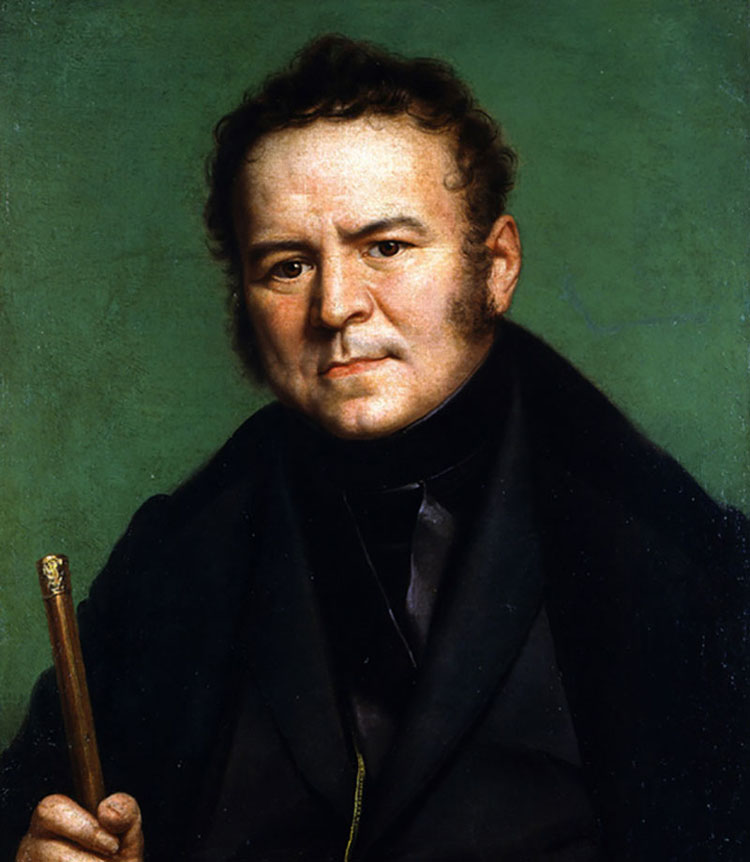
C.K. Scott-Moncrieff, a translator of Proust, also translated Armance, The Red and the Black as well as The Charterhouse of Parma. Three different translators have redone these three novels.
2
Before entering into “overlong and tiresome” technicalities of literary translation, let the storylines and plots begin.
3
Three Novels
Armance
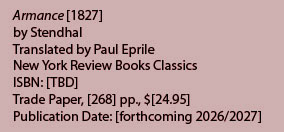 Armance is as much about its heroine, Mademoiselle Armance de Zohiloff, as it is about its hero. Monsieur le Vicomte, Octave de Malivert, is a vintage Stendhalian anti-hero. He “believed himself to be philosophical and profound.” As we shall see, this cool understatement, typical of the one Stendhal adopts when laughing cruelly at folly or chortling gently with folly, sets the tone for all of these novels. At the appropriate time and place, we shall further develop our theme of how Stendhal’s classical mode is almost always on pitch and in key. Whereas full-blown Romanticism, meant to extend his range, sometimes injures his voice. Armance is an overture to the grand operas to follow.
Not his first book, this first-novel reveals how Marie-Henri Beyle molted into The Great Stendhal.
From 16 to the ripe old age of 20, Octave has sworn never to love. His distant cousin Armance has likewise sworn never “to renounce the code of perfect conduct she’d imposed on herself.” Scarcely more than teenagers, these two have for all their lofty idealism lived more in their hearts and heads than they have in the wider world. Stendhal’s heroes and heroines are highly self-conscious but not always self-aware. Losing one’s head—literally to the guillotine via decapitation or figuratively to l’amour fou—throughlines all these books. Chapter after chapter, Armance gradually acquires depth and fullness. Stendhal’s superb, even in this early novel, at intersecting triangles and love-triangles. Knowingly, Stendhal plays his cards close to the vest.
Out of the blue, Octave inherits millions. A certain madame schemes to get poor Armance hitched. Octave’s father and his greedy uncle are likewise anxious to find him a suitable match. “The Marquise,” Stendhal the Narrator informs, “was but indifferently pleased” about the idea of Octave’s marrying “impecuniously.” Surely, Armance, is not a suitable match! Chambermaids insinuate Armance is out for Octave’s money. For nearly 70 pages, Stendhal keeps the reader—and perhaps even the characters themselves—guessing as to their true feelings and/or motivations. Does she love him? Does she not?
In too sudden a reversal of fortune, Armance comes into money of her own. A certain chevalier goes out of his way to lavish attention on Armance. Because he knows that will annoy Octave. Octave “esteemed Armance highly … he found himself scorned by her, and he esteemed her precisely on account of this scorn.” Armance schemes to dupe Octave into thinking she has a marriage offer. Is this chevalier the mystery suitor Armance’s family has found to ask her hand in marriage? Octave writes to a certain madame letters so noncommittal as to be leaked to Armance, but not so careless as to convince gossips Octave’s actually in love with Madame. Was Armance lying when she told Octave she was about to get married, but broke it off? If she lied, then why’d she lie? The suddenness of Armance’s realization, or at least her confession to it, is deftly handled. The revelation comes as a shock both to reader and to Octave himself. Armance confesses to Octave that her marriage engagement is just a fiction.
But, I thought you were “in love with the Chevalier.”
“The Chevalier fills me with horror. But you, Octave, are you not in love with Madame?”
Sainte-Beuve had a poor opinion of Stendhal’s writing, which struck Sainte-Beuve as merely odd. He disliked Armance. Then again, there are Stendhalians, “as the reader may have guessed,” and anti-Stendhalians like Flaubert. More of that later. André Gide’s “Preface to Armance,” from Pretexts: Reflections on Literature and Morality, ranks this novel among the very best Stendhal wrote. The New York Review Books Classics edition leaves little room for doubt that Armance is worth reading in its own right, not just as a precursor to Stendhal’s later masterpieces.
The Red & The Black
 Like Madame Bovary, this novel is a fictionalized tabloid account. Intermittently comic, ultimately tragic, The Red and The Black portrays Julien Sorel, a social-climber from the provinces. Julien’s ladder, both physically and symbolically, is the mechanism by which he rises through the military or ecclesiastical ranks, sneaks into mistresses’ bedroom windows, and finally winds up on the scaffold, where he’ll pay to the guillotine the ultimate price for hypocrisy and rebellion.
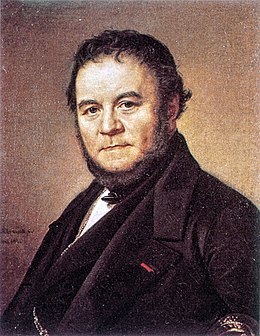
Stendhal was born at Grenoble, in southeastern France. Turin lies a few hours due east. He published The Red and the Black the year of his appointment as French consul at Trieste and Civitavecchia. Which explains such expert depictions of court intrigue in ministerial chambers, antechambers and secret passageways where outright insults are hurled behind closed doors or suspicions planted in a rival’s mind the way Iago whispers poison in Othello’s ear. The varied regions of Northern Italy and Piedmont in general as well as Lombardy in particular saturate The Charterhouse of Parma. Italy grew on Stendhal, who remained there almost his entire career, until his fatal illness in Paris.
Reader, be advised. The Red and The Black is long, though its 75 chapters are manageably distributed between Books I and II.
Book One: Julien’s First Misstep
We first encounter Julien reading Napoleon’s Mémorial de Sainte- Hélène. Knowing which way winds blow, he idolizes but daren’t praise Napoleon. The Church being the most powerful institution in Restoration France, Julien aspires to the priesthood.
Julien discovers Hypocrisy fast-tracks success.
The first step up Julien’s ladder is clambering out of his father’s lumber mill. The second rung is hiring on as tutor in the household of Verrières mayor M. de Rênal. Triangles unpredictably intersect. Mme. de Rênal is the wife of M. de Rênal. Conceited, obtuse and greedy, the Mayor cares more for his rank and title than he does for his wife. A classic Stendhal heroine raised in a convent, unpracticed at adultery, Mme. de Rênal naturally believes all men are like her husband: motivated by money and status. She’d never known true love, and seems not to realize she’s unhappily married till Julien arrives on the scene. In fact, so unworldly is she that it never occurs to her how great a scandal it would be for the ceremonial figurehead of a small town were it made known among his political enemies that his wife, the mother of his children, was cheating on him with one of his servants. Which is what M. de Rênal considers Julien to be. After all, Julien lives rent-free in the Mayor’s house, tutors the Mayor’s children, and earns his meager living at the Mayor’s pleasure.
Starved for the flirtatious attention Julien lavishes on her housemaid Elisa, the jealous Mme. de Rênal falls hard for Julien. Madame begins paying more attention to her appearance, something the Mayor never even notices. Eliza, jealous of Mme. de Rênal, notices everything. Informs M. V—, the mayor’s nemesis, that Mme. de Rênal is guilty of an affair with Julien. Mr. V— writes an anonymous letter to the Mayor, and so forth. We shall not describe for the reader how rumor spreads, how deeply embarrassed the Mayor is, or how easily Madame convinces him these rumors are false. In this and other matters, Mme. de Rênal leads her husband around by the nose, not because she’s devious but simply because she’s smarter than he is.
One of the great heroines of 19th-Century fiction, Madame de Rênal may superficially remind readers of Emma Bovary. The difference between Mme. de Rênal and Madame Bovary being that former’s intense feelings of guilt and remorse seem genuine. What Mme. de Rênal, Julien, Fabrizio and other characteristic precursors to Emma, Odette and Chéri have in common isn’t the mere fact that they cheat. What makes Lost Illusions, Lost Souls, Madame Bovary, The Immoralist, Swann’s Way or the great Chéri novellas worthy successors to Stendhal’s work is that these classics are about more than just seduction and betrayal, possessive jealousy (stalking, leering through peepholes), infidelity or even adultery. They’re about something more insidious: corruption.
Many of Stendhal’s female creations are tacticians of psychological warfare—mind games, love games. In their soft-power ingenuity, Stendhal’s mesdames tend toward a resourcefulness utterly lacking in the male consort. Commander Monsieur de Soubirane’s “barrenness of mind” is just one example. As is Madame de Malivert, Octave’s mother, who characteristically prevails over the demands of her clueless husband the Marquis de Malivert, Octave’s father, before he can figure out he’s been duped. Madame de Rênal in action is a marvel of superiority in generalship—not only in the domestic sphere—right down to her details of diagraming battle plans. As we shall see, “the Duchess Sanseverina’s [salon] effected an internal revolution that echoed throughout all of Parma.” Not only do these Great Ladies improve from novel to novel, they come to dominate their Imperfect Gentlemen. Love is an extension of warfare by other means for Julien, who deludes himself that he’s a Napoleon-caliber tactician. He imagines he’s made amorous conquest of Madame de Rênal. Fact is, she’s the one literally and figuratively schooling the boy.
Balzac, the younger, was among the first to champion his predecessor. Lucien de Rubempré has lots in common with the self-styled Julien de Sorel. Way Julien sees it, all he need do is add that small nobiliary particle to his name—that, and roll the dice. The “man upon whom fortune had not smiled,” Stendhal writes, would soon be “at war with all of society.” Julien’s most implacable enemy is himself.
Book Two: Julien’s Fatal Misstep
The town priest, Julien’s mentor, smuggles him from Verrières to a Besançon seminary. There, he spends 14 months holed up until the Affair Rênal blows over. At seminary, petty politics are even more vicious, if possible, than those of the Parmesan Court will be. Our mercurial Viscount, Octave de Malivert, starts out in the upper echelons of society. He comes to a bad end. Julien starts out near the bottom rung, then lies, cheats and steals his way up the ladder, with tragic consequences, toward the top. Where will he land? Will he eventually become Prime Minister? Pope?
Like Octave and Fabrizio, Julien the naïf falls under the protectorate of an older, more worldly character.
He receives an envelope from an aristocrat in need of a personal secretary. The grand marquis Monsieur de La Mole has enclosed a year’s salary in advance. Is willing to pay double that amount, if need be. Julian flees Besançon for the capital.
A triumvirate of strong personalities vie for possession of his soul: Madame de Rênal; Monsieur de la Mole; and the half-crazed Mathilde de la Mole. In no short order, the marquis’s secretary is banging the marquis’s daughter, Matilde. She becomes pregnant. Furious at first, the Marquis eventually decides to ennoble Julien. That way, Mathilde can marry him.
Then Mme. de Rênal sends the marquis a letter denouncing Julien as a womanizer scheming after his fortune. The Marquis refuses to let Mathilde marry him. Julien returns to Verrières. Shoots Mme. de Rênal. Who survives, though Julien is sentenced to death for attempted murder.
As the reader may have guessed, Julien’s dalliance with religion was entirely cynical and careerist. Julien’s ladder to Mathilde’s bedroom became his ladder to the scaffold. It served as both gardener’s tool and symbol of the high-stakes risk/reward game of climbing ranks in the military or ecclesiastical spheres of power. It represents “all that was most corrosive in a social climber’s ambitions.”
The Charterhouse of Parma
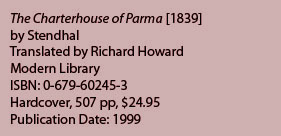 The Charterhouse of Parma is a tale of cronyism, extortion and greed set in era “whose turpitude and venality cannot, [in] your wildest imagination, be exaggerated.”
From now on, Stendhal knows exactly what he’s doing.
Entering Milan, Napoleon crowns himself king of Italy. Fabrizio del Dongo is two. Prone to clumsiness, Fabrizio knocks back four brandies, one after another, then tries not to fall off his horse. Which “whinnied, reared two or three times.” More than just a pitiless observer of manners, Stendhal is a history-painter.
On Sunday, 18 June, Fabrizio “heard the cannonade: Waterloo had begun.” Stendhal’s battle descriptions are thick with cannoneers and cannon fodder; blood; the amputation of a shattered leg; rag-tag groups of soldiers, shouting and swearing; abandoned sabers; whistling bullets and musket-fire (in that specific order); flames and mud.
It’s easy to see why the author of Hadji Murat admired Stendhal. Military history fascinates him, as it did Tolstoy. Virginia Woolf paints a glorious battle-scene in Jacob’s Room. She reminds us that Tolstoy proceeds “not from the inside outwards, but from the outside inwards.” V.S. Pritchett describes Stendhal’s prose as a “hard, clear, nonchalant” manner “with its faint smell of gunpowder.”
Fabrizio’s not yet 17. Far from the great cynic he imagines himself to be, Fabrizio—like Octave and Julien—is naïve. He is only too vulnerable to the “romantic side of his character.”
“Verisimilitude” isn’t always the right word to describe Stendhal’s fictions. Sudden reversals of fortune and/or role-reversals strain credulity. Fabrizio’s a day-dreamer, a skirt-chaser. Yet the goal is to fast-track him for the position of Vicar-General to the Archbishop of Parma, then Coadjutor and, finally, Archbishop of Parma. Fabrizio is to be installed in a palazzo, with ten liveried footman to attend him. It’s fully expected that Fabrizio, like Julien, will rise to power in the Church hierarchy. But when something’s expected of him, Fabrizio does just the opposite.
Presumably, Charterhouse centers around Fabrizio. But Stendhal’s vast social canvas of cast members altogether more vivid than Fabrizio is, large even by Balzac standards—social-climbing haute bourgeoisie, the economically rising and politically ambitious petite bourgeoisie, minor functionaries, the middle classes, chambermaids, actors, shopkeepers, carpenters, peasants, thieves, bribed prison guards and lunatic fringe of poets—constantly steal his scenes. Fabrizio spends literally months waiting in the wings of a maximum security prison while others, in his absence, plot and scheme for or against him. These “characters” include:
Count Mosca della Rovere Sorezana—Prime Minister of Parma, Minister of War, Minister of Finance, Minister of the Police—is “a perfect gentleman in all things,” says Stendhal, “except politics.” Count Mosca “considered himself obliged to seek above all the happiness of Count Mosca della Rovere.” He knows his duty, which is to ego-stroke the deeply fragile tyrant-Prince, Ranuccio-Ernesto IV.
Foremost among Parma’s ultra-nobility, “monsters of vanity and rancor,” is the Sovereign Prince, a despot subject only to his wounded vanity and temper tantrums. Even after “his accession to an absolute throne,” Ernesto the Terrible “was not able to forget his griefs and grievances.” He’s “stupid and prolix,” grows easily bored with serious matters, yet prides himself on his “wit, brilliance” and “quick replies.”
He lives in the very fear he instills in others—fear of ridicule, of opera-orchestra musicians, of “a consummate intriguer,” of tax collectors, of priests scheming for bishoprics, physicians scheming for hush-money. Bribery is just the cost of doing business, meaning staying alive. Because, thanks to his reign of terror, secrets are for sale, spies and not-so-secret agents on the take are everywhere. “If a floor-board creaks, he reaches for his pistols, convinced that a Liberal is hidden under his bed.”
Freedom of speech, for the Prince, is a dangerous heresy of recent vintage cooked up by Rousseau and their ilk. How else to keep rival toadies and opposing factions of ultra-monarchists in check, unless he plays them off against each other? If his not-so-Serene Highness “believes himself to be challenged,” says Count Mosca, he “is capable of anything; he will call this setting an example.”
Under this brutal regime, with its show-trials and corrupt judges whose only “talent comes down to finding legal reasons for hanging a man “whose sole merit was knowing how to ride” if he’s disliked by the authorities,” a confession tortured out of one guilty-until-proven-innocent accused condemns another to execution. A death decree by decapitation is considered merciful. Because capital punishment typically means being drawn and quartered.
At the Palace, gallantries are stale. “A lackey magnificently appareled in daffodil-yellow livery all covered with silver braid, as well as the red waistcoat which completed such magnificence, came to collect the plumed hats and canes.” “Seven or eight individuals of this species” of sycophant stick to safe subjects of conversation. “Should His Highness’s soldiers wear seven buttons on their jackets or nine?”
Power is everything, ethics is nothing, incompetence is no disqualification and treason no crime, provided it be committed under the auspices and accrue to the benefit of the Prince. What’s the big deal? A hitman does your dirty work, you lie low for a few months, and it’s as if nothing ever happened. Some are above the law. None is immune from treachery.
Yielding center stage not even to this man, inspiring jealousy in the hearts of all women, is Angelina-Cornelia-Isola (“Gina”) Valserra del Dongo, Contessa Gina Pietranera. She marries Duke Sanseverina, seldom in the picture, thereby acquiring the title of Duchess. The Duke squanders his fortune renovating his palazzo. The Duchess oversees the work. Like Mathilde de la Mole, Gina’s impulsive, unpredictable, subject to vividly portrayed paroxysms of wild enthusiasm. “She was, as they say in these regions, moonstruck.” The Prince manipulates the Count’s insecurities. The Duchess, “with an enormous burden of leisure to dispose of,” manipulates both Count and Prince. The Count chases after Gina the way Swann chases after Odette. But no man makes Gina feel the way Fabrizio makes her feel. The Duchess is madly in love with Fabrizio. Fabrizio, not coincidentally is the Duchess’ nephew.
“But the reader is perhaps a trifle weary of these procedural details, no less than of these Court intrigues.”
Fabrizio eventually becomes Archbishop. Which leaves him unfulfilled. Longing for peace, he retreats to a monastery, Parma’s charterhouse, seeking solace in reflection upon his past.
4
Three Translators
“Swept away,” Stendhal winks, by “the incidents we have related,” the reviewer has neglected the art of literary translation. The three translators are very different: Eprile is a poet; MacKenzie a scholar; and Howard a lexicographer. Why was each compelled to work on Stendhal for months on end?
If translations have shelf-lives, then Scott-Moncrieff’s Stendhals are expired.
Stendhal’s straightforward classical manner is conducive to caricature and intricacy. What seems tricky to translate are the operatic leaps of his High Romantic manner. The classical sentences are “sparkling with wit and malice.” But what’s ingenious is how Stendhal captures the stormy unpredictability of a character’s inner weather. “There is often a physiognomy in the position of the words,” he himself says, “which no translation can depict.”
He embraces both the irrational and clinical detachment. The characters’ inconsistencies or absurdities lend drama to scenes and situations. As early as Armance, Stendhal understood this. He just got better at it.
Calendar-wise, a child of the Scientific Revolution and so-called Age of Enlightenment, Stendhal belongs to the 18th Century. Rebellion against then-dominant French Neo-Classicism during the Romantic era coincides with Stendhal’s exact dates, 1783-1842. It was Voltaire whom Stendhal read during Napoleon’s retreat from Moscow in the War of 1812. Stendhal, the child of Jean-Jacques Rousseau, was father to the man Balzac became. But the “satiric subtlety” of Fielding’s 18th-Century-novel coexists somewhat uneasily with Stendhal’s at times overblown Romanticism.
“Mawkishness” or “sentimentality” are overly harsh words. The word Stendhal himself uses is “overheated.” Stendhal’s steely, baroque/classical asides sound very Pergolesi-Cimarosa. You almost hear harpsichords, continuo. Some of Stendhal’s rapid modulations of tonal center seem hard for translators to “register” convincingly.
Stendhal was a fan of stage-comedy. He failed at it, but remained an opera-lover, seria and buffa. In some ways, theatre-going stood him in good stead as a novelist. In Armance and Red and Black, Stendhal’s epigraphs, sometimes fictitious, seem intended to set the tenor or mood for each chapter’s text, like an opera overture. Too often, declamatory speeches are forced into the mouths of malnourished characters. Which speeches continue on for pages before that character disappears, never to return. Oftener still, a name is appended to a source of income, and that’s all she wrote. The cliff-hanger endings accompany ham-fisted plot twists—a dose of opium here, of rat poison or laudanum there—and dangling threads. Hard to tell how much this arises from hasty dictation to his secretary, purposeful ambiguity, or simple restlessness. The endings of both Armance and The Charterhouse of Parma seem haphazardly tacked on. Nothing translators can do about that.
Stendhal was a connoisseur of Mozart’s The Marriage of Figaro, of Rossini’s The Barber of Seville. His novels owe as much to non-literary influences as to the written word. Victor Hugo had no use for Stendhal. Yet Franz Schmidt’s “Intermezzo” from his romantic opera Notre Dame seems note-perfect as musical illustration of where Stendhal’s Neo-Classicism leaves off and the recitatives and arias of 19th-Century Romanticism begin, of where grand opera blurs into soap opera.
To put musical terminology in terms of literary translation, Schmidt’s “Intermezzo” rises to a Hugolian emotional pitch that seems impossible to express in a libretto. Hence, certain passages in Stendhal, like Poetry, hover at the limits of translatability. There’s nothing inherently wrong with locks of hair exchanged as mementos of undying love. At its best, Stendhal’s prose combines the classically restrained sententiae of Roman writers with the satire of 18th-Century English novelists and the emotional extremes of high Romanticism. In awkward places, pieces of the jigsaw puzzle show grays between the colors and shapes.
A conductor raps her baton—sharp-sharp—on the music-stand. Up come the fiddles. Down come the bows. For good reason, Stendhal’s work has been translated from medium to medium: film (Bertolucci’s Before the Revolution); television; and, naturally, opera. The creative process of translation occurs not just between languages but also between various media.
Imagine with what gusto Stendhal passed his nights from 2000 hours till midnight, in a fourth-ring box at La Scala, in Milan, squinting through opera-glasses at commedia dell’arte troupes turning cartwheels, performing slap-stick pratfalls or doing somersaults in white-face pantomime. For the entirety of the performance, Stendhal interrupts the storylines to gossip with his companions about this person or that. Suddenly, it hits him.
“I shall make,” he says, “a novel.”
Sound design and stage-lighting determine the tenor of a Stendhal text. His novels live or die by their translations. All three translators felt the need to do-over each novel. They had their reasons.
Paul Eprile
Translators compromise between fidelity to source text and natural-sounding target texts. From book to book within an author’s oeuvre, from author to author across the spectrum of a language’s literature, each speaks unique idioms. A translator’s Prime Directive forbids a translation to interfere with the natural development of its writers. PD prioritizes non-interference—even when the writer’s wrong—to safeguard the Work from unwarranted intrusion. Eprile texts pride themselves on fidelity to the Source. For the above reasons, mistakes found in the original aren’t always “corrected.”
Why retranslate Armance, 200 years later?
Both Scott-Moncrieff and Stendhal were polar opposites of the obsessive-compulsive reviser Flaubert was. “Unwieldy” is the descriptor Eprile uses for Scott-Moncrieff’s version. Nevertheless, when Eprile agrees with his predecessor’s choice, he lets it stand. Otherwise, he makes a change. This reviewer logged a 40-hour work week, spot-checking Eprile’s version against the French-Canadian BeQ edition, cover to cover, and double-checking Eprile’s English against Scott-Moncrieff’s.
Where appropriate, his English sounds colloquial and conversational. Where appropriate, the translator maintains that slightly formal and distanced register familiar to readers of 19th-Century prose. Deliberate archaism is merely one tactic Eprile employs. It’s not his entire strategy. In small doses, it’s a perfectly viable option, not a mistake. Stendhal says, “si vous voulez, ne parlons plus de cet arrangement.” A 21st-Century reviewer’s guessing what Stendhal really means is, “let’s drop it, if you don’t mind.” Judging by his previous translations of Colette and Giono, Eprile can relied upon to have weighed every nuance. He chooses to stick closer to the original French: “if it please you, let’s not talk any more about this arrangement.”
Nor does Eprile over-modernize. To good effect, he often uses the words “you” or “we” for the commonly used impersonal pronoun “on.” Which sounds natural in French, but in English not so much. Skillfully, he makes Armance sound like a 19th-Century novel in written in English, while avoiding Scott-Moncrieff Syndrome. Octave being Octave, the reader senses Stendhal means something like “seriously pissed.” Where Scott-Moncrieff says. “greatly vexed.” If what Stendhal simply means is “God damn it,” then that’s what Eprile says, not “begad.” Stendhal taught himself English by reading English novels, Goldsmith’s Vicar of Wakefield, Fielding and such. The tone of Eprile’s flashback scene from Armance, Chapter V, sounds close to the sound palette of Tolstoy’s Hadji Murat.
Eprile’s vocabulary’s as vast as his shadings are precise. The reviewer noticed Scott-Moncrieff was often paraphrasing rather than translating Stendhal straight, even when there was no real need for “improving” upon original. By contrast Eprile, without distorting the original, economically uses four words where the original used at least 12. As in, l’idée du sentiment exagéré de ce qu’une femme se doit à elle-même. Which Eprile translates as an “exaggerated sense of self-worth.” Getting back to the storyline and plot, it’s worth noting that Eprile and Scott-Moncrieff both omit the subtitle used in some French editions of Armance: Quelques scenes d’un salon de Paris. Because in all 1,300 pages of Stendhal’s novels under discussion here, Fabrizio, Julien and Octave don’t merely survey as if they were theatres of battle the fashionable country- house or hôtel drawing rooms “at the far end of Rue de Richelieu,” where salonniers and salonnières host dueling principals who engage in a battle of wits. They “reconnoiter” them. Not least among Eprile’s accomplishments is keeping Stendhal laugh-out-loud funny.
Raymond N. MacKenzie
Translator of Lost Illusions, Lost Souls and Sentimental Education, MacKenzie shortens the title to three words: Red and Black. Precise in some ways, Stendhal was either hasty, vague or deliberately misleading in others: faulty punctation, occasional anachronisms, inattention to genealogical or theological niceties, misattributed or just plain forged epigraphs, misattributed lines of poetry. For this reason, the beautiful University of Minnesota Press reissue provides 33 pages of translator’s notes. MacKenzie’s introduction, “Chronicling the Nineteenth Century: Stendhal, Politics and the Novel,” will likewise be helpful to readers of The Charterhouse of Parma.
Throughout Red and Black, we find Stendhal’s “unexpected felicity” of phrasing. Whereas MacKenzie notes a “woodenness” in Scott-Moncrieff’s translation. For one thing, an almost Victorian quality pervades the dialogue. Also, Stendhal himself mocked the kind of flamboyance which comes so naturally to Scott-Moncrieff. MacKenzie writes: “[c]apturing life was [Stendhal’s] aim, not cold perfection of form. . . . the rough edges of [his] fiction remind us how little he cared for smoothness.” So easily lost in translation, humor in Stendhal, be it extra-brut-champagne dry or veering off into screwball comedy, is one of the many things that makes the MacKenzie translation work.
Richard Howard
Howard, an American living in France during the Korean War, was a poet, essayist and literary critic. He translated 100 books.
“Very well then, go, Signora Duchess,” the Prince retorts angrily, “and take my contempt with you.”
One of Fabrizio’s enemies shouts, “Stop here, you asshole!”
Stendhal put his talent into geometry, and his genius into dramatic monologues and rapid-fire shifts in point-of-view. What’s astonishing about Stendhal, in Howard’s translation, is how clearly we see what a given character may or may not be feeling, versus what another character imagines he or she is actually thinking.
The Duchess asks the question, expecting a certain response. Count Mosca understands the question differently, and gives an entirely unexpected yet logical response. Julien misreads the frown on Madame de Rênal’s face because “Julien was far from being able to read her thoughts.” She seems to snub him when the King makes a state visit to the mayoral chateau. When in fact she’s lobbying behind closed doors to get Julien promoted to the honor guard.
The language of Stendhal’s narrator mirrors his characters’ states of mind. Moods scud like clouds over a given countenance, whether or not that person is speaking. It’s not always clear to the characters who’s seeing what clearly. For the reader, Howard skillfully renders Stendhal’s characters saying and thinking contradictory things at the same time.
5
The Charterhouse of Parma seems synonymous with the great 19th-century novel, and vice versa. Each of these imperfect novels improves upon its predecessor. Each was a milestone in the author’s development. Each retranslation improves upon Scott-Moncrieff’s first stab. Armance and the other novels demonstrate why, in spite of his flaws, Stendhal’s still read 200 years later. In book after book, he got exponentially better at the depiction of brooding young heroes/anti-heroes.
It’s fair to say those encountering for the first time Flaubert’s “A Simple Heart” can be safely guided from that perfect short story toward that perfect masterpiece, Madame Bovary. There seems little point in recommending one of these three Stendhal retranslations over the other. Because the books aren’t mutually exclusive. But they aren’t created equal. Well deserving of reissue, Armance is the shortest and perhaps most approachable of these novels. It’s a stand-alone overture to the grand operas that followed. But it may not be the best place for beginners to start.
6
For readers new to Stendhal, where to begin? He wasn’t just a three-book writer. Lydia Davis speaks highly of The Life of Henri Brulard. Others recommend Lucien Leuwen. MacKenzie translated the Italian Chronicles. Taken in reverse-chronological order, among the three novels under discussion here, The Charterhouse of Parma seems a safe point of departure. Readers won over by that book may enjoy the even longer Red and Black. From there, Armance is a logical point of return.
Table of Contents
Kevin Anthony Brown is author of Countée Cullen’s Harlem Renaissance: A Personal History (Parlor Press, 2024). He translated Mexican poet’s Efraín Bartolomé’s first book-length work of prose, Ocosingo War Diary: Voices from Chiapas (Calypso Editions, 2014).
Follow NER on Twitter @NERIconoclast