Two Reviews: Liu Lianzi’s ‘Ruyi’s Royal Love in the Palace’ and The Real Meaning of ‘F Troop’
by Seth Barrett Tillman (December 2025)
–
–
Liu Lianzi’s Ruyi’s Royal Love in the Palace
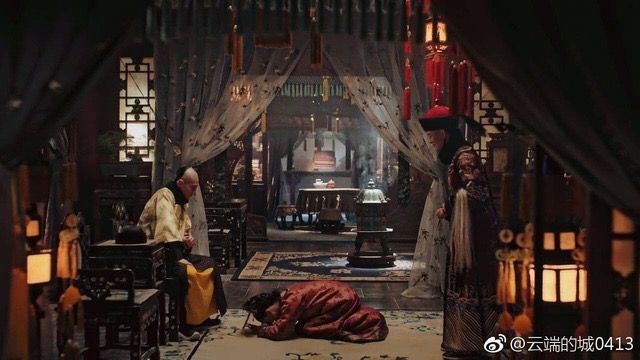
Ruyi’s Royal Love in the Palace is an 87-episode fictional historical drama based on the lives of 18th century Emperor Qianlong, and his consort, and subsequently his empress, Ruyi, of the Ula-Nara clan. Qianlong was the Qing emperor—the Manchu dynasty which succeeded the Ming. Qianlong was the fifth Qing emperor, and the fourth to rule over China. But the plot is not really about Qianlong—it is about Ruyi. The series was shown on Chinese television in 2018. I came across it on Youtube. You can find the first (45-minute long) episode, with English subtitles, here:
If I were pressed to suggest an analogue, only The Tudors or Wolf Hall comes to mind. But the scale of Ruyi is much grander than the two Tudor dramas. That is, in part, because of the vastness of Qianlong’s multi-ethnic Manchurian/Mongolian/Chinese empire: by population and size, in its time, the Qing empire was the largest nation in the world. And it was, according to good historical authority, during Qianlong’s long reign, circa 1735–1796, in which that empire reached its zenith—in terms of military security and cultural greatness.
One can only be transfixed by Ruyi’s set design and costumes. The scale of the scenes is reminiscent of Cecil B. DeMille’s films. The musical score was haunting, and the acting—superb, notwithstanding that much is, no doubt, lost through translation and subtitles. Albeit, some of the English subtitles put forward helpful historical explanations or explained references to classical and ancient Chinese literature, as well as wordplay otherwise lost in translation. There are several points where characters write in Chinese—I am sure that something is lost when their logographs were left unexplained (to those, like me, who cannot read Chinese).
I will make a few quick points about this series. First, I cannot remember the last time that I have been moved to tears by film. I cannot remember the last time I saw a film with so much genuine ambiguity about various characters’ conduct, leaving one contemplative, knowing that there is (and can be) no real closure to come. I do not really know if these moral conundrums emanate from Buddhism, or from Confucian or Daoist philosophy—or from the author’s imagination—or, perhaps, should be best understood as universal problems of the human condition, merely set amidst an eighteenth century Chinese historical plot. I cannot remember the last time I saw a film with multiple unexpected plot twists.
Second, this series portrays women as developing close relationships and loyalties with one another, affecting both the development of their personal character, and the political future of their polity. For example, Ruyi and Hailan (another of Qianlong’s consorts) have a complex and intellectual relationship. The truth is: I cannot think of any analogue in Western film, at least, not any analogue about women.
Third, I will describe one very affecting scene. Ruyi falls victim to a plot. Essentially, she is framed by two other members of Qianlong’s harem for killing two of Qianlong’s children (by other wives). Qianlong, not quite believing the evidence, sends Ruyi to Cold Palace—a palace in the Forbidden City. Although it is a “palace,” it has been allowed to fall into decrepitude, and so is used as an internal open-air prison for abandoned consorts, concubines, and female servants of the imperial family. Many of the prisoners are mentally ill. Ruyi languishes there, with a faithful servant, for three years. By that time, sufficient evidence emerges which casts doubt on Ruyi’s guilt. As a result, Qianlong permits her to leave Cold Palace, and before returning to her new home, Yikun Palace, she walk along the ramparts of the Forbidden City.
Ruyi looks out over the Forbidden City’s many palaces. Her facial expression is difficult to gauge. When I first saw this scene, and when I first heard its musical score, I saw it as uplifting—as one, short happy moment when virtue and right overcome injustice and evil. (Ruyi’s musical themes.) But having watched this scene now many times, I am not so sure. Could it be that Ruyi, although glad to be out of Cold Palace, and pleased to have her reputation restored, realizes that she has only traded one prison for a more glorified one? The whole of the Forbidden City is a prison. All the people, from the smallest to the greatest, who live there are trapped by the calculations, schemes, and machinations of others’ seeking advantage, for themselves, their families, and their clans. Or is the point, that this “trap” is the human condition, and all one can do is endure, while doing as much good as we can until we must leave? See Ruyi, Episode 27, at 25:00 to 34:00ff); see especially at 28:02 (where the logographs on the courtyard’s gate are translated).
And by the way: The Chinese Communist Party sought to cancel Ruyi’s Royal Love in the Palace. “The cancelling of Yanxi & Ruyi shows that the [Chinese Communist] Party remains unswerving in its vigilance.” Jiayang Fan, “In China, Shows Like ‘Story of Yanxi Palace’ Go Viral, and the Party Is Not Amused,” The New Yorker (April 23, 2019).
Ruyi’s Royal Love in the Palace gets full marks.
The Real Meaning of F Troop
In their Celtic thesis, the late historians, Grady McWhiney and Forrest McDonald, argued that the American South was primarily colonized and settled by Irish stock, whereas the North was primarily settled by Anglo-Saxon stock. This tension was to play a role in the assertion of Southern independence and the style of fighting embraced by confederate armies during the Civil War.
The prime exemplar of McWhiney and McDonald’s Celtic thesis in popular culture is F Troop. The dramatic dyad between English and Irish culture had found its natural home and classic statement in Edith Somerville and Violet Florence Ross’s Some Experiences of an Irish R.M. (1899) (R.M. means resident magistrate)—where the local Irish get the edge on the transplanted Englishman, sent by the central government to Ireland to govern the uncooperative locals.
Naturally, in the United States, the dramatic dyad shifts from literature to television. But, in all its essentials, the conflict remains much the same. In F Troop, Sergeant O’Rourke, having an Irish last name, generally outsmarts Captain Parmenter, who actually has an Anglo-Norman name. The conflict with Native Americans and the prior American Civil War were only incidental to F Troop’s plot—instead, the storyline primarily involves O’Rourke’s continuing efforts to outsmart the U.S. Army and Captain Parmenter, while remaining loyal, broadly speaking, to American ideals (including making money).
Thus, the real battle (of wits) is again between the Irish and the English—in the USA—which, in itself, continued the prior established literary tradition. McHale’s Navy followed the same pattern: Lieutenant Commander McHale is the Irish-O’Rourke character, and Captain Binghamton is the English-Parmenter character. Of course, all this made more sense to our public at a time when Hollywood’s writers remained immersed in (and, generally, supportive of) the English-language and Western literary canon.
Table of Contents
Seth Barrett Tillman is an Associate Professor at Maynooth University School of Law and Criminology