Book review: The Medievalist by David Angsten
The Medievalist by David Angsten
“like an egg into a finely crafted beer”
By Carl Nelson
Roland Grimsky (a modern day Quasimodo) stumbles forward through David Angsten’s latest book, “The Medievalist”, as the protagonist/scriptwriter-missionary/reluctant gumshoe whose ambition is to bring an appreciation of Dante Alighieri, the great Italian poet and writer’s work, to the public through a movie production.
Daunting task?
Undoubtably.
But the author’s, even more daunting, task is to get this Quasimodo-like fellow some traction in a culture in which he represents the blindspot.
We initially encounter the monkishly robed and cowelled Roland working in his candlelit studio, deeply 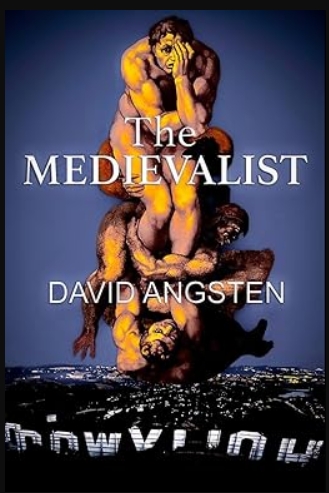 immersed on a production panel depicting the seventh circle of hell. Roland’s good fortune we’ll find is that the Hollywood he inhabits offers nearly every form of corruption the tawdry human soul contains. So, populating Dante’s nine circles of Hell may be doable though it’ll use all Roland’s crayons. In fact, our tale kicks off as Roland has gone next door to clip a black tube of his neighbor’s lipstick – just the blood red needed – and finds himself caught ‘red-handed’ (literally) as a suspect in Veronica (his neighbor’s) disappearance.
The worry here is that Veronica might have become the next in a series of murders whose corpses were arranged so as to convey iconic noir murder movie scenes as staged by a serial killer who in the press has been given the moniker, “the Showrunner.”
Veronica never appears. But her look-alike sister Emily does, who adopting Veronica’s identity, uses it to escape her own collapsing life. Then Roland shadows Emily in an attempt to discover what has happened to Veronica (there is a smidgeon’s history of un-returned love, here). All of which pulls Roland into a web of murders, deceit, a bitter, alcoholic, maddeningly elliptic conversationalist/screenwriter named Howard Ritter, a Yale-educated pool boy and his mogul Sasha, the inscrutable oriental gallery owner, a hunk of an actor who naturally confesses that “what I really want is to direct”, two dogged cops and some confusing gender types.
The readers get Dante’s (or is it Virgil’s) wry metaphysical gumshoe asides, as Roland Grimsky, our modern day Dante, pursues the sadistic murderer through Hollywood’s “nine circles of Hell”. Everyone appears corrupted. No one appears trustworthy, as cover-ups are peeled back by Roland’s investigation like layers of a tear-creating onion. Add cinematic aspiring beauties, and lavish hedonistic displays of moneyed privilege and pool parties swarming with drunks, drugs, pool boys and coquettes. All through which Roland Grimsky picks his way along like Dante escorted by Virgil through the nine circles of Hell. Thoughtful asides are contemplated. Literary place markers are set. Useful aphorisms locate us. It’s all great fun.
Hollywood, as depicted in this latest noir thriller is a community of desperate characters pitching their fabricated personas which are afloat on the necessary lies and illusions of the cinematic industry waters. On my last visit to this town, the cityscape alone was enlightening. Rolls, Maserattis and other luxury cars sat in a lot behind a chain fence on the same street as tattoo parlors and fast food outlets. Middlebrow tourists and panhandlers drifted by exorbitantly priced businesses where off-the-scale glam parked their Bugattis to run in for a quick shopping spree. Our son, during the visit, located a yellow one which he circled like a bug around a neon-lit zapper. (Author’s reveal: Later after moving to LA, our son, Tin Tin, impressed the author enough to be given a cameo appearance.)
Our cinematically experienced author’s Hollywood is a rapid rise and rapid descent universe, rather like a Disney fun-ride. Into this our author drops Roland Grimsky, former Benedictine monk, Rhodes Scholar medievalist, current penitent and aspiring screenwriter, as the moral center into all of this like an egg into beer.
Plop!
Right into the City of Fallen Angels.
We get not only a third person point of view, but also an omniscient aside to this fictional critique of Hollywood. In short, this gumshoe comes with clerical insights.
Roland frowns in sympathy. “At the monastery, the prior would often remind us: it’s always better to humble yourself; the hard way is having God humble you.”
“That’s sweet,” she says. “But God had nothing to do with this creep.” She looks at Roland. “You of all people should know.”
Roland casts a side glance at her. “You’re right,” he says. “Not God’s doing.”
– (Pg. 110)
Add Hollywood agents, publicity hounds and gossip columnists, script pitches disintegrating before overly nitpicky breakfast orders, lots of duplicitous assistance, and… our socially inept, humped backed, bug-eyed, overweight and rather clumsy seeker of truth, embodying (literally) a loose, Pillsbury Dough Boy’s attributes, assembles himself wonderfully over the course of our story to become a formidable protagonist. (A big hero! As he saves the girl and a couple lives, (several times!) and fends off a knife attack – all as a modern day Quasimodo, counter cast to a tank of lizards.)
Like a good story, this novel and the characters within it, gain momentum as the tale collects itself in a final kick to the wire through the book’s final third.
Bottom line. What you’re getting here is a well-written, thoughtful page turner thriller, which also grasps a bit for the stars and meaning – just like Hollywood.
– Carl Nelson is an essayist/poet/playwright who lives in a small town along the Ohio River. To find more of his work, please visit his substack, barkingsquirrel at carln.substack@com or visit his publisher, Magic Bean Books at magicbeanbooks.co