Broadway Baby
A Review of ‘Stephen Sondheim: Art Isn’t Easy’ by Daniel Okrent
Born in 1930, the only child of two rag-trade machers, Stephen Sondheim was raised by “governesses, nannies, and cooks” at the sumptuous San Remo apartment building on Central Park West, his father distant but loving, his mother (as the adult Sondheim would tell almost anybody) a “monster.” But the lodestar of his youth was the era’s leading Broadway lyricist, Oscar Hammerstein II, who lived next door to the family’s country place in Doylestown, Pennsylvania. Lin-Manuel Miranda, the author 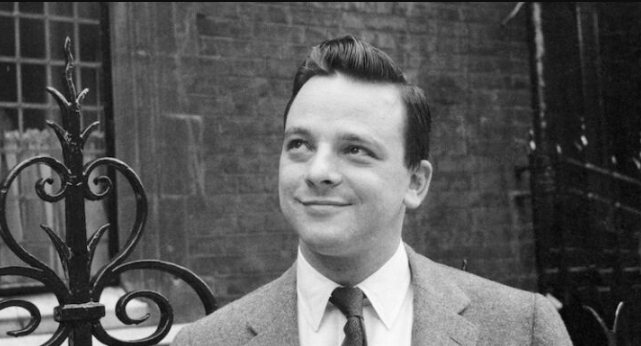 of Hamilton, has called Hammerstein’s mentorship of the young Sondheim, beginning when the boy was 12, “the most significant relationship in the history of our art form.” It’s true, yet bizarre. Hammerstein’s relentlessly sunny lyrics (“There’s a bright golden haze on the meadow…”) were of the sort that made many sophisticated theatergoers, Sondheim among them, cringe. But somehow the young prodigy managed to learn lessons in Doylestown that helped him develop, eventually, into the creator of some of the wittiest—not to mention darkest and most cynical—songs ever heard on Broadway.
It’s conventional wisdom to say that Sondheim, the subject of a terrific new biography by Daniel Okrent, started on top, contributing the lyrics to West Side Story in 1957, which, when adapted for film four years later, nabbed the Oscar for best picture and spawned a soundtrack album that spent 54 weeks—still a record—at No. 1 on the Billboard charts. But Sondheim himself wasn’t entirely thrilled by the project or the results. First, although he was only 27 when the show opened, he was already possessed of a formidable ego, and he chafed at not being able to write both music and lyrics, even though his collaborator was the legendary Leonard Bernstein. And second, despite the aforementioned ego, he was also among his own toughest critics and was never happy with most of his West Side Story lyrics. He felt that any actual human being resembling the Spanish-speaking Maria, newly arrived from Puerto Rico, would never have sung a line like “It’s alarming / how charming / I feel.” But why agonize about such things? In real life, Maria wouldn’t be singing at all. Nor would she be so good at rhyming in English or at concocting catchy tunes on the spot. If you’re going to accept the artificial conventions of the musical-play form, why draw the line at vocabulary?
Sondheim’s second show, Gypsy (1959), is regarded by many as the best musical comedy ever. (I’d definitely put it in the top five.) Again he was confined to lyric-writing, but, as with West Side Story, a number of the songs he wrote with veteran composer Jule Styne (“Some People,” “Small World”) became standards. The title of Sondheim’s first-act finale, “Everything’s Coming Up Roses,” notes Okrent, “went straight from his imagination into the English language.” And when Styne, Sondheim, and the show’s star, Ethel Merman, “visited an ailing Cole Porter and performed the score for him, the quadruple rhyme in ‘Together Wherever We Go’ elicited a gasp of delight.” That series of lines—“Wherever I go, I know he goes / Wherever I go, I know she goes. / No fits, no fights, no feuds, and no egos, / Amigos!”—and that moment with Porter, said Sondheim decades later, “may well be the high point of my lyric-writing life.” Styne recalled the collaboration joyfully. “I felt I was working with a genius,” he said. Sondheim remembered the thoroughgoing vulgarian Merman less kindly—“a talking dog,” he called her. Okrent makes one thing clear: When it came to his lyrics, Merman’s character, the stage mother from hell, was based not on Gypsy Rose Lee’s real mother but on Sondheim’s.
Following Gypsy, Sondheim finally was able to write both music and lyrics to his own shows. The hilarious Plautus-inspired farce A Funny Thing Happened on the Way to the Forum (1962) was a blockbuster, but then Anyone Can Whistle (1964) flopped. Six years later came his breakthrough work. In Company, Bobby is a single Manhattanite in his mid-30s whose circle of friends consists entirely of upscale heterosexual couples eager to find him a girlfriend. Sondheim always insisted that Bobby was (a) not he, and (b) not gay. What he seemed not to grasp was that an ordinary bachelor (as opposed to, say, a famous songwriter) wouldn’t be endlessly harassed by would-be matchmakers; nor did he (or his collaborator, the librettist George Furth) seem to realize that straight men tend not to have the kind of relationships with married women that Bobby has.
Which brings us to Sondheim’s sexuality. He’d known he was gay from an early age, but for a long time neither talked about it publicly nor (it appears) acted on it. He did try to go straight. (“I was never easy with being a homosexual,” he told an earlier biographer, Meryle Secrest, when he was in his 60s.) At one point, he pursued a relationship with Rodgers’s divorced daughter, Mary, his best friend since they were teenagers. “So we would get into the same bed, side by side, frozen with fear,” Rodgers wrote in her memoir Shy. “We just lay there. We didn’t discuss anything; we didn’t do anything. If we touched, it was en passant.” Later he “dated” the actress Lee Remick, whatever that might mean. To read about Sondheim’s series of theatrical triumphs, and to learn that instead of enjoying them he invariably found something to explode about, is to sense that his rage wasn’t about the show; it was about the fact that he was alone, and that it’s especially when everything’s coming up roses (to coin a phrase) that a deeply sensitive person—and that Sondheim most assuredly was—misses ha-ving someone to share it with.
Not everyone loved Company. Variety dismissed it as of interest only to matinee ladies, misogynists, and “homos.” (For my part, while I love the songs, I find the book annoying and obnoxious.) But a lachrymose Alan Jay Lerner, who had achieved the summit of golden-age Broadway eminence with his book and lyrics for My Fair Lady in 1956, told his wife on opening night, “My way of writing musicals is over.” Indeed, writes Okrent, with Company, “Sondheim’s life changed utterly and forever. So did the history of the American musical.” Before the 1970s ended, Sondheim had turned out several more shows that, while in some cases faulted for their books, were uniformly praised for their extraordinary songs. Follies (1971), a tribute to vaudeville, lost money but became a cult classic. A Little Night Music (1973), based on Ingmar Bergman’s 1955 film comedy Smiles of a Summer Night, is sheer perfection, a breathtaking masterpiece that, in my view, is the best American musical ever (never mind that Sondheim himself, an unlikely channeler of Jackie Mason, considered it “so damn goyische”). Pacific Overtures (1976), while a flop, included the song of which he was proudest, “Someone in a Tree.” And Sweeney Todd: The Demon Barber of Fleet Street (1979) is as brilliant and bewitching as it is brutal, although Bernstein, likely envious because Sondheim’s star had risen while his had waned, found it so “disgusting” that it made you “want to throw up in your galoshes.” (In the wake of Bernstein’s death, Sondheim struck back: Il maestro, he charged, had tried too hard to be au courant, had exhibited “a form of self-importance” that was “both embarrassing and silly,” and had been weak at composing ballads. (True, true, false.)
Throughout the magical 1970s, in harness with the producer Hal Prince, it seemed almost as if Sondheim could do no wrong, with dazzlingly clever lyrics and complex but arresting melodies that were charting a new course for the Broadway musical. Then the musical went one way (see: Andrew Lloyd Webber) and Sondheim went another. After the colossal failure of Merrily We Roll Along (1981), “he thought about stepping away from Broadway altogether.” (Four decades later, following many failed efforts to reconceive Merrily, it was finally revised and revived with spectacular success.) Sunday in the Park with George (1984), his tour de force about Georges Seurat, inaugurated his collaboration with director and librettist James Lapine, and it was widely viewed as a career high. But Sondheim, who had routinely amassed Tony Awards throughout the 1970s, saw the 1984 ceremony turn into a near-sweep for the musical version of La Cage aux Folles. When composer-lyricist Jerry Herman’s name was announced for best score, Sondheim emitted “a sound that sounded like he’d been punched in the gut.” To make matters worse, Herman, in his acceptance speech, gloated that his prize disproved the “rumor … that the simple hummable show tune was no longer welcome on Broadway.”
He was, of course, taking a shot at Sondheim, who himself had made a self-referential joke in Merrily about how his own scores never featured a “humm-ammum-able melody.” That is a shame. These two men of the theater who wrote both music and lyrics—both gay, both Jewish, both first-rate, both born (14 months apart) in New York City—embodied two exceedingly different, if equally valid, ways of furthering the musical-theater tradition. Herman was the consummate sentimental crowd-pleaser, Sondheim the bracing wit. They were complementary, not competitive.
Sondheim’s consolation prize for Sunday was not too shabby: It got the Pulitzer. It was, however, his last solid hit. Its successors—Into the Woods (1987), Assassins (1990), Passion (1994), Road Show (2008), and the posthumous Here We Are (2023)—all have their enthusiasts. But while Sondheim accumulated armsful of lifetime-achievement awards in his last decades, saw many of his old shows revived to great acclaim, and even had a Broadway theater renamed in his honor in 2010, he couldn’t get one of his own new musicals mounted on the Great White Way. Still, life went on, and other projects engaged him. His song “Sooner or Later,” performed by Madonna in Dick Tracy (1990), won an Oscar. He devoted years to the magisterial volumes Finishing the Hat (2010) and Look, I Made a Hat (2011), in which he reprints all of his lyrics and offers illuminating, comprehensive commentaries on the songs, the shows, and the stories behind them.
Some offers didn’t tempt him. When the gay activist and playwright Larry Kramer suggested they work together on a show about “the sheer joy, elegance, pain, complications of being a gay man,” Sondheim declined prontissimo. Writing about being gay was for Herman; for Sondheim, it was far too private. Indeed, almost anything was too private. In Okrent’s words, he erected “a sort of force field” around himself “to secure his desire for distance.” Elaine Stritch once quipped: “When you say something personal to Steve, he says ‘Taxi!’” Hollywood songwriter Sammy Cahn contended that Sondheim was “scared to say I love you” in his lyrics. (Sondheim proved this untrue with two aching Sweeney Todd ballads, “Joanna” and “Not While I’m Around.”) Lerner agreed: Sondheim, he lamented, “doesn’t reach out and touch.” Asked in 1982 why he didn’t want to direct, Sondheim explained: “I don’t like dealing with people. The fun’s in not dealing with them.”
In perhaps his most heartbreaking lyric, to “Anyone Can Whistle,” the singer depicts herself as a polymath—“I can dance a tango, / I can read Greek, / Easy”—while at the same time confessing to an inability to make meaningful human contact: “What’s hard is simple. / What’s natural comes hard.” That was Sondheim in a nutshell. Which is why it surprised everyone he knew when, in 1991, his decades of solitude were interrupted by a brief love affair (accent on the “brief”). More gasps of astonishment ensued when, at 87, he married Jeff Romley, half a century his junior; the marriage lasted until Sondheim’s death in 2021, their relationship strengthened, maintains Okrent, by their extreme differences. (Romley was a triathlete, and for a while Sondheim’s Oscar “sat atop Romley’s Xbox”—an item that no Sondheim intimate could ever imagine seeing in his home.) During his twilight years with Romley, friends experienced “a warmer Steve, a contented Steve”: Bernstein’s daughter Jamie relished his new “happiness”; Lapine saw “the reservoir of anger inside of him dissipate.” Better late than never.
Okrent’s book is a consistently winsome, snappy, and smart piece of work; he’s the rare biographer of a songwriter who actually knows how to write about music. It is also part of Yale’s Jewish Lives series. Perhaps it’s unnecessary to say that Sondheim was Jewish in pretty much the same way as most other Manhattan Jews who (as Okrent puts it) “never lived south of Forty-ninth Street.” He attended Ethical Culture School; “he didn’t even know what a bar mitzvah was until he was twenty-one”; and “his political views…conformed in most matters to those expressed by the New York Times editorial board.” In 1970, he attended Bernstein’s infamous Black Panthers fundraiser; the “insurrection” of January 6, 2021, led him to wonder aloud, tearfully: “What has happened to our country?” Nonetheless, he was savvy enough not to advertise his standard-issue leftism too often: When, in 2003, he told a Times reporter that George W. Bush was a fascist, he asked to have it kept off the record. In any event, he wasn’t anywhere near as far to the left as some of his cronies. When Barbra Streisand invited him to write new lyrics for his anthem about Hollywood survival, “I’m Still Here,” in which she wanted him to excoriate showbiz sexism, he took the job, but told friends, “the militant feminism is hers, not mine.” When asked in 2012 “what he’d like to see ‘LGBT-wise’ in the coming years,” he shot back: “I’d like to see the term LGBT disappear from the English language.” Nice to know that when push came to shove, the PC instincts that might’ve compelled him to embrace “LGBT”—a label at once ugly and preposterous—yielded firmly to the respect for words, in all their precision and beauty, that, along with his love of music, had defined him since he was a lad at Oscar Hammerstein’s knee.
First published in Commentary Magazine