How Napoleon Came To Be the Greatest of All Conquerors
Conrad Black, in an excerpt from his new book, argues the French emperor lost everything in his lifetime, but he won all of it back in posterity.
By Conrad Black
The following is an excerpt from Conrad Black’s The Political and Strategic History of the World, Vol. III: Louis XIV to the Brink of World War I, A.D. 1661-1914, published by World Encounter Institute/New English Review Press
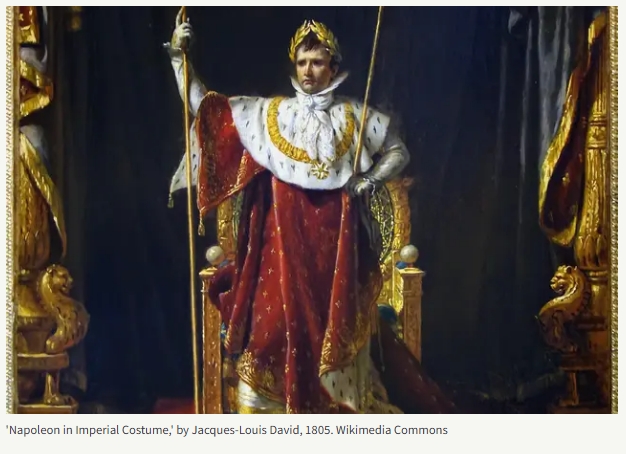
It is hardly to be wondered that Napoleon’s historic reputation remains contested. Almost no one disputes, and it is practically impossible to deny, that he was a military genius and probably without peer anywhere in recorded history. He had to face established armies often with relatively distinguished commanders for twenty years of almost constant war. He could not repeat the same tactical methods of victory indefinitely as his success caused all possible rivals to study his techniques carefully, and be on guard against the repetition of any particular formula. He had an unlimited ability to improvise, and almost instantaneous recognition of the potential danger of combinations or deployments of forces or variations of geography. He had an encyclopaedic knowledge of the campaigns of the great commanders of the past and an instant recall of any of the lessons of their campaigns that could be applied.
He could describe entirely from memory and in great detail all of the significant engagements of Alexander the Great, Hannibal, Julius Caesar, and other classical commanders as well as more recent ones such as Subutai and Frederick the Great. He knew how to cultivate his legend and had a personality that was both affable and remote, and he never suffered any significant defections from his own ranks, even in the most dire circumstances. He was never discouraged by odds and conditions that would have intimidated almost anyone else. At the Beresina at the end of 1812, and again a year later on the Rhine, he showed that even though heavily outnumbered and in desperate conditions, he could find some unsuspected method of outwitting and defeating his opponents. The only battles he actually lost, were Leipzig and Waterloo, and in the first he was heavily outnumbered, held his own in casualties and made a completely orderly retreat from an Allied army that was too enervated by the three-day battle to pursue him aggressively. At Waterloo, he would probably have won if the marshal delegated to run down the Prussians after Napoleon had defeated them two days before at Ligny, had done his job properly, though it must be said that the Duke of Wellington mounted such a fight that even if he had ultimately been forced to withdraw, Napoleon could not have annihilated the British Army on that day. He would have lived to fight again and it is impossible to foresee with confidence how events might have turned. The facts of his career as a military commander and the mystique of his personality are equally beyond question. As a ruler, Napoleon’s record is more uneven. He was one of history’s great lawgivers, and the influence of his Code is very great in all the civil law jurisdictions of Europe, as well as in Québec and Louisiana and some other European-influenced jurisdictions. His reorganization of the French state was admirable and swept away centuries of accumulated inefficiency and ingrown injustice. He was an uncompromising meritocrat who promoted talent, civil and military, regardless of age or ethnicity. He founded the Bank of France, narrowing the imbalance in capital and monetary organization that Britain had enjoyed, and radically improved both the quality and availability of education in France, though by continuing to employ clerical personnel, he avoided severe cost increases. He was a militant opponent of anti-Semitism and while he did little to democratize the French government until the rather popular Constitution of 1815, he did radically democratize socioeconomic opportunity, and his fiscal and agrarian policies substantially alleviated poverty in France. He was personally affectionate with his wives and child and stepchildren, and often engaged in elaborate games with Josephine and their friends in their relatively carefree early days. Josephine, who was popular with the French people because of her unpretentiousness and somewhat rugged background, always remained calm and gently admonished him: “Oh Bonaparte, do please stop!” Napoleon’s rages were famous, and he did anger easily and at times somewhat excessively, but he was often a genuinely sensitive person, a good listener, and an appreciator of talented and interesting people wherever he found them.
It is not clear whether Napoleon developed any real affection for the French, or was just using them, as a fugitive from a despised little island, to pursue his own ambitions. At the least, he respected France in comparison to other nations and was certainly aware of that people’s services to him, which were not unrequited. Napoleon came from an Italian-Corsican family in a minority in that island and rose to military command almost as swiftly as Alexander the Great, who achieved that status by inheriting a kingdom. Napoleon was astoundingly successful for over a decade (apart from a partial and inconsequential échec in Judea), and proceeded deftly through implacable years of sanguinary intrigue, political treachery, and hitherto unheard-of exercises in total war.
If he had started earlier, unleashed the Guard and the cavalry on the retreating Russian army after Borodino, annihilated the Russian Army, observed the burning of Moscow, and returned to Poland unvexed and in good order before the arrival of the Russian winter, little would have durably changed from when the campaign began. But he would have taught the Russians and all Europe a lesson that no one would soon forget. Everyone with the least knowledge of the subject knows how far this scenario varies from what actually occurred. When it all went horribly wrong, he could never quite adjust his judgment of current developments to the pace of the objective decline of his military and political fortunes. He could still defeat his opponents in the field if he had even remotely comparable forces, but he could not adjust to the necessity of ending an unequal combat for long enough to allow the unanimity and militancy of all of the other powers in Europe to subside and grant him the time to stabilize his position while the animosity of his enemies gave way to self-satisfaction at having apparently bested their great enemy. Thus, he lost everything while he still lived, but he won all of it back in posterity. There is also the inconvenient problem for Napoleon’s historic critics that his defeat was a defeat of France and not ultimately of Napoleon himself, given his imperishable historic stature. The various coalitions, led by the British, made a terrible strategic error in imagining that the elimination of Napoleon was an unambiguously benign development. In pushing France back to the natural borders of the Rhine, Alps, Mediterranean, Pyrenees, Atlantic, and English Channel, as they transformed three-hundred squabbling whelps of the Peace of Westphalia into a confederation of thirty-nine German states, they assured the rise of Germany to be the greatest power in Europe. The defeat of Napoleon looked like a triumph over tyranny when viewed through official British eyes, though Britain’s allies were less democratic than Napoleonic France. But seen with perspective, it would have been better for everyone, literally everyone, if Britain had offered France a reasonable peace in 1807, as Richelieu had been seeking nearly two centuries before — an alliance between the world’s leading land and sea powers, which had fewer natural frictions than both had with Austria and Prussia and Russia, all of which were less politically sophisticated and less susceptible to liberal reform than Britain and France. Germany had to be unified eventually, but not in the aggressive way that it was, and introducing Russia into Western Europe caused no end of problems. France has been a much easier power for the Anglo-Saxons to deal with than Germany or Russia. For a time, British historians pretended that Napoleon was a menace to every person in the world and there are still some British historians of the period that claim that the six million dead of the Napoleonic Wars were to Napoleon’s personal account just as much as Hitler was responsible for the twelve million dead in the Nazi death camps. The fact that this is rubbish need not be elaborated upon here. More often, British historians have either been charmed by the mystique and even romance of the Napoleonic legend (A.G. Macdonell, David G. Chandler), or objectively impressed by the scale of his achievements. (The distinguished contemporary historian Andrew Roberts titled his authoritative biography of 2014: “Napoleon the Great.”) While he ruled, Napoleon relied on his mystique as an invincible commander — he never became the personification of magnificent romantic national traditions like Churchill, or the custodian of the nation’s legitimacy and immortality, as de Gaulle did, or the mysterious but magnetic apostle of a benign future like Roosevelt, or, fortunately, the high priest of a fanatical ideology, like Hitler and Stalin. He only entered this field after his involuntary retirement, and his legend, of authentic military glory conquered his posterity and has been indestructible. In deference to the fact that all historians are to some extent unlicensed psychiatrists, a final attempt to appreciate Napoleon’s character requires recognition of a fluctuating balance between his opportunism and cynicism and his somewhat mystical quality. He noted that his star rose and was aware when it was setting, and as he revealed in his remark on returning from Moscow about the proximity of the sublime and the ridiculous, he believed in destiny whether the trajectory of it was positive or otherwise. In this sense, he was philosophical and even somewhat humble. This trait was ultimately more preponderant in his judgment than his many cynical, though usually realistic, aphoristic reflections: “History is lies agreed upon. .. Of course the people must have their religion, and of course the state must control it. .. God is on the side of the heavy battalions,” etc. The two strains may conjoin in his famous assertion that “The best general is the luckiest.” He had his own notion of how the world worked. He was often angry, usually with good reason because of the dishonesty or incompetence of others, but rarely engaged in self-pity. His morale only once cracked completely when he attempted suicide in 1814, but he recovered his mental equilibrium quickly, and even in ultimate defeat, correctly foresaw what he could still do to create a Napoleonic legend that would reduce all of his contemporary rivals to comparative historical obscurity. This would be his last, and perhaps his greatest victory. Like all folklore, the Napoleonic legend is exaggerated, but it is based on facts and because it is abstract, it has proved unassailable. Napoleon is probably the greatest of the conquerors.
No conquering personality since Napoleon has been as estimable, and we’ve probably reached the point where these comparisons are invidious. All of these outstanding personalities stand on their own, but none surpasses Napoleon. The French themselves, in opinion polls rate Charles de Gaulle, Churchill and Roosevelt’s abrasive comrade, more highly than Napoleon, as a benefactor of France, not as an historic personality. Napoleon’s status as a gigantic and almost irresistible historical figure has not wavered or flickered these two-hundred years. It would be hazardous to suggest that anything will obscure or surpass it in the ages to come. On empirical evidence, the answer to the question that is sometimes posed about departed great historic figures, “When will we see another like him?” when applied to Napoleon, may possibly be never.
First published in the New York Sun