International Criminal Court: Bad from the Start
By Roger L Simon
The International Criminal Court, established by the 1998 Rome Statute and opening its doors in 2002, was a bad idea from the start.
It has provided fertile ground for politically based selective prosecutions, weirdly similar to what we have seen domestically (Jack Smith, Robert Mueller, Letitia James et al.), but on a global scale.
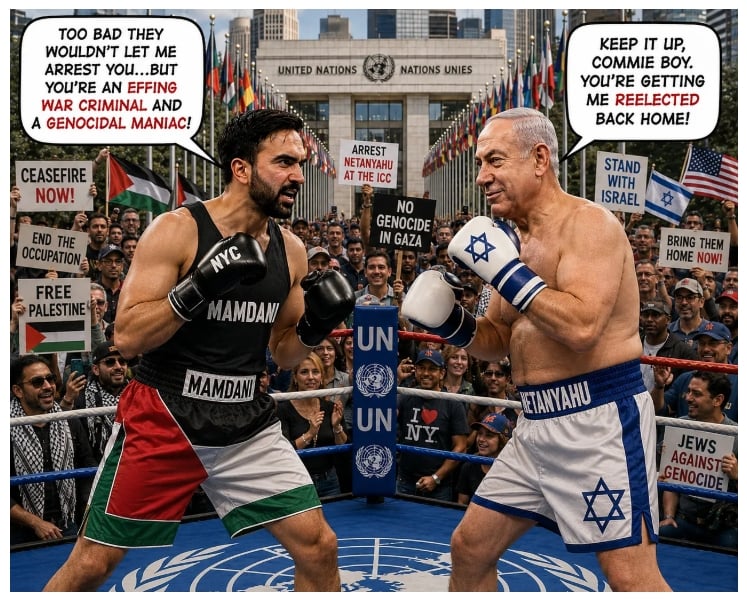
We have a perfect example in NYC Mayor Zohran Mamdani’s recent doubling down on an ICC-sanctioned arrest of Benjamin Netanyahu should the Israeli PM come to the UN this September.
This arrest is impossible and is no more than a publicity stunt by the Islamoleftist mayor. The ICC has no jurisdiction here. The U.S. never joined the 125 nations that have signed up with the court. It did the opposite, passing the American Servicemembers’ Protection Act to shield U.S. personnel from them.
In that spirit, President Trump responded to the New York mayor’s aforementioned grandstanding by stating on TruthSocial, “Benjamin Netanyahu will not be arrested, in any way, shape, or form, while in the United States of America.”
That this will shut up the New York mayor is doubtful, but it is good news since even attempting such an action would have created an international incident of untoward proportions. In fact, as I write this, via the Times of Israel, Mamdani has finally acknowledged he lacks “the independent legal authority” to arrest Netanyahu, although he, of course, still accuses the Israeli PM of being a “war criminal” and “the architect of a horrific genocide against the Palestinian people.”
All that predictable blather notwithstanding, why was the ICC established in the first place?
It’s something of a mystery. You could think of it as global virtue signaling gone berserk or, if you were being kind, deeply committed idealism in search of world peace.
Given the state of things, any worldwide court would have many potential war criminals to prosecute, so how do they select them, and, more importantly, who does the selecting? How is political bias avoided?
Their method runs through the Office of the Prosecutor (OTP) and uses something called the Principle of Complementarity, meaning the ICC only steps in if a country doesn’t act itself against its own people. This is all overseen by a group called the Assembly of States Parties (ASP), not to be confused (or maybe, as we shall see, it should be) with Iran’s Assembly of Experts.
The ICC seems addicted to gnomic bureaucratic terminology, as if out of Bertolt Brecht; only the German playwright was being sarcastic.
Nevertheless, the real power, the real selection of target miscreants, at the ICC seems to rest with the chief prosecutor. Lately, however, that has been a problem. He is under suspension, and whether he will be fired altogether is in the hands of the Assembly of States Parties.
The prosecutor in question is Karim Khan, a British lawyer, who was responsible for the arrest warrants against Netanyahu, his then Defense Minister Yoav Gallant, and, for equal opportunity, three now deceased Hamas leaders, Yahya Sinwar. Mohammed Deif and Ismail Haniyeh.
Why the suspension? Two women have accused Khan of sexual misconduct, some of the details of which can be read on Wikipedia. At least one of those allegations was made just two and a half weeks before Khan announced his arrest warrants against the Israeli leaders.
Khan, not surprisingly, has denied both allegations. We don’t know if there are more, but perhaps the Assembly of States Parties does.
Worth noting is that Karim’s brother, Imran Ahmad Khan, a Conservative Member of the British Parliament, was expelled from the party and Parliament when he was convicted of the sexual assault of a minor, for which he was sentenced to 18 months, but only served 9.
Khan family values do not make particularly good “optics,” as they say, for the International Criminal Court. Nevertheless, Karim Khan has his supporters. We will see how it all turns out when the Assembly meets at UN headquarters in New York on July 28. Or we won’t.
Ironically, since Karim K. is British, if it is shown he was fibbing about his private life, he and the entire ICC are subject to the famous common-law doctrine, Falsus in uno, falsus in omnibus. False in one thing, false in everything.
Meanwhile, as Israeli journalist Amit Segal and others have noted, Mamdani’s overstated attacks only serve to improve Netanyahu’s reelection chances.
First published in American Refugees