Kouri Richins Murdered Her Husband For Money
By Janice Fiamengo
And domestic violence activists have nothing to say

The case of Eric Richins, whose wife Kouri was recently convicted of his aggravated murder, is a case study of a man’s entrapment in an abusive and ultimately fatal marriage. Not surprisingly, however, his killing has not been discussed as an example of intimate-partner violence.
Hundreds of men—over one thousand in 2021—are murdered in the United States every year by their wives or girlfriends. But we are told repeatedly that because these murders are only a small percentage of domestic violence murders, they are of no importance.
Eric died in his bed on March 4, 2022, of a lethal dose of fentanyl that his wife Kouri had bought from her house-cleaner, Carmen Lauber. Eric was 39 years old, a successful businessman and father to three young boys. Kouri wanted Eric dead because she needed millions of dollars to save her house-flipping business, and killing him was the only way she could procure it. A pre-marital agreement had ruled out the usual method by which wives access husbands’ funds.

A year after Eric’s death, in 2023, Kouri promoted a children’s book, Are You With Me?, that told of how she was helping her sons grieve the loss of their father. It emerged later that she had hired a ghost-writer to put the book together, hoping to make money from it. She was charged with Eric’s murder two months after the book’s publication.
During her 2026 trial, prosecutors made the case that Kouri had unsuccessfully attempted to kill Eric a few weeks before his actual murder, on Valentine’s Day, 2022, by poisoning a sandwich she had bought for him, also using drugs obtained from her cleaner. When that attempt failed, she had asked her friend for stronger pills (“the Michael Jackson stuff”), claiming they were for a real estate client with back pain.
Various pieces of evidence, including the significant length of time it took Kouri to phone 911 after going into the room where Eric lay dead, her unwillingness to perform CPR (and subsequent lies about it), the many life insurance policies (totaling about $2 million) she had taken out on her husband without his knowledge, many other lies told to Eric and others, and the drastic indebtedness of her house-flipping business, pointed to her as the only viable suspect. She was having an affair with a man who worked for her, whom she had told she wished her husband gone.
She had likely been thinking about Eric’s death for some years.
A Black Widow
If Kouri had been killed by Eric, the usual narrative of gendered abuse, male violence, and women’s vulnerability in the home would almost certainly have been activated immediately. Feminist pundits would have spoken of how society failed an innocent woman; they would have outlined what might have been done to help her in escaping from her abuser. They would have emphasized that domestic violence is an unacceptable scourge.
But when it is a man murdered by a woman, the domestic abuse lobby goes silent—unless there are reasons to blacken the male victim’s name in order to excuse his killer. No domestic violence pundits lament the deaths of men killed by women. Most people have trouble believing that a woman can be a danger to those around them, and even when a woman shows herself a cold-blooded killer, people look for mitigating circumstances to excuse her.
The full picture of what happened to Eric Richins, and whether his death might have been prevented, may never be known. Kouri Richins continues to proclaim her innocence and is vowing to fight her conviction. It’s possible that her bid for a new trial will be successful.
From the little that is known now, it seems that Eric wouldn’t or couldn’t save himself from his wife because he couldn’t sacrifice his three sons to a self-aggrandizing and amoral woman willing to do nearly anything to get what she wanted. For years, it seems, Kouri got away with flagrant crimes because she was small and delicate-looking, and a persuasive advocate for her interests.
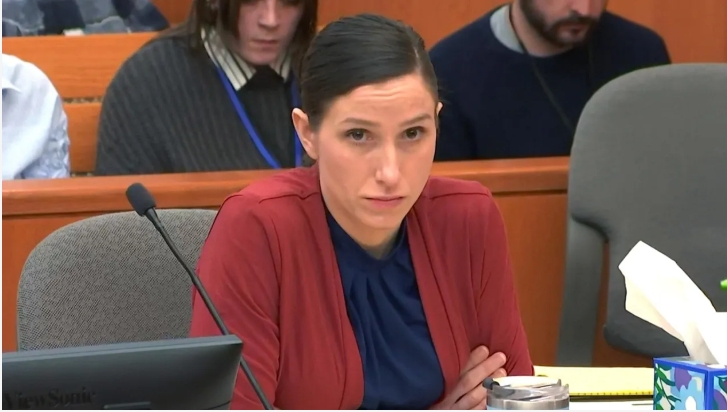
She sat through her trial with vivid facial expressions ranging from outraged disbelief to angry contempt, often staring balefully or smirking with performative disdain during testimony by former in-laws or statements by the prosecution or judge. It seems she could not or would not control her expressions for a sympathetic presentation. She has shown no sadness for her husband. The only time she shed tears was when her brothers paid tribute to her goodness in the pre-sentencing hearing.
Murder and attempted murder were not Kouri’s only crimes. She is charged with multiple counts of mortgage fraud, money laundering, issuing bad checks, forgery, communications fraud, and engaging in a pattern of unlawful activity. Part of the prosecution’s murder case involved a document Kouri wrote in jail (“Walk the Dog!”) in which she instructed her brother Ronnie to lie about her husband’s drug-taking and spoke of taking revenge against Eric’s sister Katie and her young daughters. Kouri’s former best friend testified that Kouri swindled her out of $45,000, leaving her penniless and homeless.
Like many manipulative women, Kouri appeared to act without empathy or conscience, and with ruthless determination.
Facts about Male Victims
Feminists like to emphasize the alleged disparity between female victims of intimate partner murder and male victims of intimate partner murder. They tell us that while men are the majority of homicide victims overall, women are the vast majority of intimate partner homicides.
But when one examines the numbers, the differences are not as stark as pundits stress. For example, a Bureau of Justice Statistics page on intimate-partner murder tells us that for the year 2021, “The percentage of females murdered by an intimate partner was 5 times higher than for males.” But speaking of percentages is misleading because there are so many more male victims of homicide generally than female victims of homicide. If one reads further, one can make a proper calculation:
“Of the estimated 4,970 female victims of murder and nonnegligent manslaughter in 2021, data reported by law enforcement agencies indicate that 34% were killed by an intimate partner. By comparison, about 6% of the 17,970 males murdered that year were victims of intimate partner homicide.”
According to these numbers, 1689 women were murdered by their intimate partners in 2021; while 1078 men were murdered by their intimate partners. The discrepancy no longer seems remarkable. Why should we minimize more than 1000 men dead in one year at the hands of their intimate partners simply because a larger percentage of men were killed by strangers, acquaintances, or other family members?
The Child Custody Trap
Eric Richins’ murder was a sensational instance of a crime that, as the above numbers indicate, is far from uncommon, yet is rarely lamented or even noticed.
Men who have reason to fear their wives or girlfriends have few sources of aid. A man who complains about his wife’s viciousness is usually considered a fabulist at best—or, more likely, an abuser himself. If he goes to the police or child welfare agencies about his concerns, he is likely to find himself in jail or undergoing a psychiatric assessment. His wife will almost certainly claim that he is the one endangering his family. He may find himself facing criminal charges and denied contact with his children.
His wife, on the other hand, will be largely insulated from suspicion and given plenty of opportunity to imagine herself a victim.
A writing sample by Kouri Richins, a mini life history, from a women’s retreat she attended in 2021, about a year before she killed Eric, showed her sense of grievance. She had married Eric, seemingly without loving him, in order to have what she had never achieved as a child: family stability and wealth.
She had grown up with a gambling-addict for a mother, who had divorced her alcoholic father (in prison for hitting a police officer with his car while drunk driving) when Kouri was a child. Eric seemed to offer the security and status she longed for. He had a successful stonemasonry business and came from a good family. He was ambitious and hard working. Together, they had three sons in quick succession.
But Kouri found that she wasn’t happy. She wasn’t happy being married, and she wasn’t happy being a mother. Eric apparently wasn’t pleased with her either; he had told her she was selfish. He had had what she called “an emotional affair.” He had also discovered that, over the years, she had stolen hundreds of thousands of dollars from him.
The only thing that seemed to provide satisfaction to Kouri was her real estate business, in which she bought and re-sold homes, eventually owning multiple properties in wealthy neighborhoods where she had once worked as a cleaner. But there was trouble here too because she had taken on far too much debt. Ridding herself of Eric seemed the surest route to freedom and wealth.
It’s not clear when Eric first realized that there was something seriously wrong with his wife. Like most men married to horrors, he was tight-lipped about his plight. He did not proclaim himself a victim. He built his business and took THC gummies to help him sleep at night.

But he did begin to take some action against Kouri. In 2020, after learning that his wife had taken out a $250,000 home equity line of credit on his house without his knowledge, he talked to a lawyer about a divorce, but he did not proceed. Even with evidence of her lies, financial double-dealing, and recklessness, he would never be able to convince a family court judge that Kouri was a danger to her sons, and he did not want to leave them in Kouri’s care even part- time.
He began to take steps to protect them in the event of his death, perhaps expecting that he would not survive the marriage. His sister Amy told police of his belief that Kouri would kill him. He created a living trust to protect his assets from Kouri, with his sister Katie as trustee, making sure that his money would be kept safe for his sons.
Katie said she begged her brother to divorce Kouri when he told her what he was doing. She quoted him that he would “live his life through hell every single day of his life until his youngest was 18 because he believed Kouri was the most evil person he had ever met.”
Eric’s concerns were partially realized. His three boys reported neglect, shaming, and abuse while they were living with their mother after their dad was killed. “You took away my dad for no other reason than greed,” wrote one in his victim impact statement, “and you only cared about yourself and your stupid boyfriends.”
The boys wrote that Kouri frequently locked them in their room or in the basement. She neglected their pets, many of which died due to inadequate care: rabbits and chickens froze to death; goats died without sufficient food and water; a kitten was left out at night to be killed by raccoons; the family dog was not allowed to be taken for walks and would be beaten by Kouri if he peed in the house; Kouri threatened to kill her son’s lizard because the son wouldn’t do something she wanted.
The boys’ victim impact statements paint a portrait of a raging woman indifferent to her children’s well-being; she even taunted one of them by saying he might die if he slept on his dad’s side of the bed. “I do not want you out of jail because I will not feel safe if you are out,” the child wrote. “You have never said sorry for anything you have done to me and my brothers.”
Most people, propagandized by our feminist and gynocentric culture, will continue to believe that women like Kouri are one in a million. But they are not. Other grisly cases of women who murdered husbands in cold blood can be found here, here, here, here, here, here, here, and here.
**
I am surprised that Kouri didn’t save herself from a long prison term by concocting a battered woman defense, which might well have convinced some jurors (or at least one) that she was acting under duress. She might have claimed to have been terrorized by Eric—threatened, bullied, psychologically victimized—claims that worked well for multiple-sex-murderer Karla Homolka, would-be killer Nicole Doucet, and convicted husband-killer Sally Challen.
Feminist advocates would have rallied to Kouri’s side, telling sad stories about female fear and desperation. Such advocates have often defended female killers to save them from prison time. With feminist help and public sympathy, Kouri might be free today, preparing to write another book about surviving trauma. She might devote herself to advocating for other female “victims,” as Lorena Bobbitt did. She might be living with her boys, seeing her new lover, and deciding what to do with the life insurance money.
Perhaps in her arrogance she did not realize where her advantage lay.
Fortunately, most sociopathic women do not murder their husbands, but they often in one way or another make their lives the living hell that Eric named. Our system regularly fails men who find themselves married to such women.
The truth is that we are comfortable with the fiction that only men cause harm. For the most part, we are even comfortable with the harm that women do, as is proved by our abundant willingness to do nothing about it.
Eric didn’t expect otherwise, and neither, alas, will most men who walk the same bitter, hazardous path.
First published in the Fiamengo File