Mamdani’s America, Land of the Hyperreal
By Roger L Simon
Christopher Rufo has another of his compelling articles this post-election morning (Nov 5): “What Everyone Misses About Nick Fuentes”.
I’m not sure everyone does, but Rufo expresses with great clarity what is going on in our society, which, in essence, is turning our constitutional republic into a farce. I would like to further elaborate on this here.
Rufo makes the following point about the outrageous views of Nick Fuentes, and the uproar stemming from his being platformed by Tucker Carlson, that has been dominating the ever-more-tedious X:
“Both sides fail to understand the Nick Fuentes phenomenon. They take his statements seriously and engage with them in good faith. But Fuentes’s stated beliefs, while abhorrent, are not best parried by taking them at face value. Instead, the Right should consider him an actor in what postmodern theorist Jean Baudrillard called ‘hyperreality’: a system in which the simulation of reality comes to replace reality itself.
“Under conditions of hyperreality, symbols of past phenomena lose their original meaning. Emptied out, they then circulate through digital media, where they drive the discourse and, while purely derivative, still spark real emotional involvement. In this way, the hyperreal becomes ‘more real than real,’ masking the true nature of reality.”
More real than real, indeed. This phenomenon is pervasive and has progressed to such an extent that recalling what reality actually is has become an arduous task.
We can be grateful to Fuentes for being so extreme in his adoration of Hitler and Stalin as to call attention to what is going on because he has many brothers and sisters in hyperreality on all sides.
To name just a few, we have, on the right, besides Fuentes, Candace Owens, Steve “Third Term” Bannon, and Carlson himself, who now embraces Sharia law; on the left, AOC, Jasmine Crockett, Bernie Sanders, and now Zohran Mamdani.
There are, of course, many others. The entire world of punditry is arguably hyperreal, given the disconnect between the endless pronouncements and what is actually occurring—ditto for academia.
The Mamadani victory was, in a sense, the apotheosis of this phenomenon. His victory speech was a masterpiece of hypperality with one promise after the other asserted in a manner reminiscent of the famous dictators of the past. He did this in a style that was grim, determined, hyperreal. I thought of Mussolini.
Did he know that most of these promises were impossible to achieve, that they would never happen? It didn’t matter. The performance was all.
Interestingly, many of his supporters, when interviewed, acknowledged their doubts that the new New York mayor would be able to succeed with many of these same pledges, but they didn’t care. They supported him anyway, knowing they were voting for something that wasn’t true, already comfortable living in the world of the hyperreal.
Obviously, it didn’t hurt that Mamdani was running against two of the most useless opponents imaginable. But that New York could elect their first Muslim mayor—a man who seemed more concerned about “Islamophobia” toward his “aunt” than 9/11 itself, only 24 years after the murderous act of mass terror—speaks of hyperreality taken to the nth power.
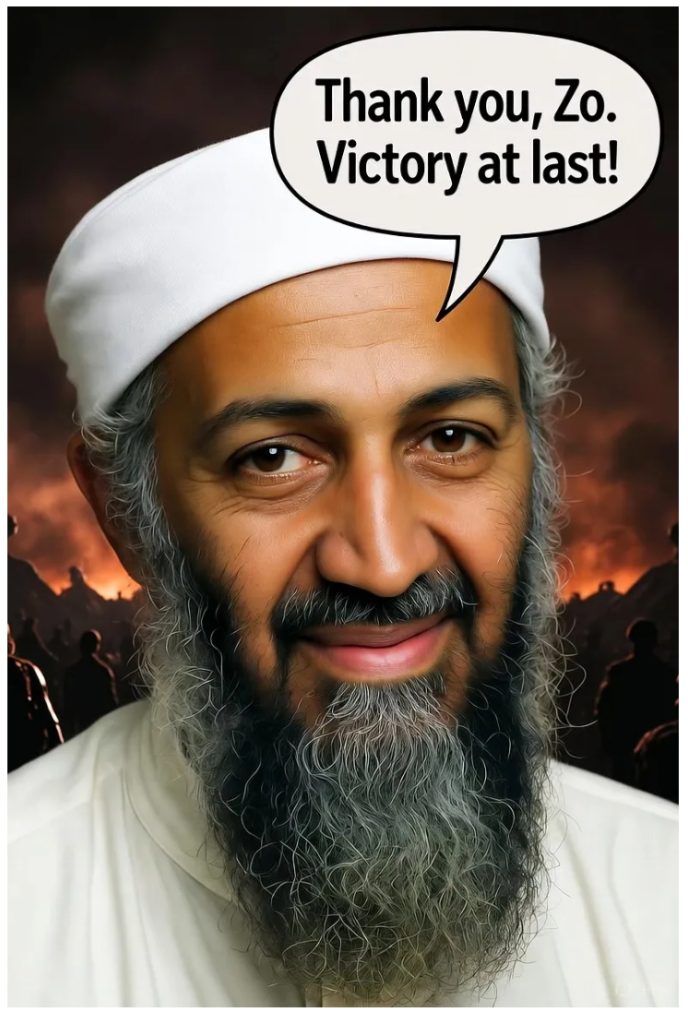
It also speaks of a posthumous victory for Osama bin Laden. That, sadly, is very real.
First published in American Refugees