Our Self-Colonized Nation
By Glenn Harla Reynolds
“Every successful system accumulates parasites.” That statement, quoted in Kevin Kelly’s Out of Control, was proposed as a law of nature by evolutionary biologist Thomas Ray back in the 1980s.
This is how we know that America is a very successful system indeed. But every system has a limit to how heavy a parasite load it can carry, and I think we’ve reached ours.
One often sees graphics like this:
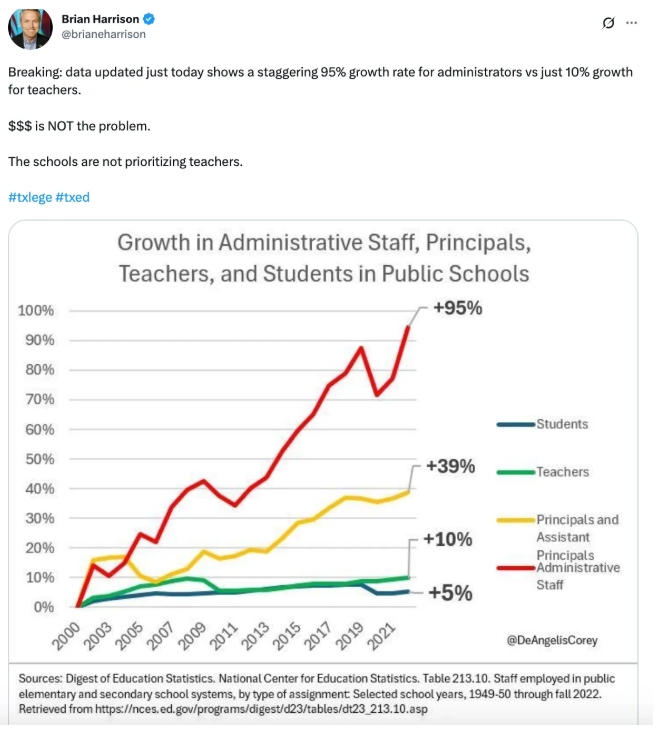 They’re shocking, and yet not really because everyone knows it’s true, and you see it everywhere. For example:

No one believes that all these administrators create value commensurate with their numbers. Mostly they’re a drain on productivity.
These administrative jobs exist not because they add value, but because of politics (political machines need supporters on the government payroll, because those supporters’ jobs give them an incentive to vote even in low-turnout elections), because of regulatory pressure (often designed to increase administrative payrolls) and because of bureaucratic empire-building. Whether in government or corporate bureaucracy, having more people report to you makes you more important, and often more influential.
When it comes to the operation of government, though, there is a second level of parasitism. Once the government became big, and rich, and prone to handing out cash on the one hand, and interfering in everyone’s business on the other, it created whole industries dedicated to influencing its operations. How much growth? It’s huge, but hard to measure. Some might, as Jeff Bezos did, buy the Washington Post for political influence and, more importantly, protection. Many (most) nonprofits and NGOs exist for the purpose of influencing the government, as do Political Action Committees, public-employee unions, and the like.
But just picking two core measures, lawyers and lobbyists in Washington, D.C., the trend is ever-upward. Graphic generated by Grok, using BLS statistics:

- Lawyers (blue line, left axis): Steady, long-term growth since the 1970s, reflecting the expansion of the federal government, regulatory state, and legal services in the capital region. From ~16,000 in 1970 to nearly 49,000 recently.
- Lobbyists (red line, right axis): Shorter modern series (consistent data from 1998 onward). Sharp rise in the mid-2000s, peak around 2008, dip post-financial crisis, and recent rebound.
- Both professions have grown significantly over decades, but lawyers show smoother, more consistent expansion while lobbyist numbers are more cyclical (tied to major legislation, elections, and economic events).
Bottom line: Fast growth. Hey, when it’s raining goverment-money soup, you’d be a fool not to bring a bucket. And that goes way beyond the lawyers and lobbyists, they’re just an indication of the trend.
Now a certain amount of that is to be expected, and goes back to the early days of the Republic, when Presidents and Senators had to put up with regular visits by “office-seekers” — people seeking cushy government-job appointments, which in those days usually involved the Post Office, for the simple reason that it was the most-populous government operation.
But now whole sectors of the economy depend on government money. President Trump’s abolition of USAID cost thousands of phony-baloney jobs. The New York Times recently ran a tear-jerker piece on how people who lost cushy NGO positions funded by USAID money haven’t been able to obtain comparable private sector employment. “Sheryl Cowan, 57, was making $272,000 a year as a senior VP at a U.S.A.I.D.-funded nonprofit when she was let go at the end of March 2025. Last month she had an online interview for a $19-an-hour job managing a Penzeys Spices store in Falls Church, Va.” (Her husband also lost his job running a nonprofit that was 100% funded by U.S.A.I.D. My take: If your nonprofit or NGO goes out of business without government money, it’s just an arm of the government seeking deniability. And freedom from government pay scales!)
These victims receive a lot more compassion than the laid off coal miners and steelworkers who were dismissively told to “learn to code” a few years ago. But someone whose labor is valued at $19 an hour in the private sector who can make well over a quarter million a year is doing better than any 19th Century assistant postmaster in the cushy-job department.
Even the sympathetic Times piece acknowledges: “Others acknowledged that there was bloat and waste in the agency and a need for reform. Much of the $35 billion it managed in 2024 went to Washington-based contractors, not directly to people in need overseas. The success of many projects was hard to measure.”
First published in Glenns Substack