Restoring Canada Special Series Part III: National Sovereignty in the Age of Mass Migration
By Patrick Keeney
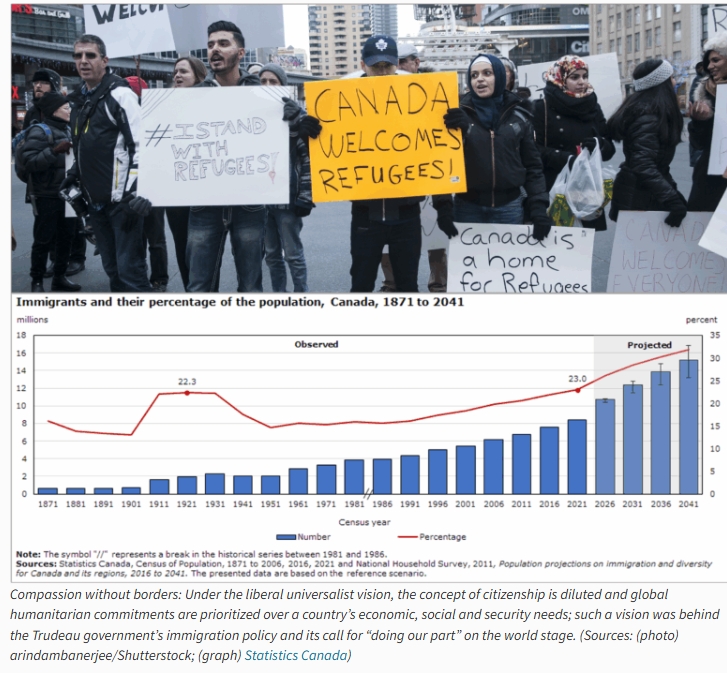
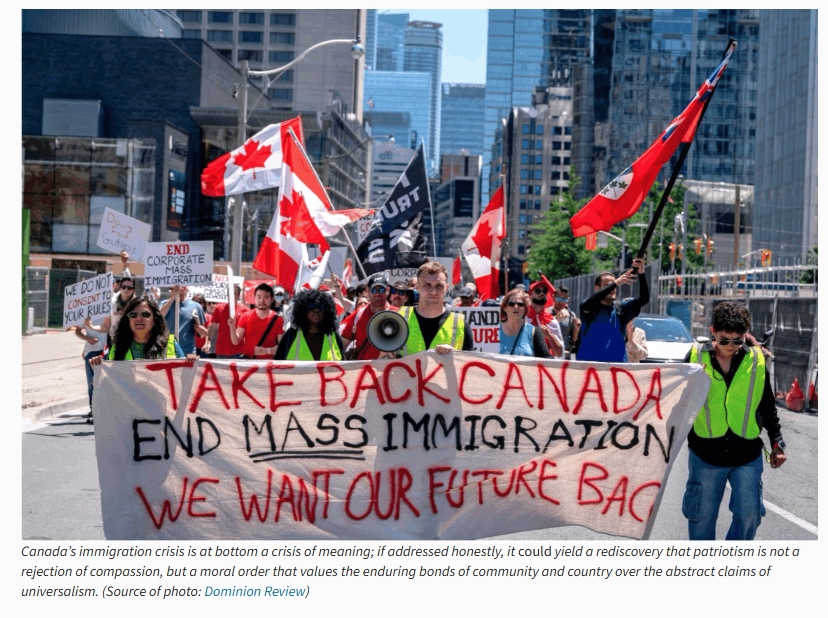
Canada is undergoing one of the most radical demographic experiments in the Western world. In 2023 the country admitted 1.25 million newcomers, the highest number in its history, pushing the total population over 40 million. Underscoring the scale of this transformation, immigration now accounts for 98 percent of Canada’s population growth. This is not a temporary surge but a deliberate government strategy that gathered momentum throughout the Justin Trudeau era. In response to mounting public pushback, his Liberal government last year issued a smokescreen of grandiose pronouncements that masked a meagre underlying promise to “stabilize” Canada’s population growth – while maintaining a target of 500,000 new permanent residents per year, plus hundreds of thousands of temporary foreign workers and international students.
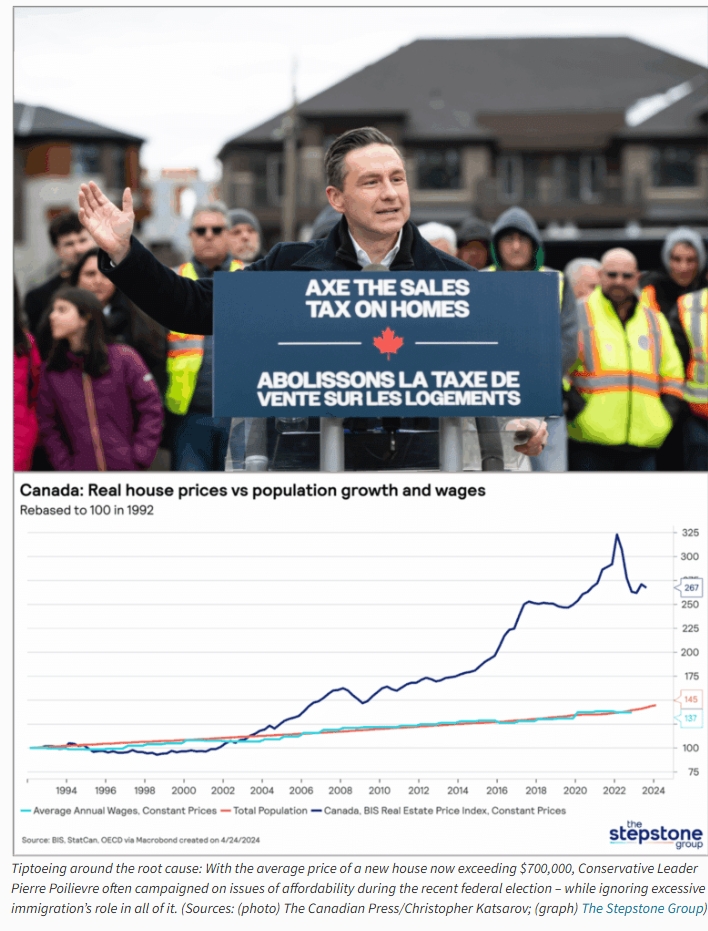
The negative consequences to life in Canada have been glaring. Housing grows ever-less affordable, particularly in major urban centres like Toronto, Vancouver and Montreal, where surging demand gallops away from puny supply additions. The average cost of a home in Canada has soared past $700,000, effectively pricing out most young working families and first-time buyers. Even rental markets are being squeezed beyond sustainability, with vacancy rates in major cities hovering near historic lows. In Toronto, average rent for a one-bedroom apartment exceeds $2,500 per month. Healthcare systems, already strained, are buckling under the weight of rapid population growth, with waiting times for non-emergency surgery often stretching into years. Public infrastructure like roads, public transit and schools has not kept pace, eroding Canadians’ quality of life.

Economically the situation is equally troubling. While Canada’s GDP continues to (just barely) expand, this is driven entirely by increasing population. GDP per capita – a much more insightful measure of how a nation’s people are doing – has been declining for years. So even as the country’s headline economic figures are propped up by immigration, Canadians themselves are becoming poorer. As the Bank of Canada notes, this is linked to stagnation in labour productivity, largely caused by declining capital investment but exacerbated by an influx of low-wage workers in sectors like retail and hospitality. Meanwhile, inflation continues to erode purchasing power and the cost-of-living crisis plagues millions. And then there is continuing urban decay and surging crime, exacerbated by Canada’s ever-lighter vetting of incoming migrants – including from hotbeds of terrorism like Gaza.
Political acknowledgement of immigration’s role in these problems remains decidedly muted. Federal Conservative Leader Pierre Poilievre campaigned vigorously during the recent election campaign on inflation, housing costs and the decline in Canada’s standard of living. His rhetoric doubtlessly resonated with a working-age middle class and younger voters who feel abandoned by elites. Yet on the immigration file, Poilievre tiptoed as if picking his way through a minefield. The party’s campaign platform acknowledged the housing crisis but avoided directly linking it to immigration levels. Instead, Poilievre focused on bureaucratic inefficiencies and tax policies, sidestepping one of the root issues. Why?
The answer, I suggest, is not merely political but philosophical. Among Canadian elites – on both the left and the right – immigration has become a kind of secular virtue, an unquestioned good that transcends debate. To question it, even modestly, is to risk moral excommunication. Canadians have been fed the mantra that “diversity is our strength.” The progressive left frames any critique as racism, xenophobia or white nationalism; the corporate right views immigration as a driver of economic growth and disregards its social costs. Even many conservatives, while eager to pose as defenders of the forgotten Canadian middle class, are hesitant to challenge the dogma that the more open we are to the world, the more virtuous we become.
This silence betrays a deeper unease – an ambient confusion, even a kind of moral embarrassment – about what a nation truly is and what it means to belong to one. It reflects a reluctance to articulate, let alone defend, the idea that national identity entails more than administrative citizenship, that it carries with it bonds of memory, mutual obligation and shared destiny. It also reflects a failure to confront the moral and philosophical foundations of national identity. To understand this crisis, for that is what I believe it is, we must turn to the roots of our predicament – not in policy papers or economic data – but in the competing visions of human belonging that shape our politics.
The Ascent of Liberal Universalism
At the heart of the immigration debate lie two contrasting visions of the moral order: one universalist, liberal and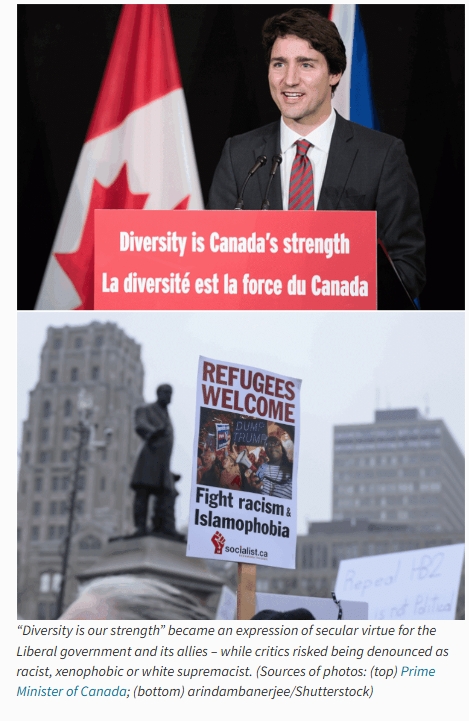 abstract, the other particularist, conservative and rooted. These visions are not merely academic; they influence how we think about obligation, community and the purpose of the nation-state.
The liberal universalist vision (which can also be described as cosmopolitan or globalist) is dominant in Canada’s elite institutions: universities, media, government, NGOs and many corporations. It views human beings primarily as bearers of rights and consumers of things, detached from place, history or culture. From this perspective, compassion must be borderless and justice requires an impartial and equal concern for all persons, regardless of citizenship or proximity. In this view, the nation is little more than a legal construct, a container for administering universal principles; certainly, it is something less than entirely sovereign.
It is not hard to see how such an outlook renders preferring one’s own countrymen over strangers morally suspect, a form of chauvinism, a jarring and almost bizarre double-standard. This worldview underpins much of Canada’s recent immigration policy, one that has increasingly prioritized global humanitarian commitments over the country’s economic, social and security needs. This is why Trudeau’s government framed high immigration levels as a moral imperative, a way for our “post-national state” to “do our part” on the world stage.
Beneath this policy framework lies a profound metaphysical conviction, one rarely articulated but widely assumed. It conflates the universality of human dignity (a Christian concept, one that I consider both legitimate and central to the Western conception of humanity) with the feeling that it therefore follows that people are abstract and interchangeable – detached from the specificities of history, culture and community.
Rooted in Enlightenment-era universalism, this view regards the individual as existing prior to and independent of all cultural, historical, or communal ties. From this abstraction, liberalism determines that distinctions of nation, kinship and cultural inheritance are at best arbitrary and, more often, unjust. Love of one’s own is no longer regarded as a natural and noble form of human attachment, but as a moral defect that requires correction.
The Conservative Alternative
In contrast, the conservative-communitarian tradition asserts that we are not disembodied agents of reason; we are beings shaped by particular loyalties, customs and traditions. Accordingly, love and obligation flow outward from the near to the far: from family to neighbour to nation to humanity. We develop our caring for the wider world not by negating these natural loyalties but by affirming them. The love of one’s own is not a moral failure; it is the seedbed of all moral development. This perspective views the nation not as an arbitrary and ultimately dispensable construct but as a moral community, bound by shared history, culture and mutual obligations.
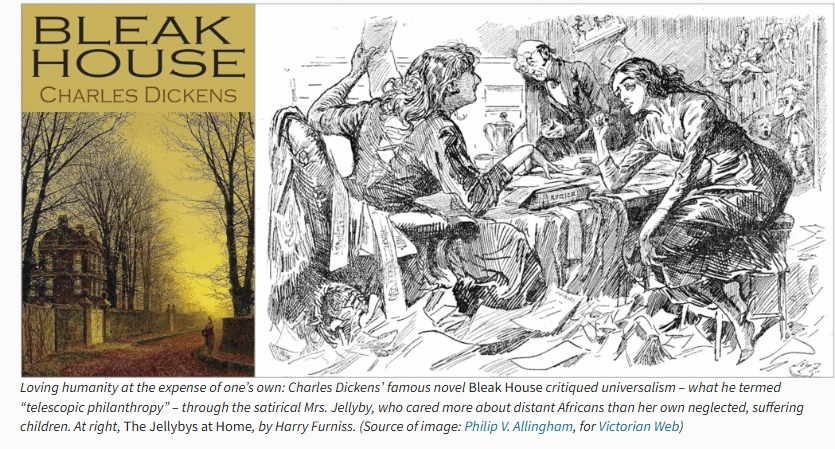
Charles Dickens made a similar point in his novel Bleak House through the satirical Mrs. Jellyby, whose “telescopic philanthropy” extended compassion to the distant peoples of Africa while her own children and neighbours languished in neglect.
Just as a father who treated his own children no differently from complete strangers would be rightly judged morally derelict, so too should be a nation that fails to prioritize the good of its own people. Vance’s Munich speech emphasized the primacy of national cohesion and the duty to care for one’s own. To love rightly, Vance argues, is not to love indiscriminately, in some flattened, universalist fashion, but to acknowledge a hierarchy of moral obligation grounded in closeness, kinship and civic belonging.
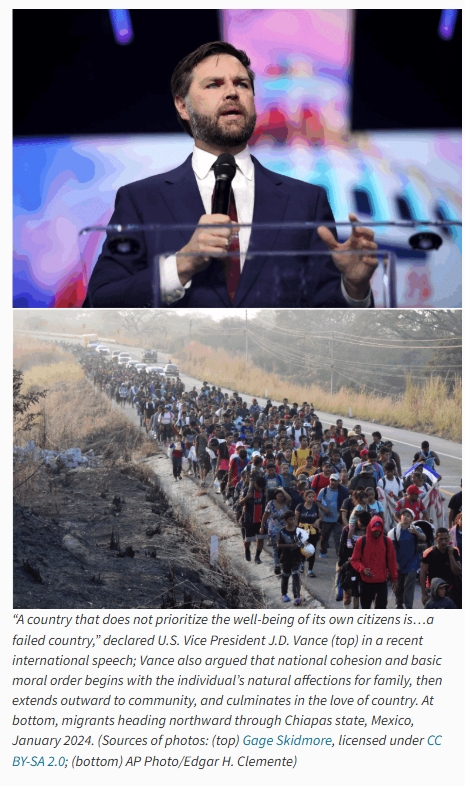 This affirmation of graded moral obligation elicited a swift rebuke from cosmopolitan quarters, most notably former UK MP Rory Stewart, who on his popular podcast “The Rest is Politics” dismissed Vance’s remarks as a retreat into parochialism. Yet in doing so, Stewart laid bare the sentimental confusion at the heart of liberal cosmopolitanism: it mistakes the universality of fundamental human dignity for the erasure of particular loyalties. Stewart appeals to the abstract duties of global citizenship, whereas Vance stands firmly within the older tradition of moral realism, which begins with his natural affections as a husband and father, extends through the bonds of community, and culminates in the love of country.
The contrast is telling. Canadians have long struggled to reconcile their humanitarian impulses with their responsibilities as stewards of a unique, historical political community. We pride ourselves on our kindness, openness and soft-power decency, but these virtues become vices when they are severed from the rootedness of civic love and extend outward in all directions. The ordo amoris may jar polite Canadian ears, trained and subdued by decades of multicultural idealism. Still, it names a truth we neglect at our peril: that moral seriousness begins with loyalty, with loving rightly those who are ours to love. To invert that order is not compassion, it is dereliction.
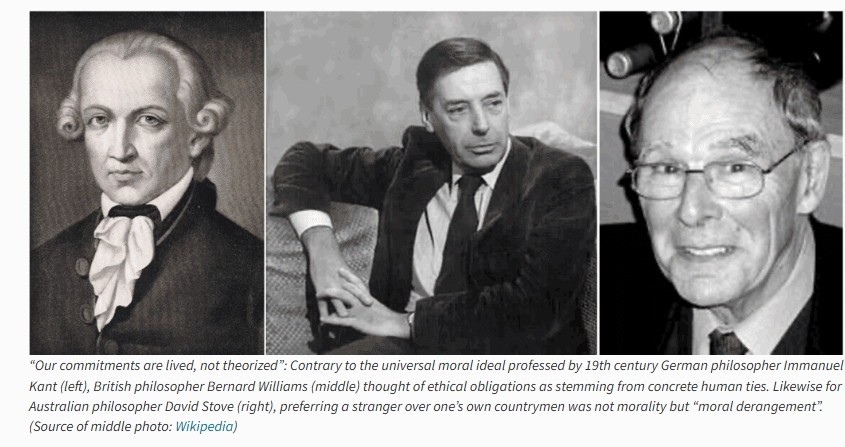
Though not a conservative, the distinguished British philosopher Bernard Williams recognized the limits of cosmopolitan abstraction. In his 1985 book, Ethics and the Limits of Philosophy, Williams reminded us that any credible moral philosophy must contend with the concrete realities of human attachment. He was deeply skeptical of the ideal of a universal moral law propounded by 19th-century German philosopher Immanuel Kant, which seeks to untether ethical obligation from the particularities of personal relationships. Such an ideal, Williams argued, places an impossible demand on moral agents, one that overlooks the densely woven ties that bind us to those we love. To ask a father to regard his child and a stranger with equal concern is, for Williams, not the apotheosis of rational ethics but a fundamental misunderstanding of human nature.
Prioritizing the needs of distant strangers – recall the “telescopic philanthropy” of Dickens’ Mrs. Jellyby – over those of one’s fellow citizens is not, as our political class would have it, the peak of moral enlightenment; rather, it is the abdication of the responsibilities that make moral life possible. Such a stance reflects not compassion and generosity but forgetfulness: forgetfulness of the fragile bonds that sustain our civic life and the quiet duties we owe one another. In the name of unlimited kindness, we risk dissolving the forms of life that make kindness more than sentiment. At stake is more than simply a policy debate, but a philosophical one: What does it mean to belong? What do we owe, and to whom? If the answer is to be serious, it must begin in the ordered loves that bind us to home, history and each other.
First published in C2C Journal