RFK Jr can be a crank, but he’s not wrong about Lyme disease
By Theodore Dalrymple
When a man is known as a crank, it is all too easy to dismiss his every subsequent idea or utterance. Robert F Kennedy Jr, the US secretary of health and human services, once propounded the theory that the causative organism of Lyme disease was bioengineered for military purposes. But that does not mean that his decision to devote millions of dollars of research into methods of controlling the ticks that spread the disease is absurd.
Some people hold the idea that Lyme disease is not a disease at all, more imaginary than real, because its symptoms are often vague, occult and long-lasting, even after treatment, but they are mistaken.
The disease is highly prevalent in the US, particularly in the North East of the country, and last year 460,000 people were treated for it. This does not mean that they all suffered from Lyme; cases proven by laboratory testing were only about 90,000. By contrast in Britain in 2024 there were 1,581 proven cases.
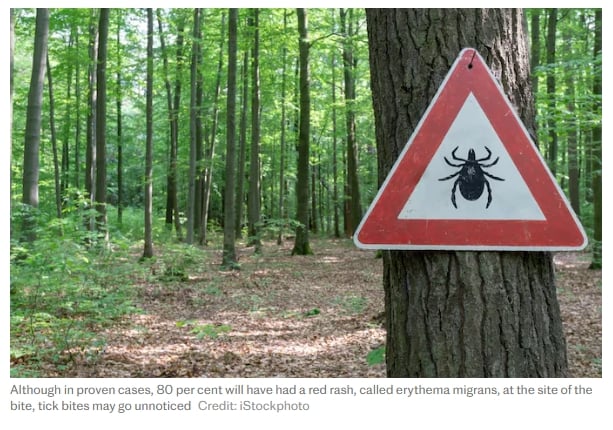
The true number of cases is difficult to assess. Some people who are treated for Lyme disease do not have it, and others who have it are neither diagnosed nor treated. The reasons for this are manifold. Although in proven cases, 80 per cent will have had a red rash, called erythema migrans, at the site of the bite, tick bites may go unnoticed.
The symptoms of the disease, such as fever, aches, pains, arthritis and tiredness, which may occur long after exposure, are non-specific, and if not diagnosed and treated, the disease can continue for years. Moreover, while treatment with antibiotics such as tetracycline is usually effective, it is not invariably so.
In Britain, cases are concentrated in areas like the New Forest, Wiltshire and some parts of Norfolk, but that does not mean that they cannot occur elsewhere: anywhere, in fact, where there are deer.
How concerned or worried about Lyme disease should we be? A warming climate will make it more prevalent, but we are unlikely to reach American levels of prevalence, if for no other reason than that we are more urbanised, our population is denser, and our contact with areas in which deer roam is much less.
But it is not always easy to align one’s anxiety with objective risk: or rather, it is impossible for humans to do so. We are not statistic-calculating machines.
I was bitten by a tick in France, where I lay down in the grass to read and sleep. Some time later, I noticed a tick feeding on my ankle.
What should I do? I knew that Lyme disease was insidious and often not diagnosed for weeks, months or even years. I knew an expert and consulted him by telephone. Should I take tetracycline prophylactically, I asked him, to prevent Lyme disease from developing before it even started?
No, was his answer, it was not necessary. Most tick bites are not followed by Lyme disease, he said, and the adult tick that had bitten me was in any case much less likely to pass it on than ticks at an earlier stage of their life. I thanked the expert for his advice and did not follow it: I took the tetracycline for a week anyway. I think I had already made up my mind.
My reasoning was as follows: if I took the tetracycline unnecessarily, I would do myself no harm (I had taken it before without ill-effect), whereas if I did not take it and I were the one in a hundred in these circumstances who contracted the disease, I might suffer severe adverse consequences, which, in say one in 20 cases, would not be reparable. It followed from this that I should take the tetracycline.
Was I right? The one in 2,000 chance that I would come to harm if I did not take the tetracycline acted far more powerfully on my imagination than the one thousand nine hundred and ninety-nine in two thousand chance that no long-term harm would come to me if I did not take the tetracycline. And after all, I have survived to tell the tale, so my decision (I falsely tell myself) was correct.
Better safe than sorry: we often tell ourselves that, avoiding remote dangers while courting or not noticing much nearer ones. It is difficult – actually, impossible – to get everything exactly in proportion and act accordingly.
First published in the Telegraph