The Fall of Tariq
The rise and ruin of the West’s favorite Islamist intellectual.
By Bruce Bawer
For a while he was riding high. As I wrote two decades ago in my book While Europe Slept, “Tariq Ramadan is widely seen as the leading voice of European Islam, a bridge between European Muslims and non-Muslims, and the prophet and potential architect of a ‘Euro-Islam’ that would involve a compromise of values on the part of both Muslims and non-Muslims in Europe.”
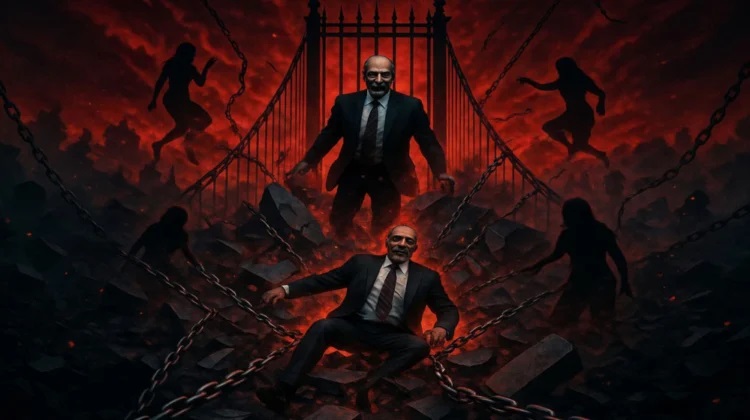
The year was 2006. Back then, there was a lot of talk about bridge-building. While admitting that Islam presented a serious challenge to Western values, many men and women in the West’s corridors of power insisted that there were, here and there in the Western world, intelligent Muslim leaders who loved peace, who preached brotherhood, and who could help bring Westerners and Muslims into harmony.
And nobody embodied that naive hope more than Tariq Ramadan, who was born in Switzerland, who was fluent in French, English, and Arabic, and dressed as if he’d just come straight from Savile Row. Oh, and he was the grandson of the founder of the Muslim Brotherhood.
Granted, by 2006 he’d been denied entry to both America and France because of his purported terrorist ties – but he’d also been chosen by Tony Blair to sit on a British government panel tasked with curbing Muslim violence, and hired in 2005 to teach at Oxford. Indeed, by the time I’d published Surrender, my follow-up to While Europe Slept, in 2009, Ramadan’s star had definitely risen, at least in the U.S., where his visa was restored to him in that year after a lengthy court battle. He was already a familiar name in Europe, but now he was out to conquer the States.
And it worked, to an extent. In previous decades, the New York Times had given hefty PR boosts to both Stalin and Castro. In much the same spirit, on February 4, 2007, the Times ran a glowing profile of Ramadan by the Dutch journalist Ian Buruma, who at that juncture was something of a darling of the New York intellectual scene. A few months earlier, Buruma had published Murder in Amsterdam, an appalling little book in which he smeared the martyred Islam critics Pim Fortuyn and Theo van Gogh for failing to share his view that the West should trade away a degree of its freedom in exchange for some semblance of peaceful coexistence with Islam.
And in Buruma’s view, nobody was better suited to establish this new settlement than Ramadan. For Buruma, Ramadan was “an Islamic superstar,” culturally European and spiritually Muslim, who was uniquely qualified to unite people with different worldviews.
But what, I asked in Surrender, were those worldviews? Buruma surely knew the truth, but did a brilliant job of whitewashing it. He acknowledged Ramadan’s enthusiasm for Islamic war against the capitalist West, but did so (as I put it) in such “careful, muted language” that you could easily think Buruma was describing something far tamer. Buruma cited Ramadan’s conviction that Islam is justice – but omitted to mention that in Ramadan’s eyes, justice meant sharia law, period.
Buruma also feigned confusion about Ramadan’s attitude toward women, even though the author Caroline Fourest had written a tour de force, Frère Tariq (2006), in which she documented his stone-age prejudices on that front – and, for good matter, illustrated at length Ramadan’s consistent practice of saying one thing to Arabic-speaking audiences and another to English and French speakers, a ruse Buruma chose to ignore.
Buruma wasn’t the only high-profile member of the Western intelligentsia to whitewash Ramadan at around that time. So did Mark Lilla of Columbia University and Timothy Garton Ash of Oxford, among others. And the Times wasn’t through doing its own part. On January 6, 2008, the New York Times Book Review ran a piece by Ramadan that bore no resemblance to anything that had ever appeared previously in that publication. It was entitled “Reading the Koran,” and instead of examining the scores of troubling passages in that vile volume that command the subordination of women and the murder of Jews, Ramadan coughed up 2500 words of vacuous gush: in Islam’s holy book, he oozed, “God beckons us with the simplicity of his closeness….God responds to whoever comes to his Word.”
What’s new with the prophet of “Euro-Islam”? Well, it turns out his luck has finally run out. And the reason is that most challenging topic of all for Westerners who fantasize about an accommodation with Islam: women. In 2012, you see, Ramadan was accused of assaulting a woman at a Holiday Inn in Paris. As I commented about this story in 2017: “I’m shocked. No, not that Tariq Ramadan may have raped somebody. I’m shocked that there’s a Holiday Inn in Paris.” (Why should anyone ever be shocked that a devout follower of the Koran actually believes what it says about the sexual rights of men?)
In 2024, Ramadan was convicted by a Swiss court of raping a woman in Geneva – one of several accusers who said he’d seduced them in that city when they were his teenage pupils. Now, a Paris court has sentenced Ramadan to eighteen years behind bars for raping three women in France. Ramadan, who fled that country during trial, is now in Switzerland, which, as it happens, does not have an extradition treaty with France. So he’s safe for the time being, unless some other Swiss victims step forward.
The Paris verdict was actually handed down in March, but I only became aware of it the other day. As Douglas Murray writes in his own account of Ramadan’s rise and fall, “There has been so much news of late that stories which might once have caused a splash have sailed by all but unnoticed.”
He’s right, of course. Besides, Ramadan is no longer the marquee name he once was. Time has moved on, and as the hold of Islam on Western Europe has strengthened steadily, the dream of “Euro-Islam” has become a quaint memory, evoking a time when a surprising number of starry-eyed Westerners spoke excitedly about a grand “compromise” with Islam.
Many of them have since learned that it’s in the nature of Islam never to be satisfied with compromise – a realization that has (a) led governments such as Keir Starmer’s to capitulate with a degree of cowardice that would have been inconceivable a few years ago and (b) bolstered the forces of resistance, such as Tommy Robinson, in a way that also would have have been beyond imagining until recently.
And this is why Ramadan’s disgrace should not go unnoticed: not only because this hollow hero has been exposed, but also because a long line of political, academic, and cultural luminaries – who were ready to trade away individual liberty, sexual equality, and church-state separation in exchange for Ramadan’s glib, vague promises – deserve to be remembered for their cravenness, to share in this hustler’s well-deserved iniquity, and to serve as models of shame whom solid citizens should contemplate with disgust as they participate in the noble, if perhaps quixotic, struggle to save civilization from Ramadan’s dreadful creed.
First published in Front Page Magazine