The NGO Network Driving Antisemitism in Canada
Posted by Geoffrey Clarfield
Canada just voted in the UN to recognize “the state of Palestine.” They make it look like they are “responding to citizen’s values.” Well the Canadian government sure has spent a lot of money supporting Pro Palestinian and Pro Terror NGOs in Canada. You will NOT read about this is in the government controlled (bought) CBC and so I humbly submit this report by NGO Monitor.
Since the Hamas-orchestrated October 7, 2023 massacre, Canada has experienced a dramatic increase in violent antisemitism.1 This dangerous spike is concurrent with an increase in activity by an interconnected and coordinated network of NGOs, whose campaigns of anti-Israel demonization, antisemitism, and intimidation create a hostile environment throughout Canada. A number of the leading groups are linked to Palestinian terror organizations and hide their sources of funding.
NGO Monitor’s mapping of Canadian anti-Israel groups, partnerships, and funding shows the extent of NGO cooperation in advancing their agendas of isolating Israel and attacking the Jewish State’s supporters (and perceived supporters). This NGO network is responsible for violent public events, student encampments, statements, and legal actions. Ominously, many of these groups have publicly celebrated the Oct. 7th atrocities, and expressed support for Hamas and other Canadian-designated terrorist organizations.
The main findings from the mapping are:
- There is a blatant lack of transparency regarding the funding sources that enable the NGOs in the network.
- 38 out of the 111 groups are registered with Canada Revenue as a business or charity. 29 organizations are known to have received some funding from the Government of Canada or provinces.
- Samidoun – a Palestinian terror-linked NGO with chapters in Vancouver, Toronto and Ottawa – is one of the key groups promoting hate and incitement in Canada through its planning and promotion of numerous antisemitic events and extensive partnerships across the country.
- Independent Jewish Voices (IJV), which claims to have 9 university and 18 regional chapters, has the most connections, partnering with 76 out of the 111 groups.
- While small in numbers, campus organizations are prominent in the network and have partnered with many NGOs, including those that receive Canadian government funding.
- On the cluster map, organizations are situated closer to other organizations with which they have more links (“force-directed layout”). Legal NGOs appear to be fairly central and connected, suggesting that they are providing important services to many of the activist groups.
This data takes on higher salience following the October 15, 2024 decision by the Government of Canada (in parallel to the United States) to list Samidoun “as a terrorist entity under the Criminal Code.” As evidenced in this mapping, Samidoun is a central node in a broader network of anti-Israel and antisemitic NGOs operating in Canada.
Recommendations
- A number of NGOs represent threats to public safety and may have violated Canadian laws related to terrorism, incitement, violent extremism, and hate speech (antisemitism). Canadian authorities should systematically investigate these groups, and prosecute and take other legal action where warranted.
- Samidoun was a known PFLP entity, even before Canada designated the NGO as a terror organization. Authorities should investigate whether universities, faculty, and NGOs that partnered with or hosted Samidoun and its officials could be liable for violations of Canadian law.
- In particular, PYM (Palestinian Youth Movement), which has many links to the PFLP terror group, should also be banned from operating in Canada.
- Canada should improve financial transparency requirements for non-profits and charities, especially for groups involved in the disruptions, intimidation and antisemitism on the campuses of public universities and in mass rallies in the public sphere.
NGO Monitor presents this mapping in the hope it will serve as a valuable tool for researchers and decision-makers. By understanding the structure and dynamics of this NGO network – its organization, funding, and partnerships – stakeholders can better comprehend the phenomena at play and make informed decisions.
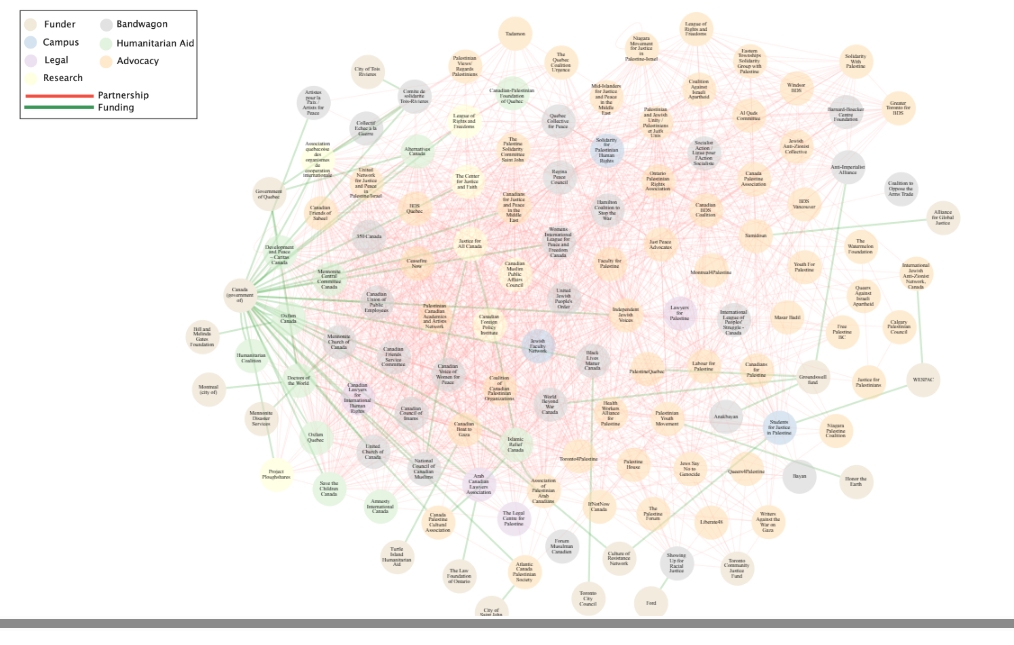
Continue for a list of the numerous groups and their activities. Read all about it.