The Odyssey Hullabaloo
By Victor Davis Hanson
Acclaimed British filmmaker Christopher Nolan’s (The Dark Knight, Oppenheimer) newest film, The Odyssey, opens this week in the United States.
But controversy has already surrounded Nolan’s adaptation of Homer’s 2,700-year-old epic poem about Odysseus’s 10-year struggle to return home after the Achaian victory in the decade-long Trojan War.
Some of the film’s actresses have suggested that Nolan is offering a more feminist—and long-overdue—take on the ancient poem. Actress Lupita Nyong’o, in particular, has criticized Homer’s purported sexism.
Perhaps her misreading of Homer stems from her admission that, despite receiving degrees from elite Hampshire College and Yale, the 42-year-old actress had never even read the Odyssey until she was cast in the minor dual roles of Helen and her sister Clytemnestra.
The Odyssey was composed orally sometime around 750–700 B.C., contemporaneously with the rise of the Greek city-state. Along with Homer’s other epic, The Iliad, The Odyssey marks the inauguration of Western literature. Over the next three millennia, it came to be recognized as not only the earliest but also one of the most profound works of Western civilization.
Far from being sexist, Homer’s Odyssey offers a timeless and diverse panorama of powerful, independent, and savvy women.
Take Penelope, the wife of Odysseus and queen of Ithaca. Unquestionably loyal to her missing husband, she outsmarts the bloodthirsty suitors who seek to force her into marriage and seize the kingdom through her steadfast courage and cunning.
She confounds them through a series of brilliant ruses, ultimately enabling her husband’s revenge.
Far different, but equally independent and crafty, are the immortal sorceress Circe and the divine nymph Calypso, who both shelter, seduce, and eventually bond with Odysseus. Both ultimately release him to continue his tragic journey home. Together they serve as archetypes of unmarried women who choose to live magical lives on their own sexual, economic, and political terms.
Helen makes a cameo appearance in both the poem and the film. Her beauty is all-powerful and dangerously—even destructively—seductive. It prompts the Trojan boy toy Paris to kidnap her, win her over, and flee back to Troy, setting in motion the decade-long Greek expedition against Troy and the extraordinary effort to bring the beauty home to her cuckolded and vapid husband, King Menelaus of Sparta.
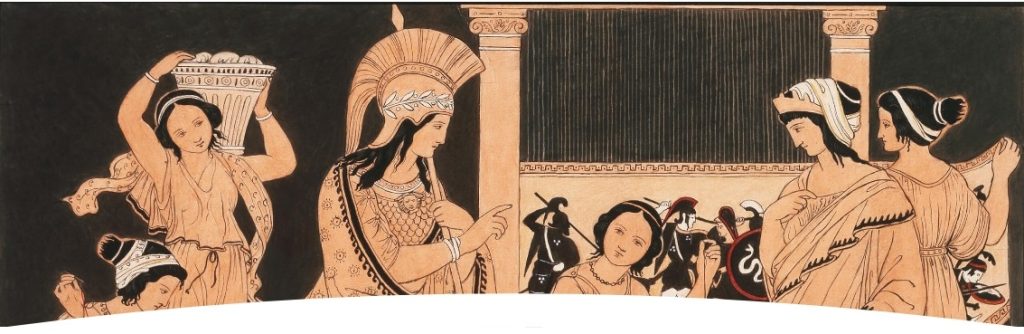
Without the help of the virgin goddess Athena—often regarded as the wisest, most stable, and most humane of the Olympian gods—Odysseus would never have reached home.
By the same token, among the kindest figures in the poem are Odysseus’s loyal nurse, Eurycleia, Penelope’s trusted confidante, and the young, innocent Phaeacian princess Nausicaa, who befriends Odysseus and ensures her parents’ goodwill toward him, eventually securing his safe return to Ithaca.
The monstrous, man-destroying female Scylla and the Sirens are every bit as deadly, but far more astute than the cannibalistic and dimwitted Cyclops Polyphemus.
Far from being sexist, then, The Odyssey offers the earliest—and one of the finest—gallery of capable women in Western literature.
Controversy also arose from Nolan’s casting of Kenyan-Mexican-American actress Lupita Nyong’o as a black Helen, contrary to the Spartan queen’s ethnicity in Homer’s poem.
Cultural appropriation is a heated but often inconsistently applied charge. (When white women wear dreadlocks, that is somehow deemed to be cultural appropriation; black women wearing blond wigs isn’t?)
Yet there is a long history of directors using marquee actors to play characters of different races or ethnicities. British actor Laurence Olivier achieved fame by brilliantly playing Shakespeare’s black Othello. Mexican-American and Irish Anthony Quinn portrayed a stunning Zorba the Greek. Burt Lancaster, Charles Bronson, and Audrey Hepburn all effectively portrayed Native American characters.
In the age of sophisticated makeup and costuming, great actors can believably play almost any role. Problems arise only when a literary or historical figure’s race or gender is so central to the character that it permeates the entire narrative of the film, novel, or poem.
No white actor could play a believable Martin Luther King Jr. or Muhammad Ali. Nor could a black actor be believable as Abraham Lincoln. Nor could a woman realistically play James Bond—Ian Fleming’s womanizing playboy and hypermasculine secret agent 007.
Now, in Nolan’s defense, Helen is a minor figure in both the poem and the film version of the Odyssey. That she was white in the poem and black in the film does not undermine the adaptation of Homer’s poem. But had Lupita Nyong’o perhaps played the key character of Penelope, then the glaring racial disparity might have introduced new and extraneous issues or distracted from the central narrative.
A final note.
The Odyssey is an embodiment of Hellenic culture—and still deeply revered in Greece as an iconic symbol of the ongoing national experience. Given the tradition of brilliant Greek actresses such as Irene Pappas or Melina Mercouri, Nolan might have employed at least one Greek actor or actress in an epic about the indomitable people of Greece.
First published in American Greatness