The Oslo Accords
By Sammy Stein
As more governments move to recognise a so-called non-existent State of Palestine, they are not advancing peace. They are undermining it. In their rush to issue symbolic declarations, they are ignoring the only binding, negotiated and mutually recognised framework that has ever governed Israeli-Palestinian relations. That framework is not a UN resolution, not an advisory opinion and not a press release from Brussels. It is the Oslo Accords, anchored in the historic exchange of letters between Israeli Prime Minister Yitzhak Rabin and PLO chairman Yasser Arafat on 9 September 1993.
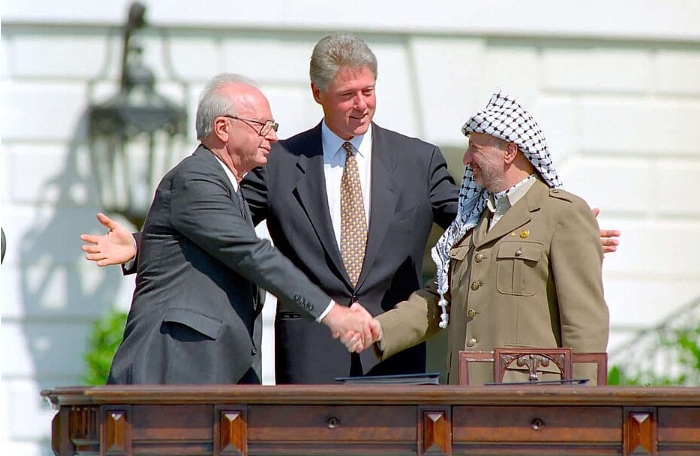
Those letters were not ceremonial. They were constitutive. In his letter to Rabin, Arafat formally recognised the right of the State of Israel to exist in peace and security, committed the PLO to resolving all outstanding issues through negotiations, and explicitly renounced the use of terrorism and other acts of violence. In return, Rabin recognised the PLO as the representative of the Palestinian people and agreed to negotiate with it. Without that exchange, there would have been no Oslo process, no Palestinian Authority and no internationally recognised Palestinian political entity of any kind.
It is now conveniently forgotten that the very existence of the Palestinian Authority derives entirely from those agreements. Its presidency, its security forces, its governing institutions and its standing in the international system all flow from Oslo. There is no alternative legal source for its authority. No UN General Assembly resolution created it. No international court endowed it with powers. It exists because Israel agreed that it should exist, pending the outcome of negotiations on permanent status.
Oslo was explicit on one fundamental point which stated that nothing was final until everything was agreed. Borders, settlements, Jerusalem, refugees and security arrangements were all designated as permanent status issues to be resolved only through direct negotiations between the parties. Until then, interim arrangements would apply. Those arrangements divided the territory into Areas A, B and C. The Palestinian Authority was granted full civil and security control in Area A, civil control with shared security responsibility in Area B and no governing authority in Area C, which remained under full Israeli jurisdiction.
This was not imposed by Israel. It was negotiated, signed and repeatedly reaffirmed. The Palestinians accepted that, pending a final agreement, Israel would retain full authority and responsibility in Area C. That acceptance has never been revoked. No subsequent agreement has replaced it. Yet the same governments that insist Oslo is “obsolete” rely on it every day when dealing with the Palestinian Authority, whose very existence depends on it.
Despite this, the international community routinely describes Israel as an “occupying power” exercising “belligerent occupation” over territory whose legal status was explicitly left unresolved by mutual agreement. This claim is not merely political rhetoric. It is legally incoherent. The Palestinians agreed that the status of the territories would be determined through negotiations. To declare the outcome in advance is to negate the agreement itself.
The same logic applies to settlements. Oslo contains no prohibition on Israeli building in Area C. Settlements were designated as a negotiating issue, not a crime. Palestinian campaigns to have them declared illegal through international bodies are therefore not acts of diplomacy but violations of the Accords. They represent an attempt to secure unilaterally what could not be achieved at the negotiating table.
Borders are treated with similar dishonesty. Calls for a return to the “1967 borders” are endlessly repeated despite the inconvenient fact that no such borders ever existed. The pre-1967 lines were armistice demarcation lines established in 1949 and explicitly defined as non-permanent. They were never recognised as international borders, a point insisted upon by the Arab states themselves.
UN Security Council Resolution 242 recognised this reality. It did not call for a full Israeli withdrawal to the armistice lines. It called for negotiations leading to secure and recognised boundaries, precisely because such boundaries had never existed. To pretend otherwise is not a misunderstanding of history. It is a deliberate distortion of it.
While Israel is endlessly accused of violating Oslo, far less attention is paid to the Palestinian Authority’s systematic breaches of its core commitments. The Accords required both sides to prevent terrorism, incitement and hostile acts and to take legal measures against offenders. Yet the Palestinian Authority has consistently failed to meet these obligations. Its relationship with Hamas and Palestinian Islamic Jihad, both designated terrorist organisations, stands in direct contradiction to the commitments Arafat made in writing.
Even more damaging are the institutionalisation of incitement and the policy of paying salaries to convicted terrorists and their families. This “pay-for-slay” programme is not an aberration. It is a budgeted, defended and celebrated component of Palestinian governance. No serious observer can reconcile it with any claim to peaceful intent.
Economic cooperation was also a pillar of Oslo. Instead of building mutual prosperity, the Palestinian leadership has embraced and promoted the BDS campaign, a movement explicitly designed to isolate, stigmatise and ultimately dismantle Israel. To support economic warfare while demanding economic assistance is not resistance. It is bad faith.
Yet despite this record, the Palestinian leadership is rewarded rather than held accountable. Governments that would never tolerate such behaviour from any other actor treat Palestinian violations as regrettable footnotes, while Israeli actions are magnified into existential threats to peace. This double standard is not accidental. It is structural.
Recognition of a Palestinian state under these conditions does not advance peace. It entrenches rejectionism. The entity being recognised does not meet the basic criteria for statehood under international law. It lacks defined borders, effective control over its claimed territory, and a unified government. Gaza is controlled by Hamas. Large parts of the West Bank remain under Israeli jurisdiction by mutual agreement. Sovereignty exists nowhere.
Recognising a state that does not exist in law or reality is not a diplomatic breakthrough. It is a political indulgence. Worse, it actively undermines the Oslo framework by signalling that agreements can be ignored, commitments violated and negotiations bypassed without consequence.
If the international community were serious about peace, it would insist on adherence to the only agreement ever signed by both parties. Instead of encouraging Palestinian appeals to international courts and symbolic votes in hostile forums, it would demand a return to direct negotiations, exactly as Oslo requires.
European governments in particular bear responsibility. They routinely accuse Israel of obstructing peace while funding, legitimising and excusing Palestinian obstructionism. By shielding the Palestinian leadership from accountability, they perpetuate the very deadlock they claim to oppose.
Peace cannot be declared into existence. It cannot be imposed through recognition of a legal fiction. It can only emerge from negotiation, compromise and mutual recognition. Those principles were embodied in the Oslo Accords and abandoned not by Israel, but by a Palestinian leadership and an international community unwilling to accept the discipline that peace requires.
Until existing agreements are upheld rather than circumvented, recognition of a non-existent Palestinian state will continue to be not a step toward peace but another barrier to it.
Sammy Stein is the Chair of Glasgow Friends of Israel