Trump Looks Assured To Win the Iran War, Even If the Results of the Midterms Appear Less Certain
Americans dislike higher gas prices, but the president’s critics fail to notice that this is not a ‘forever war’ that will vaporize support for the commander-in-chief.
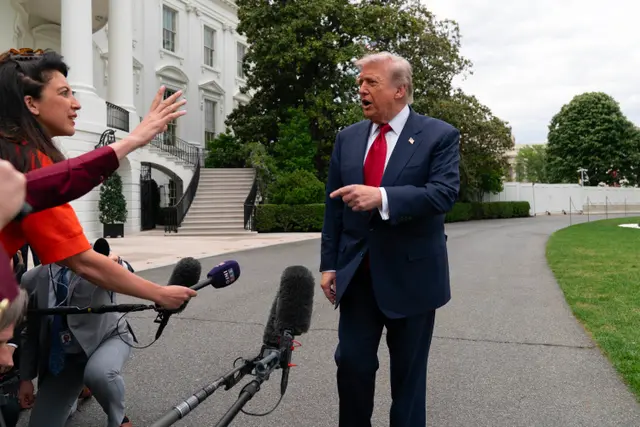
by Conrad Black
President Trump is almost certain to win the Iran War, both against Iran and against his domestic opponents. All the main Democrats and most of the national political press appear incapable not only of approving any initiative by President Trump, but also of even comprehending his political tactics, though after a decade of life and death political engagement with him, they should by now be familiar with some of his techniques.
The American public is not hostile to the Iran War. The president has never seriously explained it, other than the desirability, to put it tepidly, of preventing Iran from becoming a nuclear military power. The country does not like higher gas prices and is unusually late approving the president’s economic policies.
The tariff “liberation” was oversold but in general the tariffs have worked: the trade deficit has been significantly reduced, there is little evidence of the tariffs in inflation numbers, and most of the countries affected have agreed new tariff arrangements more favorable to America. It was scandalous for America to be running a trade deficit of over $1 trillion. Mr. Trump’s tax reductions have taken effect and cannot fail to be popular, and job-creation numbers are relatively good despite the steady inroads of advanced forms of automation.
The president’s critics do not notice that this is not a “forever war” that will vaporize support for the commander-in-chief: the United States is sustaining no casualties while imposing an onerous blockade on Iran oil shipments. Mr. Trump has the options to reduce gas prices in the United States by, say, using American naval supremacy to open the Straits of Hormuz.
Plus, too, given the United States’ status as an energy exporter and as the controlling influence on Venezuelan oil production and sales, it does not have to adhere rigorously to the international oil price. And as the president has stated several times, a more agreeable oil price could easily be attained by a temporary reduction of the sales tax applied to it.
No one not directly involved in the shadowy and helter-skelter negotiations between Iran and its enemies can opine with much confidence about them. Mr. Trump’s critics constantly state, as if this was news to him, that the Iranians are unreliable negotiators.
The absurd offers that they have made for peace with America indicate that they had foreseen that their navy would be sunk and their air defenses destroyed and that they would be reduced to the importation of Iraqi terror squads to contain aggressive disorder within Iran. Even the thugs in the Islamic Revolutionary Guard Corps could no longer be relied upon to massacre their fellow Iranians.
Yet the conduct of the collective leadership in Iran also indicates that they thought that the Americans and Israelis had gone as far as they are able to go, and that they could rely upon the pacifistic forces of the West, including the pope, to restrain the United States from going further. And it is also clear that the Americans have threatened to go a good deal further.
This is why Iran has at least hinted at concessions that might get them close to an acceptable agreement for the United States. Mr. Trump is now doing the necessary work to convince his foreign and domestic opponents that he does not accept that he is under any pressure whatever to make an early agreement and therefore is under no pressure to be a strenuous champion of an early return to war either.
The false theory that he has miscalculated in the war which has caused the most vocal self-exalted military strategists among the Democratic senators, such as Richard Blumenthal and Chris Van Hollen, regularly to denounce the war as ”an epic failure.” This has caused a revival in the most far-fetched calumny in the repertoire of Trump-haters: that he has lost his judgment and is now mad.
This is widely deemed to be the basis for his successful purge of his party, and in particular of Louisiana’s outgoing senator, Dr. Bill Cassidy, who voted for Mr. Trump’s conviction in the second impeachment trial, and Congressman Massie of Kentucky who has been almost unrelievedly hostile to his party’s leader.
It is not the least of this president’s accomplishments that he has demonstrated greater authority over his own party than any president in modern times. Even the otherwise incomparable electoral champion, President Franklin Roosevelt, was unsuccessful in his effort to purge what he judged to be reactionary elements from his party in the late 1930s.
FDR was not only unsuccessful, he was untimely, as the requirement to rearm and take a highly supportive stance in favor of Great Britain and Canada in the difficult early years of World War II forced Roosevelt to ditch the progressive isolationists who had helped him enact the New Deal and replace them with southern advocates of a big military and a generous policy towards the British.
Chief among those whom FDR unsuccessfully attempted to purge was the aptly named Senator Walter George of Georgia, who as chairman of the Senate Foreign Relations Committee managed adoption of the Lend-Lease Bill which enabled Britain and Canada to continue in the war against Germany.
Meanwhile, the Democrats in their complacency are nominating a lot of Nazis and other lunatics for the midterms. Mr. Trump will end the Iranian War very satisfactorily when and by the methods that he chooses. The outcome of the Iran War is a foregone conclusion; the results of the American midterm elections are not.
First published in the New York Sun.