Trump’s Mount Rushmore Speech Signals Start of Midterm Election Showdown Against America’s Detractors
By Conrad Black
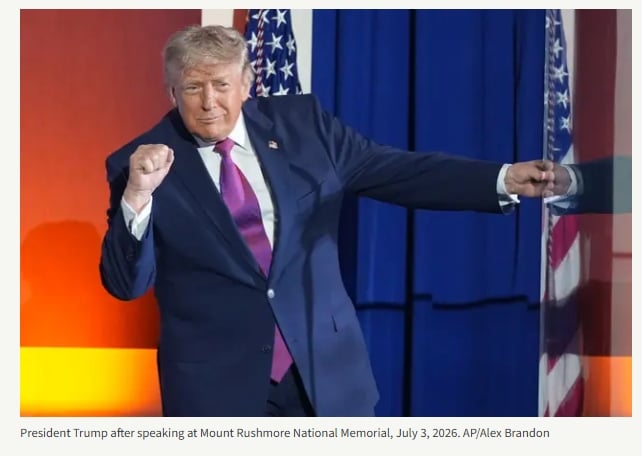
The celebrations of the 250th anniversary of the Declaration of Independence were impressive and the president spoke well both at Mount Rushmore and Washington. No informed and fair-minded person could dispute that the American Revolution was one of the most important events in history and that the country that has arisen from it has been by many measurements the greatest and most successful in the history of the nation state and of all political organizations since the Roman Empire. Like other countries, the United States has a widely believed mythos that obscures some relevant facts.
The war was essentially a dispute over taxes. Benjamin Franklin in particular lobbied the British government strenuously to remove the French from Canada and Britain did so in the Seven Years’ War (1756-1763), which doubled the British national debt. Though much of that money was spent in Europe and India, it was not unreasonable that the British would expect the Americans, as the wealthiest British citizens, to take on some of the tax burden. Their mistake was in not arranging this in advance. Nor did the Americans have significantly more civil rights after the war than before, or more than contemporary British, Swiss, Dutch, and Scandinavians; but they did have a government of their own in their own country.
Since they were in revolt, the chief author of the Declaration of Independence, Thomas Jefferson, although he was a deist if not an agnostic, claimed that the rights the American colonists sought were granted them by God. This formula enabled the United States, more successfully than any other important society, to unite the spirit and inspiration of the Enlightenment, which tended toward religious skepticism, with his continued belief in the existence of a just divine intelligence. This was exceptional. President Trump speaks at Mount Rushmore National Memorial, July 3, 2026. AP/Matt GadeIn general up to that time, most countries had a language of their own. The United States did not and so defined itself in terms of what was claimed to be the novelty of that society: the absence of hereditary privileges and the emphasis on meritocracy were innovative and have greatly contributed to America’s extraordinary success. This too was exceptional.
Jefferson ignored slavery altogether, and the vehemence of his indictment of King George III and even his slurs on the American Indians were outrageous. Yet because the United States had the ability to settle and populate the entire center of the chronically under- populated continent it was able to build a new form of empire (which was exceptional, though emulated by Canada and Australia). Instead of going overseas to impose itself upon native populations who did not welcome colonists as the British did in India and the French in North Africa and Indochina, and other European countries elsewhere, the United States enticed scores of millions of foreigners to come to America full of ambition to become citizens of this new country. They built an empire on adjacent almost vacant territory with foreigners who came with zeal and enthusiasm, rather than imposing themselves on foreigners in their own countries. This really became possible after the passage of the Homestead Act in 1862, promoting the wholesale settlement of the interior by immigrants. Emanuel Leutze: ‘Westward the Course of Empire Takes Its Way,’ detail, 1861. Via Wikimedia Commons
This could only be done once the southern states had seceded and their effort to maintain a virtual equality between the influence of the slave and free states could no longer be maintained. (The native Americans were rather roughly treated.) Canada and Australia developed along the same path, without the blight of slavery.
American exceptionalism is now mainly a question of scale: for over a century the United States has operated on a scale that the world had never imagined to be possible and it has completely debunked the idea that Communist China will surpass it as the world’s largest economy. The United States has also shortchanged itself in the credit it has earned for making a greater and more successful effort than any society in history to raise up its former enslaved population to complete equality.
While Americans rightly celebrate this auspicious anniversary, they should not be under the illusion that all of the rest of the world would wish to be American, or that they have the freest society. The United States has 4 percent of the world’s population and 25 percent of its incarcerated people, and a profoundly corrupt 98 percent federal criminal conviction rate, 95 percent of these without a trial, because of the misuse of the plea bargain system that enables prosecutors to extort and suborn false incriminating evidence with oppressive threats of prosecution and promises of exemption from charges for perjury in respect of extorted testimony. An attendee at a gun rights rally carries his gun in a holster that reads ‘We the People,’ on January 18, 2019, at Olympia, Washington. AP/Ted S. warrant
o be sure, the country was founded by recourse to violence and there is no dispute about the right to bear arms. Yet many other countries are horrified by the profusion of guns and level of violence in the United States as they are horrified by the spectacles of poverty and drug abuse in many of America’s greatest cities.
There is nothing inappropriate in the superlatives that American Fourth of July orators traditionally confer upon their country. Yet the historically minded of them might wish to recognize that the British, from a little island, propagated the English language, the Common Law, the parliamentary system, the American colonies, and Britain’s immense contribution to human rights in the world. Other principal European nationalities, though less benignly influential politically, are now often as well functioning democracies as America. So are Canada and Australia, which have generally kept pace with American growth and prosperity, without a civil war or remotely as great levels of crime.
Britain and Canada and Australia also have made immense contributions in the great armed conflicts of the last two centuries and in the case of Canada its forces were almost entirely volunteers fighting only for the cause of freedom throughout the world, since Canada itself was not attacked and never threatened.
People rally in response to President Trump’s comments about Canadian sovereignty at Ottawa. Justin Tang/The Canadian Press via APAn eminent academic friend of mine from Canada accepted a distinguished academic position in the United States some years ago and said that he was moving from the best country in the world to the greatest country in the world but that they are both good countries and they are both great countries.
Astonishing though the rise of America has been and indisputable though its status as the indispensable country for the preservation of democracy and the free market is, it could still learn something from some other countries. And it is worrisome to Americans and to all who care about the United States, that between 35 and 40 percent of Americans are not proud of their country. It is certainly a country that all of its citizens should be proud of and this level of dissent from America’s patriotic self-regard is unjust and distressing, and cannot be cracked up entirely to controversy over the current president. It was good to hear the president fire the opening pre-election gun against the domestic haters of America in the symbolic shadow of four of its greatest statesmen at Mount Rushmore on Friday.
First posted in the New York Sun