Wrecking-Ball Revisionism: How Picton, Ontario Turned its Back on Its Own History
By Jerry Amernic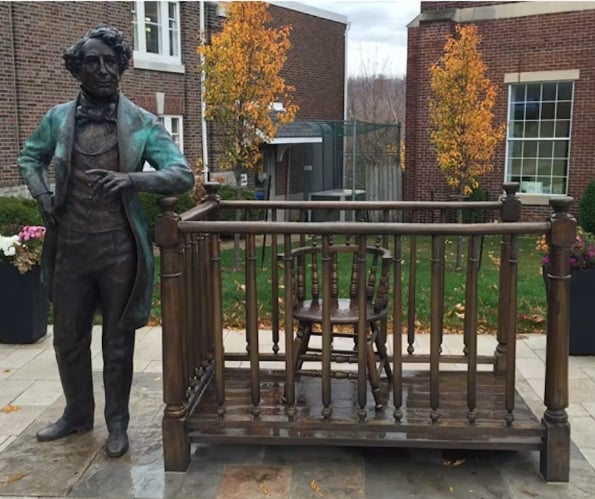
It was in Picton, Ontario in 1834 that Canada’s most important prime minister first made a name for himself. A teenaged John A. Macdonald had arrived in town the year before to help his cousin run a legal practice. Amid the heated political atmosphere ahead of the Rebellion of 1837, however, Macdonald found himself in a nasty debate with a local doctor. It got so raucous that both were charged with assault. The doctor was later found guilty and fined a token amount. Macdonald defended himself and was acquitted, to much public acclaim.
As scholars observe today, the case marks the moment “John A. came of age,” proving “that he was effective in both the courts and the court of public opinion.”
The event was significant enough that 181 years later Picton decided to immortalize it in bronze. On Canada Day, 2015 a life-sized statue of a young Macdonald triumphant in court was unveiled on Main Street at a ceremony attended by 5,000 people, many of whom came dressed in period costumes. The statue was intended as a sign of Picton’s pride in its most famous resident, and as a tourist draw.
Less than six years later it was gone. How did Picton turn its back on its own history so quickly?
Following allegations – still unproven – that the remains of 215 children’s graves were found on the grounds of the former Indian Residential School in Kamloops, B.C., cities and towns across Canada tore down their statues in a moral panic over our country’s history. Macdonald’s statue in Picton was among the casualties; in June 2021, the local council voted 13-1 to remove it from its prominent downtown location and put it in a warehouse.
At the time, Picton’s council promised to return the statue “within 12 months.” It’s still in storage.
In an effort to jumpstart the return process, earlier this year a local councillor introduced a motion that called for the statue to be put back on display. This effort turned an ordinary council meeting into a referendum on Macdonald and his legacy.
Leading the charge to return Macdonald was Mark Johnson from the grassroots group Save Our History. Johnson called Macdonald “our most important prime minister” and cautioned against letting emotion get in the way of a proper understanding of historical facts. On the strength of my recent book SLEEPWOKING about historical revisionism, I also made a presentation, pointing out the many factual errors made by Macdonald’s critics.
After his supporters spoke, then came a deluge of Macdonald haters who pronounced him guilty of the most horrible crimes imaginable. He was called a “villain” and “evil” and a “racist” and “white supremacist” who starved Indigenous people in an attempt to wipe them out.
That an inanimate sculpture posed a real threat to public safety was a common theme among the presenters, many of whom claimed Indigenous heritage. “My Mom is white and my Dad is Cree,” local resident Joyce Hunter told the council. “The first distinct memory I have of the John A. Macdonald statue was my Dad pointing out the car window and saying, ‘That’s the Indian killer and he’s going to kill me because I’m Indian.’” She called Macdonald “an awful person” and then burst into tears.
There was plenty of emotion on display. But little attention was paid to historical facts. All the claims made about Macdonald were either flat out wrong, or misrepresented. In the end, the council voted 8-6 against returning Macdonald to his place on Main Street.
This can be considered yet another depressing defeat for the truth about Canada’s history. The country is clearly on a losing streak. But there are some green shoots of optimism to be found in this recent setback. First, losing a vote by 8-6 is not as bad as losing 13-1. Opinions are clearly starting to shift.
Additional evidence that we have reached the peak in ‘woke’ Canadian history can be found in the fact that other statues that were also removed elsewhere are starting to come back. A statue of Macdonald at Queens Park in Toronto was boarded up for five years. It’s now back on display. And a series of statues in a park called the Prime Ministers’ Path in Wilmot, Ontario is also returning. What’s more, a poll in nearby Kingston, Macdonald’s home town, shows that 70 percent of residents want their Macdonald statue back as well.
Equally important, the deception of the Kamloops “discovery” is also now being acknowledged publicly. Even The Globe and Mail editorial board has admitted that no graves have ever been found despite five years of allegations. The recent success of fact-based books on Canadian history, including my own, further suggests that Canadians want to hear the truth about their past.
Taking steps to confirm and celebrate Canada’s past requires not only research and understanding, but fortitude and backbone. Some elected officials have it. Others don’t. The fight for historical truth continues in Picton and elsewhere.
Jerry Amernic is a journalist and novelist based in Toronto; his most recent book SLEEPWOKING is available at Amazon. The longer, original version of this story first appeared at C2CJournal.ca