A Lament for the Printed Word
by Theodore Dalrymple (January 2026)
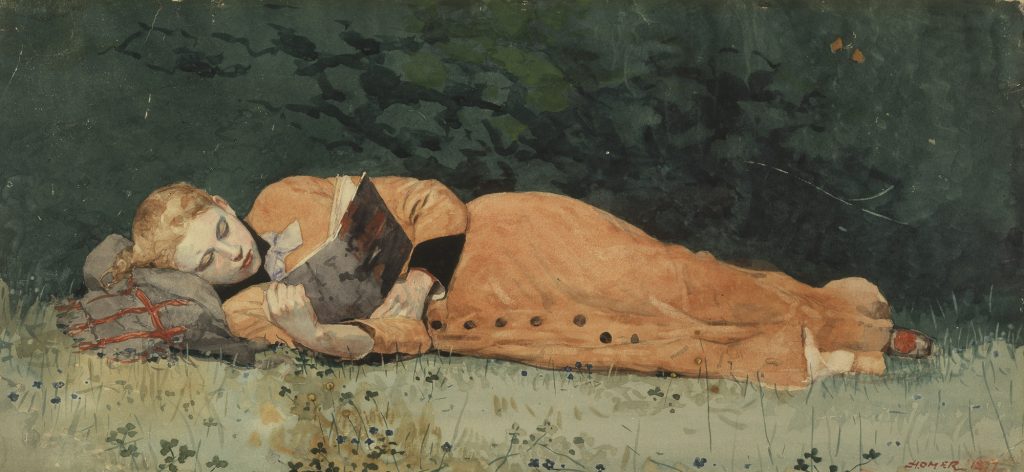
Of all the pointless activities in which humans are apt to indulge, the most pointless (apart from the playing of golf) must surely be the writing of books that no one will read. I have extensive experience myself of this activity, having written many such books. But yet I continue.
As inflation may be defined as too much money chasing too few goods, so the writing of books in the modern world may be defined as too many books chasing too few readers. Never have there been so many books published; never have there been so few readers (or so we are told). The young do not read, certainly not many pages consecutively; and where once on suburban or underground trains you would have seen many people absorbed in a book, now you rarely see one per carriage. People are hypnotised not by the printed word, but by the screens of their telephones: very few of them, according to my straw polls, are reading written text.
Of course, complaints of declining standards are commonplace, even constant, in history: which does not necessarily make them false, however, at least in certain periods and for a certain time. When I was growing up, my teachers always said that I was a member of the worst class that they had ever had the misfortune to teach; and while, even from an early age, I took this with a pinch of salt, I was soon aware that, grosso modo, it contained a grain of truth. Discipline had relaxed, and I was not as well educated as my not-distant predecessors had been.
No doubt unsuccessful authors have always complained about the evils of publishers, but it seems that their complaints have rarely been so justified as they are today, at least of those publishers with some influence in the market. The publishers are a cartel, and what is more a cartel not only of financial interest, but of ideological interest also. I have given up on them (they gave up on me a long time ago). Even if what you propose to them is ideologically neutral, so to speak, they will demand that you insert some obeisance to the current, supposedly virtuous orthodoxy, as Soviet publishers once demanded a quotation from Lenin, as if Lenin had been a great entomologist, archaeologist, musicologist, or scholar of whatever the book was about. This kind of censorship is deadlier by far than the negative type: having things that you must say is incomparably worse than having things that you must not say. Indeed, a certain type or degree of censorship may be good for literature, for is it not the case (tell it not in Gath, publish it not in Askalon, lest the daughters of the Philistines rejoice) that most of the worlds greatest literature was produced in conditions of censorship? The way to be a bore, said Voltaire, is to say everything: and he might have added, the way to be frivolous, too.
The necessity of self-censorship in the modern world is often decried, but to condemn self-censorship tout court is far too blunt and unnuanced. The ability to censor one’s thoughts, and even more to refrain from expressing them to others, is of cardinal importance, since social life would be impossible without it: at least, if other people’s thoughts resemble my own when they are at their wildest or most uncharitable. And since practice becomes habit and then character, moderating one’s thoughts is highly desirable.
This is not to say that one should always hold back or never say anything that might offend. I have known people who always spoke so guardedly, or ironically, that you never knew what they truly thought, which was irritating. Perhaps they did not even know themselves, for it is sometimes in speaking unguardedly that one discovers what one thinks, occasionally to one’s surprise and discomfiture.
There are thus occasions when the same thought must or must not be expressed. Politeness may slide and slither into pusillanimity, and the desire not to offend may be more a fear of the person to be offended than true concern for politeness. One can censor oneself for the worst of reasons: to curry favour with a powerful but dreadful person, for example, or to uphold a false belief to which one is deeply attached.
On the other hand, the urge to frankness and truth-telling may disguise, even from the speaker, a desire to offend or upset. The truth may set us free, but it may also pain others unnecessarily. Much could be said of truth, or rather of telling the truth, as sadism.
There are also intermediate cases, when a thought may be expressed, but in an emollient or less stark fashion. (How what is said is often as important as what is said.) I doubt that rules could be laid down that would be an infallible guide to proper and improper speech: it is as much a matter of instinct as of principle, and some people have not that instinct and never develop it. Besides, a world in which everyone invariably was polite and tactful would be only somewhat less intolerable than one in which rudeness was the invariable rule. Indeed, but for rudeness in the world, we would hardly know what politeness was. The great sociologist, Durkheim, suggested that crime and criminals performed a useful social function because they helped to unite society, whose members might otherwise have not enough or little in common, against them (though it is not possible to specify exactly how many criminals or how much crime is necessary to achieve this end, nor would it be much consolation to the victim of a serious crime to know that it had helped to cement society by providing a focus for common outrage). Similarly, perhaps, the habitually rude cause us to appreciate the well-mannered the more, whose mannerliness might otherwise go unperceived.
But to return to books and what Matthew Arnold might have called ‘their melancholy, long, withdrawing roar’. It was the decline in religious belief to which Arnold was referring in Dover Beach, but it is to the decline of reading that I now lament—at least, if reports of it are to be believed. Even students who have elected to study literature at university, so one hears, are unable to read a long novel, or find it onerous to do so, even the requirement to do so being a cause for complaint.
There have, of course, been opponents or denigrators of reading. Schopenhauer, for example, thought reading is often an alternative, rather than an aid, to thought, and indeed often a means of stifling thought. And certainly, I have known scholarly persons whose minds were so overburdened by what they had read that they were quite incapable of writing anything themselves when they tried. They tripped over themselves when they set pen to paper, like a person who is rushing too fast for his legs. Their every statement had to be qualified, their qualifications qualified, and so on ad infinitum. They feared also to have missed the very latest research on their subject, and the criticism that omission of it might evoke. If you don’t write, you can’t be read; and if you’re not read, you can’t be criticised. The pedant delights in error more than in truth but also fears to be in error himself more than he hopes to advance knowledge. Silence is the safest policy.
Then comes the thought that erudition itself, however judicious, is fleeting. The most erudite people I have ever known are all dead: where is their learning now? It is at one with holes-in-one and other golfing feats that I consider nugatory. (I recognise, of course, that golfers may be highly skilled, but this does not impress me, or rather impresses me unfavourably, insofar as it implies great devotion to acquiring a skill of no worth. A well-made bad film is worse than a badly made bad film, insofar as it implies a waste of ability and even of talent. Some things are not worth doing well.) Yet it remains true that not only all our pomp of yesterday, but all our erudition, if any, is one with Nineveh and Tyre. Vanity of vanities, all is vanity.
Yet an intellectual appreciation that all human endeavour is, in the last analysis, at one with Nineveh and Tyre, cannot be held in the mind for very long, at least by the great majority of mankind. We are made for endeavour of one kind or another, and since the struggle for raw existence is in effect over, we are obliged to find the most meaningful endeavour we can. Instinctively, I feel that the pursuit of knowledge and understanding for its own sake is about as meaningful an endeavour as can be found.
Of course, there are other means of obtaining knowledge than by reading, especially nowadays. I can speak only for myself, but I have found nevertheless that reading books is the most pleasurable, as well as the most efficient, way of acquiring knowledge (I am not talking of experimentation in science), and that all other means are, by comparison, superficial.
Theoretically, there is no reason why reading text on a screen should be inferior to reading print on a page. In practice, however, I think that few people struggle through the equivalent of a three-, four- or five-hundred-page book on a screen, unless they have a very special reason or motive to do so. I am reminded here of the late Neil Postman, who argued in Amusing Ourselves to Death for the inherently trivialising effect of television (at the time, 1985, he did not anticipate that medium’s decline in importance). I recall thinking as I read it that there was no inherent reason why television should be trivialising, it not being a logical necessity that it should be so; but the world, especially the human world, is not ruled entirely by logic, and Postman was more correct than he was mistaken. The medium is not wholly the message, but it seems to have an impact on the human mind irrespective of its contents.
One has a natural tendency to suppose that one’s own tastes are best: that, for example, a taste for reading is morally and intellectually virtuous, in a way that most other activities are not. Is this mere snobbery, or does it have some basis in reality?
Even if it does not have such a basis, it is too late for me to change my now ingrained tastes. One of my few regrets on leaving this world will be that I have not read all that I would like to have read. Notwithstanding the decline of reading, and the lowering of academic standards, I still find, when I visit a good bookshop, that there is much, too much, being written that I wish I had time to read. I wish I knew more about marsupials, Barbary pirates, the philosophy of Spinoza, the history of Sicily, Japanese art, and so forth; and if I now know much more than I did when I was born, I shall still die infinitely ignorant.
If it is better to know some things than others, it is nevertheless better to know something that not to know it, provided only that one’s capacity to know is virtually without limit. Some wives of old, who were in despair because of their husbands’ propensity to accumulate books, made a rule: one in, one out. I do not think that the brain treats facts in like fashion: one in, one out. Barring neurological degeneration, one can learn until one dies.
However, I now feel a little like the last surviving thylacine, or Tasmanian tiger, filmed in 1936 in Hobart Zoo. With it, the species died out (though there are still occasional alleged sightings, and there are people who spend their spare time, and even their lives, trying to prove that the species has survived). The difference between the last Tasmanian tiger and me is that I know that I am of the dying race of bibliomanes, whereas the Tasmanian tiger was, I think we may safely assume, unaware that he was the last of his breed.
No doubt, bibliomania will sputter on till the last child of the last baby-boomer dies (the price of second-hand books, particularly rare ones, has not fallen, baby-boomers still being sufficiently numerous and sufficiently rich to maintain prices): but when I look at my bookshelves, I think ‘I am a dinosaur,’ destined to be extinguished by the much suppler digital mammals.
Table of Contents
Theodore Dalrymple’s latest books are Neither Trumpets nor Violins (with Kenneth Francis and Samuel Hux) and Ramses: A Memoir from New English Review Press.
Follow NER on Twitter @NERIconoclast