Music Against Time
by Theodore Dalrymple (July 2026)
Every year in the small town in which I live when I am in England, there is a festival of the music of Joseph Haydn (and of, to a lesser extent, his contemporaries) lasting several days. People come from far and wide to attend it, and the town seems suddenly to have been invaded—I won’t say by a plague, but by a comparatively large number of very old people of comparatively high social class.
Suffice it to say that when I attend a concert during the festival, I lower the average age of the audience, though I am also forced to confess that I am by no means any longer in the finest flower of my youth. I am of that more fortunate half of the audience that does not have to wear a hearing aid, at least I don’t think that I do, which admittedly is not a perfect guide to need, for I recall the time, when I was twenty-six years of age, when, at a hospital clinic-pathological conference in which a histology slide was shown, I protested, ‘What is the point of putting up all these pink and blue blurs?’ The young doctor next to me said, ‘Here, have a look through these,’ and handed me his spectacles. They were revelatory, and it became evident to me that, for an unspecifiable number of years, I had been living in a fuzzy world, or perhaps I should say a world that was fuzzy to me. When my own spectacles arrived, the leaves on the trees suddenly became clearly delineated rather than being a greenish mass in an Impressionist haze.
Indeed, it has been suggested that Impressionism was the result of various artists’ ocular defects, but I think a glance at the academic painting of the time, of some of William-Adolphe Bouguereau’s work, for example, should be sufficient to persuade anyone that the time had come for an alternative way of painting. (His picture Nymphaeum illustrates to perfection the appalling consequences of an alliance of technical accomplishment and absence of taste.)
It was not encouraging that at the Haydn chamber concerts that I attended there were few people whose hair was not white. In front of me a small, tragic scene played out. There was a couple in their eighties, the man clearly suffering from dementia. He could hardly keep himself upright in his seat, constantly leaning sideways and seemingly about to topple over completely until his wife propped him straight again. No doubt she was his twenty-four hour carer, and bringing him to the concert was a treat for her, even if such a foray into the world of culture with him was full of its various anxieties, for she probably had but rarely the opportunity to leave their home. A live performance of a Haydn quartet, even if punctuated by the need to keep her poor husband upright, allowed her to escape for a moment the sorrow, the tragedy, of her existence.
Why was there almost no one in the audience under the age of fifty at the concert? One reason, perhaps, was the price of the tickets; but I suspect that many young people would have been prepared to sell their mothers into slavery to raise the money to attend a concert by a rock star or other avatar of popular culture.
Haydn has always seemed to me an accessible composer, but I must be mistaken: for it is all too easy to suppose that what is easily accessible to oneself is easily accessible to everyone else. Living in our bubbles as we inevitably do, we lack the imagination to understand what it is like to live in other bubbles.
Whenever anyone suggests that genius is incompatible with ordinary goodness, that it requires personal unpleasantness, extreme egotism or psychopathy for its exercise, I cite Haydn as a counterexample. His virtual inventions of the symphony and string quartet were surely marks of genius, to say nothing of the fact that he was, and has remained, one of the greatest practitioners of the very art forms that he founded.
He was a decent and modest man, whom Mozart called, and revered as, Papa Haydn. When Mozart dedicated six string quartets to him, Haydn wrote to Mozart’s father, Leopold, to tell him that his son was the greatest composer known to him. To appreciate great art as it is produced is much more difficult than to appreciate it after a century or two, and Haydn’s unequivocal judgment of Mozart was an achievement in itself. But its self-effacing quality was also moving, for it is not easy for a man who is twenty-four years older than another, and who is himself a great man, to recognise the even greater genius of the younger man, who was still young.
Here, incidentally, I cite Mozart’s letter of dedication to Haydn of his quartets as a refutation of the portrayal of the composer as a drunken boor in Amadeus, the play by Peter Shaffer subsequently made into a film. The letter is one of deep and sincere filial piety, impossible to imagine emanating from the coarse personage, a kind of vulgarian idiot savant mysteriously touched by genius, depicted by Shaffer.
The play was of some cultural or psychological significance. I do not mean in any of what follows to suggest that Shaffer was not a good playwright: we do not, after all, look to plays for literal historical truth, nor do we call a piece of literature bad merely because some of its ideas do not coincide with our own; but I surmise that the depiction of Mozart in the way Shaffer depicted him was comforting to a population, or at least an intelligentsia, increasingly uncomfortable with the idea of inequality of any kind, however much it, the intelligentsia, might in practice have been attached both psychologically and economically to its own social superiority. True, Shaffer did not disguise or attempt to hide Mozart’s almost miraculous facility (though in the dedication to Haydn, Mozart speaks of the hard work and study it took him to produce the quartets, so that he did much more than merely take dictation from God), but he had somehow to be brought down to a common level, or even below it, so that we, ordinary people, should not feel what Bertrand Russell once said he felt by comparison whenever he heard Mozart, namely a worm. We want our feet of clay at least as much as we want a pound of flesh.
It so happens that one of the quartets dedicated to Haydn was played at the concert to which I have referred, and like so much of Mozart’s music, it was simultaneously joyous and melancholy, to a degree seldom equalled (of all the things that I know). This combination of joy and melancholy is one of the features of much good art, which reflects the inextricable and simultaneous presence of different and seemingly opposed emotions in the human psyche. Sometimes it seems (almost) as if art relies for its power on the sordidness of much of life, to which it provides a contrast if not a reproach, and which is perhaps why we do not expect great art to be produced by those who have been most fortunate in their birth and throughout their subsequent lives. In a perfect world, if such can be imagined, there would be no need of art; it is the attempt, eternally unsuccessful, to perfect what is imperfectible.
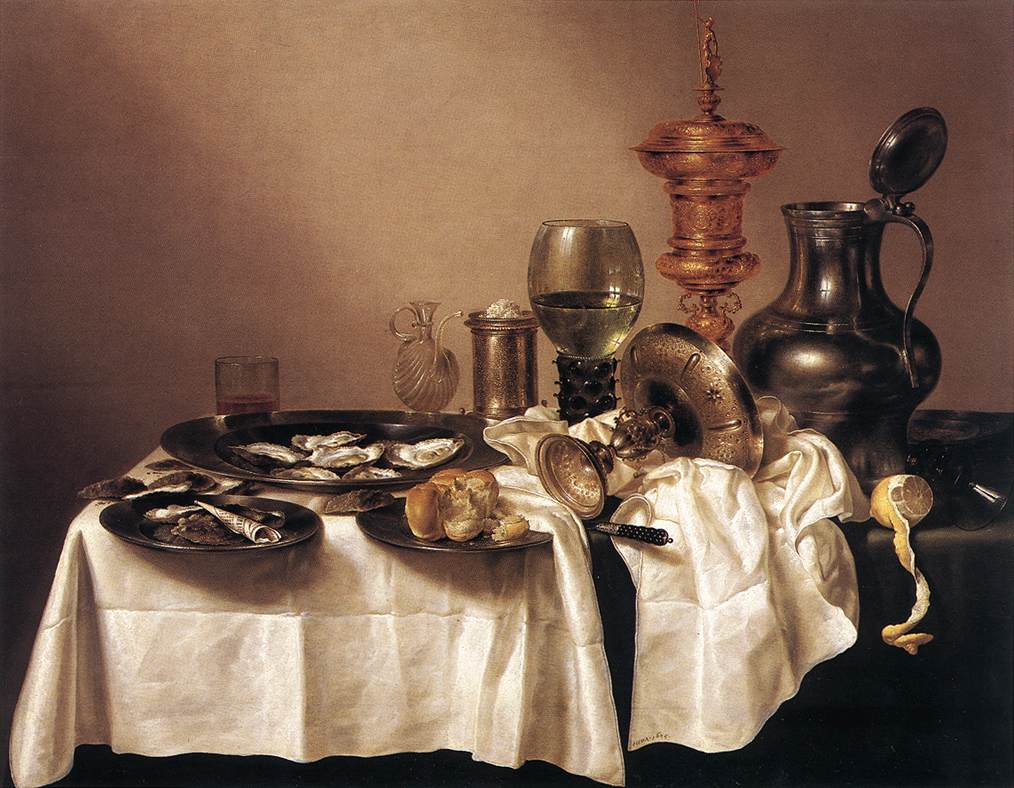
It is not only in music that we find this union of joy and melancholy. I think it is implicit in the genre of still life, for example. It is not so much a protest against the mutability of everything, which would be futile, as an attempt to freeze a beauty that is inherently fleeting. Who does not know that a flower, a fruit, a piece of bread, will not remain long in the condition in which it is painted, and even the more durable objects in a still life—a bowl or a glass, say, a cloth or a table with cutlery upon it—will not for long remain in the same relation to other objects? The beauty, which gives us joy, will soon be gone; the working of time is melancholy, or rather gives rise to melancholy.
This working of time and its effect on present beauty is a commonplace of poetry. The very first lines of Shakespeare’s sonnets are:
From fairest creatures we desire increase,
That thereby beauty’s rose might never die…
The beauty of youth is but short-lived, though youth does not know it; only when it is gone, when we are older, do we understand this. Knowledge increases appreciation, the faculty of not taking things for granted, but at the cost of sadness.
This union of joy and melancholy is not found in all art: I am not trying to establish any criterion or definition of art. But it very common.
If so, however, why is it that so many people seem not to appreciate it, or even to detest, avoid or evade it? Why can you get so few people to attend a concert of Haydn or Mozart chamber music when, within a few hundred yards are to be found bars throbbing so loudly with popular music of various kinds so loudly that young men have to shout, and young women to scream, to make themselves heard—and where in all probability they will spend greatly more than a ticket to the concert would cost?
I suspect that in a culture that increasingly regards any deviation from a state of perfect and continual happiness as an illness to be cured by technical means, any reminded of the close association of joy and melancholy is unwelcome.
The almost total absence of the young in the audience depressed me. I did not think, though I hope, that the absence was simply a cohort effect, and that the people in the throbbing bars would in later years develop a different taste. On the contrary, I thought that I was witnessing the dying throes of a great and wonderful tradition. After all, when I was young, students in large numbers, aged 18 to 22 or 23, would attend both chamber and symphony concerts regularly. I went to one or two a week for several years. The absence of young people at the concert brought to mind a visit I paid a few years back to a convent in Flanders, founded in the fourteenth century, now with only a few nuns left, and those either in or approaching their nineties. When those died, the convent would be no more; another purpose would have to be found for its buildings. I do not think that one has to be a believer to find this sad, almost tragic. It is a civilization turning its back on itself.
There is one small ray of hope, though. Many of the musicians performing at the festival were themselves young, at least by comparison with the members of the audience—younger in quite a number of cases by a half century or more. They performed at a very high level, and where people perform at a very high level you can be sure that there must be a large cadre of those who are less accomplished than they. There is no human activity at which people perform only at a high level. For every world champion boxer, for example, there are a thousand journeymen (as they are called), and for every journeyman professional, a hundred or thousand amateurs. Excellence at anything does not emerge fully formed like Venus from the sea.
Very pleasing also about these young musicians was that, though they were performers in public, they did not regard themselves as celebrities. Alas, in such classical music concerts as attract large audiences and popular attention, the musicians are now constrained, if they are young female pianists, to dress up like Suzy Wong and treat the piano as if it were an aid to sexual pleasure. But there is, so to speak, a surviving undercurrent of traditional music-making.
Still, I cannot help but notice that our cultural traditions, literary, musical, artistic, and other, are not, grosso modo, in a flourishing state. Our societies are increasingly becoming like a plant with no roots, they are more like algae that float on the waters of the present moment. Young people are not only cut off from the past, except a version of it that serves as a source and justification of their own discontents, but from awareness that anything from the past was valuable or worth preserving, that they have inherited something other than misery.
–
–
Table of Contents
Theodore Dalrymple’s latest books are Neither Trumpets nor Violins (with Kenneth Francis and Samuel Hux) and Ramses: A Memoir from New English Review Press.
Follow NER on Twitter @NERIconoclast