Negation of the Golah (Exile); Hebrew Identity of a New Nation
A National Economy Based on Productive Laboror Rather than traditional Diaspora Occupations
by Norman Berdichevsky (October 2025)
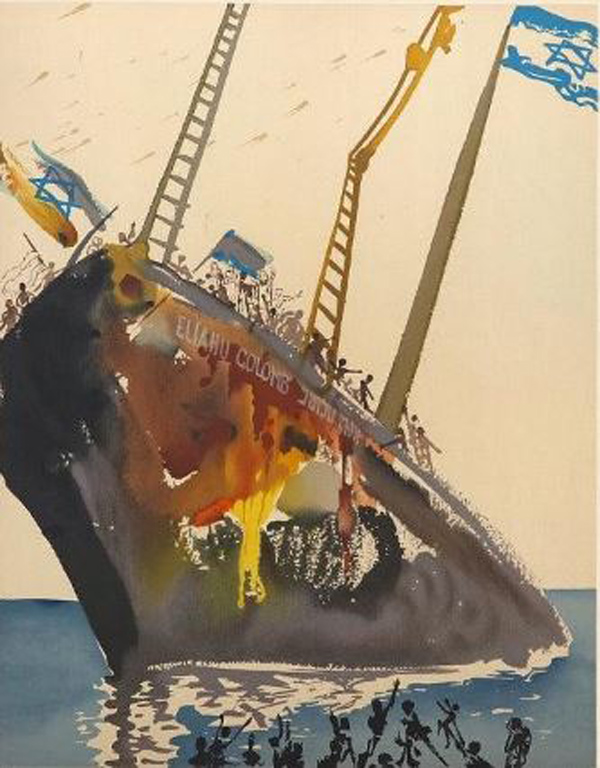
As dissatisfaction with the British Mandate grew, a clandestine underground emerged and began to contest the official Zionist leadership. These movements made more and more use of the term “Ivri” (Hebrew) as an adjective to express their instinctive attachment to the language, soil and landscapes of the homeland, their creativity in music, song, literature, dance, humor, as nationally “Hebrew” rather than “Jewish.” Zionism amounted to a revolution in traditional Jewish life and the majority secular elements sought to include every aspect of social, economic and political life. This was the most ambitious response to a challenge and dilemma facing an oppressed people.
The term was used prominently in the Biblical passage in which Jonah proudly asserts his identity “IVRI Anochi” (I am a Hebrew!) Seeking to escape God’s command to fulfill a mission, Jonah boards a ship bound for Tarshish. When the ship is struck by a storm, the sailors seek to discover why the gods have deserted them and threaten disaster:
“And they said everyone to his fellow, Come, and let us cast lots, that we may know for whose cause this evil is upon us. So they cast lots, and the lot fell upon Jonah. Then said they unto him, Tell us, we pray thee, for whose cause this evil is upon us; what is thine occupation? and whence comest thou? What is thy country and of what people art thou? And he said unto them, “I am a Hebrew; and I fear the Lord, the God of heaven, which hath made the sea and the dry land.”
The passage was deemed the most appropriate to inculcate a sense of pride in the new Zionist movement’s attachment to land and language imitating Jonah, who first tried to hide his identity. These passages are part of the book of Jonah which is read in its entirety on Yom Kippur – an indication of its importance. The Zionist movement embraced new cultural elements to separate and institutionalize a distinct Hebrew identity starting with language and literature but extending to personal and family names, and different attitudes towards male-female relationships, child care, courtship and marriage, work, clothing, sports military training, seamanship the home, a love of nature, the cinema, the nature of a new national identity based on the Biblical or pre-exilic past[vi], even a different cuisine and cooking than in the Golah (exile) featuring eggplant, chickpeas, olive oil and citrus fruit.
=
Ben-Yehuda’s Campaign and the Fierce Opposition
The Zionist “elite” emerged at the end of the 19th century to propagate Hebrew, teach it in primary schools, and follow Ben-Yehuda’s pioneer work. They were all volunteers and “powerless” in the traditional sense of being without financial means, the support of the authorities, access to mass media, or organizational tools on their side. Resistance from the orthodox religious community in Palestine was immediate and determined.
The Orthodox in Jerusalem acted aggressively against Ben Yehuda—they even refused to bury his children, and denounced him to the Turkish authorities leading to his imprisonment. In several of the agricultural colonies, teachers of Hebrew were threatened or expelled because they had gone too far by promoting Hebrew as the language of instruction in secular subjects.
=
Hebraization of Personal and Family Names
This renaming process started with Eliezer Ben Yehuda himself who had been Perelman before arriving in Palestine. Many new Hebrew speakers arriving in Palestine chose first names, not the traditional ones from the Bible but those symbolizing hope, optimism, wild animals and nature such as Rina (Joy), Geulah (Redemption), Rakefet (Cyclamen), Narkis (Narcissus), Tikvah,(Hope), Zohar (Shining Light), Tal (Dew), Dror (Freedom), Ŝaĥar (Dawn) Ilan (Tree), Nitzan (bud of a plant) Ayal and Ayala (a male and female Deer). Some even selected the names of shady characters from the scriptures not previously used by Jews in Europe such as Nimrod (mighty hunter), Boaz, Ehud and Yoav.
In 1944, the Zionist leadership and the Jewish National Council proclaimed it the “Year of Naturalization and the Hebrew Name” and published a booklet which contained guidelines on the creation of new Hebrew surnames.
Many immigrants to modern Israel changed their names to erase memories of the oppressive Russian, Austrian, Polish “exiles countries” where Jews had often been humiliated. Although certain “typical Jewish” names in particular ending -berg, -stein or -man are actually of German origin, and those ending -sky and -vitz are Slavic, they nevertheless came to be regarded as reminiscent of a humiliating past.
The switch to Hebrew surnames was spearheaded by the principal leaders of the Zionist Movement, so Schneor Zalman Rubashov became Shazar, Yitzhak Shimshelevitz became Ben-Zvi and Golda Meyerson became Meir. It is interesting to note that the Revisionist/Rightwing leaders within the Zionist Movement, such as Menachem Begin and Joseph Klausner, did not change their names and neither did Israel’s first president Chaim Weizmann.
After the establishment of the State of Israel, Ben-Gurion, in an order to the IDF soldiers wrote,
It is desirable that every commanding officer (from Squadron Commander to Chief of Staff) should change his surname, whether German, English, Slavic, French or foreign in general, to a Hebrew surname, in order to be a role model for his soldiers. The Israel Defense Forces must be Hebrew in spirit, vision, and in all internal and external expressions.
A “Committee for Hebrew Names” was established to supervise the implementation of the order, whose task was to assist in the choice of a Hebrew name.
A fact that indicates the growth of a purely national rather than religious identification of many none-Jewish Israelis who feel a sense of patriotism (Druze, Arab-Christians, Bedouins, Circassians) is that they have not sought to change their surnames to give the impression that they are Jewish.
The Zionist movement not only pleaded for Aliyah (immigration to Israel) but it also desired to create a new national identity in the image of a native Eretz-Yisraeli (Palestinian Jew in the language of the period 1920-1948) who would be different from the Yiddish speaking Jew of the Diaspora and the image of the “non-productive” shtetl. Israeli banknotes in the 1960s featured a trio of muscular young anonymous healthy men and women engaged in the military, agriculture, fishing and industry as symbolic of the new Israeli nation and traditionally regarded as “non-Jewish occupations.”
It was no accident that many of the leading Hebrew writers who settled in Palestine or were born there and were active in the 1930s, 1940s and 1950s Hebraized their family names- Ratosh, Amir, Meged, Shamir, Tammuz, Yizhar, Bartov, Guri, Shacham, Aloni and Kenan. After the Establishment of the State of Israel, there was still the attitude that the Hebraization of family names should continue, in order to get rid of names with a Diaspora sound. Israel’s pre-state leader and first Prime Minister David Ben-Gurion, was very committed to Hebrew names (he changed his surname from Gryn to Ben-Gurion). He endeavored to influence many people to adopt “real” Hebrew family names and convinced Herzl Rosenblum to sign Israel’s Declaration of independence as “Herzl Vardi,” a pen name (and later he changed it to his legal name), Nine more of the signatories of the document would later go on to Hebraize their name as well.
Yitzhak Ben Zvi leader of the Labor movement, historian and second President of the State of Israel was a founding member of the Socialist-Zionist Party Ahdut ha-Avodah Party and active in the Haganah, a member of the Jewish National Council, and a signee the Declaration of Independence. He expanded on Ben-Gurion’s views:
Our surnames are mostly of foreign origin, which cling to exile […] even names based on Hebrew first names were damaged and distorted from the original […] by German and English suffixes, like “son” or “sohn” and the Slavic “in,” “ovich,” “ovsky,” and “shvili.” These surnames fill the air and the pages of our newspaper, the posters and announcements in our streets and public square. Indeed if not really clear if the hardship of this inheritance which remained with us as a result of the Middle Ages and subsequent ghettoization should be tolerated…
Even a number of rabbinic authorities encouraged a Hebraic format of first names but the movement also provoked opposition among those Jews who saw it as an act of erasing part of Jewish history and their origins.
Some Jews including those who were committed Zionists were of course emotionally attached to their Diaspora last name, and could not accept a dogmatic Hebraic-Zionist contention that it would be out of place in the Yishuv (modern Jewish community in Palestine). One anecdotal story used as a joke to represent this view tells of an Israeli diplomat who told David Ben-Gurion, “I will change my name if you can find me one non-Jew named Lifshitz.”
The debate over the issue of Hebraization of surnames continued during the Mandate and in the formative years of the new state of Israel. The famous archeologist and Israeli General Yigael Sukennik changed his name to Yigael Yadin and Levi Shkolnik, Israel’s third president, became Levi Eshkol.
There is also an opposite trend underway that has been noticeable for the past thirty years–returning to one’s roots just as in the United States, i.e. people re-adopting the name their family previously abandoned for the sake of “Israeliness.” These include Israeli writer Yitzhak Orpaz who restored his family’s original family name of “Averbuch.” His decision is indicative of the dilemma of dual identities in Israel felt by many.
The vast immigration from the ex-Soviet Union during much of the 1990s of mostly Russian speakers has profoundly changed the Israeli cultural landscape with the number and variety of Russian language publications, radio and a general weakening of the practice of Hebraizing names—as part of the marked tendency of these immigrants to cling to their specific Russian linguistic and cultural identity.
A recent eye-catching and ear-catching example is a former Israeli Minister of Tourism, Stas Misezhnikov. In spite of his right wing nationalist position (and anti-religious!) stand on many issues, Misezhnikov did not feel impelled to change his clearly Slavic first name and surname. There was no public pressure on him to do so, as there previously would have been on an Israeli minister during the country’s early years.
The following principles were recommended by a committee for changing a foreign surname to Hebrew:
- Change of vocalization where there is already a close Yiddish variant of an original Hebrew name: Leib becomes Lev
- Retention of the basic consonants of a foreign name that can be equated with a Hebrew word Borg (originally meaning mountain in German-Scandinavian name) becomes Barak (lightning in Hebrew)
- Shortening by omitting a “foreign ending”: Rosenberg becomes Rosen or Rozen.
- Shortening a name with a Hebrew meaning, by omitting the foreign suffix: Yakobovitch (Jacobowitz, Jacobowicz) becomes Ya’akovi
- Translating the foreign name into Hebrew according to the meaning: Abramovich (Abramowicz, Abramowitz—son of Abram) becomes Ben Avraham.
With regard to first names adopted as surnames:
- Name of a father or mother who were murdered during the Shoah, thus: Bat Miriam, Ben Moshe, (batand benare the Hebrew equivalents of daughter and son).
- Son or daughter who fell in battle: Avinoam (avi = my father)
- Brother or sister who were killed or fell: Achimeir (aĥi = my brother)
- Beloved or admired Biblical figure: Shaul, Davidi, Yitzhaki, Gidon (Gideon),
Change of names by using names of places, plants or sites in Eretz Yisrael—Hermoni, Eilat, Gilad, Yarden (Jordan), Negbi, Galili.
Some of the most common translated Hebraized names are:
- Goldberg = Har-Paz; Steinberg = Har-Even
- Rosenstein= Even-Shoshan; Meyerson becomes Meir or Ben-Meir.
- Mendelssohn becomes Ben-Menachem (means: son of Menachem) (Yiddish diminutive: Mendel); Davidson becomes Ben-David
- Wilner becomes Vilnai (both meaning from Vilna)
- Often, a name was chosen in Hebrew when it had approximately a similar sound or was a partial translation …
- Rosen becomes Shoshani; or Vardi from Vered meaning rose
- Shkolnik (a yeshiva student in Yiddish) becomes either Lamdan ( a student or learner in Hebrew ) or else the similarity in sound makes it into Eshkol meaning cluster of grapes. Thus we get Levi Eshkol.
- Feld becomes Sadeh (means: field). Israel’s Palmach commander was Yitzhak Sadeh; Loewe becomes Lavi meaning lion; Lempel meaning a little lamp in Yiddish becomes Lapid in Hebrew meaning torch.
Negation of the Golah extends to many other aspects of how Israelis have redefined themselves from Diaspora Jews including what is their sense of humour (subject of a future article).
Table of Contents
Norman Berdichevsky is the author of An Introduction to Danish Culture and Modern Hebrew, The Past and Future of a Revitalized Language.
Follow NER on Twitter @NERIconoclast