Tenured & Tethered
by G. Tod Slone (November 2025)
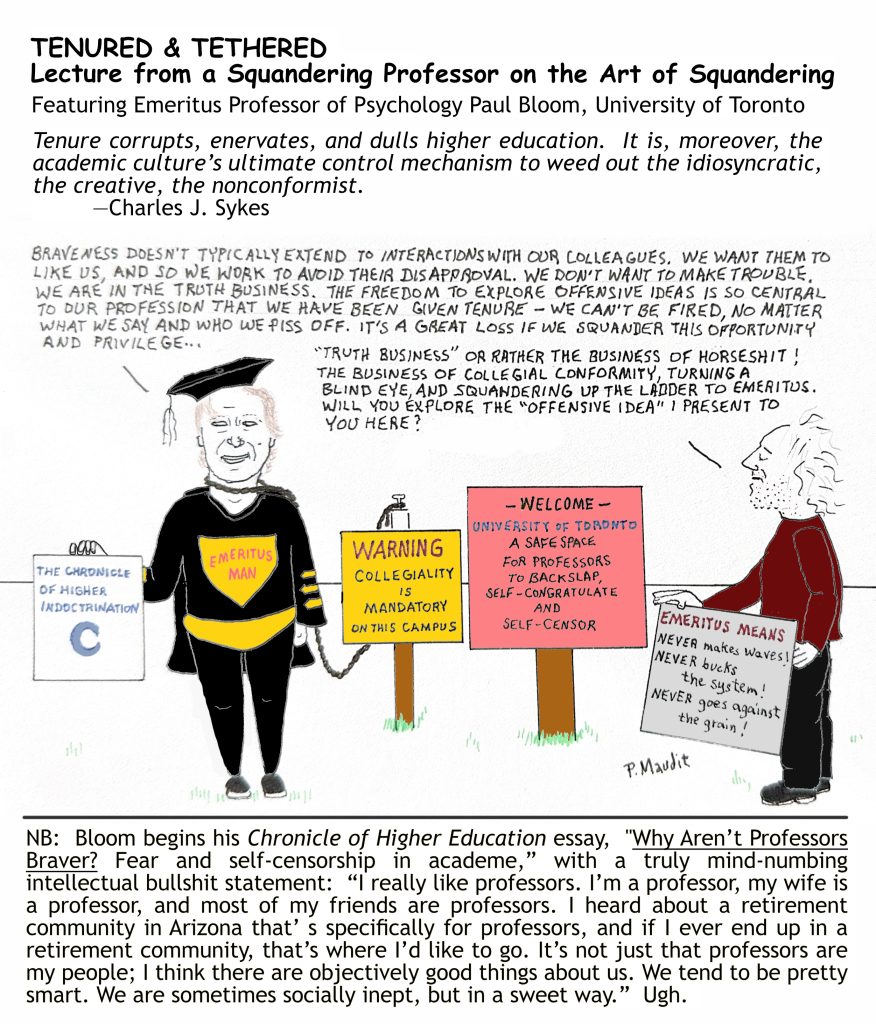
Tenure corrupts, enervates, and dulls higher education. It is, moreover, the academic culture’s ultimate control mechanism to weed out the idiosyncratic, the creative, the nonconformist. —Charles J. Sykes, Profscam
Once upon a time, I was a professor on the tenure track. Over the years, after teaching at two universities in France, I taught at five different colleges in the US, including two HBCUs. At one of them, Fitchburg State University, I openly questioned and challenged my colleagues and administrators for five years while on that tenure track. Due to my idiosyncratic, creative, and nonconformist behavior, tenure was of course not accorded to me, though I received a check for a sixth year after an in-house legal/union fight at that university. At each of the other colleges where I taught, I openly expressed my thoughts and even sent my criticisms to the student newspapers, several of which published them. Bravo to those rare student editors! As an example, examine the letters here. Sadly, however, the student editors at Fitchburg State refused to publish any of my criticisms with its regard. My tenure battle was rough, but rewarding in the sense that from the dross, I created … many essays, poems, cartoons, and even a literary journal, The American Dissident, devoted to criticism against the academic/literary establishment.
Intellectual corruption likely festers in every college for the simple reason that to climb up the rungs of the academic ladder successfully one has to be collegial, turn a blind eye, and never bite the diverse hands that feed. Sadly, I have not yet been able to find a professor who will openly counter that m.o. even in the slight cover of writing an essay or poem. My experiences underscore that the bulk of administrators and chairpersons cannot bear an iota of criticism. Why does it seem that collegiality is far more important than rude-truth telling in the realm of the ivory tower? Why, for example, do few professors ever examine and openly criticize DEI at their institutions and its inevitable assault on freedom of expression, vigorous debate, and diversity of opinion? And what about the dubious status of professor emeritus? Is not that designation, perhaps more than anything else, a seal of administrative approval and collegiality, as opposed to one of courage and rude-truth telling?
What good is tenure if professors who possess it do not dare criticize the institutions that gave it to them? What are the real intellectual limits of tenure? What is the point of tenure if the professors who have it don’t really need it? What is the point of free speech, when poets, writers, artists, and professors don’t really need it because they dare not exercise it regarding the academic/literary establishment that distributes the money, grants, prizes, invitations, sabbaticals, tenure-anointments, etc.?
Since I’ve got only one life to live, I chose to live it in the truth, speak the truth openly, and to hell with recognition, grants, prizes, invitations, and publication possibilities. That’s what I did, for example, at the Festival international de la poèsie de Trois-Rivières … and for that crime, I was never invited back and never again received another $800 government check from the Canadian government footing the bill for the Festival. Yet, I’d have it no other way. Period. Sadly, the other 150-paid invited poets kept their mouths in-lockstep shut, regarding the organizers, as you can read about here. Should not tenured professors (and professor poets) stand up and go against the grain, make waves, and buck the system, especially when that entails a certain degree of personal risk?
Interestingly, tenured professor Camille Paglia argued: “Unfortunately, tenure has led to the ossification of American education. The hiring, promotion, and tenure system has institutionalized sycophancy toward those in power.” How not to agree with that statement! Unfortunately, however, Paglia failed to provide any examples of her not being sycophantic by criticizing her academic employer. She also mirrored the usual tenured professor M.O. of non-response regarding outsider criticism, my criticism, for example.
As for Judge Larry J. McKinney, his statement, made in the Appeal from the United States District Court for the Southern District of Indiana, is spot on: “A tenure system does not select for boldness.” When now and then a professor calls for boldness, I inevitably end up questioning and challenging the professor in question. Rarely, if ever, does the professor deign to respond. Examine, for example, my counter-essay, quite critical of Professor Nolan L. Cabrera and his article, “Dear Colleagues: The Time for Boldness Is Now,” which was published in Inside Higher Ed. Another recent article, this time in the Chronicle of Higher Education, grabbed my attention, “Why Aren’t Professors Braver? Fear and self-censorship in academe.” Its author was a tenured, emeritus psychology professor, Paul Bloom. Unsurprisingly, at least for me, it contained not an iota of “brave” criticism regarding the institutions that employ and employed Bloom: University of Toronto, Yale University, and University of Arizona. Are those institutions really somehow perfect? Hell no! Bloom begins his essay with a mind-numbing statement:
I really like professors. I’m a professor, my wife is a professor, and most of my friends are professors. I heard about a retirement community in Arizona that’s specifically for professors, and if I ever end up in a retirement community, that’s where I’d like to go.
A desire to remain in the professorial box of paucity of braveness is certainly not somehow a manifestation of braveness! As an ex-professor, I certainly learned not to like professors, for nearly all of whom I’d known over the years were anything but brave or bold and in that darkness were pathetically apathetic regarding their particular institution’s punishment of rare free-speech advocates. Bloom praises his ilk, and in essence himself:
It’s not just that professors are my people; I think there are objectively good things about us. We tend to be pretty smart. We are sometimes socially inept, but in a sweet way. We are genuinely excited about ideas—professors spend a lot of time thinking about questions such as the origin of the universe, the nature of truth, the evolution of species, and whether Shakespeare discovered the unconscious. We are often generous. For instance, many professors spend a lot of time mentoring students in ways that aren’t requirements of the job and don’t lead to any tangible rewards. And we are a peaceable lot. If you’re sitting at a bar, minding your own business, and some drunk takes a swing at you, the drunk is unlikely to be a professor.
It seems Bloom has been forever dwelling in the safe-space bubble of the ivory tower. If one does not actively and personally test the immediate waters of that tower, one will certainly not be able to perceive just how murky they really are. Bloom then gets into the article’s purported crux:
But I don’t think we are very brave. We don’t tend to be troublemakers. I’m not denying that many of us say and write things that upset the public.
What about saying and writing truths that upset the administrators and colleagues of ones own university? Perhaps Bloom ought to examine the counter-essay I wrote on one of his University of Toronto colleagues with that regard: “Dull.” If a tenured professor is going to write about boldness, he or she ought to begin by presenting one of his or her career-risking acts of boldness, as opposed to self-inflating fluff. Bloom states:
But this boldness has its limits. It doesn’t typically extend to interactions with our colleagues. We want them to like us, and so we work to avoid their disapproval. We don’t want to make trouble.
Well, that indeed is the fundamental problem that turns professors like Bloom into anything but examples of boldness. Bloom weasels around that problem, adding to the backslapping and self-congratulating, which seems to have become the general professorial M.O. today.
We are in the truth business, after all. The freedom to explore offensive ideas is so central to our profession that we have been given the protection of tenure—we can’t be fired, no matter what we say and who we piss off. It’s a great loss if we squander this opportunity and privilege.
And so, who has Bloom pissed off? Again, he fails to provide a single example. He doesn’t even mention that the few professors without tenure, who actually dare stand up and speak truth (“piss off” colleagues and administrators), will likely not ever become part of his privileged ilk. It is aberrant that the Chronicle would publish an article on how “It’s a great loss if we (tenured professors) squander this opportunity and privilege (to openly criticize),” written by a tenured professor who evidently squanders that opportunity and privilege. The egregious absence of mention of any personal experience testing the waters of democracy in the realm of Bloom’s own university in the article serves as proof that Bloom is indeed a squanderer… lecturing others about squandering. Perhaps it is high time for the editors of the Chronicle to become bold and brave and actually publish harsh criticism with its regard and theirs. Will that happen? Doubtfully!
In conclusion, for a horse, being tethered is not the horse’s choice. For a professor, however, being tenured (i.e., tethered) is the professor’s choice, a choice to self-censor, team play, and otherwise not be brave and bold.
Table of Contents
G. Tod Slone, PhD, lives on Cape Cod, where he was permanently banned in 2012 without warning or due process from Sturgis Library, one of the very oldest in the country. His civil rights were being denied because he was not permitted to attend any cultural or political events held at his neighborhood library. The only stated reason for the banning was “for the safety of the staff and public,” yet he has no criminal record and has never made a threat. His real crime was that he challenged, in writing, the library’s “collection development” mission that stated “libraries should provide materials and information presenting all points of view.” His point of view was somehow not part of “all points of view.” In November 2022, he requested the library rescind its banning decree, which it finally did. He is a dissident poet/writer/cartoonist and editor of The American Dissident.