The Shakespeare Essay that Got Me Blocked by a Jordan Peterson Academy Professor
In response to my critique of his talk on Romeo & Juliet, lecturer Andrew Doyle called me “woke” and an “ideologue,” then deleted all his tweets and blocked me

This article was originally published here.
Well that didn’t go as expected!
Last month (September), I published a critique of the Jordan Peterson Academy lecture on Romeo & Juliet by Andrew Doyle in the online magazine New English Review.
In it, I discuss how Doyle “rhapsodizes” about Shakespeare’s lovers, calling their love not just “true” but “transcendent,” a term he repeats half a dozen times.
I shared the essay on X, tagging both the Academy and Doyle, yet not really expecting a response. But to my surprise, Doyle didn’t just respond. He wrote angry tweet after angry tweet.
At first, he accused me of misinterpreting him:
You appear to have misread everything I said. But don’t worry – it happens a lot.
I responded with a quote from his lecture:
“Shakespeare is dealing with transcendental love, the transcendental heights of love, and when you are in love, Shakespeare seems to say, nothing else matters.”
He answered,
Yes, the intensity of love can blind its subject to all other concerns. That’s precisely why it can be so dangerous.
Then, after Canadian columnist Barbara Kay retweeted my article, calling it a “fascinating and persuasive argument against the received wisdom that Romeo and Juliet is a great love story,” Doyle responded,
A remarkably literal-minded misreading of my words from this chap! He seems to believe I say things I don’t, in fact, say. Romeo is not the idealised form of love – he’s an infatuated adolescent who is drawn into an emotional state too intense for his understanding.
Again, I responded with a quote from his lecture:
“We have true, transcendental, celestial love, as depicted so beautifully in the relationship of R and J… The sexual act between Romeo and Juliet is not degrading. It’s elevating, it’s spiritual. Romeo’s journey is from adolescent lust to a higher form of love.”
He answered,
Well done. You can quote one sentence out of context and ignore the broader points. You’ve wildly misunderstood the lecture, and you’ve also misread Shakespeare. A double whammy! 👏
I responded with a link to my essay and saying,
Perfectly happy to let people decide for themselves whether I’ve misrepresented you and misread the text.
And that’s when the name-calling began.
First, he compared me to the “woke”:
You strike me very much like the woke, trying to impose one narrow interpretation where there are many.
In response, I took the transcript of his lecture and pasted it into both Grok and ChatGPT and asked, “Is it fair to say the presenter romanticizes the lovers?” Both answered affirmatively. “Yes,” said Grok,
it’s fair to say the presenter romanticizes the lovers in Romeo and Juliet. The presenter emphasizes the transcendental, almost divine nature of their love…
“Yes,” said Chat,
It’s very fair to say that the presenter romanticizes Romeo and Juliet in this transcript… The presenter’s emphasis is consistently on the sublime, poetic, transcendental qualities of Romeo and Juliet’s love…
Despite this, Doyle persisted in saying I’d misrepresented him—and proceeded to call me an “ideologue, not a critic”:
Okay, since you are content to write factually inaccurate information in order to make your point, you can’t be taken seriously. You’re an ideologue, not a critic.
At this point, Barbara Kay chimed in, saying she was “disappointed” in his “mean-spiritedness” and calling for “civility.” In response, Doyle criticized her too, saying he “expected better” of her.
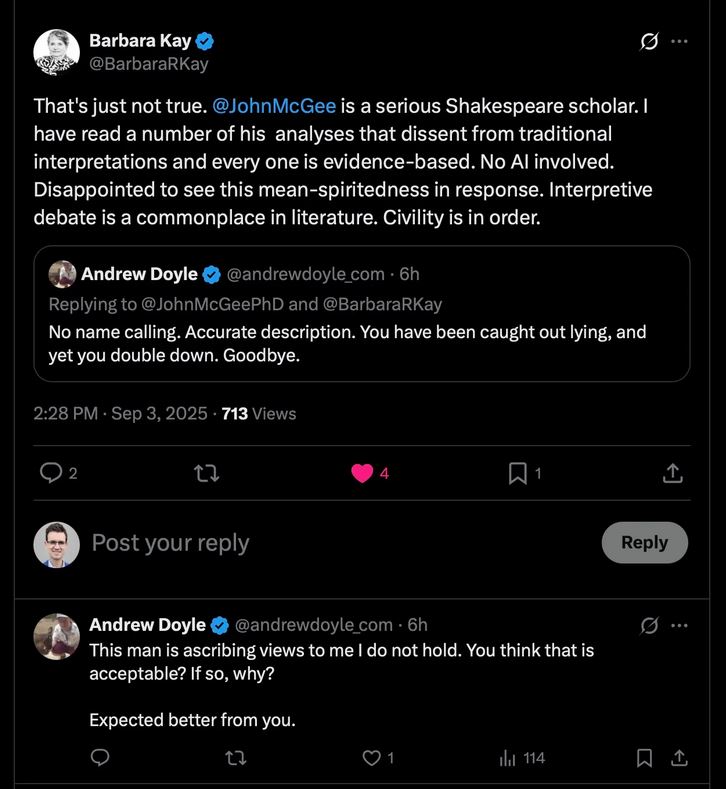
The next day, I asked Peterson Academy if they found this behavior “becoming” of one of their professors:
Dear @petersonacademy and @jordanbpeterson. I wonder if you consider this conduct becoming of one of your lecturers. I publish a critique of his talk. In response, he calls me an “ideologue, not a critic,” implies I’m a liar (”You have been caught out lying”) and compares me to the “woke” (”You strike me very much like the woke”). CC @MikhailaFuller, @jordan_m_fuller.
Doyle responded by calling my tweet “pathetic” and telling me to “grow up”:
How pathetic. If don’t want to be criticised, try the following: Don’t attempt to intuit the private thoughts of others and then present your intuitions as fact. Don’t refuse to retract factual inaccuracies in your work once they have been pointed out. Don’t use AI algorithms to support your misinterpretations of someone else’s analysis. In short: grow up.
But then, the next day, poof! Everything was gone. Doyle had deleted all his tweets—and blocked me.
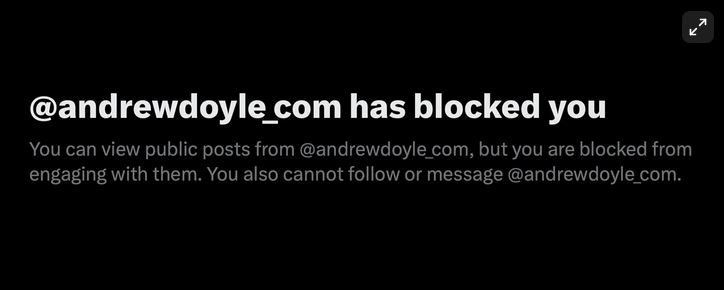
Did he have a change of heart? Or did Peterson Academy pressure him to remove the posts?
Here again is the essay, which apart from critiquing the lecture, presents an overview of my contention that Shakespeare is satirizing the young Italian lovers:

Shakespeare’s Romeo & Juliet—According to @PetersonAcademy
Sep 22
Read full story
If you read it, I’d love to hear what you think!