by Andrew Klavan (March 2026)
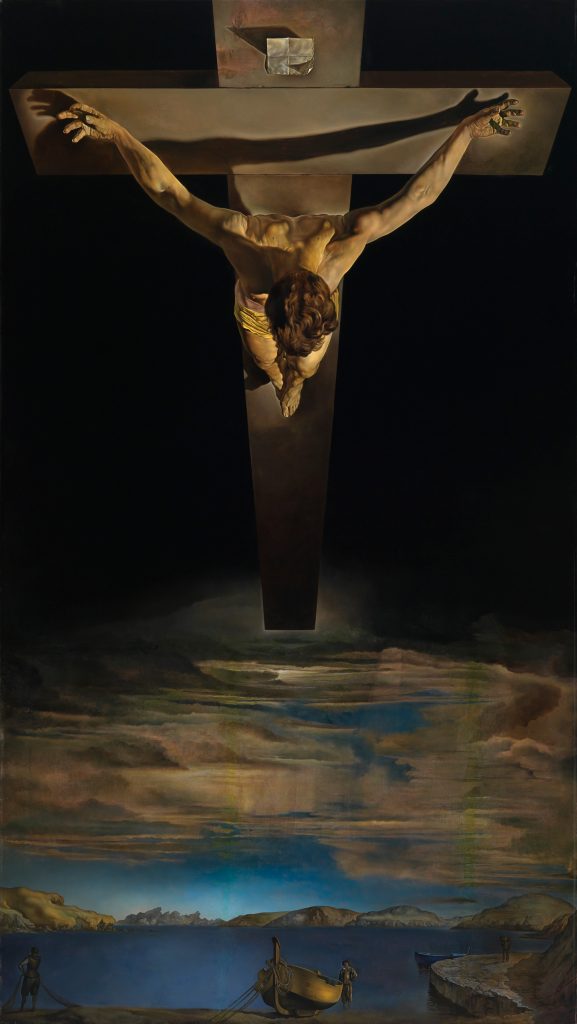
To be clear, I came to Jesus in the hope of getting laid. When I say “Jesus,” of course, I mean Jesus, The Movie, and when I say “laid” I mean, well, laid—having sex—and with the Virgin Mary, no less, by whom I mean Anna del Castillo, who had landed the role despite being widely known for her non-Virgin-Mary-like activities.
Now you may wonder: How did a distinctly secular-type reprobate like myself get involved with a project like this in the first place? After all, I had not gone anywhere near organized religion since I’d leapt over an altar rail at 12-years-old to escape Father Tumescence of Blessed Sacrament Church and Bathhouse in Huntington Long Island. So why had I signed on to write the irredeemably trashy straight-to-streaming piece of pseudo-pious dreck that was the Schmeckel Brothers production of the Life of Christ? The answer is: I had to. It was the only job I could get.
Once upon a time, I had had a thriving and lucrative career as a screenwriter. I had written the Colony X film trilogy. I had created the premium cable spinoff of the same name—hailed by the New York Times as a “profound melding of serious sci-fi with the transgressively pornographic.” But all that success had vanished in a single moment during a panel discussion at the annual Sword and Sorcery Conference in San Diego.
I was joined on that panel by Colony X show runner Julia Yaselhof, among others. Julia was the sort of screamy, evil-eyed feminist bully who, in a more enlightened age, would have been burned at the stake. For some reason, as my mind drifted during what was supposed to be a discussion on “Pushing the Boundaries of the Fantasy Genre,” this harridan started smacking the table with her open hand and excoriating any unenlightened male who would dare to deny a woman her sacred right to choose an “after-birth abortion.” Startled from the fog of a vaguely sado-masochistic daydream, I blurted out, “After-birth abortion? Isn’t that just murder?” There was an audible gasp of shock and condemnation from the enlightened industry audience. In Hollywood, you understand, slaughtering unwanted infants is considered a sort of improved version of the condom: it allows consequence-free sex without deadening penile sensitivity.
Anyhow, my Colony X contract was terminated at the end of the season. And over the course of the next eighteen months or so, I discovered my writing services were no longer required anywhere. I had been blacklisted, in other words— “canceled,” as they call it now—banished from show business for double-bad wrongthink. And while you might have thought I’d have saved some of those millions I’d made over the years for just such an eventuality—no. Aside from my Malibu mansion, my wristwatch collection, my twin S-Class Mercedes Benzes, and my residuals, I had nothing. Plus my second-and-a-half wife had gotten knocked up in a drunk driving accident: I’d gotten drunk and gone driving into her without insuring she was current on her birth control.
Mrs. 2½ was the sweetest of country creatures, an innocent show biz civilian who had clearly married someone else she only thought was me. To her, the destruction of my Hollywood hopes and dreams was an opportunity.
“Don’t you see?” she consoled me, in her whispery down-home accent. “This is really a gift from God, darlin’. If we sold this horrible house and all those silly watches, we could move home to South Carolina. With your residuals and all, we’d have plenty of money there. Plus Daddy would give you teaching work at the college, if you wanted. Then you could finally write that book you’re always talkin’ about.”
Needless to say, I was desperate to avoid anything even vaguely resembling this scenario. So when the Schmeckel Brothers called my agent looking for someone to write their cut-rate religious epic, I leapt at the chance. The Schmeckels had built a profitable business by seizing on whatever genre was currently doing big box office and churning out a few crappy straight-to-streaming imitations to catch the financial run-off. This season, it happened, “faith-based” pictures were all the rage.
“What made you think of me?” I asked them.
“Your agent said you were some sort of anti-abortion religious fanatic,” one or the other of the Schmeckels answered. “The goyim love that shit.”
“I’m your guy,” I said, and signed on at Guild minimum.
Now, my contract required me to attend the first week of filming in Nevada, with travel and accommodations paid for plus a small per diem. The script was already written and there was, to be honest, no reason for me to be there, but there were two reasons for me to want to go anyway. One, my wife was four months pregnant by then and I was beginning to feel the walls of my future closing in on me like a trap in an old adventure serial. And two, the Virgin Mary had come to me in a vision and made it clear that if I did show up, she’d screw me. The Virgin, Anna del Castillo, was a telenovela actress from Mexico. Her main talent was breathing heavily in such a way that her spectacular bosom rose and fell hypnotically during every scene, regardless of the emotional content. She had exhibited this talent during a conversation with me after the table read in L.A. when she placed a cool hand limply in mine and said, “I hope to see much more of you in Nevada.”
So, as I said, I came to Jesus. The movie.
***
In Nevada, the cast and crew were housed in a rundown motel-slash-bar-slash-bordello. It was out in the midst of the desert that would stand in for Roman Palestine, a few miles from the lake that would stand in for the Sea of Galilee. Our director was Jean Chevrolet, a French auteur of insanely gory art house horror films, a tiny little fellow whose bald head resembled a bowling ball with wire-framed glasses on it. He had taken the gig for the cash same as me, but he was clearly trying to convince himself this garbage-fest had artistic possibilities.
“We must weave our deconstruction of theez vapid Christian mythologeez into the very fabric of its narrateeve,” he explained to me in what was either a fake pretentious French accent or a real one.
It was the second day of shooting. On the makeshift set behind us in the motel conference room, the actors were rehearsing the Last Supper, led by our Jesus, Nigel Simon. Like all British actors, Nigel was a raging alcoholic. He had come to Hollywood as a romantic lead of almost angelic beauty. He had been nominated for an Oscar for his performance in the film of his Broadway hit How Gay the Stars! Drinking with single-minded determination, he had managed to transform himself, over a mere seven years, into a desiccated walking corpse. Because of that, and because of his drunken shenanigans, he now couldn’t get hired to clean an on set Port-o-San. So here he was with the rest of us: our Jesus.
It was only one in the afternoon, but already, not only he, but every single one of the apostles were stewed out of their ever-loving minds. As Jean Chevrolet and I conferred, they sat at the long make-believe Passover table. They were slurring their way through the Institution of the Eucharist, collapsing in hysterical laughter at their own jokes.
“Jean,” I explained to the director, “if we deconstruct Christian mythology, the people who would come to see this movie won’t come to see this movie.”
“Thish ish my bloody body,” intoned Jesus in the background. “And oh look, what ho, here’sh my bloody blood!”
“Lovely vintage,” said Saint Peter, sniffing his cup. “Oh, I say, now can we start killing each other over the question of transubstantiation?”
“Forget all that theological shit,” Jesus told him. “Just drink and eat this in remembrance of me, what.”
“Then can we kill each other?” asked Doubting Thomas.
“No, no, no, just drink and eat in remembrance of … oh, I forget what … something.”
“But when can we kill each other?” asked Saint Andrew.
“No killing! Did I bloody stutter? Just drink and eat and remember!”
“I was told there’d be killing,” Saint Peter muttered, disappointed.
“Believe me, mon ami,” said Jean Chevrolet, reaching up to clutch my shoulder, “anyone who believes in such merde will not comprehend the true intentions of our art.”
Leaving Jesus and the apostles sobbing into their goblets with laughter, I returned to my room and phoned one of the Schmeckels. It felt like tattling, but the only alternative was to do more work on the script and, like I said, I was only getting Guild minimum.
“The crazy French bastard wants me to deconstruct Christian mythology,” I complained. “If I do that, you won’t make a dime.”
“Just write something and tell him it deconstructs everything,” said the Schmeckel. “The guy can barely speak English. He won’t know the difference.”
After the call, I sat on my bed, sullenly reflecting that I had only made matters worse. Now I had to figure out how to write something that looked like deconstruction but wasn’t. I wrestled with that project through most of the next day, producing only a single sentence, which I quickly deleted.
At this point, there was a soft knock on my door. I opened it to find Anna Del Castillo, decked in her Virgin Mary mantle.
“I have to go film the Annunciation,” she said breathily—and even under her peasant robes I could see her magnificent breasts rising toward me. “But I’ll be free after dinner.”
“I’ll be waiting,” I told her, breathing pretty heavily myself.
When she was gone, I returned to my laptop and tried again to write something that pseudo-deconstructed Christian mythology. But to my dismay, I found my original scenes had such organic flow and made such internal sense that any additions or subtractions would destroy my one source of pride in this job—namely, that I had actually written an excellent script.
After a couple of hours, I gave up. I wandered out to the desert where they were shooting. There, beneath the key light and camera, was the Virgin, kneeling in the shade of a solitary acacia. A willowy homosexual angel stood above her, breaking the big news that she was about to have magic sex with the Big Guy and bear His son, who was also Him.
Mary lifted her eyes to the gay-gay-Gabriel and her virgin breasts rose and fell as she breathed, “Behold, I am the handmaiden of the Lord. Let it be with me as you have said.”
My lips parted. My breath caught. I knew at once I had made a terrible, terrible mistake. I shouldn’t have come out here. I shouldn’t have watched this. Maybe it was some tattered psychic remnant of my Catholic upbringing. Maybe it was the fact that Anna really was a decent actress, that her face was actually transformed in that moment into an image of innocence and devotion. Maybe it was that that image of innocence and devotion reminded me of the way my second-and-a-half wife looked at me whenever she outlined her horrific plans for my literary and moral reclamation. But in any case, as Anna spoke, I felt my desire for her shrivel in my jeans. With a shock of despair, I realized I could not go through with my plans for the evening—my only real purpose in coming here. My body simply would not allow itself to rise to the task of banging the Virgin Mary.
Oh, oh, oh, what a dejected fellow was I. Humiliated too, because how was I going to explain to Anna that her performance had rendered my performance impossible? I dreaded that moment of failure and revelation all day long.
In the event, however, hallelujah, I was saved by the blood of the lamb.
Anna did not return to my motel room until around seven o’clock that evening. By that time, the rest of the cast had been with Nigel in the motel bar-slash-bordello for several hours. As the door clicked shut behind her, she stepped out of her mantle and stood before me in a v-neck t-shirt and skintight jeans. She didn’t say a word, just breathed and let her bosom speak for her. I could not think of a reasonable excuse not to, so I pulled her against me and kissed her. But as delicious as it was to press that yielding form into mine, it was no good. When I drew back to look into her eyes, I saw the mother of God again and in the mother of God I saw my second-and-a-half wife and in my wife I saw the life I’d meant to live, and my miniature self lay stubbornly dormant in my underwear, refusing to arise and degrade the rest of me as I wanted it to so badly.
A questioning expression came over Anna’s face. I was just about to confess that I’d been struck impotent. Then suddenly—and again, hallelujah! —a fist pounded on the door. Someone shouted, “Help! Come quick! Jesus and Judas are fighting!”
A chance to escape! Thinking quickly, I pretended to give a shit, and rushed out the door into the parking lot as if I might be needed in the fray for some reason. Several members of the crew were already pounding over the asphalt toward the blinking neon of the bar beyond the motel bungalows. I joined the throng and was soon pushing through the glass doors into the shabby tavern.
By then the brawl had become a general melee. Apostles, still in their robes and sandals, were punching one another in the face and flying every which way. Judas rode on Jesus’s back while the Son of God, with the aforementioned blood of the lamb rolling from his hairline into his eyes, kept blindly swinging a whiskey bottle over one shoulder then the other, trying to smash Judas in the head as Judas ducked from side to side.
Various crew members were trying to pull various holy men apart. As often as not, they’d catch a wild elbow and wind up joining the fight themselves. I ran back and forth ineffectually for as long as I could keep up the charade. Then, finally, when there was just no getting out of it, I tried to get between Saint Peter and Doubting Thomas. I’ll never know which one of them hit me, but I was soon sitting in a puddle of beer with stars flashing and bluebirds twittering around my head like in an old cartoon.
Eventually, the donnybrook subsided on its own. Bleeding apostles limped back to the bar and resumed drinking as if nothing had happened. I climbed to my feet and stumbled back out into the parking lot.
Slowly, tugging at the beer-damp seat of my pants, I made my way back toward my room. The lights were still on in there, and I could see through the large window that Anna was gone. A leaden cloud of sorrow descended on me. But sorrow for what? My loneliness, I thought. But loneliness for whom?
I drew a breath of the desert night and looked around me. And from the darkened window of what I knew was the director’s room, I saw a dim glow flickering. The rhythm of the flicker was hypnotic. I was drawn toward it. Soon I was at the window, peeping in through the broad gap in the motel drapes. I saw Jean Chevrolet, sitting at his desk in there, hunched eagerly over his laptop, peering at the monitor. His glasses flashed in the strobic glow as he watched the rushes of yesterday’s filming.
I could see he was mesmerized; delighted. I could see the screen too, and I didn’t blame him. Somehow, he had managed to make the scene quite beautiful. It was the Visitation of the Magi—the three kings bringing gifts to the Virgin and her child. He had filmed it so that it looked like a painting come to life: a chiaroscuro of humility and grandeur. The bejeweled Magi gleamed within the squalid manger. The radiant mother beamed into the desolate night. I could not hear the dialogue from where I was. But I had written it. I knew it by heart.
“Look, Balthazar! Look at the child! It is the face of the living God!”
Exhausted, I shuffled back to my room. I lay down upon my solitary bed. The pompoms on the bedspread pressed uncomfortably into my back. I reached out and switched off the lights so no one wandering by outside—or looking down from the halls of heaven—would see that I was weeping.
***
I spent the last two days of my visit hiding in my room, hoping that Jean Chevrolet would neglect to ask me for the deconstructive revisions I hadn’t written. He never did ask for them, not then, not ever. When my car arrived on Friday to take me to the airport, no one even noticed I was leaving. No one said goodbye.
Another car was supposed to meet me on my arrival in L.A., but my second-and-a-half wife was waiting at the baggage claim instead. She had canceled the limo and come herself. As a joke, she was holding up a piece of cardboard with my name scrawled on it, as if she were my hired driver.
“You didn’t have to do this,” I said. “The car would have picked me up.”
“I was excited to show you,” she said.
“Show me what?” I asked her.
She took hold of my right wrist and pressed my palm against her belly.
“What?” I said again—but before she could answer, I felt the child kick inside her.
I leapt back from her as if I had been burned. I gaped at her, amazed. She giggled and her eyes shone proudly.
Speechless, then, I wrapped her in my arms.
=
Table of Contents
Andrew Klavan is a New York Times bestselling author and Edgar Award-winning writer, known for his crime novels like True Crime and Don’t Say a Word, which were adapted into films starring Clint Eastwood and Michael Douglas, respectively, and Empire of Lies and When Christmas Comes. He’s written over 40 novels, including the Homelanders series for young adults, and has been nominated for the Mystery Writers of America’s Edgar Award six times, winning twice. His latest non-fiction book, The Kingdom of Cain: Finding God in the Literature of Darkness, has been nominated for a 2026 Edgar in the Criticism category. He hosts “The Andrew Klavan Show” on The Daily Wire.
Follow NER on Twitter @NERIconoclast







67 Responses
Too funny
Andrew Klavan is unpredictable and impossible to categorize, but always entertaining. Here the pleasures of the modern secular world are undone by a series of unlikely events leading to the protagonist’s grateful realization.
Love this.
Andrew Klavan is obviously very good at satire. But, call me a prig, had I his talent, I wouldn’t have used it to satirize the icons of Christianity. Perhaps there is a reason it was not previously published and widely seen. His Lord doesn’t like his mother satirized.
I think Klavan was satirizing Hollywood, not Christianity.
Duh. Some people have horrible reading comprehension. I loved it.
He is satirizing materialism and postmodernism, not Christianity.
Did he satirize Christian Icons? Or did he tell the story of a man who was not a believer but then found faith almost accidentally in the movie he wrote and then the miracle of his upcoming fatherhood? Which seems to be the heart of the story.
I think that, if you were more familiar with what Drew says and writes in general, you would have an opinion more like a lot of the other commenters here.
I must agree. True he’s satirizing Hollywood and writing a hyperbolic version of his experience but this didn’t work for me.
It seems to me he is satirizing Hollywood here, with its cheesy attempts to profit from “Christian-y” fare–and showing how even a cynical Hollywood hanger-on can be transformed from an authentic encounter with the story of the Incarnation–however unlikely that encounter may seem–and realize (and return to) the universal truth of the story of Mother and Child.
What a wonderfully concise and raw short story! It reminds me of Twain or Vonnegut.
Fun read. The Lord moves in mysterious deconstructions.
The unmitigated gall! It’s terrifying to behold, almost certainly blasphemous, and horrifyingly beautiful. It reminds me of a story about a man named…wait a minute…I think this guy ripped this story straight out of the Gospels…
Joking aside, thank you Mr. Klavan. This story somehow succinctly encapsulates YOU and the gospel of Christ that has so clearly shaped your life. I’m amazed to consider how you managed it. It’s true, it’s beautiful, it’s good.
“Either a fake pretentious French accent or a real one,” will have me laughing for days!
Thank you for publishing this!
It was hard to see how this would come across without being preachy but you wound it up perfectly. Bravo Sir.
I loved this. One day, not soon, I will stop laughing.
Clever writing. Great threading to a beautiful point or three.
Brilliant! You truly are a master.
You know the feeling, you are taking in some classical piece of art from a long gone master. You wish you could have lived in the same time as that master craftsman.
We are living in the age of Klavan.
Absolutely stellar!👏🏼👏🏼👏🏼
The funniest guys are the ones you should take seriously. I stole that sentiment from GK Chesterton but I can’t find the quote. In any case, I take Klavan seriously and read everything by him that I get my hands on.
I never feel quite so ignorant as when I’m reading Drew’s writings. Like I need to go back to my college lit class. Nevertheless, I’ll always return to read and ponder anything he writes. A look into a truly beautiful soul. Thank you!
Deborah, I so agree with you!
Great short story. Klavan is the GOAT
I have to confess that I read this sitting on the toilet. As a sixty something woman, laughing deep belly laughs, with tears streaming down my face, causes the inevitable bladder failure.
Well done Klavan, as per usual.
I laughed and laughed and laughed, until your left-handed, second-and-a-half wife took your right wrist and pressed your palm. Then, the tears of a supernaturally exquisite and pure, life-centered emotion began to flow uncontrollably, as this excellent story did so much more than I could have expected; and don’t wait for me to explain. Let’s just leave it at HalleluYah.
“Father Tumescence” hooked me right at the start. Such a master wordsmith. Andrew has many styles and is always insightful or funny or both at once.
A real man transformed by the throngs of Christianity! You are a breath of fresh air. Brilliant!
A real man transformed by the throngs of Christianity! You are brilliant Klavan; simply brilliant.
Who else had Another Kingdom flashbacks?
In many ways all of life is comedy when you don’t take yourself seriously. Drew always illustrates this.
Thank you, Andrew Klavan, for recommending this excellent story written by Andrew Klavan. You are masterful in your writing and recommendations.
Beautiful
As I read this wonderful short story, it was if Andrew was giving one of his monologues on “The Daily Wire”. Both his actual and literary voice came through loud and clear, and were a delight . Thank you, Master Klavanator. Well done!
So much fun. It’s like the satirical introductions to your show on the Daily Wire, but much longer!
I watch your show every week, and I am working my way through your entire catalogue of books.
So, let’s have another one…
Good stuff. I feel like this could have been a fun novella too. I would have enjoyed exploring how the words of Christ affected the main character despite himself.
Just excellent.
A man goes looking for blasphemy and stumbles into reverence. That is the oldest Christian joke in the world. The fellow sets out to mock the sacred, to cheapen it, even to seduce the Virgin—yet it is he who is quietly undone. The miracle is not that the holy survives our cynicism; the miracle is that it patiently waits until we are tired of it. Satire often burns down churches, but this one discovers—rather sheepishly—that the church is still standing.
“I don’t know why. Corruption just makes me laugh.” – Drew Klavan
“You know, and we all know, you are not the person God made you to be.” – Also Drew Klavan
“For God so loved the world that He gave…etc..” Drew Klavan, AD 80 when he was helping draft a Gospel, probably.
Loved it, thanks mr. Klavan and N.E.R.!
Satirizing those who would satirize Christianity.
And done, of course, in the unique Klavanesque style.
Classic Klavan. Loved it.
K L A V A N, I think I spelt it right. Thank you for the introduction to New English Review and your submission, Jesus the Movie. As it turns out when I searched New English Review your name and short story were at the top of the search. Anyway, it was a cute story. Classic Klavan. When will The Daily Wire turn it into a movie?
I was watching Andrew Klavan on the Daily Wire, he told me to come here and read this…or pretend to. Now, I shall return to that horrible dark void of Klavanlessness.
It’s beautiful. The protagonist is a wretch, but the Holy Spirit is still calling him, though he doesn’t know it or want it to be. He feels it in the end through the baby’s kick and can’t deny reality in that moment.
I loveAndrew Klavan, and all of his writings. I highly recommend “Kingdom of Cain.”
That was fun. Thank you Klavan – yet again.
I love a good short story. Klavan never disappoints!
Andrew is brilliant in humble presentation – a feast for those who have eyes and ears to hear. Creative yet compellingly honest, he swings my own conscience around until foolishness shakes itself free and flees. This short story reflects truth’s authority over the absurdity of what is anyone’s sin. Masterful.
Leah, thanks for your very poetic and spiritually deep response to the enticements and deception of sin.
Klavan of course paints a satirical picture of having nothing come to mind holding him back from indulging with the ‘Virgin’; all the while his wife and baby are waiting for him. The baby’s kick was perfect against all his foolishness.
I adore Klavan in an entirely platonic way. A true honest man. And a genius. This story… bravo.
I was worried this would become despicable but ended transcendant.
Well done Drew.
Reading Andrew Klavan’s “Jesus the Movie” felt like staring at one of those CAPTCHA grids, agonizing over whether the wicker basket counts as part of the bicycle — except here the question is whether the chaos on the film set is really just a pixelated extension of the human soul’s own unrest. Klavan writes so sharply that you start clicking “select all squares with turmoil” until you realize there’s no way to pass the test without implicating yourself. Brilliant, unsettling, and faintly hilarious, it turns spiritual discernment into a cosmic verification exercise.
So moving! I laughed and cried. Best story I’ve read in a long time.
More Schmeckel Brothers stories, please…
Delightful!
Well, there goes the neighborhood. Klavan is here.
It’s a welcome event though–this dose of Klavanny Goodness will prevent NER from becoming too fusty. We need more art like this: philosophical Christian fiction seasoned with wicked humor and gritty realism.
Hilarious first line. This combination of humor and meaning is brilliant.
Thanks Klavan, it was perfect. Loved the story and the way you write it.
I will read this important short story to my children. Family is the only important thing at the end of the day.
As always, you do not disappoint, Sir. I’ll enjoy reading this to my husband who says that there is something of Irving Bacheller in you and that is high praise.
By the bye, I’m reading your book: The Truth and Beauty. It is one of the most pleasing and important books I’ve read in a very long time and I’ve been reading it slowly, lightly marking personally significant places, trying to draw it out as long as possible. I don’t want it to end.
I came to your work by reading an essay written by Spencer Klavan (no relation) about growing up with his father’s library. It reminded me of my own childhood and of the treasures in our bookcases which were kept partially in the dining room for easy access during family dinners. I’ve looked for that essay since but to no avail, however, I’ve had better luck looking for the father in the essay — you were easy to find. God is good. What an amazing father you are!
I’m enjoying the New English Review. Thank you!
Blessings, ThePlagueFairy
Reminiscent of Flannary O’Connor’s short story Parker’s Back. God can work for and even through miserable, damaged people, even people who have no desire or intention to be of use for good- and His mercy and grace have no bounds.
Loved this!
I wasn’t sure what to expect from this story, but I absolutely loved it. Andrew is the absolute master of snark! Laugh-out-loud hilarious!
Andrew, any hack can write a page turner. It takes real talent to write something funny. Congratulations.
Andrew, I expect. New short story here each month. Start now to ensure you have a healthy backlog, please.
I’d say this piece was a bouillabaisse of Bierce, Twain, Rogers, Vonnegut and Tom Robbins, but in fact it is uniquely Klavan, and for that we give thanks.