New English Review Press
PO Box 158397
Nashville, Tennessee 37215
27 Old Gloucester Street
London, England WC1N 3AX
Submissions should be sent to Rebecca Bynum – [email protected]
Guidelines here.
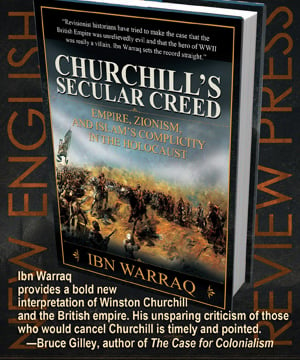
New English Review Press is pleased to announce our sixtieth title: Churchill’s Secular Creed: Empire, Zionism, and Islam’s Complicity in the Holocaust by Ibn Warraq.
The statue of Winston Churchill standing in Parliament Square in London has been repeatedly defaced in recent years – acts which would have been unthinkable to a previous generation. Revisionist historians have tried to make the case that the British Empire was unrelievedly evil and that the hero of WWII was really a villain. Ibn Warraq sets the record straight as only someone born in Colonial India could. Warraq is that rare example of someone who has broken the mental chains of his former culture and embraced Western ideals with a whole heart. He begins the present work by exploring Churchill’s mental development, his prodigious reading, and his military experiences defending India’s northwest frontier with Afghanistan and clashes in the Sudan and Egypt. He explores the immense benefit British colonialism bestowed upon the people of India and how little it benefitted the British themselves. Warraq also goes into great detail about the circumstances of the Balfour Declaration and Churchill’s deep and abiding Zionism and defense of the Jewish nation. Lastly, the absurd idea that Churchill considered converting to Islam is thoroughly debunked.
Advance Praise for Churchill’s Secular Creed:
Ibn Warraq provides a bold new interpretation of Winston Churchill, arguing that his famous success as a statesman was borne of his belief in the civilizational progress that had been achieved by the British empire, whether battling Islamic terrorists, ruling Hindu India, or establishing a homeland for the Jews. His unsparing criticism of those who would cancel Churchill is timely and pointed.
—Bruce Gilley, author of The Case for Colonialism
Great men and their best biographers are often well bred and well read. Churchill and Warraq are well matched here. What our historical icons read matters. Such is the case here with Ibn Warraq’s Churchill’s Secular Creed. Winston’s Churchill’s erudition and moral clarity are rare today, an era where secular and religious fascism have merged. “Totalitarian,” as Churchill might say, is an absolute, then and now.
—G. Murphy Donovan, retired USAF, former chief of Russian (nee Soviet) Studies at ACS Intelligence, HQ USAF, Washington DC.
New English Review Press is pleased to announce the publication of our fifty-nineth title: The Political and Strategic History of the World, Vol. III: Louis XIV to the Brink of World War I, A.D. 1661 – 1914 by Conrad Black.
Advance Praise for The Strategic and Political History of the World, Volume III:
Our modern Gibbon, in this volume Conrad Black takes the reader from the age of Louis XIV to the dawn of World War I with erudition, humour, insight and immense readability. In the course of the gripping story, he stumbles upon the hugely uplifting (and surprisingly Whiggish) fact that Mankind’s ability to govern itself is improving, albeit in fits and starts.
—Andrew Roberts, author of Churchill: Walking with Destiny
Lord Black’s ambitious work is presented with elegance and erudition.
—Dr. Henry Kissinger
Comprehensive world histories often require collaborative teams of scholarly specialists. Contemporary academic historians naturally assume that there can no longer be any Gibbons, Grotes, Mommsens, Bancrofts, or Prescotts still to be found. Conrad Black, however, is a rare historian who has undertaken a narrative, multivolume history of world civilization, and thereby restored the value of that grand classical tradition. This task, of course, demands prodigious research of primary and secondary sources, facility in a number of languages, and a lifetime of wide reading and publication. Such a monumental work is impossible without a fertile imagination, common and good sense, scholarly rigor, a masterful prose style, and unrivaled discipline. In all these areas Black excels. The result is a landmark work of universal history that will capture the public imagination while earning the respect and admiration of scholars for many decades to come.
—Victor Davis Hanson, The Hoover Institution, Stanford University, author of Carnage and Culture and The Second World Wars
New English Review Press is pleased to announce the publication of our fifty-eighth title: Woke: A Critique of Social Justice Ideology, edited by Jon Mills.
Jon Mills’ Woke: A Critique of Social Justice Ideology brings together a high-powered cast of liberal scholars who break new ground in the emerging discipline of “Critical Woke Studies,” the study of cultural progressive extremism. The contributors apply a sophisticated centrist lens—drawing on intellectual history, analytic philosophy, and the sociology of institutional capture—to interrogate the excesses of left-wing race and gender activism. They follow the trail of progressive fundamentalism from its deep roots in postmodernism and critical theory toward its institutional manifestation in the form of DEI activism in universities, professional bodies and other elite spaces. Anyone concerned about the cultural vandalism of Critical Social Justice should read this book.
—Eric Kaufmann, Professor of Politics, University of Buckingham and author of Taboo: How Making Race Sacred Produced a Cultural Revolution
At last, Left and Right agree that woke ideology is intellectually bankrupt. Readers across the political spectrum will find here something to affirm, something to enrage, and in the process, a deeper understanding of the issues.
—Janice Fiamengo, Professor of English (retired), University of Ottawa
When the social, intellectual, and institutional history of our extraordinary and often insane times comes to be written, this book will serve as an invaluable guide.
—Theodore Dalrymple, author of Farewell Fear and The Terror of Existence
This perfectly timed and smartly edited book has something for anyone who has observed, or been subject to, victim ideology run wild. Being a psychiatrist, I was particularly drawn to the eye-opening chapter on the ways in which the woke regime threatens mental health care. Professor Mills has been on the front lines of psychotherapy and his urgent dispatches reveal how social justice imperatives have infected therapists’ ideas about the causes of patient suffering and corrupted their treatment practices.
—Sally Satel, MD, Yale University School of Medicine, author of PC, M.D. How Political Correctness is Corrupting Medicine
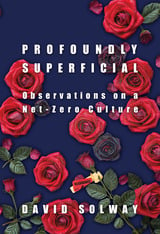
New English Review Press is pleased to announce the publication of our fifty-seventh title: Profoundly Superficial: Observations on a Net Zero Culture by David Solway.
David Solway is one of this generation’s leading chroniclers—and one of its most penetrating analysts and humorists.
In this collection of timely, elegantly written, and often strikingly astute essays, Solway’s moral imperatives are the foundations of each chapter. With a broad pallet of subjects that he works like some epistolary Chagall or Mondrian, Solway juggles these items with finesse: snobby artists abusing art on the public dole, Donald Trump, Feminists, Hockey, Stephen Hawking, the ins and outs of being in and out of academic philosophy; the corruption and collapse of western academics; the viciously biased and inaccurate fake media coverage of Israel, and the false compassion of the political left, just to name a few.
A realist and pragmatist, Solway relies on his excellent eye for detail, his insightful thinking process, and his gift with words and stories to present this important and entertaining collection of prose (with some prose about poetry, too, for good measure). You will be challenged and entertained—and you’ll learn some things, as well.
David Solway is a rare writer with exceptional authorial and observational skills. The result is a very special collection of essays that will stay in your thoughts long after the last page is devoured.
Advance praise:
David Solway is one of the most insightful, perceptive, eloquent and compelling writers of our time. This is not a matter of opinion, or dispute. Anyone who knows his work, as everyone should, knows that he far outstrips even the most widely touted ‘intellectuals’ and writers of our age. If free societies survive and free people in them are reading books from our sorry and absurd age, they will find in David Solway one of the most thoughtful, articulate, and consistently engaging observers of our contemporary scene. If you haven’t read him, it isn’t too late. This book is your place to start.
— Robert Spencer, author of The History of Jihad and The Critical Qur’an
Solway is a man of many parts—poet, scholar, teacher, chess enthusiast, education theorist and literary critic. Hopefully, readers will heed his message and “awareness will precede action and recollection will influence the future.”
—Janet Levy, American Thinker
This is a no-nonsense text—a masterpiece of concision, yet one that is comprehensive in its coverage, and an elegant and droll chunk of prose.
—Bruce Bawer, Arts & Opinion
Solway has mastered the art of leaping from the mundane to the sublime, always in such a way that we are startled into a realization of strangeness.
— Russell Potter, Rhode Island College
New English Review Press is pleased to announce the publication of our fifty-sixth title: Islamizing Europe: Is the Conquest Inevitable? by Hugh Fitzgerald.
The Islamization of Europe has been in steady progress for decades and this fact is finally becoming undeniable both for native Europeans and the rest of the world. Hugh Fitzgerald has been patiently, yet forcefully, sounding the alarm on these developments for over twenty years in column after column written for Jihad Watch, which has been at the forefront of this issue since its inception. Fitzgerald writes with the cool voice of reason as he clearly and calmly lays out the case that unless this demographic catastrophe is reversed, Western Civilization in all its glory will fall.
Twenty years ago, this prediction may have sounded extreme, even laughable, but no one is laughing now that the full horror of the situation is coming slowly into view, and the measures necessary to reverse it become ever more draconian. Unless European political leaders take steps to reverse this trend soon, civil wars may become inevitable in nations that have foolishly allowed the gradual demographic conquest of their lands and political infiltration of their institutions.
____
Only now, with the demographic transformation of the European continent well underway and possibly irreversible, are the facts that Hugh Fitzgerald has been discussing and sounding the alarm about for two decades at last becoming obvious to the distracted and propagandized world. If history is written by free people, they will note that he was a watchman on the wall at a time when precious few dared to make such a stand, or were even aware that doing so was necessary.
—Robert Spencer, Director of Jihad Watch and author of 29 books on Islam and related matters.
Hugh Fitzgerald has been writing for Jihad Watch for over twenty years on the steady but sure Islamification of the West. His articles are witty, well-researched and, above all, expressed in exquisite English. But why is he not well-known, and why has he not received honorary degrees or the Presidential Medal of Freedom, which is normally bestowed on all those who have made especial contributions to national security? Hugh is a modest, and unassuming scholar, but now thanks to the diligence of his friend Robert Spencer we are able to share in Hugh’s knowledge, humour, and counsel. Will we listen? I hope so.
—Ibn Warraq, author of The Islam in Islamic Terrorism and many other works on Islam and the Koran
In crisp, narrative-oriented prose, Fitzgerald brings a sober and well-researched, historical perspective to the critical subject of unassimilable Muslim immigration and its effect on contemporary Western societies. The scholarship is impeccable; the tone, urgent; the wit, lacerating; the argument, powerful; and the conclusion, harrowing. Those who cherish our freedom and security should listen attentively to his message.
—David Solway, author of Crossing the Jordan
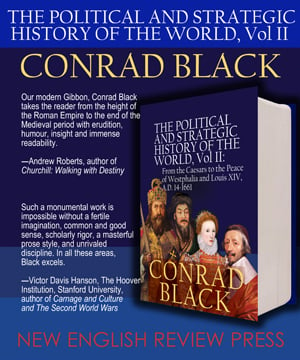
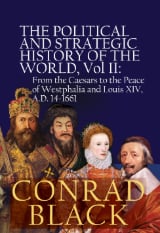
New English Review Press is pleased to announce the publication of our fifty-fifth title: The Political and Strategic History of the World, Volume II: From the Caesars to the Peace of Westphalia and Louis XIV, A.D. 14-1661 by Conrad Black.
In this sweeping second volume of the series, The Political and Strategic History of the World, Volume II: From the Caesars to the Peace of Westphalia and Louis XIV, A.D. 14-1661, covers the height and long decline of the Roman Empire, the barbaric invasions, the rise of Christianity, the Holy Roman Empire and Byzantium, the Mongol and Islamic invasions, the slow rise of the nation states of Europe and the history of the early Church through the Reformation to the end of the Thirty Years’ War and the accession of Louis XIV.
Contrary to the modern proclivity to view history as a coalition of forces working upon passive human society, viewing individual human beings as helpless cogs in the machine, Lord Black insists that history is shaped by very human ambitions and motivations – Churchill’s “fine agate points” on which history turns – individual human decisions made in specific times and places. These are especially illuminated by Black’s learned assessments of the accomplishments of the many and varied emperors, kings, and queens appearing throughout this volume and in which Lord Black often differs markedly with other historians, most notably Edward Gibbon on the role of Christianity in the late Roman Empire.
A delight to read, this is history for the history lover and is also a mighty reference work to be returned to again and again. A must have for all home libraries to pass down to future generations that they may contemplate the doings of their ancestors, draw strength from their courage and tenacity, and revive hope in the certain knowledge that human society continues to progress despite the hardship and setbacks which often accompany it.
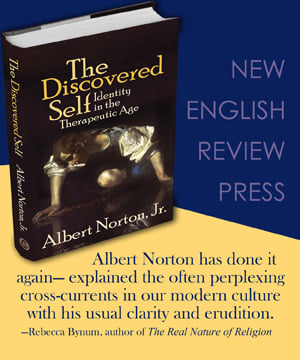
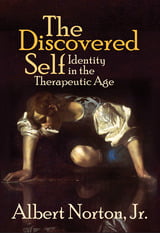
If you think people in general have gone crazy in the last decade or so, you’re right. Some do ok and some barely have their heads above water, but millions wallow in mass delusion about what a human being even is.
Social contagion of mental illness is not unprecedented in the history of the world. What is unprecedented is the shift from a solid objective foundation for truth, to a shifting flow of subjective, irrational emotion. It is a worldview shift, across society, casting us adrift now in ceaseless flow, with no land in sight.
The new dispensation is a self-care therapeutic mentality. It invites us to imagine an innocent emerging authentic self, rather than perceiving that the line between good and evil cuts through every heart. If we imagine there is no real moral structure in the universe, our failures are seen as psychological disorder, an inescapable self-imposed identity. It leaves us to walk through the world in perpetual victimhood, always vulnerable to psychological abuse by an oppressive world. This is bad ideology that has become a social contagion, spreading like a virus.
There is hope. We can break out of the
mind-trap. But first we have to understand it.
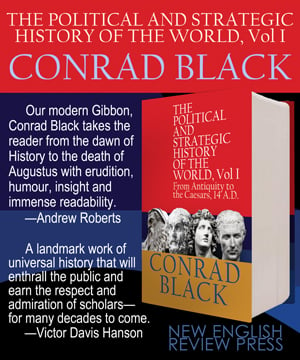
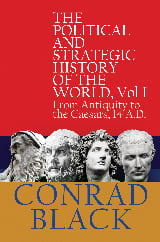
New English Review Press is pleased to announce the publication of our fifty-third title: The Political and Strategic History of the World, Vol I: From Antiquity to the Caesars, 14 A.D. by Conrad Black.
The Political and Strategic History of the World, Vol I: From Antiquity to the Caesars, 14 A.D. covers great swathes of time beginning with the earliest written records of the Hebrews, Sumerians, Babylonians, Egyptians, and the ancient East, through the rise of the Greeks and Persians, the conquests of Alexander the Great, and then the rise of Rome, culminating in the Augustan Empire. The great men and women of the ancient world are portrayed with admiration (or opprobrium) and always with a dash of humor and the perspective that only someone as widely read and deeply learned as Lord Black can deliver. This is a landmark history which will stand together with Gibbon, Mommsen, Prescott, and Churchill among the greatest histories of the world ever written.
Advance Praise for The Political and Strategic History of the World, Vol I:
Our modern Gibbon, Conrad Black takes the reader from the dawn of History to the death of Augustus with erudition, humour, insight and immense readability. In the course of the gripping story, he stumbles upon the hugely uplifting (and surprisingly Whiggish) fact that Mankind’s ability to govern itself is improving, albeit in fits and starts.
—Lord Andrew Roberts, author of Churchill: Walking with Destiny
Lord Black’s ambitious work begins with prehistory and gains momentum with the death of Caesar. It is presented with elegance and erudition.
—Dr. Henry Kissinger
World histories usually require large collaborative teams of scholarly specialists. Contemporary academic history just assumes that are no longer any Gibbons, Mommsens, or Prescotts to be found. Conrad Black, however, is one of a handful of contemporary historians who could undertake a narrative, multivolume history of world civilization, and restore the value of that grand tradition. Yet the singular task requires prodigious research, facility in a number of languages, a lifetime of wide reading and publication, a fertile imagination, common and good sense, scholarly rigor, a masterful prose style, and unrivaled discipline. In all these areas Black excels. And the result is a landmark work of universal history that will enthrall the public and earn the respect and admiration of scholars—for many decades to come.
—Victor Davis Hanson, The Hoover Institution, Stanford University, author of Carnage and Culture and The Second World Wars
Lord Conrad Black is a Canadian-born British peer, and former publisher of The London Daily Telegraph, The Spectator, The Chicago Sun-Times, The Jerusalem Post, and founder of Canada’s National Post. Historian, biographer, columnist, and best-selling author, he is a regular contributor to numerous publications, podcasts, radio, and television In the United States, Canada, and Great Britain. Lord Black has published comprehensive histories of both Canada and the United States, as well as authoritative biographies of Maurice Duplessis, and presidents Franklin D. Roosevelt, Richard M. Nixon, and Donald J. Trump. He is a duel-citizen (Canada and the U.K.) and has been a member of the British House of Lords as Lord Black of Crossharbour since 2001. His latest work is The Political and Strategic History of the World in three volumes.
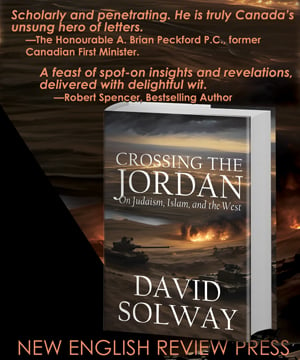
New English Review Press is pleased to announce the publication of our fifty-second title: Crossing the Jordan: On Judaism, Islam, and the West by David Solway:
During these shocking times of war, violence, and hate many are now seeking answers to important questions. What are the bases of the claims of the Jewish people to the Holy Land? What are the foundations of the conflicts between Muslims and Jews? What does Western Culture and its decline have to do with Israel and the Muslims? How does the rise of extreme leftism in Canada and the United States facilitate and encourage extreme hate and violence at home and in the Middle East? These and many other questions are answered by David Solway in this timely collection of essays– easily read, easily understood, and written with erudition, scholarship, and style.
Solway’s style is appropriate for general readers or those with long backgrounds of knowledge of Judaism, Islam, Israel, the Middle East, American and Canadian cultural and political radicalism and decline, the Jewish People, and the intersection of Judaism and Islam in the Middle East.
The most recent horror for the Jews that began on October 7, 2023, can be better understood with a clear understanding of Israel, diaspora Jews, ancient and modern Jewish history, and the decline of the West into moral relativism, communism, and leftist utopianism.
Times of strife and horror are best explained by clarity of thought and writing. Solway provides both in this important work that provides both context and background to the horrors seen recently in Israel, across Europe, in the United States, and across the world.
Advance Praise for Crossing the Jordan:
With his characteristic erudition and clear-eyed realism, David Solway here takes aim at numerous sacred cows about Israel and Islam. Crossing the Jordan provides a bracing wake-up call for those who have been buffaloed and bamboozled, and a feast of spot-on insights and revelations delivered with Solway’s always delightful wit.
–Robert Spencer, bestselling author of The Critical Qur’an and Empire of God: How the Byzantines Saved Civilization.
David Solway is that rare rose, a modern-day man of letters. He is a poet, an essayist and a commentator. The reasons to read him are plain: for his courage of thought, his excellence of style, and the range of his interests and thinking. There is no one writing with more force and consistency, and certainly no one who offers such a freight of insight conveyed with the elan of actual literature, than Solway.
–Rex Murphy is a Canadian commentator and author, primarily on Canadian political and social matters. He was the regular host of CBC Radio One’s Cross Country Checkup, a nationwide call-in show, for 21 years. He currently writes a syndicated column for the National Post.
David Solway is a writer’s writer. He rightly writes that “awareness precedes action. Recollection influences the future.” His focus is the history, experiences, and fate of the Jewish people who, with a very small population, have made an outsized contribution to the advancement of humanity. This book is an exceptionally erudite, well-thought and argued defense of Jewishness, Israel, and Jews. Solway is a champion of reason and of the Jewish people. He writes, “we still need to talk about what we cannot talk about.” This is a powerful collection not only for Jewish readers but for all those whose hearts are with humanity.
–Daniel Mallock, author of Agony and Eloquence: John Adams, Thomas Jefferson, and a World of Revolution
David Solway is a Canadian essayist, songwriter and poet. Winner of several Canada Council and Writers’ Federation Awards, the A.M. Klein Prize for Poetry, Le Grand Prix du Livre de Montréal, and a lifetime achievement award from Le Conseil des arts et des lettres du Québec, he has published over 30 volumes of poetry, travel, translation, education theory and politics, including Canadian non-fiction bestseller The Big Lie: On Terror, Antisemitism, and Identity. His most recent book is Notes from a Derelict Culture. He has also released two CDs of original songs. Formerly writer-in- residence at Concordia University in Montreal, Solway has taught at colleges and universities in Canada, the U.S. and Europe and represented Canada in Europe for the federal government. He was a Contributing Editor for Canadian Notes & Queries and Associate Editor for Books in Canada. He is a member of the President’s Circle, University of Toronto; the Quebec Writers’ Federation; the Research Board of Advisors of the American Biographical Institute; the Canadian Citizens for Charter Rights & Freedoms; and is an Affiliate Member, Order of the Knights Templar, Rosslyn Priory, Scotland. He has written for a variety of online publications, including FrontPage Magazine, American Thinker, PJ Media, LifeSiteNews, The Epoch Times, The Pipeline, New English Review, and C2C. Solway lives in Vancouver with his wife, author and video content creator Janice Fiamengo.
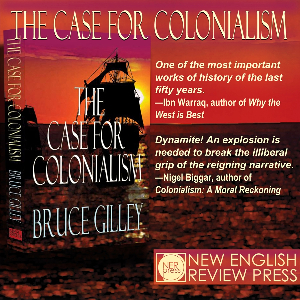
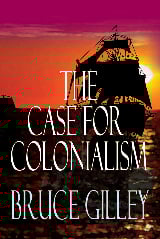
New English Review Press is pleased to announce the publication of our fifty-first title: The Case for Colonialism by Bruce Gilley.

Bruce Gilley’s The Case for Colonialism is, I believe, one of the most important works of history of the last fifty years. In an age of Western self-flagellation, and the loss of civilizational self-confidence, when every ill in the Third World is blamed on Western colonialism, Gilley’s courageous work is a welcome corrective. Of course, it is superbly documented, and the bibliography alone should provide much material for further studies, but Gilley also provides enough evidence and arguments for the case for colonialism. What is most compelling is that Gilley has used the memoirs of the colonized themselves, figures such as Ahmadu Bello, and Chinua Achebe, and Indian economic historians such as Tirthankar Roy, to make the case that it was “improving the lives of subject peoples through a transfer of liberal norms and impersonal governance institutions were the goals…For most colonized peoples, especially women and marginalized groups, European rule was an opportunity more than a threat.” One hopes that Bruce Gilley’s works will put the record straight after years of Western self-loathing, and that other scholars will no longer be afraid to speak the truth about the positive legacies of Western colonialism.
—Ibn Warraq, author of Why the West is Best and The Islam in Islamic Terrorism
Both those who oppose colonialism and approve of colonialism will learn something from reading this book. The Case for Colonialism is a long overdue response from this author to being attacked by a cancel culture mob when he contradicted their ideologies of “anticolonialism”’ and “decolonization.” Here Gilley replies to his critics plus delivers evidence and arguments for four propositions. That European colonialism had legitimacy. That colonialism delivered real benefits. That we should never accept the airbrushing of history by either intellectuals pushing victimhood, or by developing world ruling elites seeking to blame colonialism for contemporary failed policies. And that we should seek to recover the lessons and institutions of colonialism as one of the fixes for today’s weak and failing states. All 16 chapters are filled with insights and provocations worth engaging with, but the 3 chapters on King Leopold’s Congo, Chinua Achebe, and V.S. Naipaul are worth the price of the book on their own.
—Eric Louw, author of The Roots of the Pax Americana: Decolonization and white-Africans and The Rise, Fall and Legacy of Apartheid
Triumphant and noisy anti-colonialists are focusing on past cruelties and illegitimacy, but they still fail to make decolonization succeed. The time has come to address the colonial era as a whole and to unveil success stories and legacies that may empower those in need of development.
—Marcel Yabili is the author of Leopold II: the Genius and Builder King of Lumumba: The Greatest Fake News of All Time
Bruce Gilley was the first to speak out clearly against the “postcolonial” or “decolonizing” caricature of European empires as comprising nothing but a litany of racism, exploitation, and oppression. His brave, lonely stand, of which a full account is given here, has inspired others—myself included—to follow. Bruce always writes boldly, with both verve and intelligence. Some may find what he says provocative; open-minded readers will find it refreshingly thought-provoking. As I muttered to myself upon first reading his now (in)famous essay: “This may be dynamite, but it’s not at all stupid.” As with that essay, so with this book. Nothing less than an explosion is needed to break the illiberal grip of the reigning narrative.
—Nigel Biggar, Professor Emeritus of Moral Theology at the University of Oxford and author of Colonialism: A Moral Reckoning
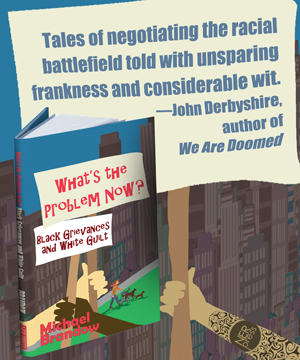
New English Review Press is pleased to announce the publication of our fiftieth title: What’s the Problem Now? Black Grievances and White Guilt by Michael Brandow.

Michael Brandow gives us a personal survey of Jim Snow America, where all social ills are blamed on whiteness and black citizens are showered with preferences and excuses. This is the “lived experience” of an older middle-class white American negotiating the racial battlefield, told with unsparing frankness and considerable wit.
—John Derbyshire, author of We Are Doomed, novelist, critic, and proprietor of the weekly podcast Radio Derb.
What’s the Problem Now? Black Grievances and White Guilt is an old white guy’s witty and insightful account of his struggle to survive in New York City without becoming a racist. Unlike so many others in these uptight times of stifling seriousness and cartoonish certainty, he hasn’t forgotten how to laugh at his race, or at another race. Anecdotes from a lifetime of “culture clashes” with black people are set against playful, non-dogmatic reflections on hot-button issues like black identity, white self-loathing, and racial conflict. This old white guy may not be a racist, but he admits our current infatuation with blackness has made him numb with “racial boredom.” A tragicomedy for people of all shades.
MICHAEL BRANDOW writes on society, the arts, and canine culture. He is the author of four books on subjects ranging from public policy to social history, memoir, and political commentary: New York’s Poop Scoop Law (Purdue, 2008); A Matter of Breeding (Beacon Press, 2015; Duckworth, 2016; Hakuyosha, 2019); Gone Walkabout (Amazon, 2019); and his latest title, What’s the Problem Now? Black Grievances and White Guilt (New English Review Press, 2023). He has contributed to many publications, including the New York Times and the New York Post. He began writing art and social criticism for The New Criterion at its founding in the 1980s (including his most recent “Found, or appropriated?”), and for Peter Collier and David Horowitz at Heterodoxy in the 1990s. Recent essays for Quillette and the Village Voice have been listed in The Best American Essays (“Notable Essays and Literary Nonfiction”). He has been interviewed by many outlets, including The New Yorker (“Talk of the Town”), The Brian Lehrer Show, and the BBC (“Newshour,” BBC Radio London, &c.).
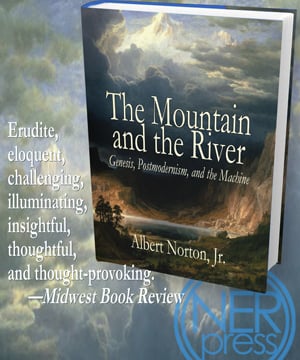
New English Review Press is pleased to announce the publication of our forty-ninth title: The Mountain and the River: Genesis, Postmodernism, and the Machine by Albert Norton.

Erudite, eloquent, challenging, illuminating, insightful, thoughtful and thought-provoking.
— Micah Andrew, Midwest
Book Review.
Whatever
your philosophical or religious standpoint, Mr. Norton is sure to
challenge it in a constructive and thought-provoking way. His dissection of our
current philosophical impasse and its consequences is forthright and
illuminating.
—Theodore Dalrymple, author of Farewell
Fear and Grief and Other Stories.
In The Mountain and the River,
author Albert Norton states that “We all feel the need for a sense of purpose
and meaning in our lives…. Inside each of us is a burbling conviction of our
own significance in a larger drama that yet remains invisible to us.” In the
tradition of C. S. Lewis, Francis Schaeffer and other astute cultural critics,
he notes: “This book is about the chasm between two worldviews: that of Genesis
and that of postmodernism.” Currently, “Western civilization is at a precarious
crossroad”… as postmodern thinking has become pervasive in our culture “like
a virus escaped from the lab.”
Throughout the book the author systematically and
meticulously applies the principles of a comprehensive Christian worldview to a
broad range of contemporary issues – everything from contrasting philosophies
regarding biblical revelation and interpretation to current controversies over
morality and ethics, sex and gender, modern psychology, contemporary political
ideologies, “woke” capitalism, and the impending collapse of traditional
Western civilization. The result is a veritable intellectual feast and
essential reading for those who seek to understand the turbulent times in which
we live. Highly recommended!
—Jefrey
D. Breshears, former history professor, founder of The Areopagus, and
author of American Crisis: Cultural Marxism and the Culture War; C.
S. Lewis on Politics, Government, and the Good Society; and Francis
Schaeffer: A Retrospective on His Life & Legacy.
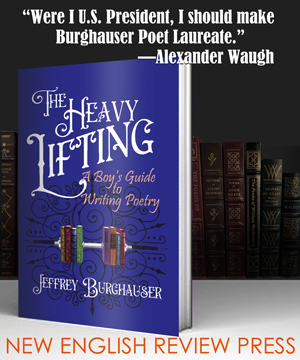
New English Review Press is pleased to announce the publication of our forty-eighth title: The Heavy Lifting: A Boy’s Guide to Writing Poetry by Jeffrey Burghauser.

In The Heavy Lifting: A Boy’s Guide to Writing Poetry, acclaimed poet and educator Jeffrey Burghauser not only makes a case for poetry—he makes a case for poetry’s restoration to the prominence it once enjoyed among the manly arts. In short, pithy chapters, Burghauser guides the aspiring poet through the values, attitudes, and techniques required for a lifelong adventure in language. The Heavy Lifting is at once an instruction manual, a textbook, a manifesto, a piece of literary criticism, a polemic, a pep talk, and an anthology—a mélange recalling Ezra Pound’s 1934 classic ABC of Reading. Find a comfortable place to sit, open this book, and meet one of our most dynamic teachers of poetry.
Advance Praise for The Heavy Lifting: A Boy’s Guide to Writing Poetry:
“In The Heavy Lifting, Jeffrey Burghauser reveals a knowledge of and love for poetry that is simply astonishing in its range and depth. And his commitment to communicating his passion for verse and his skill at stirring the interests of readers – especially his target audience of boys and young men who are, perhaps, least likely to be receptive to what poetry has to offer them (intellectually, emotionally, spiritually) – is truly admirable. This book will be invaluable for teachers of poetry and for all who are keen to learn and enjoy what it has to offer, not only in the classroom, but for life. Every page is an inspiration.”
–Barry Spurr, Australia’s first Professor of Poetry and Literary Editor of Quadrant
Critical Praise for Jeffrey Burghauser’s Poetry:
“I have really never come across a poet as consistently excellent as Burghauser. I bow to his genius, and, were I U.S. President, I should make him Poet Laureate.”
—Alexander Waugh, author of The House of Wittgenstein: A Family at War and General Editor of The Complete Works of Evelyn Waugh
“Jeffrey Burghauser’s poetry tackles the eternal questions with verbal, intellectual and emotional precision.”
—Theodore Dalrymple, essayist and author of numerous books including Ramses: A Memoir
—Ivan Head, Quadrant
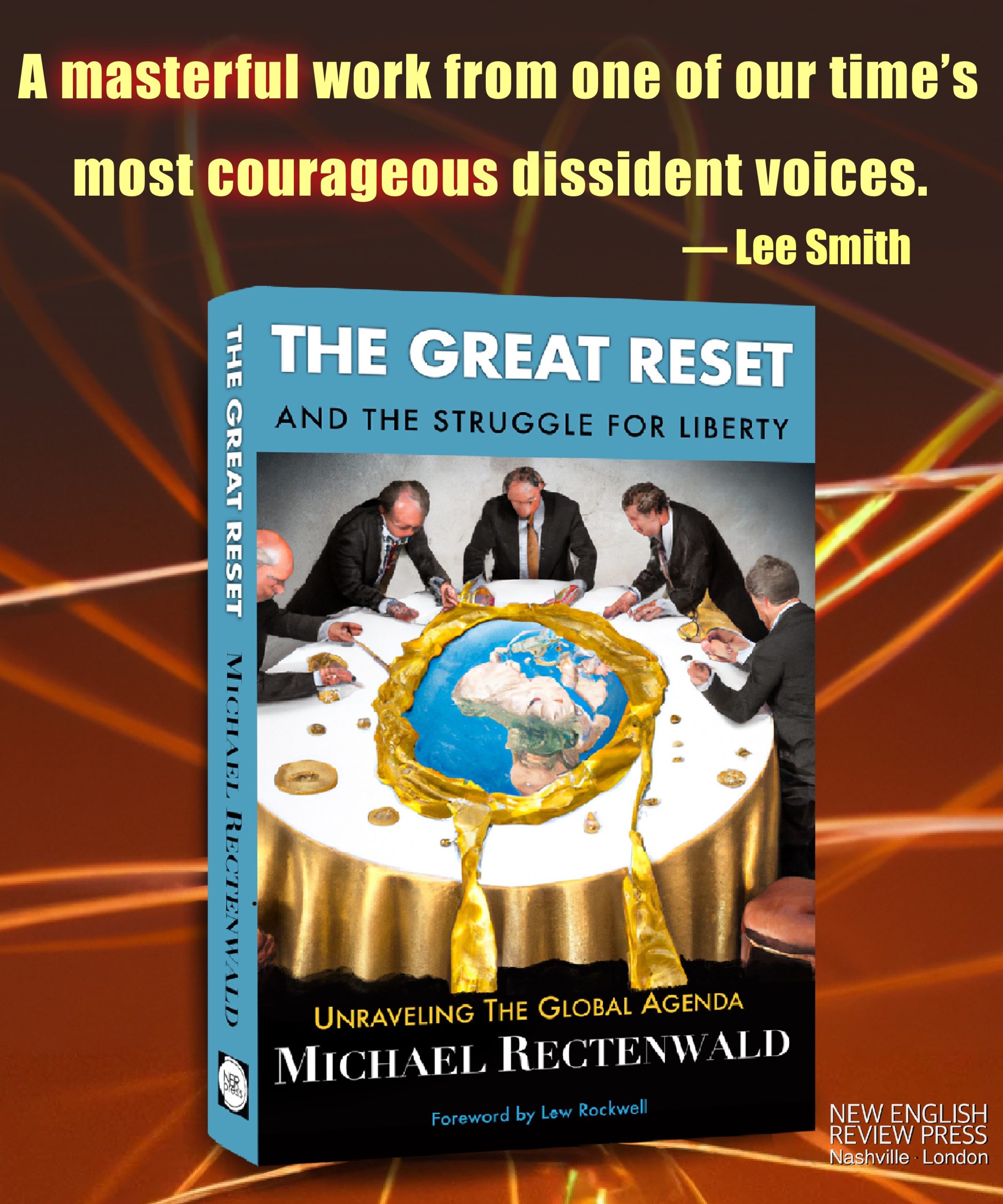
New English Review Press is pleased to announce the publication of our forty-seventh title: The Great Reset and the Struggle for Liberty: Unraveling the Global Agenda by Michael Rectenwald.

The Great Reset and the Struggle for Liberty: Unraveling the Global Agenda is the definitive treatment of the Great Reset. In a scholarly examination, Rectenwald treats the various components of the Great Reset, including the economic system it establishes, the deep history of the World Economic Forum (WEF), the population control “ethics” of the WEF and related globalist organizations, climate change catastrophism, the technologies of the Fourth Industrial Revolution (including transhumanism), and the question of conspiracy theory. Rectenwald ends with a nine-point plan for stopping the Great Reset in its tracks, as part of what he calls the Grand Refusal. Far from a conspiratorial rant, The Great Reset and the Struggle for Liberty is a thoroughly sourced account that lays bare the premises and implications of the Great Reset project.
Advance Praise for The Great Reset and the Struggle for Liberty
“Michael Rectenwald’s The Great Reset and the Struggle for Liberty is a masterful and timely work of intellectual history from one of our time’s most courageous dissident voices. With extensive research in various disciplines — from European history and sociology to American finance, and from AI to climate science — Rectenwald gives us a sweeping and detailed account of the false prophets of an anti-human movement threatening to engulf America and other Western democracies. This tour-de-force is essential reading for those engaged in the ongoing struggle to preserve man’s freedom and future against totalitarianism — and a lasting testament of hope, faith, and love for the generations to come.”
— Lee Smith, author of The Permanent Coup and The Plot Against the President, host of The Epoch Times’ Over the Target.
“When you first hear what the world’s elites are up to, you think: this can’t be true. Unfortunately, dear reader, it is, and we do ourselves no favors by pretending otherwise. In fact, as Michael Rectenwald shows us, their current program didn’t emerge just a year or two ago but is instead the culmination of a century-long effort against the liberties of the people. You’ll see how their current obsessions — woke ideology, “climate change,” vaccine passports, and so on — combine to solidify their dominance. This book lays out, in their own words, their plans and intentions, and what we can do to stop them.”
— Tom Woods, senior fellow of the Mises Institute and host of The Tom Woods Show


.jpg)


.jpg)


.jpg)
.jpg)
.jpg)
.jpg)

.jpg)
.jpg)

%20(2).jpg)