Partly, but I have a suggestion for how to solve it.
By Roger L Simon
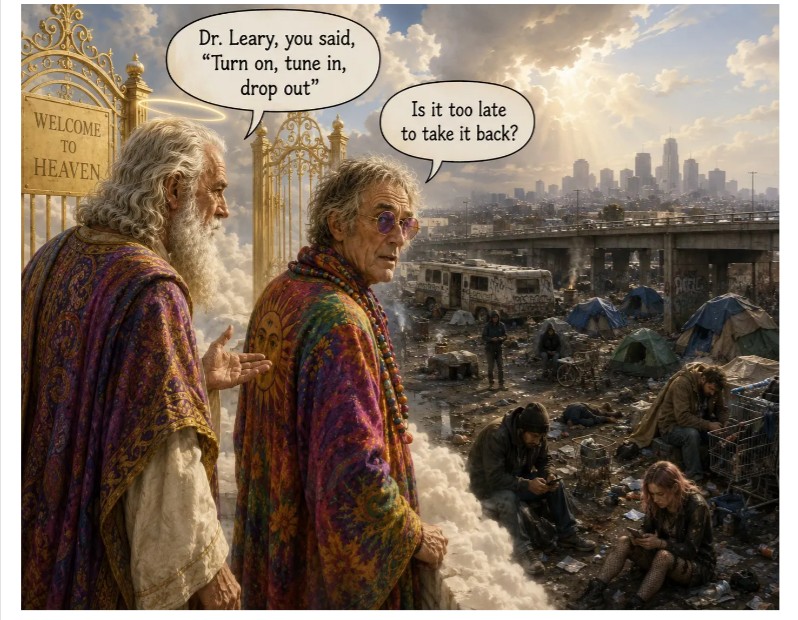
More even than the fires, the success of Spencer Pratt’s independent LA mayoral campaign stems from the massive homelessness caused by the city’s pervasive drug problem.
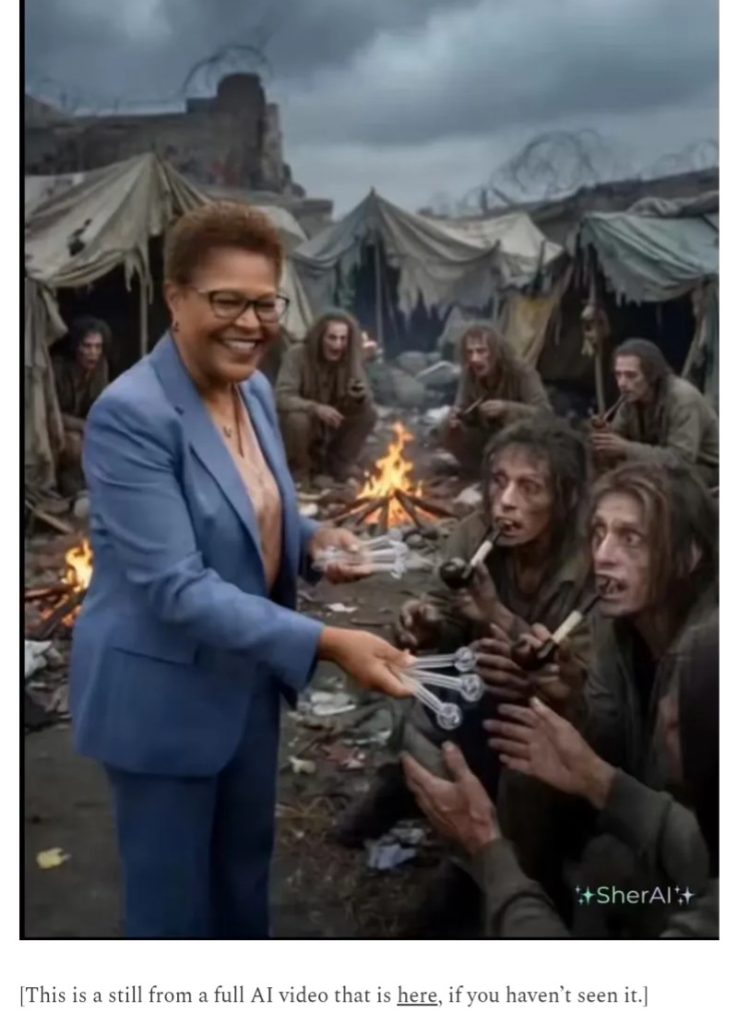
None of this is new. The problem was confirmed for me years ago by a local cop, when I still lived in the Hollywood Hills. He explained the myriad homeless shelters already being built then, at considerable taxpayer expense, were empty because they were drug-free zones. The homeless preferred $70 tents where they could do anything for as long as they wanted, even if it ruined the neighborhood and beyond, not to mention taking their lives.
Karen Bass, Gavin Newsom, et al, aren’t the only ones to ignore this for their own or their friends’ profit and power. An entire system had been instituted around it, the multibillion-dollar bullet train to nowhere being just one example.
From roughly 1980 until our family left the state in 2018, I watched the Golden State decline, culminating in the catastrophe of the last few years.
How was this allowed to happen? Much of it was greed facilitated by one-party rule, but another significant part was the extraordinary prevalence of drugs. Too many people were living in a haze, unable to realize what was happening or, if they did, to summon the determination to do something about it. Others thought it was all groovy, although the word lost its currency decades ago.
Who is to blame for all that?
Well, me, among many others.
From the sixties onwards, much of my generation romanticized getting high. It was part of the zeitgeist. You had to try everything, or most of everything. Be Aldous Huxley.
I did. I smoked opium, ingested psychedelics, including LSD, and various mushrooms and cacti, some of which were hard to stomach.
But the drug that most attracted me, as it also did so many others, was cocaine. I told myself I did it (mostly) for work. After all, Freud used it to write. Admiring the father of psychoanalysis more for his writing style—he was a Goethe Prize winner—than his theories, I would sit up nights at my desk, working on a novel, screenplay, or article, with a line of white powder by my computer.
Then one time, out of nowhere, my heart started to race. Was this tachycardia? A super-fit college basketball player had just dropped dead, allegedly from cocaine. Was that to be my fate? Alarmed, I flushed my entire stash down the toilet, never to touch the stuff again.
Ditto for all illegal drugs. I haven’t done any since then (late eighties) except for trying briefly, out of curiosity, the latest high-THC version of marijuana, which I detested. To say marijuana is not a “gateway drug” is nonsense. All drugs are gateway drugs to one extent or another, including the ones prescribed by your doctor.
Meanwhile, across America, most notably in the City of Angels, people continue to medicate themselves on crystal meth, fentanyl, other opioids, and, still, as much blow as they can get. Some are in executive suites or Hollywood studios, and others are the poor sods in the endless homeless encampments, the so-called “unhoused,” in local parlance, a fair number of whom become violent in their pursuit of a fix. How many of the latter started as wannabe hipsters is unknown.
But the situation stems from something most of us can agree on: life ain’t easy. What you do about that is the ultimate fork in the road.
Some, in the tradition of Timothy Leary, drop out. Others choose therapy. But, as was pointed out in a recent article in The Free Press—”Is Therapy Tearing Us Apart” by Jonathan Alpert, himself a therapist and author of a forthcoming book criticizing his own field—that can have a negative effect. Alpert writes:
“The problem begins with my own field. For years, my profession has trained clinicians to elevate validation over challenge, affirmation over interpretation, and emotional fluency over the harder work of behavioral change. What has followed is the rise of grievance culture dressed up as psychological sophistication.”
I’m not sure that completely covers my many years of on-and-off again therapy of various stripes—that ended, interestingly, about the same time I gave up all drugs—but it is close.
About that time, too, I was noticing vans belonging to the Haredi group Chabad on the streets of Hollywood. They were looking for secular Jewish boys on whom to wrap the leather straps of their religion, known as tefillin. More importantly to me then, they were picking up the addicted homeless and taking them for rehabilitation. I learned that they were among the most successful at that, maybe the most successful, vastly more than the governmental facilities. I was impressed.
But it wasn’t until years later that I found myself becoming more religious for the first time. It happened, as Hemingway put it about bankruptcy, “gradually, then suddenly.”
It began when I was still in Nashville, where I had several devout Christian friends. I was envious of what I observed their religion had done for them, giving them an equanimity about life far greater than mine, despite all the psychology I had studied and all the shrinking. What about my religion? Could it do that for me? After years of circling around Chabad, Sheryl and I joined the Nashville chapter.
This has led me to the belief that the solution to the drug problem, even a mammoth one like LA’s, is through God, G-d, HaShem, the Spirit in the Sky, or whatever you choose to call St. Anselm’s “than which nothing greater can be conceived.”
We are all answerable to God, who governs all in the universe He, She, or It created. He is the “true judge.”
Chabad understood that an addict, homeless or otherwise, must be made to feel and understand the presence of God in order to change. He or she is being watched by an all-seeing force of incredible dimension. At the same time, they must learn to accept God’s love, and that they will be okay if they do, that drugs aren’t necessary.
This may sound corny, but it is a corniness that has ricocheted through the ages. It is the root of Chabad’s success that I had observed years ago.
Does that mean that the homeless problem in our big cities is better solved by religious organizations than the government? To a great extent, it does, especially the best ones of all denominations. It’s obvious that the government has already failed miserably and is likely to continue to do so. It will be interesting to see how Spencer Pratt will deal with this aspect of the problem, should he succeed in the election. I bet he will parcel out a great deal to religious organizations.
XI AND TRUMP IN THE EQUATION
Our president, a teetotaler himself who has seen substance abuse tragedy in his own family, has been firmly focused on keeping drugs out, destroying narco speed boats from Latin America, and then capturing the corrupt Venezuelan president, Nicolas Maduro. He also tried, with an unknown degree of success, to pressure Chinese President Xi Jinping to halt the transfer of chemical precursors for fentanyl to the Mexican cartels.
Sometimes I wish Trump would pay more attention to the opposite end of the drug problem, why Americans use them. You might call that the “just say no” side, though Nancy Reagan’s campaign was a good idea, though it had limited success. It could be reconstituted with more teeth. But there is no doubt our president has made a significant contribution by holding a Mexican president’s hand to the fire for the first time.
No doubt the subject of the precursors came up once again on Trump’s recent trip to Beijing. I am skeptical that Xi finds the topic sympathetic for a significant reason. It wasn’t that long ago, the mid-Nineteenth Century, that the West, namely the British, was responsible for the mass addiction of the Chinese in the two Opium Wars. British businessmen were seeking a balancfor their excessive importation of Chinese tea, but the result was millions of Chinese people being addicted due to the first war alone, with one estimate being as high as 40 million from the two, all from foreign powers illegally smuggling opium into China. It would be hard for a Chinese leader, communist or not, to disregard that. The number of American fentanyl deaths (250,000+), though serious and tragic, is trivial by comparison.
Nevertheless, drugs permeate our cities. Anyone walking around New York and Los Angeles, or Miami Beach, as I have lately, can’t go very far without feeling overwhelmed by marijuana smoke. It’s become a fact of our urban lives that is unlikely to be rolled back by governments, even though it imposes on many citizens.
This brings us back to the role of the religious community, the best parts of it anyway. Chabad is the fastest-growing branch of Judaism for a reason. They preach positivity and oppose attacking others, looking for the good in even the worst-seeming people. This makes them particularly qualified to lift up the homeless. We should try to learn from them.
ENVOI
As those who have read this book of mine know, I did know Timothy Leary. He used to compliment my writing when I was more of a leftie. I doubt he would have cared for EMET.
First published in American Refugees









One Response
the underlined ‘here’ doesnt work.
get on it venue