By Sammy Stein
When people approach the Glasgow Friends of Israel stall on Buchanan Street in Glasgow city centre and declare that Israel is an apartheid state, the accusation is usually delivered with confidence rather than knowledge. It has become a slogan, endlessly repeated, rarely interrogated and almost never supported by evidence. In many cases, it is recited as a moral truth rather than a claim that needs to be defended. A few basic facts are often enough to bring the conversation to an abrupt halt.
The first question I ask is a simple one. Do they know that around 20 per cent of Israel’s population, roughly two million people, are Arabs? Israeli Arabs. Citizens of the state. In most cases, they do not. When I explain that these citizens vote in national elections, are represented in parliament, serve as judges, doctors, academics and diplomats, and organise themselves into multiple political parties, the response is often visible confusion. The apartheid claim begins to unravel almost immediately.
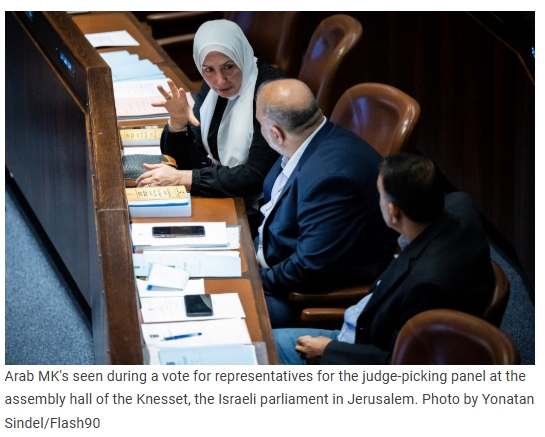 The discussion usually ends altogether when I point out that Arab politicians have not only sat in the Knesset but have held senior government positions. The clearest example is Mansour Abbas, leader of the United Arab List (Ra’am), who in April 2021 made history by joining an Israeli governing coalition and becoming chair of the Knesset’s Special Committee on Arab Society Affairs. No apartheid regime in history has invited members of a supposedly oppressed racial group into government and given them real political power. That fact alone drains the accusation of any serious meaning.
Yet while Israel’s Arab citizens enjoy political rights entirely incompatible with the apartheid narrative, their political representation is currently fragmented and contested. With growing discussion of a general election in 2026, Arab parties have begun positioning themselves for what may come. Within Arab communities, one question now dominates political debate: will the four Arab parties reunite and once again run together as a Joint List?
Recent attempts to answer that question have not been encouraging. Meetings between party leaders, including a special conference held in Nazareth, have ended in mutual recrimination rather than compromise. Accusations have flown, old grievances have resurfaced and efforts to re-establish unity have again failed. This has fuelled anger among Arab voters, many of whom believe continued division serves no one except the politicians themselves.
The Joint List was first established in 2015 as a pragmatic response to Israel’s raised electoral threshold, designed to push very small parties out of parliament altogether. Four ideologically diverse parties—Ra’am, Hadash, Ta’al and Balad—came together not because they agreed on ideology or long-term strategy, but because unity was necessary for political survival. It was an electoral calculation rather than a philosophical one.
For a time, that calculation paid off. In the March 2020 election, the Joint List won 15 Knesset seats, the largest number ever secured by Arab parties. It was a clear demonstration of the political power Arab voters could wield when their parties acted together rather than fragmenting the vote. That unity, however, proved fragile.
Ahead of the 2021 election, Ra’am broke away from the Joint List and ran independently. The remaining parties stayed together but won only six seats. Further disputes followed and, before the November 2022 election, the alliance fractured again. Hadash and Ta’al ran together and secured five seats, Ra’am again won five seats on its own, while Balad ran independently and failed to cross the electoral threshold altogether. Since then, the Joint List has effectively ceased to exist.
The political consequences of this fragmentation are measurable and stark. Surveys consistently show that Arab voter turnout rises sharply when parties present a united front. Polling indicates that if a Joint List were re-established, turnout would reach around 62 per cent. Without such a list, participation is expected to fall to approximately 51 per cent. In a proportional system with a relatively low electoral threshold, that difference can mean the loss of four to six Knesset seats. In real terms, fragmentation translates into wasted votes, reduced leverage in coalition negotiations and less funding and attention directed toward Arab municipalities.
This frustration is rooted in real and pressing concerns. Arab communities in Israel face serious challenges, particularly rising levels of crime, gang violence, illegal weapons and weak local governance. These are not abstract issues debated in political theory. They affect daily life, personal safety and economic opportunity. Many Arab voters have grown weary of protest politics that generate headlines but deliver little improvement. What they want are tangible outcomes: safer streets, better housing, improved infrastructure and effective policing.
At the heart of the failure to reunite lies a deep ideological divide over the purpose of Arab political participation in Israel. On one side stands Mansour Abbas and Ra’am, advocating a pragmatic, integration-focused approach centred on civil rights and material improvements. Abbas has openly acknowledged Israel as a Jewish state, arguing that accepting this reality is essential if Arab politicians are to achieve anything of substance for their constituents. His position is blunt. Political representation is meaningless unless it produces concrete results.
On the other side are parties and factions whose primary focus remains Arab-Palestinian national identity rather than citizenship within the Israeli state. They oppose joining governing coalitions on principle, arguing that participation would make them complicit in decisions related to security, Gaza or the West Bank. Their rhetoric consistently frames Arab citizens of Israel as part of the Palestinian people first and foremost, rather than as equal stakeholders in Israel’s democratic system. Refusal to engage with power is presented as moral purity, even when it guarantees political irrelevance.
Abbas’s decision to join a governing coalition in 2021 was unprecedented and deeply controversial. His opponents accused him of legitimising Zionism and betraying Palestinian identity. More recently, critics have claimed he deliberately obstructed efforts to revive the Joint List in order to preserve his freedom to negotiate with future coalitions. Abbas has responded by arguing that simply winning more seats is not enough. The real challenge, he insists, is turning political leverage into real improvements for Arab citizens.
His recognition of Israel’s Jewish character has been particularly contentious. Critics describe it as capitulation and argue that the Jewish identity of the state is an existential issue for Arabs given the events of 1948. Abbas counters that decades of denial have achieved nothing except continued marginalisation. That disagreement sits at the core of the current impasse and explains why unity remains so elusive.
Despite the bitterness, some analysts believe a limited form of unity could still emerge shortly before the next election which will take place by October. Electoral arithmetic may force reluctant compromises, particularly after Balad’s failure to cross the threshold in 2022. Pressure from voters may also play a role as frustration with continued division grows. Any renewed Joint List, however, would likely be tactical rather than ideological, designed to maximise votes while postponing fundamental disagreements until after polling day.
If such a list is re-established, Arab representation could once again reach double figures, restoring a degree of influence and credibility. Turnout would rise and bargaining power would increase, potentially allowing Arab parties to secure greater investment and attention for their communities. Even then, the underlying ideological divide would remain and disputes over coalition participation would likely resurface once the election is over.
If unity fails, the outcome is predictable. Turnout will fall, seats will be lost and Arab political influence will continue to decline. The loudest voices will remain the most uncompromising, and the communities they claim to represent will bear the consequences.
What this entire debate ultimately exposes is the hollowness of the apartheid accusation so casually levelled against Israel. Arab citizens of Israel are not fighting for the right to vote, to stand for office or to participate in government. They are engaged in an internal argument over strategy within a democratic system that guarantees those rights. The real struggle is not against oppression, but over how best to use political freedom. That reality alone demolishes the apartheid lie, and it is precisely why Israel’s critics work so hard to ignore it.
Sammy Stein is the Chair of Glasgow Friends of Israel
Illustration from the website of The Israel Democracy Institute