By Janice Fiamengo
Nowhere is feminism’s assault on our civilization so clear as in the domain of sexual assault law.
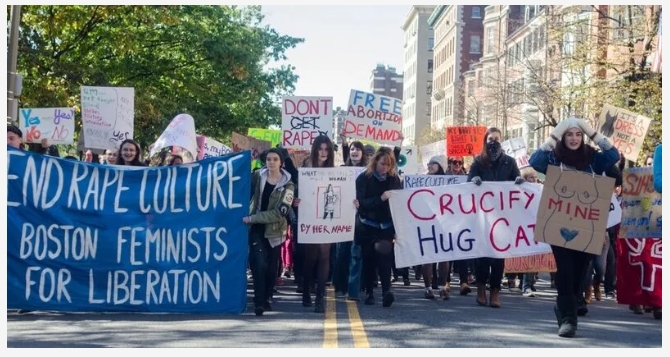
It is now routine, even among those who don’t call themselves feminists, to refer to female accusers as victims rather than complainants. High profile cases are frequently discussed as if the fact of male transgression is almost beyond doubt. In cases where a not guilty verdict ensues, feminist advocates are given abundant opportunity—usually without any rebuttal—to complain about the result and make catastrophizing predictions. Most seriously, perhaps, feminist activists no longer hide their desire to change the law so that fewer men, in future, can mount a successful legal defense.
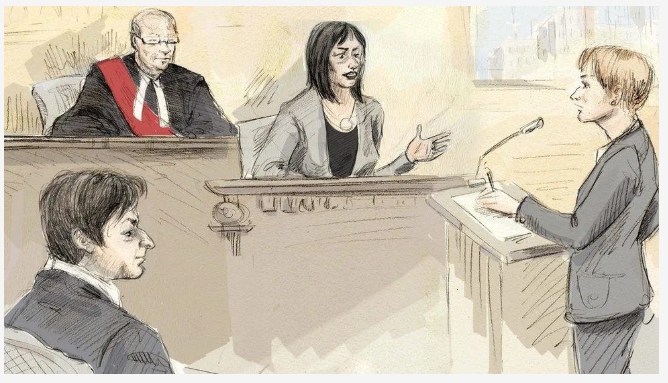
Following Jian Ghomeshi’s 2016 acquittal on four counts of sexual assault and one count of choking (more on this case later), two feminist law students, Samantha Peters and Naomi Sayers, wrote in the Huffington Post to propose scrapping the current legal system altogether. It too obviously “prioritize[d] the rights of an accused over the rights of survivors” and thus needed to be “reimagined” so as to be “accountable to sexual assault survivors.” Given that it is not, in most cases, possible to know who is an actual “survivor” without a properly-conducted trial, their assertion was an example of question-begging at its finest.
The two writers, identifying themselves as “Black and Indigenous feminists,” proposed special sexual assault courts that would operate on a different basis from other courts of law. Feminist training would be mandatory for judges in those courts, and a “trauma-informed foundation” would govern judges’ decisions. Trauma theory, which was frequently referenced in Harvey Weinstein’s 2020 New York trial, explains away inconsistencies, gaps, or untruths in complainants’ testimony as owing to their traumatic experience. “We believe all survivors of violence, especially sexual violence,” they affirmed.
Though the article was perhaps more mawkishly written and incoherent than most, it was in line with many feminist declarations following high-profile sexual assault trials in North America. No matter the trial’s outcome, but especially in cases where an accused is found not guilty, feminists have made clear over the past two decades that they reject the foundational principles of western jurisprudence, including the role of a trial to seek truth through rigorous cross-examination of witnesses and close study of the evidence.
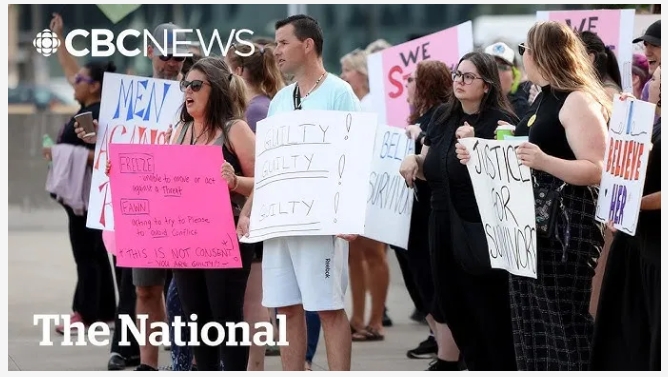
A vivid example was recently provided by the vociferous outcry this past July over the long-running Hockey Canada sexual assault saga, in which five professional hockey players, formerly with Canada’s National Junior Hockey Team in an incident from 2018, had their careers and reputations destroyed by a woman who could barely keep her story straight on the witness stand. After years of media characterizations that assumed the guilt of the accused and shrugged off the accuser’s inconsistencies, the trial ended with a full acquittal. Judge Maria Carroccia exonerated the five men in a 91-page judgement, and detailed the many untruths of the complainant that made her evidence unreliable. (I summarized and commented on the judgement here and was interviewed about it here.)
Undeterred by the volume of the judge’s meticulously-chronicled evidence, feminist legal scholars and advocates, their voices amplified by feminist-compliant journalists, continued to express their unshaken belief in the complainant’s victimhood. In the days following the verdict, they combed through the judge’s ruling (see The Globe and Mail’s “Analyzing Justice Maria Carroccia’s Hockey Canada Verdict”) not to examine her arguments and reasoning, but to find places where her sympathy for the accuser could be criticized as insufficient and where she allegedly relied on victim stereotypes.
For example, University of Ottawa law professor Daphne Gilbert alleged that, in focusing so squarely on the complainant’s inaccuracies and misrepresentations, the judge had engaged in “victim blaming” of E.M., the (still anonymous) accuser. The possibility that the accused men—their lives on hold and their reputations besmirched for years, through two police investigations, a sensational civil suit, and a tortuous trial—were the true victims is simply not conceivable in Gilbert’s worldview. “Given [the complainant’s] grueling nine days on the stand,” she scolded irrelevantly, “that is an incredibly damning indictment of E.M.” Gilbert offered no evidence for why the indictment was unjust, and seemed unconcerned about the problems with E.M.’s testimony.
Another University of Ottawa law professor, Constance Backhouse, even went so far as to instruct the judge on how she should have written her ruling to meet feminist approval. “It is true that judges must weigh evidence carefully, and make a judgement call about whether the offence has been proven,” Backhouse hedged, perhaps coming as close as she could to admitting that she couldn’t disagree with the judge’s verdict on its merits. “But a wiser decision would have left it at that—simply making the point that the Crown did not prove the case beyond a reasonable doubt.” Even in a case where the evidence to acquit was, in the judge’s view, insurmountable, it was apparently not acceptable to impugn the truthfulness of the “victim.” Better to let the taint of the accusation forever stain the accused men.
Did it matter to these law professors whether the accuser had been telling the truth or not? E.M. had changed her story over the years in order to make the accused seem more culpable, directly contradicting earlier statements she had made to police. She had collected an undisclosed sum in a settlement with Hockey Canada, the sport’s governing body, based on a narrative that was ultimately disproved—in many cases with video evidence—at trial. That evidence included two video recordings in which E.M., smiling and not evidently inebriated, explicitly consented to the sex she later said the players should have known she didn’t want. It also included video evidence from Jack’s Bar where, contrary to what E.M. had claimed in her statements, the accused had not plied her with drinks, caused her to become inebriated, cut her off from her friends, and began sexually assaulting her on the dance floor (on the contrary, the video evidence showed E.M. touching the accused).
One might have thought that professors of law would be embarrassed to demonstrate such partisan disregard for facts and such indifference to the fate of the falsely accused. But this is how it is today with sexual assault trials. No matter how often the accuser is shown to have lied or to have clearly indicated consent, feminist pundits insist that an acquittal is a profound miscarriage of justice. They allege, as in a typical article published immediately following the Hockey Canada verdict, that the trial outcome “could have a chilling effect on all victims of sexual assault” because it allegedly creates a “dynamic” in which “sexual assault is de facto decriminalized.”
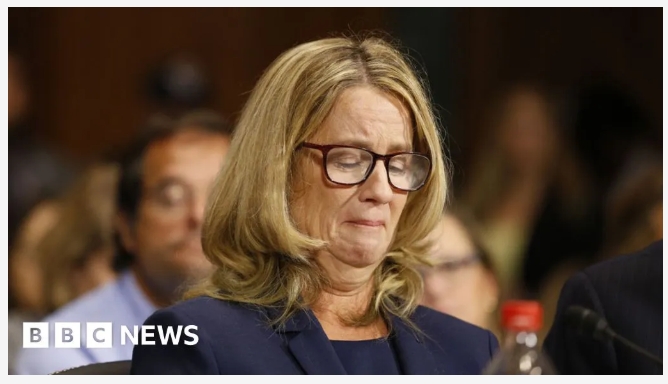
Hostility to the law has always been a plank of feminism, and is now remarkable only in its wide acceptance. “If you’re a rich, white guy with powerful friends, it seems you can get away with anything,” as feminist journalist Arwa Mahdawi phrased it crudely in The Guardian when Christine Blasey Ford’s “brave and moving” Senate testimony failed to scuttle Brett Kavanaugh’s Supreme Court confirmation.
A century and a half earlier, women’s rights leader Elizabeth Cady Stanton had written of a convicted female baby killer (later pardoned, as women usually were for such crimes) that “Men have made the laws cunningly, for their own protection; ignorantly, for they can never weigh the sorrows and sufferings of their [female] victims” (1868, qtd in The Selected Papers of Elizabeth Cady Stanton and Susan B. Anthony, p. 191). In typical feminist style, the victim in Stanton’s telling was the female murderer, not the newborn infant whose life she had ended.
Well-known feminist theorist and philosopher Simone De Beauvoir, herself accused of sexually abusing her under-age female students, alleged that hatred of women had been codified into patriarchal law over the centuries: “Afraid of woman, legislators organize her oppression” (The Second Sex, p. 88). Feminist law professor Catharine MacKinnon dedicated her career to the proposition that the legal notion of consent was inadequate to the realities of women’s inequality, with the result that “consent to sex, or failure of proof of nonconsent, is routinely found in situations of despairing acquiescence, frozen fright, terror, absence of realistic options, and socially situated vulnerability.” These and many similar pronouncements have led feminists to side reflexively with accusers and to regard due process in sexual assault cases as a barrier to justice.
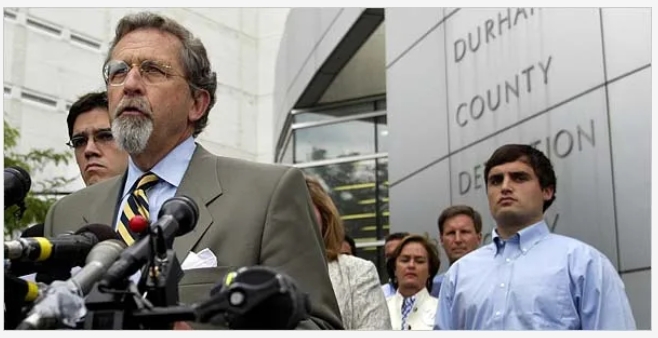
The paradigm was the 2006 Duke University rape hoax, in which three lacrosse players were falsely accused of rape by stripper and prostitute Crystal Mangum, a convicted felon with a history of abuse allegations who was eventually convicted (years after the Duke case) of assaulting one boyfriend and murdering another. (She recently confessed to fabricating the entire Duke incident.) Before the accused lacrosse players were even charged, the scandal became a pageant of exultant finger pointing and racial denunciation in which a corrupt district attorney, a craven university president, and hundreds of ideologically-motivated journalists and campus activists—including a large group of Duke faculty members calling themselves, in approved Communist style, the Group of 88—sanctified the alleged victim and excoriated the players.
Within days, Wanted posters blanketed the campus, players were singled out for condemnation in their own college classrooms, and protestors gathered to bang pots and chant slogans outside the team captains’ rented house. News headlines showcased the unapologetic ease with which the players’ guilt was assumed and promoted: “Is Jock Culture a Training Ground for Crime?”; “Sex, drink, rape: the fall of college sport”; and “Ugly stereotypes surface in Duke rape case.”
The latter article, by Lynne Duke (no relation) in the Los Angeles Times, made it clear that it didn’t matter whether the legal case against the players was ever proven; they had already been found guilty not only as privileged white boys but even as repugnant symbols of the slave owners of old: “Whatever actually happened the night of March 13 at Duke University,” the author announced, “it appears at least that the disturbing historic script of the sexual abuse of black women was playing out inside that lacrosse team house party.” Fully aware that the players had protested their innocence, the writer nonetheless insisted that the incident was “in some ways reminiscent of a black woman’s vulnerability to a white man during the days of slavery, Reconstruction and Jim Crow.”
Even after the players had been exonerated through DNA evidence and the district attorney disbarred for his lies, the febrile atmosphere of denunciation remained, and none of those who engaged in moral posturing at the players’ expense was ever held to account. Fervent feminist blogger Amanda Marcotte did not restrain her fury when charges against the players were withdrawn, fulminating that “I had to listen [on a CNN news program] to how the poor dear lacrosse players at Duke are being persecuted just because they held someone down and fucked her against her will—not rape, of course, because the charges have been thrown out.” For Marcotte, there was no possibility that the players were not guilty: “This is about race and class and gender in every way, and there’s basically no way this woman was going to see justice.”
In 2010, feminist professor Michael Kimmel of Stony Brook University was still eager to name the Duke lacrosse incident in his hit piece “Lacrosse and the Entitled Elite Male Athlete” as an example of how masculine privilege allegedly leads to sexual violence:
“Yes, yes, I know,” he defended himself for using falsely-accused innocents as an example of male predation: “The woman who accused them turned out to be a lying schemer; the guys were exonerated. But it’s interesting that their friends and classmates found the story utterly plausible, as they told countless reporters. And the team did, after all, hire strippers for their team party in violation of all team and university rules.”
Kimmel writes poorly and with hollow moral condemnation, but he provides a useful window on the feminist need to demonize white men. Kimmel’s allegation that “friends and classmates” were willing to slander the young men at the height of the Duke mobbing would seem to invalidate his thesis about the “code of silence” that enables male sexual cruelty, but the professor is clearly less interested in making a logical argument than in condemning any man unlucky enough to find himself accused of a sexual crime. (Kimmel was later denounced in turn for sexual harassment and exploitation by two former graduate students, one of whom wrote a detailed account of his alleged sexism.)
At least Kimmel was willing to admit—sort of—that Mangum was not actually the men’s victim. In later cases, feminist pundits have not even been willing to go that far. They have insisted instead that dubious behavior or outright lies by accusers do not invalidate the central truth of their victimhood and that every man acquitted represents an insult to victims everywhere. Yelps of outrage in the years since the Duke rape hoax have been predictable and unremitting, as in the following select examples:
“How Rolling Stone’s campus rape story could discourage victims from speaking out”; “Advocates fear Jian Ghomeshi verdict will cause survivors to suffer in silence”; “Overturning of [Mustafa Ururyar] conviction signals need for mandatory judicial education in sexual assault”; “Bill Cosby’s Release Could Have a Silencing Effect on Victims, Advocates Say”; “The Depp verdict could bring a chilling effect for domestic abuse survivors”; “Harvey Weinstein’s quashed rape conviction sends disturbing message to women survivors of sexual violence”; “Trump administration full of abusers sends a message that violence against women is acceptable”; “Kevin Spacey’s acquittal on sexual assault charges will have ‘chilling effect’ on other victims coming forward, legal expert says”; “Sex trafficking survivor says Diddy verdict sends a chilling message”; “Advocates concerned about effects of sex assault acquittals on victims everywhere”; “Hockey Canada trial ruling could send chilling message to victims, say advocates”; “Hundreds of stayed sexual assault cases send chilling message to victims, advocates warn.”
It not clear whether any of these feminists think investigations and trials are necessary in sexual assault cases, given that failures to convict are always, for them, a “chilling” travesty of justice.

Disregard for the presumption of innocence is commonly expressed by feminist advocates, including, in a particularly striking example, Ottawa writer Julie Lalonde, who was interviewed at length for a news article about another rush to judgement. This one was at the University of Ottawa in 2014 when, amid abundant anti-male grandstanding by the university president and chancellor, two varsity hockey players were accused of raping a woman in their hotel room after a game in Thunder Bay, Ontario. The entire hockey team was suspended following the incident, and there was much breast-beating about rape culture and sexual harassment on campus. When both players were at last acquitted in 2018, an emotional Lalonde was bombastic about the damage, saying “Every time we see a high-profile sexual assault trial result in an acquittal, it sends women back 50 years.”
Feminist theory has been spectacularly successful in seeding contempt for legal principles. It argues that western jurisprudence has been and remains biased against women, unwilling to believe their testimony or care about their suffering. Feminist author Kate Millett claimed falsely in her blockbuster Sexual Politics (1970), that “a woman convicted of a crime is awarded a longer sentence” than a man—allegedly to keep women acquiescent and afraid (p. 56). Radical feminist author Andrea Dworkin wrote thousands of words about the male justice system’s inability to believe that rape victims don’t want to be raped: “She wanted the force, the hurt, the harm, the pain, the humiliation,” Dworkin assured readers in 1979. “Why did she want it? Because she is female and females always provoke it, always want it, always like it [….] yes, the lawyers and the legislators […]. To this day, men believe the pornography and men do not believe the women who say no” (“The Lie,” Letters From a War Zone, p. 10).
The Stanford Encyclopedia’s entry for “Feminist Philosophy of Law” outlines various feminist objections to the western legal system, including that the judicial concept of the “reasonable person” “reflects male norms,” and that “a woman’s testimony may be discounted in allegations of rape if she does not fit the stereotype of an innocent victim.” Susan Brownmiller argued in her bestselling Against Our Will: Men, Women, and Rape (1975) that American and other western societies do not prosecute rape vigorously because rape is condoned and even celebrated as a way of maintaining male power (see my detailed analysis of Brownmiller’s book here).
No wonder, then, that the default feminist position is to seek changes to the law on behalf of sexual assault complainants.
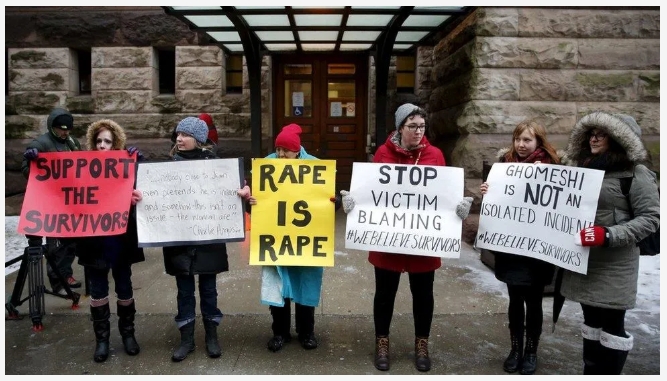
Following the unsuccessful prosecution of Canadian media personality and CBC radio host Jian Ghomeshi in 2016, new rules were introduced to Canadian law to change an accused’s ability at trial to make use of private records such as emails and text messages—documents that were crucial in securing Ghomeshi’s acquittal. According to the new legislation (Bill C-51, upheld by the Supreme Court of Canada in 2018 and defended by various legal theorists, as here), such messages can no longer be introduced at trial without the complainant’s prior knowledge.
The significance of the change cannot be overstated. Ghomeshi had been publicly accused in 2014 of multiple sexual assaults long before his case made it to court. Sensational stories about his allegedly vicious conduct were given extended media coverage and prompted Ghomeshi’s firing from the CBC as at least a dozen women told of violence and violation. His guilt seemed incontrovertible.
A different picture emerged at trial, when his three accusers were shown to have lied to the police and on the witness stand. Two of the accusers, while claiming to have had no personal interaction with Ghomeshi after the alleged assaults, had in fact sent friendly messages to him. All three had been willing to see him after the claimed violence, with two pursuing him enthusiastically. Many embarrassing communications (a picture in a bikini, a message, “I love your hands,” a selfie of one accuser fellating a beer bottle), initially hidden from police and the court, made the women look less like the appalled, fearful victims they had said they were and more like jealous girlfriends who cooked up allegations to punish Ghomeshi for being a playboy. They had either forgotten about the messages from over a decade earlier or assumed that Ghomeshi no longer had them in his possession.
Without the email evidence—but especially the ability it provided to surprise the complainants on the witness stand with their lack of truthfulness—it is quite possible that Ghomeshi would now be sitting out a long prison sentence. Judge William B. Horkins, in finding Ghomeshi not guilty, went out of his way to say that it wasn’t the behavior of the complainants—the sending of flowers after the rape, the repeated invitations for post-assault hookups—that cast doubt on their allegations (in fact, he wrote that “The expectation of how a victim of abuse will, or should, be expected to behave must not be assessed on the basis of stereotypical models” [pp. 7-8]). What harmed accusers’ credibility was their “willingness to ignore their oath to tell the truth” (p. 24, read the whole, so-carefully worded judgement here).
Under the new Canadian legislation, which makes it necessary for documents to be cleared by the trial judge and disclosed to the complainant and the prosecution before trial, accusers will know from the trial’s start what records the defense team has in its possession, and can shape their stories to conform to that evidence. It will be considerably more difficult for an accused man to prove his accuser(s) to be lying.
In a legal article about the new legislation, law professor Elaine Craig admits that the disclosure rules will in some cases reduce the effectiveness of defense cross-examination by allowing accusers to tailor their evidence; she admits that the cross-examination in the Ghomeshi trial would have been different under the new rules. But she reasons that such an impact must be set against the right of complainants to “equality and dignity” (p. 804) as well as “the public interest in encouraging sexual assault victims to report” (p. 801). Neither complainants’ dignity nor the public good of reporting are secured, she reasons, by allowing complainants to be “ambushed” on the witness stand.
Examining one part of the Ghomeshi transcript, Craig argues that there would have been “a relatively modest impact” on the defense strategy if Ghomeshi’s accusers had known beforehand of the email and text evidence Ghomeshi’s team had. Her explanations are characteristic of feminist special pleading:
“If we accept that sexual assault complainants are no more inclined towards lying than other types of witnesses,” she writes at one point, “then the question is straightforward. Which poses a greater threat to the truth-seeking function of the trial: a process which plays on a complainant’s understandable fear and distrust of the criminal justice system by attempting to catch her in lies and omissions about private records or prior sexual activity in a high-stress, anxiety-provoking, and potentially humiliating cross-examination, or one that puts her on notice that she is rightly going to need to explain to the court any gaps and inconsistencies in her evidence demonstrated by the contents of such records? Presumably, in most cases, it is the latter” (pp. 796-797).
Craig’s own word choice reveals her faulty reasoning. Sexual assault trials are about sexuality, not car theft or bank fraud. Sex and sexual assault are replete with emotion, ambiguity, shame, and anger, involving “potentially humiliating” admissions and details. Often with no evidence other than her own testimony, the accuser has strong reason to suppress, omit, or exaggerate details in her testimony.
Even if one accepts that sexual assault accusers are generally no more likely to lie than other witnesses—an untenable claim (see Rick Bradford’s analysis of the incidence of false allegations here)—it is not at all obvious that revealing defense strategy ahead of time is the best approach to truth-seeking at trial. In cases where the complainant is lying, mistaken, or deluded (for even a feminist like Craig cannot deny there are such cases), it is highly damaging to the search for truth to allow a malicious or wrong-headed witness to rehearse, with the assistance of her legal counsel, a plausible narrative to fit defense evidence. Such may gut an accused man’s ability to demonstrate the dishonesty of his accuser. Craig provides an elaborate justification for why Canadian men will simply have to live with that. Securing sexual assault convictions, she makes clear, is a top feminist priority.
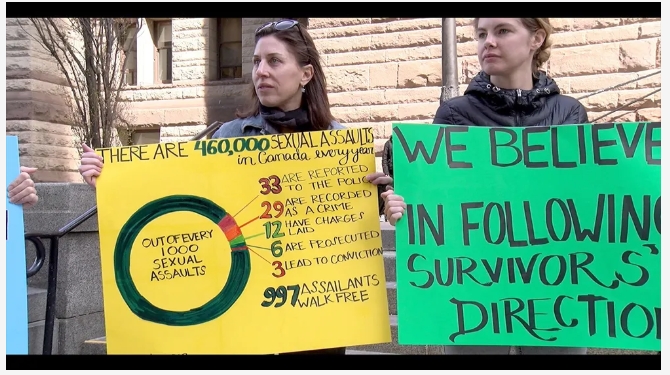
What would an ideal feminist judgement look like? We need seek no further than that delivered by Justice Marvin Zuker in 2016 (notably after the much-criticized Ghomeshi judgement), in which Zuker found Ontario graduate student Mustafa Ururyar guilty of raping fellow graduate student Mandi Gray. The guilty judgement was rendered despite the fact that Gray had texted Ururyar, her casual boyfriend, promising him “hot sex” on the night in question if he joined her and fellow graduate students at a bar—and then never told him that she had changed her mind.
Far from changing her mind, in fact, Mandi consumed plenty of alcoholic drinks, fondled Ururyar throughout the evening, went home with him to his apartment, and got into his bed in a state, as she afterwards claimed, of silent non-compliance. In a word-perfect application of feminist thinking, Zuker declared that it didn’t matter that Mandi hadn’t conveyed her lack of consent to Mustafa: consent “must be ongoing throughout a sexual activity” [394] and, furthermore, “Silence or lack of resistance […] does not demonstrate consent” even when, as in this case, the woman was the one who had initially invited the man for sex, went to his home for sex, and appeared to be an active participant.
Zuker’s decision reads more like a stream-of-consciousness work of fiction than a logic-based legal argument, and that seems to have been the point. Zuker was pioneering a new style of verdict: unabashedly feminist, partisan, engaged, and enraged. Quoting from feminist icons Maya Angelou, Virginia Woolf, and Susan Brownmiller, he railed against rape myths and affirmed his belief in “counter-intuitive victim responses to trauma” [393].
Parts of the judgement sounded as if they might have been lifted from Valerie Solanas’s rage-filled 1967 SCUM Manifesto: “For much of our history,” Zuker fumed, “the ‘good’ rape victim, the ‘credible’ rape victim has been a dead one. When someone takes control of you and pushes their penis into your mouth, what can you do? It is frightening and shocking. That was Mr. Ururyar. Mandi Gray was intoxicated on January 31, 2015 and typically could have been disassociated from herself as she stated. This I accept. Who can, who should remember the details of a rape?” [514].
Zuker’s words expressed a near-complete identification with Gray, calling her ordeal “A nightmare” and alleging that “Asking her to remember the details is ridiculous” [516]. “And often there is a desperate wish by the victim to please the rapist,” he speculated, “a desperate hope that the rape will end and maybe, just maybe, I will survive.” He also expressed disgust at her abuser, whom he fulminated against as “the ultimate game player, pushing to Ms. Gray and then pulling from Ms. Gray” [521]. For Zuker, it seemed, each rape trial is an opportunity for the many horrors of patriarchal history to be partially avenged. Zuker sentenced Ururyar to 18 months in jail and an $8,000 payment toward Gray’s legal fees.
Fortunately, the conviction was overturned on appeal, and prosecutors decided not to re-try Ururyar, at least partly because Gray indicated lack of interest in another go-round. Gray continued to posture as a victim, and her advocates continued to complain about the justice system’s failures. One feminist wrote bitterly of the overturning of the conviction: “And now Mandi Gray is rendered unraped, I suppose, and the lesson to others in her position is ‘don’t come here.’” The possibility that Mandi Gray simply didn’t have a legitimate legal case against Ururyar does not seem to have occurred to the author, as it rarely does to any feminist who discusses a rape trial.
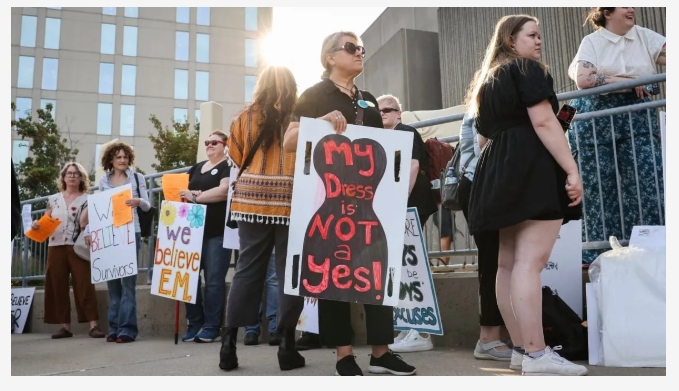
So far, feminists have not been consistently successful in gaining convictions—and they’ve made their dissatisfaction clear.
But just as advocates in Canada moved to close off one avenue of legal defense after the Ghomeshi verdict, so they will likely be active now to promote further changes to sexual assault law (with their sisters across the English-speaking world watching closely).
In the days before the Hockey Canada verdict last July, some pundits were already forecasting one new direction for legal activism. An article in The Globe and Mail predicted hopefully that the Hockey Canada verdict could “break new ground on the question of what constitutes voluntary consent in cases of an apparent power imbalance.” It is already a part of Canadian law that the simple absence of a No is not sufficient to signal consent. With further refinement, however, even Yes may no longer be sufficient.
Professor of Law Janine Benedet was quoted in the article that genuine consent may not be present if the woman feels intimidated or fearful. Sometimes the only “reasonable” action by a man in such a case is not to be sexual at all.
A post-verdict article in the journal Policy Options took up the same line of reasoning, beginning from the premise that “The Hockey Canada judgment and acquittal is a missed opportunity to advance the understanding of consent.” The author concluded that “The circumstances described at trial by E.M., many corroborated by the hockey players themselves, were nowhere near conducive to voluntary agreement to sexual activity.” According to this view, no matter how many times E.M. signaled her agreement, the situation could never have been anything but sexual assault if she later judged it to be.
Can things really go so far? Given feminist willingness to say out loud that every acquittal “sends women back 50 years,” added to the fact that women are now the majority in Schools of Law, with feminist perspectives becoming ever more aggressively anti-male, who can say no?
The distinctive legal protections of western law have perhaps never been more imperiled.
First published in the Fiamengo Files









One Response
Feminist: “Believe all women.”
Normal Person: “Okay, if a man rapes a woman and is convicted, he should be executed.”
Feminist: “Fascist!!”
Normal Person: “The Islamic rape gangs targeting young White women in England must be prosecuted to the fullest extent of the law.”
Feminist: “Islamophobe!”
Normal Person: “All of the Hamas terrorists who raped Israeli women on October 7th must be brought to justice.”
Feminist: “Free Palestine!”
Normal Person: “Mass migration has severely increased the number of rapes in Europe.”
Feminist: “Xenophobe!!”