By Conrad Black
This past Tuesday I attended a discussion between former prime ministers Jean Chrétien and Stephen Harper sponsored by the C.D. Howe Institute in the annual Aaron Regent dinner, and moderated by its affable and well-informed president, Bill Robson. The issue was national unity. In the contemporary manner, guests were invited to indicate the level of their concern on that subject before the discussion started and after it had ended. The majority remained at least partially concerned at the end of the exchange but less so than at the beginning, so they found the words of these two men who between them were prime minister for nearly 20 years, somewhat encouraging.
The two men spoke well in their familiar ways: Jean Chretien was lively and lucid, aged 91,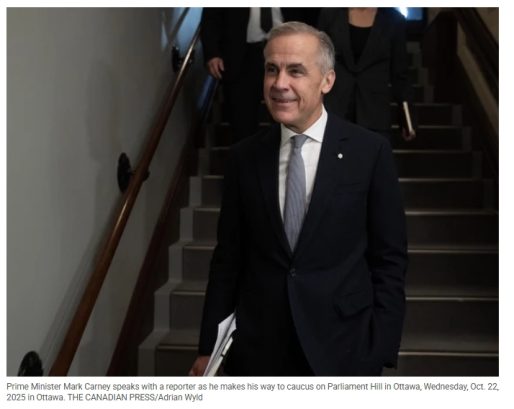 professed to be fairly sanguine about Alberta’s restlessness in Canada, (having rarely won any support in Alberta or known the province well when he was federal Liberal leader). He stressed the need to recognize the historic rights of Indigenous people in laying pipelines, and cast himself as a victorious veteran of the two independence referendums in Quebec. He naturally did not refer to his having completely mismanaged the second referendum, in 1995, giving a panicky address on the eve of the referendum, and urging Quebec to contemplate the beauty and serenity of Canada before “voting to break it up,” and eking out a victory of 1.16 per cent of 4.67 million votes, on a trick question that sought authority to negotiate the independence of Quebec while retaining all worthwhile aspects of Confederation. Like most Quebecers, he didn’t take seriously any inclination of Alberta to secede, (although the likely next leader of Quebec has said he would recognize Alberta’s independence at once).
Stephen Harper, the most successful federal Alberta politician in history, gently stated that if the current federal government does not accommodate Alberta’s rightful ambition to export oil and gas and help enrich the country, ”There will be serious problems.” But he passed lightly over the imperishable question of Quebec sovereignty by hanging his ten-gallon hat on the comfort he felt that even avowed Quebec separatists seek continued good relations with Canada. (That is true, but it is a tactical posture to secure independence, not to mitigate it.)
Harper credited Chrétien with having begun a long period of balanced federal budgets. He did not mention that this was achieved essentially by withdrawing from a great many spending areas shared with the provinces without conceding any additional tax sources to them. Venerable readers will remember that the provinces largely transfered this new burden onto the municipalities, which dumped it on the property-owners of the country. Chrétien was allegedly motivated initially by a headline in the Wall Street Journal referring to ”the Canadian Peso,” and it wasn’t quite the heroic act of self-discipline that he and his then finance minister Paul Martin claimed, but it was still an important achievement and led to 14 consecutive balanced federal budgets. Chrétien was heartened by Canada’s lower per capita debt than most other advanced countries. But he ignored our current hemorrhaging negative national cash flow and a steadily declining status in measurements of comparative national per capita income.
The exchange was interesting enough and well-moderated, but it left me with an uneasy feeling that unless Prime Minister Mark Carney is doing a great deal more heavy lifting in policy terms than appears from his hectic schedule of intercontinental photo opportunities and energetic posturing, as in last week’s outrageous call for the trial of the prime minister of Israel by the International Criminal (Kangaroo) Court, we could be in for quite a sleigh ride. It is clear that Chrétien and Harper have both effectively abandoned the Pierre Trudeau policy of defending the cultural rights of both official communities throughout the country. They simply minimize the implicit impact of Quebec’s sovereignty in fragmenting the country and completely discount the rights exercised by English-speaking Quebecers for the last 260 years, while conceding that French Canadians outside Quebec, apart from the right to communicate with the federal government in French, have rights in no way distinct from those of non-Anglophone immigrants. This was a perfect case of Irving Layton’s description of Canadian foreign policy in the 1960’S: “The spitefulness of the weak as moral indignation.”
Harper’s reference to “serious problems” if the federal government does not approve the pipelines necessary to take Alberta and Saskatchewan oil and natural gas to the markets clamouring for it (east, west, and south), was a genteel euphemism for what he must have known to be the overwhelming likelihood that Alberta would simply secede, become a landlocked republic, renegotiate the XL pipeline with the United States to get its energy to the U.S. and through it to the Gulf of America (Mexico). It could then eliminate all transfer payments and personal income taxes, and operate simultaneously as a petrostate and a tax haven state and rush forward into fantastic self-enrichment. In those circumstances, it would be right to choose that course.
The casual person attending the C.D. Howe discussions would have no idea that if the federal government does not promptly promise a serious plan to build pipelines Alberta wants and does not start to defend the rights of cultural minorities in Quebec and elsewhere then there will be more than Stephen Harper’s cool-headed conjuration of “serious problems.” And neither reflected that Quebec is purporting to write its own Constitution, having claimed to have abolished any status for the English language in Quebec, including in federal government offices. Only the importation of large numbers of Haitians, North Africans, and Lebanese to replace Quebec’s post-Christian collapsed birth-rate with some sort of francophones, but people relatively uninterested in Quebec nationalism, might prevent an independence victory in the next referendum.
Neither speaker ventured guidance on the course likely to be taken by Prime Minister Carney. No one is really defending federalism in Quebec or Alberta or anywhere else on any basis except habit and vague future potential. The new prime minister has spoken of great projects of the kind that built Canada, such as the transcontinental railway, the British Commonwealth Air Training Plan, the Saint Lawrence Seaway, the Montreal World’s Fair, and a number of giant hydroelectric project from Niagara Falls to Manicouagan 5 (the Daniel Johnson Dam) to Churchill Falls. There is some reason to hope that Carney has some ideas about uplifting Canadians. But if he clings to his public record of economic self-strangulation through the green psychosis, and a nagging authoritarian state slapping down personal material ambitions as insufficiently altruistic, his government and the country will disintegrate with startling speed. There was little hint of this last week, in the name of C.D. Howe, one of the greatest builders of Canada, (American though he originally was).
First published in the National Post