By Conrad Black
The violent cavalcade of events in Iran is starting to reveal the new range of aggressive-responsive policy options that U.S. President Donald Trump has developed to replace the obsolete concept of most of his recent predecessors. For 80 years from 1941 the basic framework was defined by Franklin D. Roosevelt in two addresses he gave at the beginning and end of that year in the Congress. In the State of the Union message in January, he warned against those who, “With sounding brass and a tinkling cymbal would preach the ‘ism’ of appeasement.”
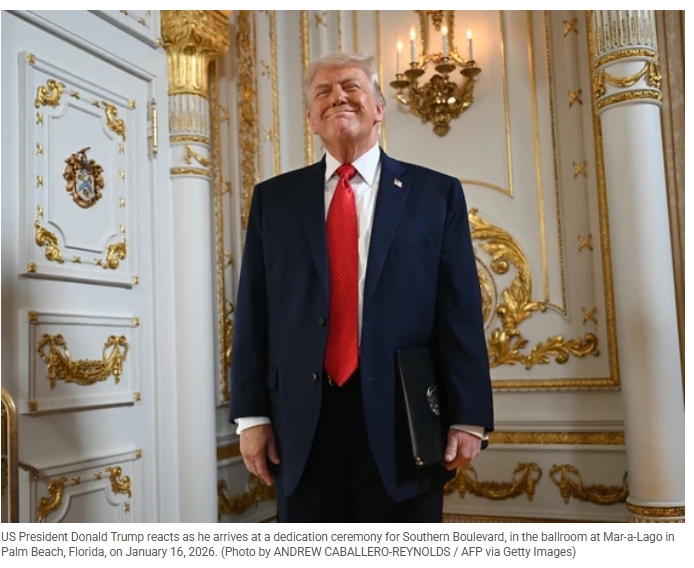
In his war message in December after the attack on Pearl Harbor, he promised that “we will make very certain that this form of treachery never again endangers us.” Succeeding presidents have followed those guidelines and the United States has not been an appeasement power and its military strength has been such that no country has dared to attack it directly.
Eventually, the enemies of America and the West devised less traditional methods of aggressive harassment and violent opposition: luring the United States into guerrilla wars or combat quagmires, where it was impossible to detect lines of demarcation or to distinguish combatants. Easier to inflict and as anonymously, were acts of terror and narco-terrorism. These are methods of combat that are only resorted to by countries that do not have the strength to enter into direct hostilities, but as we have seen, they can be cumulatively enervating even to so immensely powerful a country as the United States.
President Lyndon Johnson had no idea what he was getting into in Vietnam and inexplicably ignored the advice of the nation’s two greatest military commanders, Douglas MacArthur and Dwight Eisenhower, who warned against committing ground forces to eastern continental Asia, but said that if it was necessary to deploy them to Vietnam, they head to extend the demilitarized zone (DMZ) across Laos, cut the Ho Chi Minh Trail, and leave it to the South Vietnamese, armed and trained by the Americans, to regain control of their own country.
President Nixon‘s Vietnamization policy successfully followed most of that advice and would probably have saved South Vietnam if the Democrats, whose war it was and who had betrayed their own leader (Johnson), had not seized upon the Watergate nonsense, cut off all aid to the South and insisted on delivering South Vietnam to the tender mercies of the North.
Tragedy though it was, the Americans knew not to get locked into a guerrilla war again, at least not one at the ends of the earth where they committed 550,000 conscripts with no plausible exit strategy.
The enemies of America and the West next turned to acts of terror. They warmed up with an American marine barracks in Lebanon and then one in Saudi Arabia, then two East African embassies and a warship visiting Aden, and then came the horrible attacks on the World Trade Center in the Pentagon on September 11, 2001.
Having led a hugely successful expulsion of Iraqi dictator Saddam Hussein from Kuwait in 1991 at a cost of only 292 Allied dead compared to over 200,000 Iraqi casualties and prisoners, the United States responded to the 9/11 terrorist attacks in unison with almost all other civilized states with a generally rather successful counter to international terrorism wherever it appeared or was apprehended.
But unfortunately, this conducted them into what was almost an urban reprise of the Vietnam debacle, where they overwhelmed the Afghan, and the the Iraqi government and armed forces and set out to convert those politically infertile countries into replications of Connecticut.
The Iraqi army and police were then disemployed but took their guns and munitions into their next occupations, which, for the most part were members of factional urban guerrilla armies. The entire effort, and the 20 year battle against the Taliban guerrillas in Afghanistan, were a disaster, accomplished nothing useful and delivered preeminent influence in Iraq to the ayatollahs of Iran, the worst possible outcome.
President Trump has developed a new repertoire. He has perfected economic warfare, which in his first term squeezed Iran so severely it could no longer supply the Hamas, Hezbollah, and Houthi guerrilla forces that it sponsored.
Every country in the world would prefer to trade with the United States than with any terrorist or terrorism-sponsoring entity, and by waving access to the U.S. market around like a sword of Damocles, the US can inflict terrible damage bloodlesslessly.
In the last six months, Trump has added the lightning military strike that vaporized Iran’s $1 trillion nuclear military program in June in ten minutes with no American casualties, and removed the president of Venezuela and his wife from their palace in Caracas to the Metropolitan detention centre in Brooklyn, New York, again with no American combat dead.
The uprising against the corrupt and murderous Islamic Republic of Iran, and Trump‘s announcement that he would not tolerate the massacre of civilians there has kept the world guessing about his likely response. His 25 per cent tariff on anything coming from any country that buys anything from Iran should not be underestimated as an opening gambit.
Despite initial widespread skepticism, his tariffs have been extraordinarily successful as he has reduced the trade deficit by 60 per cent and the fiscal deficit, apparently by more than 30 percent at virtually no cost to the American public, as his tax reductions and incentives to oil production that reduced the gasoline price have almost completely compensated for any inflationary pressures provided by the tariffs.
Trump has played his customary game of mixing bloodcurdling threats with conditional statements that his critics can easily construe as backing down. As this is written, no one outside the inner circles of the U.S. administration has any idea what he will do next in Iran.
The government of Iran has placed a large reward for anyone who kills Trump and it is unchallengeably the principal terrorism- sponsoring country of the world and has accordingly committed numerous acts of war on the United States.
It is also a completely odious and despicable regime, which has completely failed Iran by any conceivable measurement. Its fall would bring rejoicing to virtually every chancellery in the world. It is an oil supplier to China and an armaments customer of Russia, but neither of those countries would lift a finger to assist the ayatollahs if Trump set the voluminous costumes they swaddle themselves in alight.
The serried ranks of demented Trump-haters are at the moment of writing, shilly-shallying between accusing him of endangering the peace of the world by hare-brained over-reaction to Iran, and rejoicing and accusing him of chickening out, under-reacting, and making a complete ass of himself. For some people, experience is a slow teacher.
He will do neither. Depending upon a very large number of facts, which only he is in a position to assess in the next few days, he may torque up the economic war to a point that slowly strangles what is left of the ghastly wreckage of the Islamic Republic, including possibly imposing a sea embargo including acceleration of his seizure on the high seas of the ghost tanker fleet that delivers quarantined oil to Iran’s customers, and watch the ayatollahs thrash about like flies in the ointment.
Or he may attack and destroy whatever may have been rebuilt of Iran’s air defenses and missile stockpiles and launchers and follow with direct attacks on the barracks of the Revolutionary Guard and the installations of the police and the military. Trump is in a position to do practically all of this with impunity and with minimal if any loss of American lives.
This is not the policy menu of a hard pressed leader. The infamous regime that Obama and Biden and the latter-day donkeys of Europe were happy to legitimize as a nuclear military power is in its death-throes. It is a miscreant among nations, trussed-up like a partridge and awaiting the decision of the president of the United States, whether to throw it to the wolves or send it to the firing squad.
Donald Trump is far from infallible, but even after five years as president in which he has changed America and the world, his enemies still have no idea of his formidability. Whatever he does, Iran has been reduced to a mangled shadow of the grim threat it formerly was.
First published in the National Post