Posted by Geoffrey Clarfield
The Muslim Brotherhood has been coordinating the fight against Israel and the West for almost a century now. The names of the players change-The Arab League, PLO, Hamas, Isis, Alqaeeda (and this alphabet soup is deliberate) but the puppet master remains the same.
This is Mariam Wahba writing in The Free Press.
Millions of phone screens across the Arab world light up every day with the same messages. The Muslim Brotherhood is a victim of brutal regimes, they say. Secular governments are traitors to their own people. Hamas is a legitimate resistance movement.
The outlets vary—TV shows, YouTube channels, X accounts, podcasts, and online magazines—but the messages remain the same.
Since its founding in Egypt in 1928, the Muslim Brotherhood has evolved into a vast network of chapters and offshoots that operate autonomously. Though each has faced periods of both repression and resurgence, the movement has preserved and enhanced its ability to control the public narrative and spread its message. Today its media empire is diverse, diffuse, and pervasive, with no single mastermind or headquarters. The group’s ideology moves across borders through a web of seemingly uncoordinated but deeply connected channels. Together, they speak in one voice, infecting generations of Arab minds with the group’s Islamist doctrine. “Dying in the way of Allah is our highest hope” is one of its slogans.
The Trump administration is currently said to be preparing to designate several of the group’s chapters as foreign terrorist organizations (FTOs), something that could happen as early as Wednesday. Yet this discussion remains narrowly fixated on political structures and leaders, overlooking a pillar of the group’s survival: its seductive and deadly message.
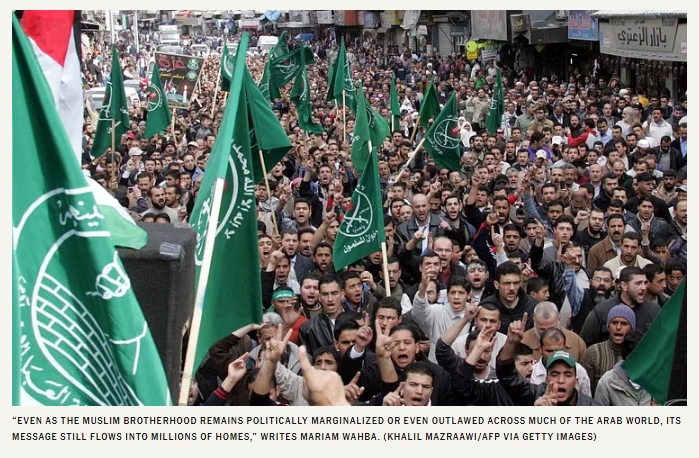
That is why, even as the Brotherhood remains politically marginalized or even outlawed across much of the Arab world, its message still flows into millions of homes. While the group’s ideas have been forced off ballots and out of parliaments, they never left the public conversation.
The Brotherhood has long understood that media is not merely an accessory to its politics. Rather, it is the primary vehicle for spreading its message and winning supporters.
At the heart of this machine is Mekameleen TV. A satellite station … its very name, “We Will Continue,” reflects the Brotherhood’s determination to endure after being toppled in Egypt. In April 2022 … Mekameleen vanished. A month later, the channel resurfaced, broadcasting from European cities. As one presenter explained, the channel would operate from places “not subject to pressure from Egyptian or Gulf authorities.” Like the Brotherhood itself, its media apparatus adapts to survive.
Mekameleen, like other Brotherhood-affiliated media outposts, goes to great lengths to obscure formal ownership or direct control. It leaves no paper trail tying it to Brotherhood leadership. This deliberate ambiguity allows it to broadcast from foreign jurisdictions without fear of sanctions or shutdown.
The Brotherhood’s fingerprints are everywhere
Alongside it are satellite channels like Al-Yarmouk TV and Watan, and digital channels like MaydanEG25, each pumping out a steady flow of Islamist commentary.
Especially after its October 7, 2023 attack on Israel that left more than 1,200 dead and 251 taken hostage, Hamas, which is the Brotherhood’s offshoot in Gaza, has been a key beneficiary of this media ecosystem.
The Brotherhood feeds on X and YouTube have churned out clips framing Hamas’s October 7 atrocities as legitimate “resistance,” denouncing Israeli operations in Gaza as “extermination,” and smearing Arab governments that oppose Hamas as “traitors to Palestine.” … lionized Hamas spokesmen, … presented Hamas’s cause as the authentic voice of the Arab world.
Since its founding, Hamas has long drawn on its parent group’s ideology. Its 1988 charter calls for Israel’s destruction and the killing of Jews, and Brotherhood-affiliated outlets have, for decades, amplified Hamas’s message, ensuring that the ideological pipeline remains intact.
And then there’s Al Jazeera. The Qatar-owned Al Jazeera media network is not formally part of the Brotherhood, yet it has long amplified the movement’s message and ideology.
After the Muslim Brotherhood was toppled in Egypt in 2013, Brotherhood members forced to flee to Qatar were hosted by Al Jazeera. In fact, several exiles lived in hotel suites paid for by the network.
Mere hours after the October 7 attack, Al Jazeera aired a recording of Hamas military chief Mohammad Deif encouraging Palestinians to “kill, burn, destroy, and shut down roads” in Israel with “cleaver axe, Molotov cocktail, truck, tractor, or car.”
For the Brotherhood, this inchoate media empire is an instrument of the movement . . . When the administration designates the Muslim Brotherhood’s most dangerous branches as terrorist organizations, it must not overlook the ecosystem that sustains them: its media outlets.
Washington and European partners must scrutinize the Brotherhood’s media ecosystems, tracing how its channels, websites, and accounts support its branches. Those that cross the line into material backing should face the appropriate sanctions and designations. If Washington is serious about confronting the Brotherhood, it must target this media empire. Anything less leaves the job unfinished.