By George Koch and Jim Mason
The federal Clarity Act is widely assumed to be Canada’s safeguard against provincial secession. As we discussed in our previous column, many Albertans who favour independence believe it provides a roadmap to leaving Confederation, while many federalists regard it as a constitutional firewall that makes separation all but impossible.
Both sides are ultimately mistaken. The Clarity Act was never designed to provide a workable path to provincial independence, it was designed to prevent one. And therein lies the danger.
Passed in 2000 by Jean Chrétien’s Liberal government, the Act emerged from Quebec’s 1995 referendum, when the country came within roughly 50,000 votes of breaking apart. Ottawa’s objective was understandable. Federalists wanted to ensure that any future vote on secession would be based on a clear question, a clear mandate and a deliberate process rather than ambiguity, confusion or political gamesmanship.
That goal was reasonable. The legislation that followed was not.
The Supreme Court of Canada’s 1998 Secession Reference established a basic constitutional principle: although a unilateral declaration of independence was unconstitutional as well as illegal under international law, if a province’s voters expressed a clear desire to leave Canada through a clear majority voting “Yes” on a clear question, all parties would have a reciprocal obligation to negotiate that province’s possible exit from Canada.
The Court deliberately assigned all of the implementation details to the political process. It did not proclaim a unilateral right to secession, but neither did it affirm an unambiguous authority by Ottawa to refuse negotiations or to operate in bad faith.
The Clarity Act purported to implement that ruling. Instead, it created a system in which almost every important decision rests with the federal government – enabling endless mischief and sabotage. The Act, for example, does not define what constitutes a “clear majority.” It does not specify what level of voter turnout would be sufficient. It does not establish a detailed process for negotiations. It does not explain how negotiations would conclude. It does not identify a final threshold for constitutional approval. Instead, it grants broad discretion to the House of Commons to determine whether a referendum question is acceptable and whether a referendum majority is sufficiently large to move forward.
In practice, this means Ottawa decides. And for Ottawa, unsuccessful negotiations are the objective; the status quo is victory. Paradoxically, that reality should concern federalists as much as separatists.
A constitutional process gains legitimacy when participants believe it is fair. People are more likely to accept outcomes they dislike when they believe the rules are transparent and consistently applied. The Clarity Act achieves the opposite. Its ambiguity creates the impression that the rules can be changed as circumstances require.
Consider how the process would likely unfold following a future provincial referendum on independence. First, the referendum question would face scrutiny. Then the result would be examined to determine whether the majority was sufficiently “clear.” If negotiations began, every stage would involve multiple governments, competing interests, constitutional disputes and political pressure campaigns. Any breakdown along the way would preserve the status quo.
From Ottawa’s perspective, this may seem like a feature rather than a flaw.
But politics does not operate solely through legal mechanisms. It also operates through public legitimacy. Suppose a province produced a strong majority in favour of independence and Ottawa nevertheless found reasons to delay, obstruct or reject the result. Suppose voters concluded that no realistic democratic mandate would ever satisfy the federal government.
What lesson would they draw? Many would conclude that the Constitutional process is not a genuine process at all. That is the Clarity Act’s Achilles’ Heel.
The legislation was intended to reduce support for secession by demonstrating the seriousness and complexity of leaving Canada. Yet if citizens come to believe the outcome has been predetermined, the Act may produce the opposite effect. Rather than strengthening federalism, it could fuel resentment. Rather than reinforcing Constitutional legitimacy, it could undermine confidence in Constitutional institutions.
The irony is striking. A law designed to discourage separatism may ultimately strengthen it.
This is not an argument for Alberta independence. Nor is it an argument that secession should be easy. The breakup of a country is among the most consequential political acts imaginable. Any such process should be deliberate, transparent and subject to rigorous democratic safeguards.
But a credible process must also be achievable. Canadians should be able to answer basic questions. What constitutes a clear majority? What obligations arise after such a vote? When do negotiations begin? How are disputes resolved? What conditions bring the process to an end?
The Clarity Act answers none of this. For a quarter-century, that ambiguity was politically convenient because no province came close to triggering the Act. Alberta’s growing separatist movement, however, has revived questions that many Canadians assumed had been settled long ago.
If Ottawa’s answer to those questions is simply that separation will never be permitted regardless of the circumstances, then the Clarity Act ceases to be a framework for democratic conflict resolution. It becomes an instrument of permanent Constitutional denial.
That may satisfy some federalists. But it risks achieving the very outcome the Act was intended to prevent – which is the subject of our next column.
The original, full-length version of this article was recently published in C2C Journal.
Jim Mason holds a BSc in engineering physics and a PhD in experimental nuclear physics; he lived and worked in Alberta for 17 years and is currently retired and living near Lakefield, Ontario.
George Koch is Editor-in-Chief of C2C Journal.
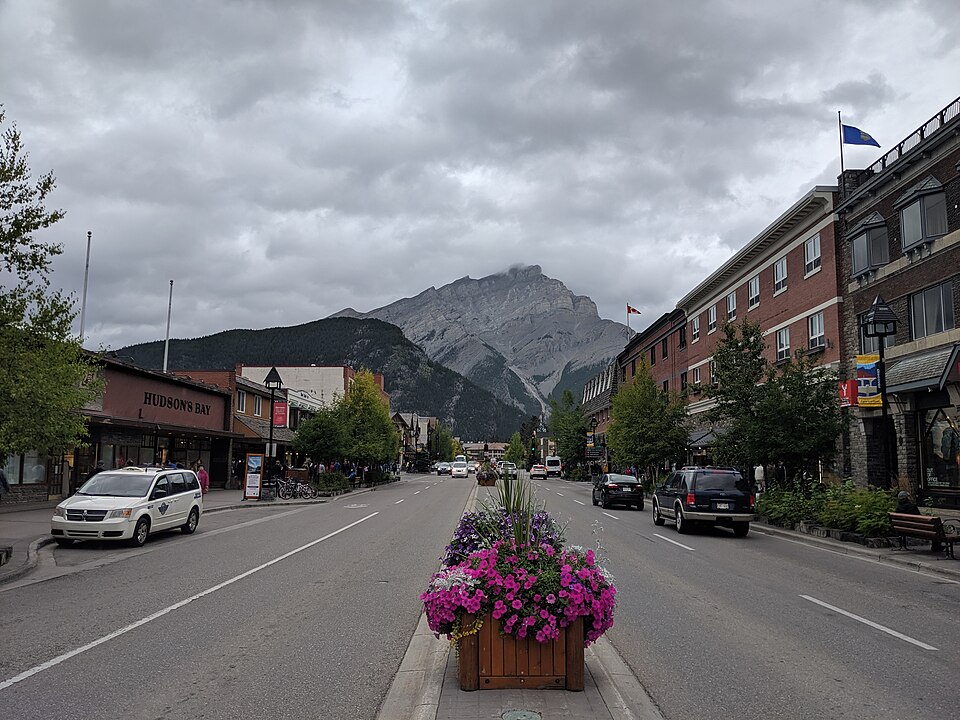
Illustration Banff by Daniel Glasgow from Wiki commons









6 Responses
Mr. Mason’s article certainly makes sense, but only up to a certain point. It’s actually just a little too “comfortable”. It seems that once all the “i’s” are dotted and the “t’s” properly crossed, then a quick lowering of the curtain would end the process.
But we instinctively know that this is not the case. Should the people of Alberta vote to leave Canada, no matter how tidy an agreement between Alberta and the Federal government seems to be, unforeseen changes would pop up by the dozen. One example would be the possible movement of people both to and from the Republic of Alberta. Then there’s the relationship between Alberta and British Columbia (and possibly Saskatchewan)… And of course let’s not forget that Quebec would be at this point be licking it’s secessionist lips…
It would seem that as many eventualities as possible should be recognized and handled at this stage by the current Alberta government, perhaps without any Federal input… There are many reasons for this, but I don’t want to endlessly extend this short piece.
With respect … both this and the previous Part I were attempting to show that, while the Clarity Act may be perceived as providing a detailed description of a straightforward process by which a province can achieve independence, exactly the opposite is the case. It provides a very unclear description of a rather tortuous process with several objectives that must be achieved but no objective metrics by which achievement can be ascertained, with the entirely process entirely in the control of the federal government.
Far from identifying a few i’s to be dotted and t’s to be crossed, it makes it impossible to even identify all the i’s and t’s so as to be able to dot and cross them.
Regarding the things that you identify … again with respect … none of them need to be addressed resolved “at this stage”—that is, at the stage of having a referendum on whether to have a referendum on independence. Quebec is already “licking its secessionist lips”—it never really stopped—the relationship with BC and SK, and indeed, with any other province, would be essentially the same as relationships with US states, i.e. relationships with subnational entities in a foreign country, the movement of people out of the new country would, presumably, be straightforward (although I gather from the experience of Gad Saad that one has to pay a big bill if one wants to leave Canada) and moving into the country would depend on its immigration policy which can be easily defined between now and then. Your suggestion that each and every eventuality that can be imagined must be resolved now is, I suggest, an application of the adage that no problem is so trivial that it cannot be rendered insoluble by reference to a bigger picture. If nothing was ever initiated until everything was resolved, then nothing would ever be accomplished. The longest journey begins with the first step.
I do agree, however, that Albertans need to figure it out for themselves without any federal government input, although, in the end, as per the Clarity Act, negotiations with the federal government will be required.
I’m an Ontarian, and like all Ontarians I so little identify with my vast and wealthy nullity of a province that I feel silly writing “Ontarian”.
So it’s almost impossible for me to understand anyone having a competing political identity against “Canadian”, which means I can’t, quite, entirely, understand why the Canadians of Alberta want to leave just because they or a majority of them at least disagree with what Liberal governments do. I disagree with the Liberals every minute of every day and do not cease being Canadian.
On one level therefore I simply cannot understand how national allegiance is so thin and so instrumental that one could leave on such a trifling basis. Because I don’t and can’t have the subnational alternative.
The quebecers I could better understand, as with a pre-British heritage there and a language I can understand why they always thought of themselves as another nation, in whole or part. And I was torn on whether I wanted them to go, except that their leaving would have destroyed the country on geographic grounds alone.
With Alberta, the same destruction would result on what strikes me as lesser cause, so I hope it doesn’t come off.
I, too, am an Ontarian with an equal dislike for the Liberal government, but I have no trouble understanding the Albertans’ position.
It is far more than simply disagreeing with what the Liberals do … although that is a significant part of it—and Ontarians, I think, don’t really appreciate the impact on Albertans of what the Liberals do, since what the Liberals do does not have the same impact on Ontarians.
For example, the Liberals pass laws and issue regulations intended to shut down Alberta’s primary industry—Trudeau was even on record as saying he intended phase it out—but when Ontario’s major industry, the automotive industry, is externally threatened or domestically dislocated by government regulations (e.g. no ICE vehicles to be sold after 2030) the Liberals lavish huge subsidies on it to help it adapt—using tax revenue disproportionately taken from the same Albertans whose industry the Liberals are diligently working to “phase out.”
The CO2 emissions from the production of oil and gas in Alberta are subject to the industrial carbon tax but the CO2 emissions from the combustion of oil and gas in ON and the rest of Canada are not taxed, despite being essentially the same magnitude.
And then, of course, there was Pierre Trudeau’s NEP, in which he undertook to pillage the wealth of Alberta for the benefit of Eastern businesses. And this attitude goes way back to 1904. In a 1904 speech in the Canadian Parliament, Clifford Sifton, Laurier’s Minister of the Interior said: “We desire, and all Canadian Patriots desire, that the great trade of the prairies shall go to enrich our people to the East, to build up our factories and our places of work, and in every legitimate way to our prosperity.”
So, yeah, the actions and attitudes of the Liberals have a lot to do with the discontent.
However, I think it is much more than that.
I think that this is exacerbated by the fact that the structure of the federation, and the way that the institutions of governance have been perverted from the original design of 1867, allows the Liberals to do what they do to Alberta with impunity. The things that Liberals do that selectively disadvantage Albertans are bad enough but the fact that there is really nothing in our governance structure to prevent them from doing so is unconscionable. While a different government might behave differently, without fundamental structural changes, Albertans would still be entirely dependent on the good will of that government.
The list of structural issues that disadvantage Albertans ought to be well known. A few examples are:
Alberta is under represented in the House of Commons except with respect to ON and BC, where the number of residents per MP is about the same. Votes in the other provinces count for more than the votes in Alberta, ranging from 3 times as much in PEI to 14% more in QC.
Alberta is under under represented in the Senate, with only 6 senators compared to 10 each for NS and NB despite generating the highest GDP per capita of any province.
Selection of senators to represent Albertans is done by the Prime Minister at his sole discretion and can be done without any consideration of the preferences of Albertans as may have been indicated, for example, by actual votes, and is usually done to reflect the Prime Minster’s ideology and often to figuratively thumb his nose at Albertans.
Then there is the propensity of the federal government to cavalierly unilaterally insert itself into areas that the constitution lists as being exclusively provincial responsibility, with effectively no constraints, since the courts have been ideologically captured as a result of the Prime Minister’s unrestrained power to appoint judges reflecting his ideology. Even when the courts do find federal unconstitutionality, as it recently did, the federal government simply tinkers with a bit of the wording. The most egregious examples of this are the areas of healthcare and social services, both exclusively provincial responsibilities over which the federal government now exercises control via the Canada Health Act and the Health Transfer and Social Transfer.
Then to top it all off there is the Equalization Program, through which Albertans have the distinct ‘pleasure’ of being required to fund the entire cost of their own provincial government services while at the same time being forced to subsidize provincial government services in 7 other provinces.
And then there is this. “Canada isn’t doing well right now because it’s Albertans who control our community and socio-democratic agenda. It doesn’t work. … certainly when we look at the great prime ministers of the 20th century, those that really stood the test of time, they were MPs from Quebec. … This country — Canada — it belongs to us.” That was Justin Trudeau when the Prime Minister was Stephen Harper.
I suggest that if you spend a bit of time contemplating the federation from the perspective of Albertans you will find that the issues are more than “trifling” or a “lesser cause” than preserving a language or a culture—which others seem to have managed to do quite successfully.
Why would we expect people, treated the way Albertans have been—and continue to be treated—to have allegiance to the power structure treating them with such disdain? One could have said the same thing about the 13 colonies circa 1776.
Alberta’s grievance is is one that everyone should take seriously. It’s not one of “we’re not like you” it’s that “you abuse us”. Sounds a little extreme but consider that come election time, there choices of Albertans rarely makes any difference and concerns of Alberta, even if the government of the day is sympathetic to the west (see Harper) little changes because every effort must focus on pleasing the east because that’s where the power lies. All of our efforts to push an EEE senate was to address this obvious injustice, and naturally the east wouldn’t have it.
Piled on top of this effective lack of input into the running of the nation, Alberta pays the lions share of other province’s budget through so called “equalization”.
The net result is effective taxation without meaningful representation. You’ll recall that at least one war was fought to remedy such an arrangement, so it’s a big deal, and arguably one of basic justice.
If Alberta votes to succeed, and negotiations actually occur (which the article suggests is improbable), then the real and perceived grievances Albertans have can be addressed and maybe they stay in Canada. But if they vote to separate, and they’re ignored, I don’t know what that will cause, but something worse than Alberta leaving, I’m sure
This is in keeping with my own perception.
The abuse goes back along way. In a 1904 speech in the Canadian Parliament, Clifford Sifton, Laurier’s Minister of the Interior said: “We desire, and all Canadian Patriots desire, that the great trade of the prairies shall go to enrich our people to the East, to build up our factories and our places of work, and in every legitimate way to our prosperity.” Then there’s Pierre Trudeau’s NEP though which he undertook to pillage Alberta’s earth for the benefit of eastern businesses. And then, of course, Justin Trudeau’s frontal attack on Alberta’s oil and gas industry. All the while, as you note, using tax revenue collected from Albertans to subsidize provincial government services in several other provinces via the Equalization Program while, at the same time, Albertans also have to pay the full cost of their own provincial government services. (Glad to see that someone else recognizes the taxation without representation as pest of this program since, with it, the federal government is doing nothing more than collecting taxes on behalf of the recipient provincial governments from residents of other provinces.)
The Triple-E senate would be the minimum, IMO, that should be done to indicate to Albertans that they should stay in Canada. To be fair, it was previously a part of a constitutional amendment that was a grab-bag of other things primarily intended to address Quebec grievances and FN issues, so could have been collateral damage as a result of these being rejected. It would be good to see it introduced on a standalone basis—although here are many more changes that also should be made to our governance structure.
The prospect of negotiations occurring under the Clarity Act is, I think, dim. Since there is no objective measure of what constitutes a “clear majority”,” I suspect that the federal government will use any excuse it can find to argue that, whatever the outcome of the vote is, it is not a “clear majority.” But if negotiations do start, I think that is is very unlikely that why will complete, again because the federal government has a myriad of ways to orchestrate that … and there is no time limit specified.
The real opportunity, IMO, is the referendum to have a referendum. An overwhelming vote in favour of that will put on record that Albertans are very unhappy with the status quo and, without serious changes, may very well vote the next time for independence.
This does, indeed, provide an opportunity to negotiate major changes without any of the attendant risk of independence. Start by repealing the ‘nine bad laws,’ which the federal government can do on its own initiative. Then revise the Equalization Program formula, say as per here, https://c2cjournal.ca/2022/01/too-hard-to-kill-towards-a-fair-equitable-and-science-based-equalization-program/, which can be done without a constitutional amendment. This would indicate willingness to address Albertan issues.
Then move to the the serious issue of changing the constitution for a better-balanced, more robust federation, perhaps as described here https://c2cjournal.ca/2025/07/restoring-canada-special-seriespart-vii-federal-institutions-that-work-for-our-times/.
In any event, simply ignoring the issue is not a good idea.