By Fern Sidman
In an era already fraught with volatility, rising antisemitism, and dangerously polarized discourse, New York City Mayor Zohran Mamdani has chosen not the path of prudence, nor that of responsible governance, but rather one of incendiary rhetoric and reckless defamation. The video in question—circulated widely and emblematic of his increasingly aggressive posture toward Israel—represents not merely a political statement but a profoundly troubling moral failure, one that resurrects ancient tropes and injects them into modern political discourse with alarming ease.
At the center of Mamdani’s remarks is his repeated assertion that Israeli Prime Minister Benjamin Netanyahu is, in his words, a “war criminal” who “belongs in The Hague.”
This is not a casual critique of policy, nor a measured disagreement with strategic decisions made during wartime. It is, instead, a sweeping condemnation—one that deliberately strips context, disregards the realities of asymmetric warfare, and places the leader of a democratic ally into the same rhetorical category historically reserved for perpetrators of genuine atrocities.
Such language cannot be dismissed as mere hyperbole. It echoes, with disturbing clarity, the ancient and pernicious libel that has for centuries been weaponized against the Jewish people: the false accusation of inherent cruelty, of malevolent intent, of bloodshed as policy. In this sense, Mamdani’s words do not exist in a vacuum. They are part of a broader and deeply troubling pattern in which Israel—and by extension, Jews worldwide—is singled out for uniquely harsh and unfounded moral condemnation.
The gravity of this rhetoric is magnified by the office from which it emanates. As mayor of New York City, Mamdani presides over a metropolis that is home to the largest Jewish population outside of Israel. His words carry weight, not only in political circles but in the lived experiences of those who call the city home. When he declares that Netanyahu is “not welcome” in New York, he is not merely expressing a personal opinion; he is signaling to millions that the Jewish state and its representatives are to be treated as pariahs.
This is not leadership. It is abdication.
One must be unequivocal in stating that such rhetoric does not merely criticize Israel—it delegitimizes it. It transforms a complex geopolitical conflict into a simplistic morality play, in which Israel is cast as the villain and its adversaries are implicitly absolved of responsibility. This narrative is not only intellectually dishonest; it is morally corrosive.
The reality, which Mamdani’s remarks conspicuously ignore, is that Israel faces existential threats from organizations that openly declare their intention to annihilate it. Hamas, Hezbollah, and other Iranian-backed terror groups do not operate within the bounds of international law. They embed themselves within civilian populations, use human shields, and deliberately target innocent civilians. To confront such adversaries is not a choice; it is a necessity.
In this context, the Israel Defense Forces have consistently demonstrated a commitment to minimizing civilian harm that stands in stark contrast to the conduct of their adversaries. Indeed, the IDF is widely regarded as one of the most morally disciplined militaries in the world, adhering to principles of proportionality and distinction even under the most challenging conditions. To characterize its actions as criminal is not only inaccurate—it is an affront to the very concept of moral accountability.
Mamdani’s rhetoric, however, makes no room for such nuance. By invoking the authority of the International Criminal Court—a body whose jurisdiction is not recognized by the United States or Israel—he seeks to lend a veneer of legitimacy to claims that are, at best, deeply contested. “The federal government… should join the ICC and execute this warrant,” he declares, as though the complexities of international law can be reduced to a soundbite.
This is not a serious legal argument. It is political theater of the most dangerous kind.
The consequences of such rhetoric are neither abstract nor distant. They manifest in the daily experiences of Jewish individuals who find themselves increasingly targeted, marginalized, and threatened. When a public official of Mamdani’s stature amplifies narratives that portray Israel as uniquely malevolent, he contributes—whether intentionally or not—to an environment in which antisemitism can flourish.
History offers a sobering lesson in this regard. The demonization of Jews has often begun with words—words that dehumanize, that isolate, that cast an entire people as deserving of condemnation. It is a pattern that has repeated itself across centuries and continents, culminating in some of the darkest chapters of human history. To ignore this pattern is to court its repetition.
It is therefore incumbent upon those in positions of authority to exercise restraint, to engage with complexity, and to resist the allure of simplistic narratives. Mamdani has done none of these things. Instead, he has chosen to “spew forth,” in the most literal sense, a series of “egregious calumnies” that betray not only a lack of judgment but a profound disregard for the consequences of his words.
One might ask: to what end?
If the goal is to advance peace, such rhetoric is counterproductive. If the aim is to promote justice, it is misguided. And if the intention is to elevate one’s political profile, it comes at a cost that is far too high—a cost measured in the erosion of trust, the deepening of divisions, and the normalization of discourse that should have no place in a civilized society.
Moreover, Mamdani’s posture risks emboldening those fringe elements who seek validation for their hostility toward Jews under the guise of political critique. When the rhetoric of a major public official mirrors the accusatory tone historically wielded by extremists, it becomes increasingly difficult to disentangle legitimate policy debate from outright bigotry. This conflation is precisely what makes his statements so perilous.
The United States has long stood as a steadfast ally of Israel, grounded in shared democratic values and a mutual commitment to security and stability. This alliance is not merely strategic; it is moral. To undermine it through reckless rhetoric is to weaken not only Israel but the broader framework of international cooperation that underpins global security.
In the final analysis, Mamdani’s remarks must be understood for what they are: a dangerous and irresponsible departure from the principles of informed and measured discourse. They do not illuminate; they obfuscate. They do not unite; they divide. And most troublingly, they risk perpetuating a cycle of hatred that has already exacted an incalculable toll.
New York City deserves better. Its residents—of all backgrounds and beliefs—deserve leadership that is thoughtful, responsible, and grounded in truth. They deserve a mayor who recognizes the weight of his words and the impact they have on the lives of those he serves.
Until such leadership emerges, the task of calling out such rhetoric—clearly, forcefully, and without equivocation—falls to those who understand the stakes. For in moments such as these, silence is not neutrality. It is complicity.
Fern Sidman, a former NY correspondent for Arutz Sheva, is the current editor-in-chief of The Jewish Voice, a New York based publication. Her writings can be accessed at tjvnews.com
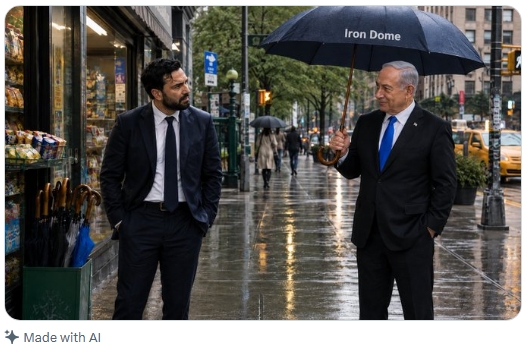
Illustration from an amusing AI video – Bibi in the City on X