The anniversary of a book
By Bruce Bawer
It was twenty years ago this month that Doubleday published While Europe Slept: How Radical Islam Is Destroying the West from Within. It was the fastest seller of all my books: in the hours after it became available, its sales rank on Amazon kept improving for hours until it was in the double digits. The next week it made the New York Times bestseller list. One reason for this instant success was obvious: the book happened to have appeared at the height of the Danish cartoons controversy, at a moment when Muslims all over the planet were rioting, damaging embassies, and committing coldblooded murder in response to some newspaper cartoons of Muhammed. This worldwide mayhem was, thus far, the most vivid example of the civilizational challenge that was the subject of my book.
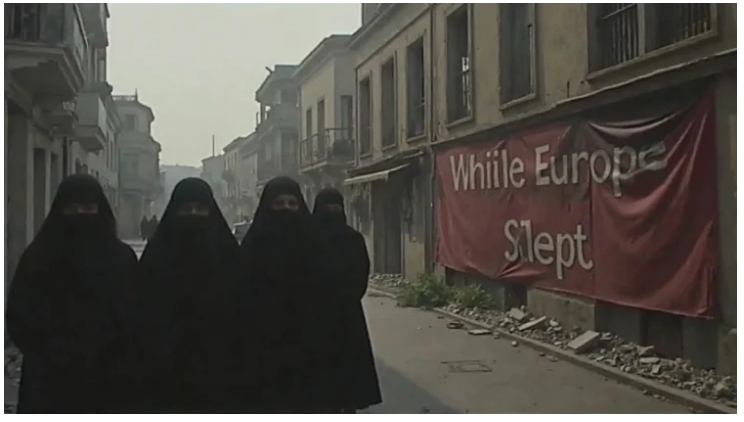
While Europe Slept won plaudits from Booklist (“a book of the utmost importance”) and from reviewers like Carlin Romano in the Philadelphia Inquirer (“timely and incisive”) and J. Peder Zane in the Raleigh News and Observer (“indispensable”). But most of the mainstream media came gunning for me. For in the years since 9/11, the Western media and political establishment had chosen to embrace a dishonest view of Islam as a “religion of peace.” Newspapers ran absurdly sympathetic profiles of imams in the West, depicting them as deeply spiritual and hard-working and devoted to their families and flocks, and to “bridge-building” with non-Muslims – all the while delicately avoiding any mention of their ties to terrorist groups, their hatred for Jews, their belief in the death penalty for homosexuality, their systematic treatment of women and girls as veritable slaves, their yearning for sharia law, and their dedication to Islamic conquest.
An example of that media dishonesty was a special 2002 issue of the Economist that was devoted to the topic of European Muslims, and that I described in While Europe Slept as “a masterpiece of euphemism and evasion.” The scale of the Economist’s duplicity was staggering. The Economist maintained that Muslims “flourish in western societies,” citing the success of unnamed “tycoon[s]” and “eminent surgeon[s]” and the Aga Khan as if they were representative. “Most work hard, hold strict family values, and commit no crimes: model citizens, you might say.” On the contrary, the levels of welfare dependency and serious crime among Muslims in Europe was far higher than among natives (in the Dutch city of Amersfoort, I noted, police suspected “that 40 percent of the Moroccans between age fifteen and seventeen” were “involved in crime”); as for their “family values,” they involved such wholesome practices as forced marriage, and honor killing.
Yes, there were problems with Islam in Europe, conceded the Economist, but the same kinds of problems could be found among all groups. Integration challenges? They’d resolve themselves “in time.” And the Economist’s way of addressing Muslim views on gays and women’s rights was astonishing in its brazen irresponsibility: it introduced readers to Riza Ahmad, the new Muslim mayor of Oldham, England, who “could be forgiven for feeling a bit hurt” at the mention of such issues, given that he “had just started to use his new position to bring people together.” This dodge was breathtaking, but not atypical of the cowardly way in which the mainstream media, in their eagerness to normalize Islam, strove to skirt its most problematic aspects.
Sometimes it was even worse. Sometimes there was sheer, unadulterated groveling. When the brave Dutch author and media raconteur Theo van Gogh was slaughtered on an Amsterdam street in 2004 for criticizing Islam, a German Middle East “expert” called his murder inevitable, because he had broken a “taboo.” The next year, the Norwegian singer Åge Aleksandersen — a sort of anti-van Gogh – released a song in which he totally prostrated himself before the foreign conquerors. I quoted the lyrics (which were not meant ironically) in While Europe Slept:
You stone your mothers
Whip your sisters
Mutilate your daughters
Behind the veil
But I want to be your friend
Such was the mentality of the media, cultural, and political establishment on both sides of the Atlantic when While Europe Slept came out. I wasn’t surprised, then, that the book garnered notices like that from Simon Kuper in the Financial Times, who, reviewing it along with three other new books about Islam in Europe (by Walter Laqueur, Melanie Philips, and Bat Ye’or), might at least have begun by acknowledging that it was curious for four writers with four vastly different backgrounds to decide simultaneously to raise the same exact concerns about the exact same subject. Might this not imply that there was indeed something here to worry about? Not in the view of Mr. Kuper, who accused us of hysterical exaggeration, of outright deceit, of relying on “anecdotal evidence,” and of sheer bigotry. Rejecting outright any suggestion that Islam is incompatible with Western values and that it preaches contempt for the infidel, Kuper insisted that the overwhelming majority of European Muslims embraced Western values and opposed terrorism, and that within a few years all Muslims in Europe would be fully assimilated. And what of the assertion that Islam is a religion of conquest? “No serious demographer,” Kuper assured FT readers, “expects an Islamic takeover” of Europe.
Then there was the Washington Post Book World, in which While Europe Slept was reviewed by Steven Simon, a member of the Council on Foreign Affairs and hence a world-class savant. Simon hit a number of notes that I would grow accustomed to in responses to my writings about Islam: there was, he declared, “not much new here”; I was “preach[ing]…to the converted”; my book offered “virtually no data other than the author’s personal experiences and conversations.” Simon contrasted While Europe Slept with another new book, The Islamic Challenge by a Danish scholar, Jytte Klausen, who, he contended, was “as dispassionate and methodical as Bawer is aggrieved and impressionistic.” While my book was based on actual observation and statistics, hers was based on interviews with “some 300 European Muslim community leaders,” who for the most part (predictably enough) fed her the kind of soothing lies that she wanted to hear. But Simon loved it: Klausen’s book, he wrote, provided “little evidence of the ‘We will bury you’ stance of the bigoted, violence-prone and opportunistic Muslims of Bawer’s world.” Islam in Europe, concluded Klausen, would “evolve into a tolerant faith compatible with the commitment to equality that underpins the liberal West.” And Simon gave her prediction a hearty thumbs-up.
Given all the negativity from the so-called experts, I was stunned when While Europe Slept was chosen as a finalist for the National Book Critics Circle Award. What also surprised me, but shouldn’t have, was that the news came with a shabby kick in the ass. At the reception at which the names of the finalists were announced, a writer named Eliot Weinberger, who had been tasked with the job of reading off the names in the criticism category, sneered that my book represented “racism as criticism.” As if that weren’t unprofessional enough, the then president of the NBCC board, John Freeman, stated publicly that he was “embarrassed” to see a volume of “Islamophobia” on the list of finalists.
A year or two later, I was paid a pretty penny to deliver the keynote address at a conference in Washington, D.C. The topic was the future of Europe, and all the participants but me were credentialed experts – academics, diplomats. Every one of them said that Europe’s future – but not America’s – looked very bright indeed. Then, as I wrote in FrontPage in 2011,
it came my turn to speak. My subject: the Islamization of Europe. Sharia enclaves. Subjugated women. Forced marriages. Honor killings. Jew-baiting. Gay-bashing. Spiraling rape statistics. Systematic welfare abuse. Police overlooking crimes, judges citing sharia law, journalists, writers, and artists practicing self-censorship for fear of giving offense to Muslim believers, and politicians pretending everything’s just fine.
My talk was a litany of horror stories drawn from newspapers all over Western Europe. And my audience’s reaction was one of pure outrage. Not over the horror stories themselves, but over my audacity. How dare I bring up such things! “These are all just…anecdotes!” one veteran diplomat angrily sputtered. “Mere anecdotes!”
Even after all the negative “expert” reviews for While Europe Slept, I was stunned that in this gang of purported know-it-alls – there must’ve been at least two dozen of them – not one would acknowledge that there was even the slightest truth in what I had to say.
That was a long time ago. Since then, I’ve followed the rise of Islam in the West very closely. I’ve written another couple of books and hundreds of articles on the topic. Things have moved, alas, in exactly the direction I expected. I honestly wish I had been wrong. But I wasn’t. The Muslim percentage of the European population has climbed steadily. In Vienna, for example, more than 40% of the schoolchildren are Muslim. In London, only 30% of the population are ethnic English. And Islam is not just a phenomenon of the big cities, as it once was. In small towns where, two decades ago, you never saw a hijab, they’re now unavoidable. A new study shows that by 2035, the majority of the inhabitants of Germany will have immigrant backgrounds. As for employment rates, recent figures from the UK – where 78% of Muslim women and 63% of Muslim men are on the dole – are more or less representative.
Two decades after While Europe Slept, the confident predictions that European Muslims, after a generation or so, would assimilate socially and culturally have been proven disastrously wrong. This January, a Norwegian politician noted that “a parents’ meeting at a school in Lillestrøm municipality requires 13 different interpreters, at a cost of 70,000 kroner” (about $7,000). As Muslims have grown increasingly numerous and powerful, moreover, they’ve grown increasingly hostile and aggressive. By 2015, even PBS had to acknowledge that Muslims in Marseilles, a city once seen by some as a model of multicultural harmony, had become radical – and violent.
As their numbers have risen, in short, Muslims in Europe haven’t assimilated – they’ve complained, more and more boldly, that European values and folkways offend them, and demanded that they be altered or abolished. Yet some countries are still holding the gates wide open. “Experts” still call for higher immigration levels. In January, Spain announced plans to grant amnesty to at least half a million illegals, and Sweden’s migration officials were ordered to obey EU guidance stating that ISIS members from Syria merit asylum, while Syrian Christians deserve asylum only “in exceptional cases.”
Then there’s terrorism. In While Europe Slept I quoted the Norwegian author Gert Nygårdshaug, who sneered after 9/11 at the notion that “the next time terror strikes, it can be at Oslo Airport, in Rome, or Copenhagen”; in his view – and that of many (probably most) bien pensant Europeans – jihadists hated only imperial America, not the good folks of Europe. Soon enough, of course, came one horrible European atrocity after another – among them Atocha in Madrid (2004), Bataclan in Paris (2015), and the Manchester Arena (2017). One dark fact: in the last few years, the terrorists have been getting younger. Some are pre-teens.
Crime? It’s one thing to speak of it. It’s another to experience it. Some people in my circle of acquaintances have experienced the very worst of it. A friend of a friend in Oslo, with whom I used to share a beer, was stabbed to death in 2006 by a rejected asylum seeker from Algeria. Two people I knew very casually were murdered in the London Pub terrorist attack of 2022. My partner and I have been luckier. During the thirteen years when we lived in Oslo, we lost track of the number of times he was assaulted by Muslim youths. (Aside from one attempted mugging in Amsterdam, I wasn’t ever assaulted, perhaps because I’m from New York, where I developed excellent instincts about avoiding thugs.) Fortunately, my partner’s size and strength saved him from what could have been disastrous consequences.
It’s getting so that, at least in some parts of Europe, hardly anybody hasn’t been the victim of such assaults. The other day I saw an interview with a Swedish father whose teenage son has been robbed three times by Muslims. Sweden, note well, used to be unbelievably peaceful. On February 1, the American philosopher and podcaster Peter Boghossian wrote on X that he’d been to dinner the night before “with 6 French people in their 30s.” When he asked whether they were “optimistic about the future of France,” they all “burst out laughing.” He commented: “I encounter this over and over again: Profound pessimism about the future. So much so, they laugh.”
Where do the police come in? Some of them admit that Islam is a profound problem. Others still parrot the pro-Islam line. So do most political and media elites, who can still afford to live in neighborhoods where they’re shielded from harsh realities. In the EU’s corridors of power, even hinting that Islam has a less than delightful side remains verboten. Yet fewer and fewer ordinary Europeans are deceived. Hence the growing support for once-marginal parties such as the Sweden Democrats. Hence the fact that the Dutch government is now following the advice of the once-despised Geert Wilders. Hence the fact that the once-anathema Tommy Robinson now enjoys the full support of the world’s richest man. Hence the flight of European Jews to Israel and America and the departure of ethnic Europeans from neighborhoods like London’s East End. Today, almost one in three Danes wants to ban Islam outright; more than half believe that immigration threatens Danish identity.
Twenty years after While Europe Slept, then, few honest Europeans would deny that the Islamization of their continent amounts to an existential crisis. Here’s one sign of this: years ago, when I even hinted that criminal or illegal Muslim immigrants might be returned to the places from which they came, the suggestion was widely viewed as monstrous. Now Denmark is sending criminal immigrants back. Sweden’s new conservative government has brought down immigration figures drastically (even though it’s recently been revealed that the Swedish agency that processes residency and asylum documents is run by Muslim clans who prioritize their own). Even in countries that haven’t yet started expelling criminal Muslims, the subject is under discussion at the highest levels.
Of course, all of this can seem like pouring a glass of water on a house fire. My own predictions can vary with my mood, but other observers are less inclined to vacillate. Some who were once sanguine about Europe’s future now predict a continental civil war. Some who once mocked Renaud Camus’s predictions of a “Great Replacement” in Western Europe now seek to ease the transition (although they still reject the word “replacement”).
What I’ve never been able to figure out is how all those professional politicians and purported experts got it wrong. Did they somehow not see what I saw after only three months of living there – me, a naïf who’d fallen in love with Amsterdam and wasn’t looking for anything there to complain about? Or were they all lying? If so, why? Could it really have been about nothing more than their careers, their reputations, their fear of rocking the boat? Whatever the answer is, how on earth could those pompous, self-important bastards have let this happen? When I let myself sit and think about it, the rage just overwhelms me.
First published in Front Page Magazine









One Response
“What I’ve never been able to figure out is how all those professional politicians and purported experts got it wrong.”
That is because they got 100% right.
That’s because the “Elites” in all these countries detest their own countries. They are 100% Woke and whether they are Christian, Jews and/or White – they hate these groups as well as Western Civilization and personal liberties.
There is a Red/Green Alliance and it is very designed and supported.
Watch Mamdani for the future of NYC, then NY, then other cities and states. In the end only one thing will stop this, assuming the rest of the population of these countries want it stopped. That will vary nation by nation it appears.
Great article by Mr. Bawer. He’s a wonderful reporter and writer.