By Eric Rozenman
Once more we are being told that “America is a Christian nation.” Asserted by some leaders of the Southern Baptist Convention and others 30-plus years ago, now Vice President J.D. Vance and former VP Mike Pence lead those reiterating the claim. But it was wrong then and remains so today.
Germinating among the Pilgrims and Puritans, catalyzed in part by the Scottish Enlightenment and its Presbyterian Church influences, the United States began and continued well into the 20th century with an Anglo-Protestant civic culture. That culture helped make the national aspiration and description of e pluribus unum—from many, one—mostly successful.
But for a creedal, not blood-and-soil, nation like the United States culture is not nationality. So, when Vice President J.D. Vance told a Turning Point USA gathering late last month that America’s sole anchor was in being a “Christian nation” he was mistaken. This country’s anchor—as Vance must know—is the Constitution. The vice president took an oath of office to uphold that foundational document and it says “no” when it comes to Congress establishing any religion.
Just days before Vance’s pronouncement, Pence had solicited potential donors to his Advancing American Freedom organization. Under a headline declaring “America Is A Christian Nation,” an AAF letter urged recipients to sign a petition reaffirming the Declaration of Independence’s revolutionary statement that all men are created equal and endowed by their Creator with unalienable rights.
Because secular fundamentalists insist otherwise, one might well subsidize reemphasizing the divine origin of our rights. But I left my checkbook unopened at the point the solicitation implored me to safeguard “our Christian nation.”
The American experiment in self-government—the longest running and most successful in history—rests on the belief that all individuals possess the same rights, including those to life, liberty and the pursuit of happiness. They do so, the Declaration stresses, because those rights were endowed by a Creator—by God. They are not privileges granted by kings, priests, fuhrers or commissars and subject to their whims.
But this particular self-evident truth of the Founders did not originate in Christianity. It stemmed directly from the Hebrew Bible’s assertion that God created human beings in His image. Not god-like but with a spark of the divine in every single person.
That spark makes human life sacred. It therefore limits innate authority of government. Rabbi Joshua Berman makes this case in Created Equal: How the Bible Broke with Ancient Political Thought. Today’s “Christian nationalists” could learn from Berman.
Secular fundamentalists scoff
While America’s founding belief comes from Judaism, Christianity—which began as a Jewish sect—incorporated and extended this insight. The former vice president is right to see it under threat.
In his solicitation Pence relates that a Politico reporter on MSNBC mocked Christians such as himself for believing in rights endowed by a Creator. At a Senate hearing last fall, Democrat Tim Kaine (VA), professed disbelief in the foundational principle.
“The notion that our rights do not come from our laws or our government should make people very, very nervous,” he countered a Trump administration nominee. “The notion that rights don’t come from laws and don’t come from the government but come from the creator—that’s what the Iranian government believes.”
The ayatollahs and Thomas Jefferson. The lead author of the Declaration of Independence and our third president asked, as Pence’s solicitation notes, “Can the liberties of a nation be secure when we have removed a conviction that these liberties are a gift of God?” Old Tom the mullah; who knew?
More recently, as Pence’s AAF also points out, the 35th president, Dwight Eisenhower, said, “Without God, there could be no American form of government, nor an American way of life.” Ike did not say “without Jesus Christ.”
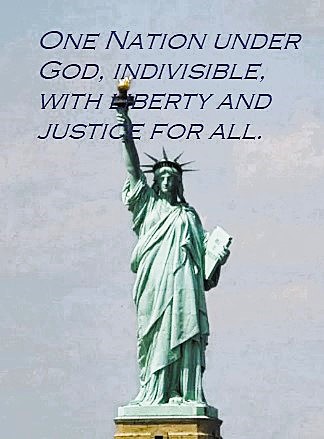
Americans in general once assumed a God of ethical monotheism. Yet today 28 percent of Americans, a figure that has been growing throughout this century, tell pollsters they are either atheists, agnostics or “nothing in particular.” The concept of God-given rights seems unlikely to resonate with them.
George Washington’s pew in Alexandria, Va.’s Christ Church Episcopal can be seen today. One must consult the history books, however, to be reminded of his reticence to mention, in public, Jesus Christ. Our first president typically cited instead a non-denominational or omni-denominational “Divine Providence” or “Creator of All Things.”
Washington’s famous 1790 letter to the Jewish congregation in Newport, R.I., stressed that “all possess alike liberty of conscience and immunities of citizenship. It is now no more that toleration is spoken of, as if it was by the indulgence of one class of people, that another enjoyed the exercise of their inherent natural rights.”
This included equality of religious practice. Hence Article VI of the Constitution with its clause prohibiting a religious test for holding public office. Americans separate church and state, Vance and Pence’s “Christian nation” assertions notwithstanding.
Where does this leave us? Neither with a God-free public life, as materialists of the left and right insist, nor living in a Christian nation. But rather, influenced by the Hebrew Bible as forwarded through an Anglo-Protestant civic culture, thriving in a God-fearing one. Up to now, anyway.
Eric Rozenman is the author, most recently, of The David Discovery, A Novel of the Near Future. He retired in 2024 as communications consultant for the Washington, D.C.-based Jewish Policy Center.








2 Responses
The arguments in this article are flimsy, to put it politely.
It’s not clear to me what is in question here regsrding everyday life expression/relations⁰.