by David Solway (December 2025)
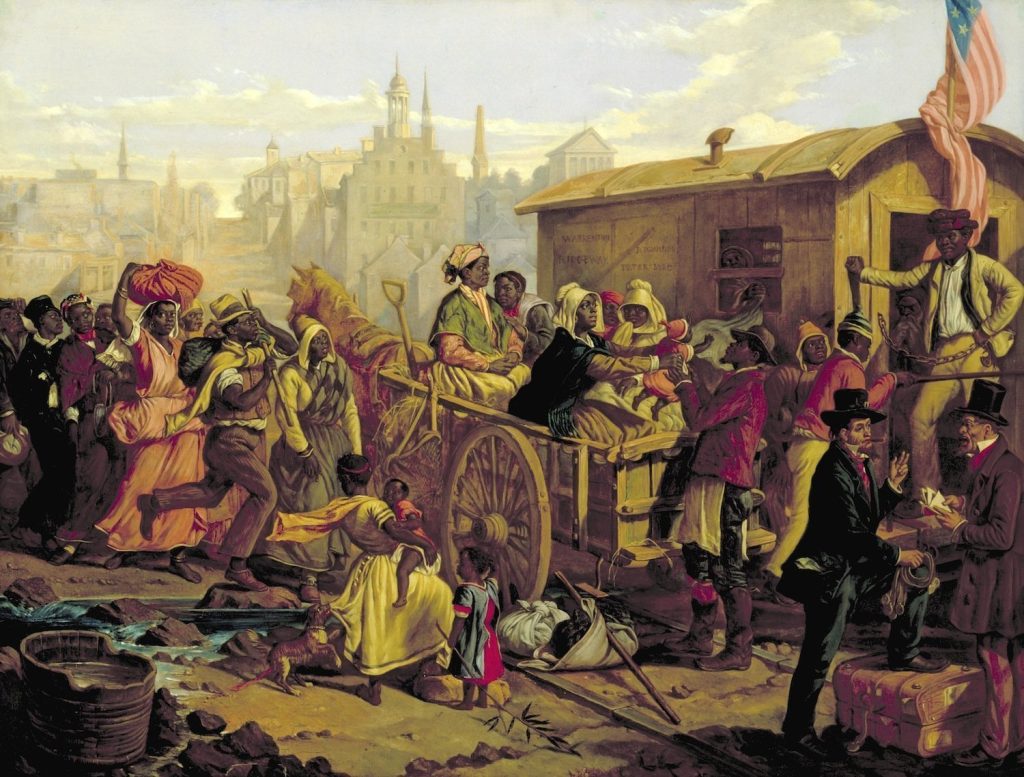
Slavery was not America’s original sin. The Civil War was. It was not a war for the abolition of slavery per se. It wasn’t a war for the abolition of racism. The issues were mainly Constitutional and economic, and it’s unfortunate that the moral shadow of slavery obscured the things that really concerned most people at the time.
Original sin is another matter. Neither Howard Zinn’s A People’s History of the United States nor Nikole Hannah-Jones’ 1619 Project: A New Origin Story, two of the most acclaimed instances of racial analysis, use the term “Original Sin,” but both have no doubt that slavery is the profound and enduring foundational element of the nation’s history.
There is no denying that slavery was a grave and terrible sin, which the nation has attempted to redress through the exercise of law and manifold forms of penance. Well-intentioned expiation, however, has not led to genuine redemption and rectification but to the continuous fracturing of civil life, racial tensions, endless concessions to the black community at the exorbitant expense of the white population, and a destructive sense of white guilt and black virtue for which the only remedy appears to be more white guilt, more white concessions, and more white self-loathing.
Pascal Bruckner’s recently published I Suffer Therefore I Am: Portrait of the Victim as Hero examines the modern obsession with victimhood and is relevant to my purpose here. He argues that integrity demands that “fault and injury end with the person who committed or suffered them, [for] humanity begins over with each of us.” Victimhood has become the “sorrowful version of privilege.” He furnishes as a classic example of this travesty the “whites who knelt at the feet of blacks” after the death of recidivist George Floyd. The moral economy of constant grievance is merely an ongoing theater of self-election. We are not responsible for the wrongs of our ancestors.
Nor is there any doubt that affirmative action, the DEI syndrome and a carefully curated narrative of black innocence and white iniquity have come at the concomitant cost of professional merit, trade competence, historical truth and political acumen. This has led to the two-term elevation of a “black” president with a sufficient dose of melanin to give him carte blanche. Containing both white and black in equal proportions in his DNA, he was given a historic opportunity to heal the racial fissure, but his “transformative” tenure brought America the corrosive poisons of growing racial animosity, widespread demoralization and near-irreparable decay.
In the last analysis, the so-called civil rights initiatives were laudable in their purpose but have invariably led to exploitation by race-card scammers and activists and to self-proclaimed black victimhood, a winning proposition. The many poorly-informed black politicians and their irresponsible white enablers have only abetted the travesty. What has followed is the erosion of civil discourse, the decline of substantive education and the atrophy of national unity.
Without an informed understanding of the social landscape, the politics and economics of the era, and the significant actors of the antebellum period, there can be no prospect of “truth and reconciliation” in the country today, no setting things on a proper foundation of honest knowledge, no restoration of moral clarity, no reclamation of the Revolutionary dream, and no return to what the Founders wanted and imagined. Of course, the famous apothegm in the Gospel of John 8:32, “And ye shall know the truth, and the truth shall make you free,” does not always and necessarily function as claimed. Truth can be met with undiminished ferocity by minds that cannot tolerate reality when it opposes personal commitment to individual prejudice or belief. And truth will often bend the knee to myth or narrative in gestures of untutored fealty.
Nevertheless, truth is the only form of atonement—at-one-ment—that counts. And the truth is that slavery, which Paul Johnson in A History of the American People calls America’s “organic sin,” was an abominable transgression before God and man, but that it is not alone or even primarily the historical evil which has led to continuing racial turmoil, social divisiveness and the specter or threat of national dissolution.
The repercussions of slavery are with us still as a “sin” that many in the black community—and, of course, the prevaricating Left—will not allow mainstream America to forget despite the mammoth efforts, institutional and cultural, to erase, or at least attenuate, what is generally regarded as an indelible stain on the conscience of the nation. These accountants of the soul themselves forget that nearly a million white Americans lost their lives and nearly two million soldiers and civilians were injured in a war that was ultimately understood to have freed the victims of collective servitude—perhaps the war’s only beneficial consequence. It is a sacrifice they should be grateful for, not resentful of, nor is it one that should be taken advantage of to advance a particular agenda of social and financial indemnification. That rivers of blood were spilled in the fiery crucible of a Civil War, that a nation was torn asunder, and that significant and amending legislation was eventually passed should be reparation enough.
But deeper than the harm slavery has done to the nation is the legacy of the war itself, namely, the establishment of a monolithic, centralized, managerial, indissoluble State that bears little resemblance to the intent of the Founding Fathers and the republican vision inherent in the Constitution. Alexander Hamilton’s economic plan—a national debt, a government fiat bank, corporate welfare and a dirigiste State—was an effort to construct a British-like mercantilist system, a rule by elites through the strength of a central Federal government, that the Revolution sought to render inoperable.
As John Taylor wrote in 1822 in Tyranny Unmasked, “I believe that a loss of independent internal power by our confederated States, and an acquisition of supreme power by the Federal department, or by any branch of it, will substantially [produce] a monarchy, and that the monarchy, however limited, checked, or balanced, would finally become a complete tyranny.” Taylor was partially correct. The Civil War created another and different America from the brave, federalist experiment unprecedented in the muniments of world history—at any rate, since the last days of Ancient Greece, and perhaps not even then.
The Founding Fathers hoped to create a political system responsible to the people; a fair distribution of powers between the three branches of government, first proposed by James Madison at the 1787 Philadelphia Convention and monitored by the core principle of checks and balances; and a meritocratic citizenry, essential to the success of the republican project. “There are strong minds in every walk of life,” wrote Alexander Hamilton in Federalist No. 36, “that will rise superior to the disadvantages of situation, and will command the tribute due to their merit.” Whether he was serious or not remains an open question since the Hamilton of the Federalist and the Hamilton of the Convention seem two very different people. But in any event, the war changed all that as the presumed eminence of distinction dissolved into the bell curve of staple mediocrity.
The creation of a centralized and overarching government was the bitter harvest of the Civil War. “The proposed Constitution,” wrote Madison in Federalist no. 39, “therefore, is, in strictness, neither a national nor a federal Constitution*, but a composition of both.” In other words, it was a mixture of a central authority and a confederation of sovereign states, contrary to Lincoln’s proleptic assertion in the First Inaugural to the effect that the Union preceded the documents that created it, that is, that the Union was older than the Constitution. This absurdity carried through the Civil War to its aftermath. For the war saw to it that the central authority won out over the confederation of sovereign states, the State having vanquished the states.
As Michael Newman puts it in his excellent The Path to Tyranny, the Civil War “turned what was once a laissez-faire representative government into a large interventionist government,” a fact hard to deny. The reverberations from that nation-changing event have not died away. The “background radiation” is constantly there. The advantages of a dominant government for the purposes of comprehensive administration, international statecraft, fiscal manipulation and coercive leverage are surely less beneficial than the focus on freedom, local and sectorial authority, independence of judgment and self-reliance that the Founders envisioned.
Three factors now need to be considered. There is no excuse for slavery, economic or otherwise. The Civil War may have been avoided, to the then and future advantage of the nation—America was the only nation at the time in which warfare was associated with emancipation, as Robert Fogel and Stanley Engerman’s go-to volume Time on the Cross reveals. And without an understanding of the individuals and circumstances of the time, there can be no settlement of the problems that distress the nation today.
The crux here is “education,” properly understood as the classical engagement with reality. Discerning what really happens or is really the case, so far as this is possible, demands “education” in the broadest sense. It demands insight, strict analysis, a saving skepticism about teleology, a knowledge of the past, and a means of expository thought and formulation that does not reflect a prior theory or a desired, neatly parcelled conclusion. It demands honesty. It demands a passion for truth. It demands what is currently lacking in America. And it demands coming to terms with the Civil War.
Table of Contents
David Solway’s latest books are Profoundly Superficial: Observations on a Net-Zero Culture and Crossing the Jordan: On Judaism, Islam, and the West. A CD of his original songs, Partial to Cain, appeared in 2019.
Follow NER on Twitter @NERIconoclast








3 Responses
You make a point of the obvious that seems to have escaped obvious notice: Obama had the DNA to address both sides of the racial coin, he could have been the one to reconcile, heal, address the past so as to move forward as one people, but grievance is the political ticket and currency of the day–at least among Democrats—and that impulse only grows. California is the exemplar with reparations on the books, such that a state that never had slavery could end up paying rich people with dubious claim —with this formula in place grievance can never die. An original legislative sin that could happen…
Indeed, guilt and grievance are the engines for perpetual reparations, a perennial cash cow.
Nice job.