by Kevin Anthony Brown (July 2025)

I.
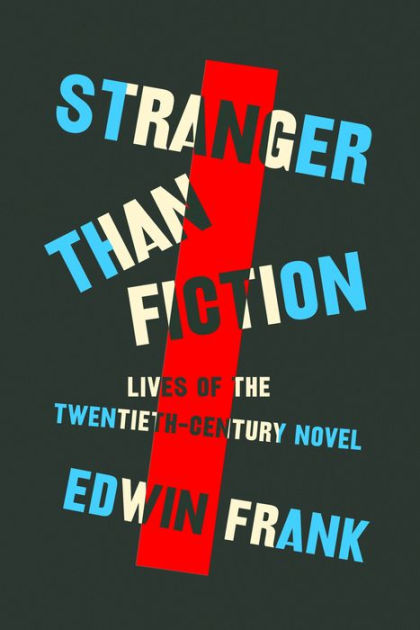
Poet-critic Edwin Frank’s 20th-Century novel didn’t begin with Buddenbrooks, Thomas Mann’s first novel. It began with Dostoevsky’s Notes from Underground (1864). Stranger Than Fiction is a personalized study of 20th-Century History as the Novel and the 20th Century Novel as History.
II.
In roughly chronological order, 21 chapters are bookended by a prologue and epilogue juxtaposing authors from H.G. Wells to W.G. Sebald. Kubin is grouped with German-language writers. Sodome et Gomorrhe and Ulysses appeared the same year. So, Proust and Joyce are linked to modernism. Others writers tie in to World War II: Hans Erich Nossack; and Vasily Grossman.
III. Critic-Practitioners: Composition as Explanation
Those who’ve left the deepest impression on Frank, critic-practitioners like Henry James, D.H. Lawrence and Woolf, “combine the critical intelligence” with “the creative spirit.”
Stranger Than Fiction is a work of what I call “descriptive criticism.”
The pendulum arc, gravitationally pulled by this influence or that, has at intervals swung back and forth in a state of disequilibrium. John Crowe Ransom and Allen Tate insist the close reading of a text take precedence over biographical considerations. In the wake of such narrow insistence on text qua text, to the exclusion of biographical considerations, over-correction has dug in. The text is now pretext for a pathobiography profile.
In Stranger Than Fiction, the two ways co-exist.
Frank’s ranges widely from histories, essay collections to travel writing. His Appendix, Endnotes and Bibliography cite to numerous primary and other sources: anthologies; diaries; fictions long- and short-form; lectures; love-letters; oral histories; reportage; stage- screen- and radio plays; translations; uncollected papers. Some sources are as famous if not more so than texts at the heart of the book.
20th-Century avant-garde movements came and went—Bloomsbury, Freudianism, Futurism, New Criticism, Post-Colonialism, Post-Modernism, Magical Realism, Social Realism, Surrealism, Symbolism. The scope of Stranger Than Fiction extends to Lukács and other theoreticians of the novel: Adorno’s Minima Moralia or Notes to Literature; Bakhtin’s Problems of Dostoevsky’s Poetics; Benjamin’s Illuminations or One Way Street; Borges’ Nonfictions; Edward J. Brown’s Russian Literature since the Revolution; Calvino’s Six Memos for the Next Millenium; Christopher Clark’s The Sleepwalkers: How Europe Went to War. Yet Stranger Than Fiction isn’t what Louis Menand calls “a literature professor’s book.” Frank helps himself to the dogmas or schools of thought of as many authors or critical theorists as suit his purpose. He remains a stubbornly independent critical thinker.
Frank’s counter-methodology is a good, old-fashioned American tradition. Close-reading of a visual artwork is central to Clement Greenberg’s Art and Culture. Elizabeth Hardwick’s essays sometimes favor the memoirs-conversations-and-diaries approach. Frank’s techniques include “tracking a novel’s turns of event and turns of phrase, its varied voices and points of view, stepping up to it and away from it, keeping an eye on it, paging through it.” His prose encompasses the ekphrastic, line-by-line interpretative analysis or a purely narrative retelling of the story “down to the last detail.” Frank, he ain’t old-fashioned; man, he just Old School.
***
Faulkner, Hemingway, Henry James and Gertrude Stein, each as she or he may be, are all “great masters of the American sentence.”
In the Anglosphere, it’s called a simple outline. Time was, this tool was as fundamental to the art of writing as drilling declensions was to the study of ancient languages. On the Continent, around the time Frank was born, Raymond Queneau and others of the group Ouvroir de Littérature Potentielle (“Oulipo”) or Workshop for Potential Literature envisioned linguistic and even mathematical solutions to the problem of how to free up creative expression via what Frank calls an “accident of composition.” Some would argue the French are more susceptible to this sort of thing than Afro-Saxons anyway, and that Stein in any case beat them to it.
What she said though “anything but obvious” as Flaubert puts it makes perfect sense. Dissatisfied with The Making of Americans, Stein had an idea. “I made of a paragraph so much a whole thing that it included in itself as a whole thing a whole sentence.” The author of “Composition as Explanation” experiments with pure sound. Which explains why so many composers draw inspiration from her work. Stein’s theory has a practical application, foreshadows the Oulipian experiment in unsuspected ways.
What if Georges Perec wrote a novel like The Disappearance (La disparition), entirely omitting the letter e? What if, as Frank says Stein does in The Making of Americans, you made sentences into nuclei, what poet Cecil Taylor calls unit structures, the bases of entire compositions, letting what Frank calls “contingency enter and drive a work”? What cadences or progressions might derive from bopping chordal changes around the following combinatorial series, 2341 or 2314?
Test the Theory.
Step 2: formulate a single sentence such that an entire composition can be organized around it, a tentative statement expressing the relationship between variables 1, 3 and 4—that which was to be demonstrated, quod erat demonstrandum. What’s the whole point of Stranger Than Fiction? Dostoevsky’s Notes from Underground is the precursor element of all 20th-Century novels. “We see the shadow of the Underground Man lurking everywhere.”
Prove It.
Step 3: develop three or four main points and subpoints bolstering your hypothesis:
(A) In the work of French-language novelists like André Gide, as in Dostoevsky, bad shit happens for no good reason. Psychopaths think themselves great artists—Creators—building a body of work. In The Stranger, Camus makes Mersault kill an Arab whose name we never learn for what reason God only knows. H.G. Wells saw this coming;
(B) Latin-American writers influenced by French writers and Americans like Faulkner—Machado de Assis, Alejo Carpentier, José Donoso, García Márquez—carry this assumption to its logical conclusion in a literary genre combining 19th-Century Realism, Naturalistic technique and Surrealist elements of memories, dreams, reflections known as Magic Realism;
(C) Dostoevsky’s influence on English-language writers is explicitly stated in Woolf’s essays, and implicit in Ellison’s underground dweller “down in the coalhole,” the Invisible Man. If, even after your third reading, the Great African-American novel only lingers in your mind as “veiled, ambivalent and ambiguous,” Dostoevsky’s probably to blame; and
(D) Dostoevsky was both editor and novelist but also a literary critic and translator of Balzac’s Eugénie Grandet. Which evidence supports point (A).
Steps 1 & 4: though not mutually exclusive, these follow Steps 2 and 3 so closely as to be—almost—interchangeable. In a speech outline the introduction will often be repeated verbatim at the conclusion. Craft a compelling introduction. End strong.
***
Great sentences make good writing endlessly readable. A single sentence can be embedded at the level of the book, the chapter, the page, the paragraph, and even at the level of the word or punctuation mark. (Flaubert composed in syllables, like a poet.) A single sentence understood as the result and not the goal, as an outcome and not an input, is what Frank calls a “generative core of writing.” Its potential is inexhaustible, like narrative itself. Whereas mere riffing—high-tempo, intricate trills and leaps of coloratura runs, at melodramatic intervals for the right hand but going absolutely nowhere with the left—riffing easily degenerates into operatic tricks for evading the difficulty of thinking rigorously and writing clearly. Amounts to what Frank calls “bad taste or just showing off, which is the opposite of style.”
Frank knows when to solo virtuosically at center stage. “Writing like [Hemingway’s] is as much as anything about writing like that. It paces itself, and it minds its paces, the play of sounds,” he continues, “symmetries and repetitions, checking and testing its progress … It is writing that works through and exemplifies attention, concentration, precision, and control. It is all about self-awareness. It is all about discipline. It observes the outer and inner worlds with equal care.” Frank knows when to accompany self-effacingly, like a sideman in a studio session. Knows when to write “flat and functional” sentences and when to lyricize; knows how much to quote verbatim and how much to gloss over; how far off on a tangent to go and when to circle back.
Stein and Hemingway have much in common, over and above what Frank calls her “ineradicable sense of foreignness.” Exile, imposed or self-imposed, is a motif recurring throughout Stranger Than Fiction. “Hemingway was at heart an exiled spirit—he stood apart as an American because he was always an American apart.”
IV. The 20th-Century Novel/21st-Century Publishing
Hard to imagine anyone of his generation who had a more immediate impact on American publishing than Frank did during the first quarter of the 21st Century.
The 20th-century novel parallels the history of 20th-century publishing.
***
What is Frank’s generation? Hemingway embraced the nickname Stein gave his cohort, a “lost generation.” Stein died at the beginning of the so-called Baby Boom era. For convenience of reference, this essay defines Frank’s generation narrowly: English-language critics between the ages of 60 and 80. Born to academic parents shortly before The New York Review of Books was founded, Master Edwin was raised in England and Boulder, in households where the “book—as an object—was still central to educated taste, and the centrality of the book in the Jewish tradition goes without saying.”
Critics of Frank’s generation were shaped by influences other than the poems of John Berryman or To the Finland Station, though Edmund Wilson was still very much alive when Frank was in middle school: films by Pasolini and Rossellini; graphic novels; Radiohead tracks like “Blowout” from Pablo Honey, its electronica effects “like a feedback loop, overloaded, hypnotic, discordant.” Born during the Cold War, coming of age as the London Review of Books was founded, the kid from out West went to college back East, authored a poetry collection, became a publisher, and moved to Park Slope.
It’s self-evident to this reader of V.S. Pritchett. More than just selectively tuning in rather than filtering out “other kinds of entertainments and sources of information, what sets Frank apart is organizing his life around reading and writing and not the other way around.
***
 Scattered about your shelves among other publishers’ books, the pattern may not be obvious at first. But line them up side by side, and suddenly you realize: despite a wide variety of spine colors, New York Review Books Classics titles are otherwise of nearly uniform height. That distinctive front-cover cartouche above the fold is always reserved for the book’s title, author, the contributor of its introduction and/or its translator. NYRBs stack up handsomely alongside Edmund Wilson’s visionary Library of America trade-paper titles, the series launched while Frank was away at college, or alongside French classics like the Pléiade editions.
How’d that come about? A former editor at The Paris Review later became known as a translator of Leopardi and Montale. Jonathan Galassi interned as an editorial assistant at Houghton Mifflin when Frank was in high school. The year Gertrude Stein died, Farrar Straus and Giroux was founded, Galassi eventually becoming its president, publisher and now its Executive Editor and Chairman.
Doubleday rejected Lolita before Frank was born. But even before that, Nabokov’s first novel published in English, The Real Life of Sebastian Knight (1941), was released by James Laughlin’s New Directions. Which was already, Frank says, “the most venturesome of the American publishing houses of the time.” Toward the end of the Korean War, Jason Epstein launched an imprint now synonymous with U.S. quality trade paperbacks, Anchor Books.
In Europe, Roberto Calasso, headed an Italian publishing house, Adelphi Edizioni. The critic Cesare Pavese had run Einaudi the generation before. In Berlin, Rowohlt Verlag did for German-language writers like Robert Musil what Heinemann did for post-colonial writers from Africa, Asia, the Caribbean and Latin America. Frank devotes the book’s final chapter to V.S. Naipaul, published by André Deutsch. Elizabeth Hardwick calls A House for Mr. Biswas (1961) “Naipaul’s single greatest book, his warmest, funniest, and saddest.”
Also in Britain, the Woolfs had started up Hogarth Press on their dining room table, and went on to publish a complete edition of Freud’s works in translation. From the mid-1930s to the mid-60s a UK publisher of Pavese’s generation, Allen Lane, pioneered the concept of mass-marketing quality paperbacks under the ubiquitous colophon we know as Penguin.
By the 1980s, mergers-and-acquisitions had driven editors like Toni Morrison away from publishers like Random House. Distinguished small presses and medium-sized houses like Atheneum, North Point Press and Pantheon were either corporatized or dissolved. Private-equity firms consumed ever-larger crustaceans, like baleen whales lunge-feeding in krill-laden waters, “leaving smaller, fertile spaces to be cultivated on its margins.” Dalkey Archive Press survived, minnowing in the depths of post-modernist fiction, poetry and literary criticism. What remained of US trade publishing, amid ghost-ship wrecks littering the seafloor of an increasingly barren literary ecosystem in the late 1990s, when Giulio Einaudi died, were the so-called Big Five: Hachette; HarperCollins; Macmillan; Penguin Random House; Simon & Schuster.
Or so it must have seemed to the reluctant doctoral candidate and trained art historian who dove right in, Edwin Frank. For a quarter-century now, New York Review Books Classics has been introducing and reintroducing to a worldwide audience out-of-print classics of both English-language foreign-language literature, many of them translated for the first time. Things are changing for the better. Archipelago Books, founded by a conglomerate of two in a Brooklyn studio apartment, specializes in artisan-edition translations of Pavese and others. Jacques Testard publishes books with alternating covers of white and Aegean blue under French flaps, Fitzcarraldo Editions.
The various New York Review Books imprints have a large footprint relative to house size. But it still seems small enough for its editorial director likely to have read—in French, in German, in Italian (Gadda, Moravia, Sciascia)—almost all the texts it’s published thus far. Russian writers abound. “Another strand of the series,” Frank explain, is “writers who were anathematized in the West and especially the U.S. for political reasons during the Cold War.” That and their aesthetic uniformity apart, however, the only other thing New York Review Books Classics seem to have in common is that they aren’t easily pigeonholed.
V. Lives of the Latin American Novel
In Memoriam Mario Vargas Llosa
The chapter titled “Boom” situates Assis, Borges, Cabrera Infante, Carpentier, Cortázar, Donoso, Fuentes, Lezama Lima, García Márquez, Vargas Llosa and other Latin-Americans in the context of novels dating from Dostoevsky’s death through the late 1960s.
From Mexico City through Santiago de Cuba down to Tierra del Fuego, Latin American literature is the history of Latin-American dictatorships.
The Boom in Spanish American Literature: A Personal History is “Pepe” Donoso’s eye-witness account of Latin American literature as covert smuggling operation, from embassy to spy-infested embassy, via the worldwide underground of diplomatic pouch.
***
What was the Boom? Where did it begin? In Mexico, with forerunners like Juan Rulfo, who’d begun writing in the 1940s? In Cuba, with publication of Carpentier’s The Lost Steps (Pasos perdidos)? Was Fuentes’ first novel, Where the Air Is Clear, foreshadowing Las buenas conciencias (The Good Conscience, the first installment of a Balzac-like trilogy), when the Boom began? Some limit the phenomenon to a dozen or so novels published between 1962 and 1968. Others argue that José Revueltas, also emerging in the 1940s, published The Hole two years after 100 Years of Solitude appeared, and continued to publish in the early 1970s.
It wasn’t an all machos. In Argentina, short-story writer Silvina Ocampo was influenced by Italian novelist Elsa Morante. A quarter-century after her death, novelist and short-story writer Clarice Lispector is quoted in Brazil, and widely translated into English.
A decade older than Vargas Llosa, Donoso identifies himself a writer of Chile’s Generation of 1950. The Boom’s “expansiveness and superabundance” wasn’t due to spontaneous combustion. Individual components were readymade. But Spanish-language writers were siloed. Her crazy geography isolated Chile—hemmed in by deserts, mountains, oceans, frozen tundra. Donoso describes Chile, despite its self-congratulatory national myth of dynamism and innovation, as “the most remote and at that time the most stagnant country of the continent.”
Poets were deemed more representative of the national literature than novelists were. Neruda was the gold-standard. In Chile, “worldly, hyper-cultivated, self-indulgently erudite” works like Carpentier’s Kingdom of This World were dismissed as “too cosmopolitan, too intellectual.” Nicanor Parra’s ironic purity, Donoso recalls, was more to the national taste.
Publishers in Santiago were suspicious of experimentation coming from anywhere but abroad. How to monetize it? They marginalized the sui generis in favor of local-color costumbrismo or criollismo—anti-baroque, colorless, tasteless, flattened out. Donoso Coronation was a first novel very much in that mold. (Roberto Bolaños said Pepe wrote three good books. Coronation wasn’t one of them. Bolaño calls Obscene Bird of Night an ambitious but uneven novel, with its “nuclei” of narrative viewpoints, which translator Megan McDowell calls “uncentered, polyphonous.”) “Literary quality,” Donoso writes, “remained subordinate to mimetic and regional criteria.” In Chile, Donoso says, he couldn’t even have written much less published Obscene Bird. No wonder Donoso felt “asphyxiated”
***
Prior to the Boom, Donoso read everything Borges had published. Few Chileans spoke of the Argentine during the early 60s. Even in Buenos Aires, where Donoso first fled, Borges wasn’t the national treasure he fossilized into once “discovered” abroad. Donoso calls Of Heroes and Tombs (Sobre heroes y tumbas) a “marvelous book”. Upon its publication, Ernesto Sábato “triumphantly came out of the drought his enemies in Buenos Aires had predicted would last forever.” Cortázar was better known in Argentina as a short-story writer and translator than as novelist, until Hopscotch (Rayuela) was published in France and Italy.
Donoso left for Princeton. Just before García Márquez’ 100 Years of Solitude appeared and Latin American literature got “discovered” by North American publishers, the Iowa Writers Workshop asked Donoso: why on earth would you want to teach a course on Latin American novels in translation?
Pepe fled to Spain.
A continental divide existed between Peninsular and Latin-American writers of the Spanish and Portuguese languages. Despite their relative proximity, Peninsular Spanish-speakers were cut off from Latin American writers. The colonials were open to foreign influences like Camus, Faulkner and Sartre. Spaniards, “lay chained for a much longer time by their own monumental tradition in which not a single link was missing.” There was no consensus at Madrid, among Latin-American refugees from political violence, as to what the Spanish-language novel could be. Where the Air Is Clear isn’t, Donoso argues, “Fuentes’ best novel.” He sees in it an “overloaded and baroque lyricism [that] almost made me feel a little embarrassed, as if someone were undressing in public.” José Ortega y Gasset lived in exiled at Buenos Aires. The remaining invertebrates, cudgeled into near silence posed no real threat to the 35-year rule of the Caudillo, generalíssimo Franco.
It was through Fuentes that Cortázar, Lezama Lima, Guillermo Cabrera Infante (who self-translated his work into English) and Mario Vargas Llosa met each other or were introduced to European and North American literary agents and publishers who “began to collect Latin Americans.” Donoso and Fuentes also have much in common: hate flying; love trains; travel together, exchange correspondence.
“I find it absurd that [Coronation] is not better known, and has not been translated,” Fuentes told Donoso. “Send it to my literary agent in New York,” he continued, “I’ll write him to see what he can do for it.”
***
But Latin American literature is also the history of publishing houses outside Latin-America. Novelist Camilo José Cela helped found Alfaguara. Writer Jorge Herralde founded Editorial Anagrama in Barcelona. These publishers, along with Víctor Seix and Carlos Barral, did for writers of the Boom in Latin America (and Catalans in Spain) what Gide and Gallimard did for 20th-Century literature in France. Some say Seix Barral founded it, but that the late don Mario, Most Excellent Marquess of Vargas Llosa—in books like Conversation in the Cathedral—was the one who built it.
A movement unforgotten by history is by definition a successful hubbub. It takes an entire platoon of anthologists and contributors, book reviewers, conference organizers, critics, editors like Victoria Ocampo, grants and prize administrators, literary agents, magazines like Rubén Darío’s Mundial or a magazine like Mundo Nuevo, whether backed by the Ford Foundation and/or Central Intelligence Agency, poets like Octavio Paz, professors, publicists, textbook and trade publishers, thesis and dissertation advisers or translators like Alastair Reid (1926-2014) to support even small squads of writerly foot soldiers. Menand calls it “cultural infrastructure.”
While others enjoyed succès d’estime, García Márquez enjoyed both critical and commercial success. 100 Years of Solitude made front page of The New York Times Book Review; sold 50 million copies, from which royalties translator Gregory Rabassa the never eared a cent. Whereas the present translator structured into his contract with the living author a 50/50 split of royalties, Rabassa’s was the typical 1960s agreement: work-for-hire, at a flat rate, take it or leave it. Before Alfaguara, Anagrama and Seix Barral interpersonal isolation and lack of distribution were endemic to Latin American writers. Edmund Wilson reviewed Rabassa’s translation of Manuel Mujica Láinez’ Bomarzo for the New York Review of Books. Gradually, things got better.
***
Can Fuentes take the credit for unifying Boom writers? Was the Padilla Affair to blame for disuniting them? Cubans awarded Heberto Padilla the Union of Writers and Artists prize for Fuera del juego, a poetry collection deemed of the Revolution of Fidel Castro. Padilla was arrested, imprisoned for counter-revolutionary activity. His case galvanized debates throughout Latin America in support of or opposition to Castro as well as Communism, freedom of thought and speech. For Donoso, the Boom ends with the Padilla Affair.
***
Where does a writer’s private, purely aesthetic responsibility begin, and her or his allegiance to the tribe, to social obligations and politics, end?
Two years before Donoso publishes Boom, Salvador Allende becomes the first democratically elected socialist President of Chile. On 23 August 1973, Allende appoints Augusto Pinochet as Commander-in-Chief of the Chilean Army. On September 11, 1973, Pinochet with the support, some historians cite, of President Nixon and Nobel Peace Prize laureate Henry Kissinger, seizes power in a coup.
Democratic elections are overturned, military rule imposed, critics of the regime are persecuted, tortured, detained by the tens of thousands in Chile’s National Soccer Stadium, or are simply “disappeared.” Pinochet holds onto power for a decade and a half.
Donoso returned to Chile under Pinochet’s rule, and was arrested. He died shortly before Frank became editor of New York Review Books Classics.
VI. World Literature in Translation
Notes from Underground appears between the Italian and Germany reunifications. Change is almost imperceptible at first. For half a century, the Austro-Hungarian imperial center had seemed to hold, under Kaiser Franz Joseph II in Vienna. But Rutherford’s atoms aren’t as stable as they seemed. Depopulation of rural areas gives way to urban expansion, stress, alienation. The matrix-mirage of 19th-Century-Novel solidity dissolves into a scatter-array of Pointillistic plots.
First came the Great War. We later learned to number them. A second world war imposed, for another three-quarters of a century or so, a new global order on Central and Eastern Europe by way of the Soviet Union. Then, stagnation grew to such a point that, crossing the Charles into Old Town, nearing the central square, not far from the medieval Castle, with its windows opened out onto the Prague spring, you could literally hear an antique typewriter pecking away at itself. The eeriness of this reality rendered a novelistic term like “Kafkaesque” absurd. The Berlin Wall had been mobbed, dismantled. Then— “as providentially,” Frank notes, “as in a novel” —the USSR collapsed.
From this point on, “the European novel is consciously refashioned in light of non-European realities, and something like a world literature begins to take shape.”
A chapter on Kim and Kipling discusses the imperial and colonial establishment of the British Raj in India. Elsewhere in Southeast Asia, Frank touches on the Meiji Restoration and modernization of 1860s Japan. Readers who’ve never even heard of Natsume Sōseki’s The Makioka Sisters may find useful what Frank has to say about that novel.
Frank contrasts spoken language with written language, the “oddly unreal and quirky idiom of the printed page.” Chinua Achebe’s Things Fall Apart dramatizes the tensions between West African oral traditions passed down by priests, priestesses and village councils or griots, transmitted in common sayings, preserved in the daily and seasonal life of the village.”
VII. French-Language Writers
French-language writers occur and recur. Proust is “continually glancing over his shoulder at the great overflowing junk shop of Balzac’s Comédie humaine.” Frankly, Colette is “sensuous and unfailingly intelligent, with a steely exactitude.” Marguerite Yourcenar interrupts her novel Memoirs of Hadrian to translate The Waves while Woolf’s still alive. Perec’s Life, A User’s Manual rounds out Frank discussions.
A chapter titled “The Abyss” begins with The Immoralist then springboards into Gide’s body of work in genres other than the novel. Gide’s wife burned 20 years’ worth of their correspondence, work Gide estimated among his best.
His Journal Gide got way out in front of, and published before posterity could distort it. “Gide was interested in himself, endlessly interested. He had only the one subject, himself,” Frank says, but that subject “was nothing if not protean.” Quite as much as his role as practitioner, Gide’s role as central figure in 20th-Century French publishing between world wars, first as founding editor of La Nouvelle Revue Française and later at the house of Gallimard, is what concerns us here.
Gide was born about the time Flaubert publicly praised while privately criticizing Émile Zola’s Thérèse Raquin for its seeming preoccupation with Social Realism to the detriment of pure Beauty. Till the end of his long life, Gide encouraged next-gen French writers, just as he himself had been embraced by older writers like Mallarmé during that poet’s at-home Tuesdays.
Gide and sometime chess opponent Jean Giono both learned English sufficient to become translators in their own right. Highly attuned to radical experiments in the 20th-Century novel, his own books banned. Exposing the tyrannies of Stalin in Return from the USSR didn’t endear Gide to French communists. Gide appreciated the role in France Maurice Girodias and Olympia Press played by publishing English-language versions, censored in the UK and US between World Wars I and II, of Beckett, Burroughs, J.P. Donleavy’s The Ginger Man, Henry Miller, Nabokov’s Lolita and the diaries of Anaïs Nin. Gide was banned by the Vatican,
Book that made Gide world-famous was a novelistic experiment using subjective interiority in the guise of a personal diary. In Nausea a decade or so later, Sartre would use alienated Antoine Roquentin’s framing devices of the-novel-as-diary, the way Gide had used novelist-protagonist Édouard to write a novel called The Counterfeiters,” what Frank calls “the struggle of two young men to arrive at self-understanding and self-expression.”
VIII. What Frank calls the “ongoing crisis in publishing,” the inherent “iffiness” of the business, isn’t just monetary. It’s generational. “The greatest challenge for the arts these days,” Frank argues, “is that close to two hundred years after the avant-garde is born, avant-gardism is no longer a matter of transgression but of tradition.” Stranger Than Fiction is a late-period exemplar in a cultural “moment when ambitious novels have become a niche taste.”
Generationally speaking, American books with that caliber of geographical, intellectual, political, psychological and social sweep are increasingly hard to imagine emerging from among those who came of age when Frank assumed leadership of New York Review Books Classics, so-called Zoomers, Millennials or Generation X. It strikes a contemporary as unlikely some hand grenade like the one James Baldwin lobbed into the pages of The New Yorker just after Frank was born, “Letter from a Region in My Mind,” should volley from that quarter. Or maybe “the self-selected audience of the select is big enough.”
IX.
A work of creative nonfiction, Stranger Than Fiction mirrors to good effect much of “what the twentieth-century novel looked like and what it could do. It had a past: great books, great authors, great characters, great lines; it had delights, conundrums, contradictions, limits, admirers and critics. It was a mature form.” With zero false-humility, Frank introduces himself into the story “A book like this one lay in its future.”
Table of Contents
Kevin Anthony Brown is the author of Countée Cullen’s Harlem Renaissance: A Personal History (Parlor Press, 2024). He translated Efraín Bartolomé’s Ocosingo War Diary: Voices from Chiapas (Calypso Editions, 2014) from Spanish into English. Kevin’s articles, essays, interviews and reviews on the literary arts, performing arts, visual arts and the art of translation are forthcoming in Poetry Magazine and elsewhere. He is working on essay collection two.
Follow NER on Twitter @NERIconoclast