by Antoni Camplese (February 2026)
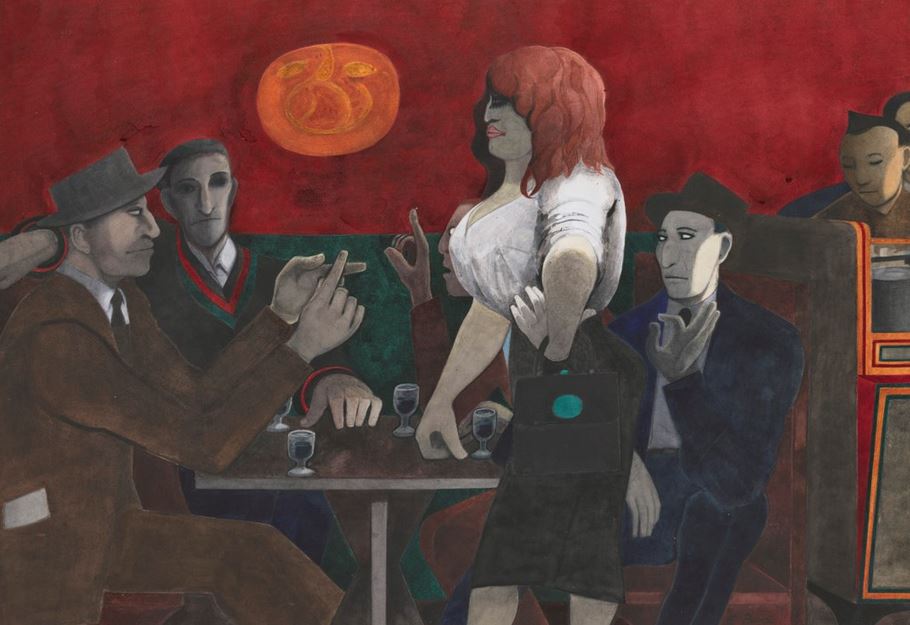
If we continue to pay bad for bad, bad will never finish on earth“—Amos Tutuola
Numbers, Charms, & “Burn heads”
Mr Cold was known to appear at the tavern late in evening, one hour before closing, always on the third Wednesday of the month. He took no alcohol, but only ever requested the last gritty dreg of coffee after it was gone cold.
Perhaps on account of cold coffee he was called Mr Cold. Others said it was simply that he looked at you with cold blank shark eyes. He was a gaunt man; tall, but not especially so. In his black suit and tie he looked out of place in the drab neighborhood bar, yet as if he were there to conduct business.
He offered a strange coin in payment. At first the bartender balked, but Cold insisted it was valuable to certain people at certain times. It appeared to be a small silver coin within a large copper coin. The heads side bore the image of a birdlike creature with a long trumplike snout or beak. The tails side showed two cones meeting at apexes, and the legend 1 HRÖNIR. The bartender picked it up, marveled at its weight, and accepted it, if only as a novelty.
The bartender slid him a cup of cold black swill. As the man reached for the saucer, the bartender observed with narrowed eye that the stranger did not extend his arm to take it, instead sidled up to the bar, swiveled, and clamped fingers stiffly onto the saucer. A thin grimace stretched over his face, and he shuffled off flat-footed, like a marionette.
Mr Cold entered the back room. It was sparsely furnished with a few wooden tables and chairs painted in scored, chipped mustard green. Sitting on the edge of a rickety chair at a corner table, he held court hearing grievances and appeals.
Most people wanted “books of luck,” pages of numbers supposed to serve up infallible odds of winning on numbers boards and lotteries. Many testified to the reliability of these sheets. Others asked for more exotic items: talismans for protection, charmed dice, love spells, augury about the market or horse races, and such like.
One night a man came in, rumpled as his damp raincoat. He ordered a bottom shelf whiskey, with a cherry. “No cherries.” said the bartender, still hefting the uncannily heavy coin in hand. The man took his drink with resignation and slouched into the back room. Wearily he slumped into the chair opposite Cold. His large soulful eyes looked furtively at one wall, then the other wall, avoiding Cold’s eyes. For a time they spoke no words, only rain falling outside. Finally Cold asked his name. When the man answered, Cold took a black fountain pen from his jacket and carefully wrote the name “Martin Novak” in a small black notebook. He put down the pen, then asked Martin what he had come for tonight.
A look of unease came over Martin. He had a long, deeply lined, rather sad face, with large brown eyes—not unpleasant, with the sadness of a poet ever disappointed by the world. He looked up at peeling paint on the ceiling, down at a dusty corner, over at the rusty radiator. Then he shook his head vaguely, mumbling that he wanted, or rather needed, something… something different.
While it spun, Cold explained: “People come for talismans, love charms, lucky numbers, and the like. Mere trinkets you get from a gumball machine. You don’t want a trinket, you want a solution. The question is, Mr Novak, what problem can we solve tonight?”
Martin looked down at Cold’s hands. His wrists protruded vaguely grey under the sleeves of his plain black suit, which came up short, as if borrowed from a shorter man. A cup of coffee sat before him. Without looking, he lifted it and took a sip, eyes straight ahead. There was something odd in the way he raised his arm to drink, as if he were invisibly controlled from another place.
Finally Martin could stand the gaze no longer. He blurted out that his life was every day nothing but the same thing. For the problem was, he simply couldn’t get what he wanted.
Cold stared at him for a long moment, his face expressionless. Then he reached into the side pocket of his jacket and laid a small red box on the table. He instructed Martin to open it. Martin slid the box open and saw that it contained ordinary wooden matches with red heads. Cold told him, “If you want a thing bad that’s not available to you, strike one. After it goes out, don’t throw it away. Take care to save the burn heads, replace them neat and straightly, and come back with the box when you’ve used all. It’s important.”
Martin nodded and asked what it cost.
Cold told him not to worry. “The box is on perpetual loan and you owe nothing, provided you follow my instruction to the letters and bring back all burn heads.”
Again and Again
While dressing next morning, Martin saw the little red box on the dresser. Suddenly he regretted his meeting with Mr Cold, and felt quite foolish. He had thought Cold a fraud until his friends spoke so highly of his books of luck, claiming the numbers brought them big winnings. Martin was skeptical, as gamblers are wont to brag and puff, as they desperately wish for any success, and always never admit they’ve been had. Even so, he had begun to feel desperate, so he relented and decided to consult Mr Cold.
Now in the bright morning light, he could see plainly it was only an ordinary box of matches, and not magic at all. He felt foolish, but no harm was done. At least he hadn’t paid monies for it.
Therefore he endeavoured to forget the encounter and go about his dailies as usual. After all, he was a steady man with a decent job, only he was bored, and had begun to feel within himself that his routine was too much dreary. As he said, it is all the same while nothing different ever comes.
Yet now that he thought upon his life, it seemed not bad at all. He had a solid job that gave his days structure to lean on, and afforded him goods and niceties that made life tolerable, if not enjoyable. Feeling much better, he took upon himself to go to a small little corner shop in his neighborhood, for it was the only that carried his favourite cigarette.
He bought the same every time: a bar of dark chocolate, a bar of milk chocolate; a can of dark roast coffee, and cigarettes. Perhaps today he would buy something different to spice up the day. He went to the counter, and was about to order his cigarettes, when he noticed a new variety of his brand. He asked the clerk what it was, to which the clerk shrugged and said, “Who knows? They’re all the same poison. Besides, you’re asking the wrong guy, I’m not stupid enough to smoke.”
This is the problem, Martin thought, whenever I try to do anything different. He said nothing, but only sighed within himself: “Again and again I am not a respected man; for nowhere is anything to admire in me.”
Rebuffed, Martin asked for his usual brand. But then recalling to himself the conversation with Mr Cold, he felt a surge of daring, and blurted out that also he should like a lottery ticket, the kind where you uncover numbers for a payoff. The clerk handed it over, shook his head, and laughed: “I don’t know why people waste their money on such things; they never win.”
Martin pondered: Why does he not wish me luck, but rather share his bitters? Angrily he stuffed the ticket in pocket, thinking he should not give the man satisfaction at his losing, so he would not play. He justified this by reflecting within himself: “Again and again I am not a money man; never was luck on my side.”
Martin paid. The rude clerk said nothing, and instead of gathering all his purchases into a bag, he only slapped a paper bag flat on counter. Immediately he turned to the next customer, a pretty young woman.
Having seen Martin buy a lottery ticket, she felt it lucky to do also, so she requested one of the same. The clerk beamed at her and politely replied “Here you are, Miss, would you care for anything else?” And when she asked for cigarettes of a particular kind, he obligingly found it for her. And even after she changed her mind, saying on second thought I’d like the one next, the ones in the green box, the clerk profusely apologized, claiming it was his mistake for reaching too quickly.
Witnessing this farce, Martin quipped that this must be the most polite store in all the city. The lady retorted with disdain: “What’s your problem? It’s a fine store.” So Martin slipped away, reminding himself: “Again and again I am no magnet man; there is no charm in me, and I have never sparked an attraction.”
He headed on home. A few blocks down the street, waiting for the traffic light to turn green, he saw a poster stuck on a lamp post, advertising a casino on an Indian Reservation. It was attractively called “The Hollywood,” but he did not care to go because he thought that he would have a bad time of it and lose a lot of money.
Then he reached in pocket and felt the box. He wondered, could it really work? Perhaps he could go to the casino as a test or experiment, and why not? What did he have to lose but a match?
As he walked on, he noticed other such things around him everydays that, but for a wish, he could have tried and done. In that moment he felt as if standing besides himself observing how he was always presented with opportunities that he failed to notice or dismissed out of hands because he felt it was not for him. And the self standing besides chided him so, he decided yes, he would visit the casino.
Throughout the week he thought about what to wear, and it wasn’t until Thursday he realized the most important concern was monies. How much should he bring? If he brought a big wad of cash, he might easily lose it all. Too little, and he wouldn’t even get started. He settled on a respectable yet safe amount. Even heading out the bank, he felt uneasy walking about with so much—much more than he usually carried, looking to and fro for robbers.
The whole venture was risky—in fact when he thought a little, it was mad. Yet he had the little box with him, and wondered, could it bring real luck?
Nevertheless the glamour of playing in a casino dangled before him. And when he thought about putting money down on the colourful tables, among the shining lights, he shivered at the risk and excitement. Life was always the same dull, and he was sick of it. This would be so much different. Even if he didn’t win, he would be in the game.
At “The Hollywood”
“The Hollywood” was a casino in the classic Art Deco style, reminiscent of an old Hollywood theatre, with stucco, chrome trim, and neon lights. On first walking in, the lobby was as glamourous as expected; portraits of film stars lined the walls, shiny brass railings, all lit by bright candelabras. Then, on entering the parlors, he beheld every sort and kind of gambling device, a forest of glowing fruits. The fancy carpet was littered with cigarette butts; the atmosphere a blue haze of stale smoke. Patrons milled about like zombies, some obese, some scrawny, some hobbling on canes and walkers; none very hale. One fellow had parked his wheelchair before a slot machine, chain smoking, furiously feeding the machine.
Not knowing where to start, Martin wandered over to the bar and bought a cheap beer. He collected himself and recalled why he was here—he had brought with him monies with which he would stake on games of chance. He sipped and considered which to try.
With that, he felt suddenly drawn to the craps table. He knew nothing of craps except that one rolls dice. He figured he could handle that. He dipped his toes and bet the bare minimum, rolled and lost. Then he bet a little greater amount, then greater again, losing each time. Quite soon he had burned a good sum. He opened his wallet and found his monies mostly gone.
Feeling faint with the rush of all this gone by, and surely not being used to spending such sums in so short a time, he returned to the bar. This time he ordered strong drink, something with a cherry perhaps—but as they had not cherries, he got a lime, and at least now he felt he was getting something out of his monies.
He sipped and thought: how foolish—after all, I’m not a lucky man, I never had one part of luck come to me. Without thinking, he took the little box out of pocket and pulled a match, then took out a cigarette and remembered what Mr Cold had said, that he must light it with intent to get what he lacked. So he lit his cigarette, saying to himself innerly: I am tired of myself as an unlucky man; I wish to get luck tonight and hence forth.
At that moment the roulette wheel attracted his eye. To him this was the glamourous gambling; for in his dreams, he was in a casino wearing a smart suit, calling out numbers as the wheel spun round. But here it was not his dream, but rather awake, hard as stale bread. And though he felt this game had the least chance of winnings, he promised himself he would try it. He had nothing to lose except his never having a single luck.
He went to the roulette table and drew a long puff on his cigarette. The croupier told them to place their bets and as he looked at the table with all its numbers, a number came to him, so unremarkable it could never be lucky.
The wheel was set aspin, and the ball dropped into the turning wheel. It rolled and rolled, and dropped into a pocket. It slowed, and the croupier called out: “Thirty one black.”
Those standing round the table clapped and beamed in approval, for it was a feat against high odds to bet on a single number and win.
He shook his head, amazed. At last, here was a bit of luck! Still, it could have been pure chance. He resolved to put the burn head to a real test. When the time to place bets came, he felt a dizzy rush, like standing on a tall cliff, and he put down his towers of chips, letting his hand be guided to another number that glowed hotter and redder than all the other numbers: 11, another number that seemed not lucky or special in any way.
The wheel set to spinning again. He waited anxiously. The ball dropped into a pocket.
“Eleven red,” called the croupier.
Again people clapped and cheered; his hand covered his mouth as piles of chips were slid over to him. He was now very surprised within himself because only now luck was working for him, when it had refused to work for him at any time before. How annoying that all it took was a stupid burn head to change it all! It was then that Martin wondered within himself: Is lucky a thing you get or a thing you are?
Thereupon he set upon a winnings streak, as terrific and uncanny as lightning striking the same tree many times. With each winning, the excitement increased and the roulette table became the attraction of the room. Ladies gathered around him, wanting to be seen near a winner. One chap, very suave, smart dressed in tweed jacket and cravatte, cheered him on: “You surely have the knack, old boy, keep at it. Do let me shake your hand—perhaps some of that luck will rub off!”
Eventually Martin found himself with a tall stack of chips, a veritable castle with turrets and ramparts. Shaking his head, he thought: nothing like this has ever happened to me—I’d better quit while I’m ahead.
So he took his winnings, as many chips as filled two canvas bags, the suave gentleman carrying the second bag, to the cashier’s office. The posh chap suggested a drink. Having plenty monies on him now, Martin thought, why not celebrate? They ordered single malt Scotches from the top shelf. Martin’s a lime and an umbrella, making it the best Scotch he’d ever had.
“Ahh—doesn’t get any better than this, my boy.” said the sleek fellow. “By the by, name’s Davenport, but it’s a stodgy name—friends call me ‘Chance’.” As a veteran at games, he congratulated Martin, but cautioned him also that winning streaks don’t last and are wont to end abruptly. On they chatted till last call.
Then Chance handed Martin a calling card with a number, and said: “Pleasure to meet a real sport such as myself. Do call next time you’re out for a night on the town and you want ‘Chance’ on your side—get my drift, eh? Heh heh.”
Not a One Took Him for Serious
Now with winnings in the bank, he decided to himself that he would take a shopping trip. He went downtown looking at the various stores and again it seemed to him that all around him there had always been opportunities, yet he never took notice of them for fear of buying the wrong thing or overspending.
Walking by a gleaming automobile showroom, he decided to stop in and have a look. He had never thought much about cars except as a way to go from here to there and all about. But now that he could afford any, he wanted a beauty like these. So admiring the sleek metal surfaces and gorgeous colours, he looked into the windscreen and longed to sit inside.
A man standing by said, go ahead and get in, anyone can try it out—and so he did. Easing into the supple leather seat, a quite magical feeling came over him: he felt comfort all over and within him, as he were the pilot of a fast comet that could travel to anywhere.
Yes, he thought, running hands along the smooth steering wheel. Now that I have a great luck, I feel alright to do this, and I shall buy this very one.
His thoughts were interrupted when a salesman tapped on the side window and said, “If you would, sir, others would like to see the car.”
Martin apologized, scrambling out of the driver’s seat. He stood by as the salesman showed off the car, and waited for another salesman to talk with him. Finally one came up to him and said, “Perhaps you might come again and browse, sir, at a time not so busy with customers.” And it was then he realized that meant he was somehow not their customer.
And so he left, feeling rather numb and deflated, but was not so for long, as he passed by a fancy building with a sign announcing boldly: “Luxury Units For Sale.” Then he remembered to himself that he was in fact a money man come into many winnings.
He resolved himself to enter with confidence, the air of a man with a fat wallet, knowing his money sat in a safe bank and could be dropped in as by helicopter and parachute if needed. A lady was there with many papers. He asked to tour the luxury unit, and she said to him that she already had many appointments for tours, so perhaps he could wait downstairs in the lobby.
He sat there a long time reading magazines, while no one came to see him. Finally he returned up the stairs to see the lady, who was now gone. He found her with a couple showing an apartment. He waited outside the door, and gestured to the lady asking to come in. She asked them to wait a moment, came out and said to him: “Look, I am sorry, but today is quite busy; perhaps you could return another day.”
Thwarted, he backed down and meekly excused himself. He saw that here too he was not an esteemed customer or any customer at all, for he did not look the part or act the part.
Finally Martin came to a jewels shop, and now thinking to act more confidently, took a deep breath and thought within himself: all these other things matter not so much anyways; for what I really always wished was a nice watch, not just any, but one they call “Oyster” because of its shining beauty and elegance.
So he stepped into the shop; it was warm and brightly lit, filled with many glittering items. He looked to right, looked to left, looked to and fro until he saw watches in a case. He peered down at them, pressing his face to the glass.
“Can I help you, sir?” asked the salesman.
Martin bolted upright, pointed to the case, and asked whether that watch were a real Oyster. The salesman replied with one raised eyebrow, “Well, we don’t carry fake ones.”
Martin asked if he could try it on. The man hesitated. “I’m not sure you really want that one, it’s very costy.”
At that moment Martin thought within himself to pull out a wad of cash and demand to see the watch on account of his wealth. Unfortunately he had not a coin to show, for all his monies were in bank, and it was the weekend. He realized of a sudden he couldn’t just call and have bags of cash dropped like bombs, here and now.
He began to protest that this was a watch he had been looking for and must have. What’s more he would pay all in cash. However, having no monies for now, he insisted he would pay on Monday, or definitely Tuesday at the latest.
But the salesman called out: “Dmitry, please assist,” and a large man emerged from the back of the store. They grabbed Martin’s arms and hastily ushered him out.
Wish Upon an Oyster
Dejected and rejected, Martin shuffled down the sidewalk. Seeing a pretty sign across the street, he thought at least he could have a nice coffee and a fancy pastry. Yes, a cheese danish! The shop was quiet and sophisticated with clean design as if in Switzerland. Here at least his monies would buy him some nice he wanted, even if small.
As he sat down then with the steaming black coffee and warm cheese danish, suddenly sitting to his opposite was his friend Chance. “Fancy meeting you here, old boy.” He removed a silk scarf, rubbed hands together, and picked up the Danish. “Simply starving. What are you up to on this beastly day?”
Martin quickly snatched up his cup and puffed upon the black pool of coffee, then told of his shopping day, how no one took him seriously and so it turned out nothing for him. He concluded again and again he is unable to get any what he wants.
“Now see here, old boy,” said Chance. “It’s not what you have, it’s what they think you have. You go in with the air of one who always never gets what he wants, so they believe you are that. They simply don’t sell to such people.”
Martin knew he could use burn heads to get any things he wanted, but it was not about money; it was all to become a different someone, a man who counts and is counted, who knows what he wants and goes to get. Surely that person would be the opposite of who he is now.
Martin popped out of his thoughts and blurted out that the only fancy thing he ever wished on but couldn’t have is an Oyster watch.
“No problem at all,” laughed Chance. “I have contacts in the business, you know. Get it for you nigh on half price!”
Martin marveled at this and asked if Chance could really get the real article, for not every jewels shop carries Oyster watches.
“Thing is, old boy, I avoid jewels shops and buy direct from the source.”
Martin advised he had no monies on him at that time, but could go to the bank later.
“Don’t worry about it now, not while we’re having this delightful Kaffeeklatsch.” Chance soothed. “Listen, I’m having a bit of a soirée this weekend—invited a few dozen close friends. Do come, you’ll meet the smartest people. Bring the money and we’ll sort it out then.”
Martin thought that Chance was indeed the most charming person, but he recoiled a bit at the thought of a party. People he did not know would be there, and he might be called upon to talk to them. But, he reflected innerly, things felt different, so why not try something new?
An Out-of-Water Fish
Walking into the party, Martin might as well have been a fish jumped out of water, flip flopping from one corner of the room to the other. Not thinking of one thing to say, only working his fish mouth in the strange air, and finally jumping in the punch bowl.
He had put on nice clothes, jacket and slacks, but still felt out of place. Everyone seemed so much more finely dressed than he.
He fretted whether he should strike up words with a few of the strangers, but there was risk in it, risk of cold shoulders or mocking. Standing there wordless by the drinks table, he found comfort in the snacks—this gave his mouth something to do without sounding stupid.
Someone came up and asked him how it goes—but as it turned out, the person just wanted him to move over so he could get to the crackers and dip.
Yet he got a mote of confidence from this exchange, stood more straightly, and made a smile at people as he went by. He recognized no one there; they were a different crowd than he mixed with: more colourful, lively, and smartly dressed. It seemed a sheer wall he could not overcome. Feeling a bit quivery within, he retreated to the balcony. There he breathed the night air and straightways felt lighter.
Blinking at the city lights, he recalled the little box in pocket, and thought: Is now not the perfect test? He realized it would look quite odd to light a match without cigarette or candle. But since no one took notice or looked his way at all, so shrugging his shoulders, he took out the box, opened it, and removed one match. He said within him: I am not a people man; I have no charm or charisma within me; so I shall cast a glamour tonight and carry it with me going forth. Striking it, he beheld the flare, a bright bloom in the night.
As the glare faded in a wisp of blue smoke and acrid brimstone, immediately then a slim lady came up to him. With a flirtatious look she held a cigarette to his match and said, “Perfect timing, I needed a light.” With a sultry look over shoulder, she returned inside to the bright party.
And as right then she disappeared, immediately his friend “Chance” came up to greet him.
“Here you are, dear chap—glad you showed up to my little shindig.” he exclaimed, sweatly pumping Martin’s hand. “Nice leather jacket, but let’s get you something a shade more impressive.” Martin removed his jacket, and Chance tucked it away in a hall closet. Then he produced a posh jacket, a crisp navy blue blazer with three gold buttons on each sleeve.
They made the rounds. Meeting people wasn’t as bad as he thought; he wasn’t expected to say much. Nonetheless, Martin soon felt exhausted. He wasn’t used to meeting or mingling (for as he said, he was not a people man). Yet the talk was small, chatter about the salty snacks or the lately weather. Once in a while someone would ask Martin what he did and no sooner he responded accountant, Chance nudged: “Admit it, Martin, you’re in finance, aren’t you now?” So on the spot Martin felt no choice but to say fumblingly it’s financial… finance he did.
After running this gauntlet, Chance took Martin aside and advised: “Don’t be so modest, my boy—you’ll never get anywhere with these people unless you have the right air about you. Remember, it’s not who you are, it’s who they think you are that counts.”
“Oh, and here’s that watch you wanted.” He pulled a gorgeous oyster faced watch out of pocket. “Let’s put this on you. Has to feel just right, or I’ll take it back, no questions asked,” he laughed. Martin tugged up sleeve and Chance slipped it on. It felt exquisite, heavy as fine gold.
Chance looked at him rather expectantly, and remembering payment, Martin fumbled around in pocket and brought out a thick pile of bills. Chance counted it unhuman fastly. “A deal it is, then!”
They weaved through the crowded room, down the hallway, and into a quiet parlor. On midnight blue walls hung gilt-framed paintings and Grecian statuettes. Sitting by the window looking at a large art book was the same attractive lady who had asked him for a light. A sky blue evening gown contrasted with her red hair. A cigarette lay in the ashtray sending up ribbons of smoke, forming a halo that hung above her.
Chance greeted unctuously, “Charity! How lovely you are this evening. My dear, I want you to meet my new friend, Martin. Martin works in—” and here he signaled with vigorous knitting of eyebrows, “—Finance! Now, aren’t you, old boy?”
Martin raised his drink and an eyebrow as if to say quite so.
Chance abruptly excused himself: “Well! I’ll leave you two to talk. Duties of the perfect host—never done, don’t you know.”
A pause settled in his wake. Martin tried to fill it with an awkward smile. Charity prompted: “So, finance?”
He replied yes, numbers, lots of numbers, all very financial indeed. He felt as if he were groping in pocket for words.
“Not a man of words; more of numbers, is that it?” she asked.
Martin had never thought deeply of it, but this was probably true. He said that numbers don’t make good friends, but at least you can count on them.
“You don’t take anything seriously, do you?” she laughed, removing a slim metal case from her clutch. She opened it and took out a cigarette, which she held just as she had before, and inclined her face, inviting ever so slightly.
Martin rightways felt in pocket for the red box, took hold, opened and carefully removed one match, trying not to fumble. He struck while thinking innerly: Never have I been a romantic man, or charmed anyone at all. So don’t turn away just yet; if only we talk a little, all the evening would be wonderful.
As he held the match, Charity looked and saw the Oyster watch beautifully flimmer and thereon remarked: “You look like you’ve arrived—have you really arrived?”
Martin replied that it was not his arrival at all, only the arrival of money.
Both and together they watched the flame bloom betwix them; she waited a beat, then drew the flame into her cigarette. She blew out a stream of smoke, saying “Be careful, money changes people.”
Martin replied that in his case such change might be a good thing.
“Money isn’t real,” she said with a breath of smoke. “It shows you what it’s like to have what you always wanted, but not who you really are.”
Martin admitted he wanted to be a new somebody; he tried going about and doing new things, yet no one believed he was anybody.
“Strange, isn’t it?” she said. “The more you try, the less you are.”
She then asked Martin how he came to know Davenport, and he replied that it was in the casino that he met Chance.
“Oh, is he still calling himself that?” she rolled green eyes. “I named him Chance as he’s there whenever there is luck, and gone when you lose your luck, but always when you least expect. Still, he’s one of those who can help you get what you want or make things happen, even it doesn’t make you happy.”
Martin agreed the nickname fit. He felt compelled to say that although he became friends with Chance, he himself was not a sporting man given to gambling or any vice.
“Only because you’ve had no choice up till now!” she teased and flashed a knowing smile.
He smiled abashed, but finally admitted he could not deny it was so.
“And have you figured out what it is you really want?” she inquired.
Martin said he only knew he wanted to see her again.
Back to Drear Life
Martin went back to his usual drear everydays. After the glitter of the casino, the streets seemed all the more grey, and after the party, his routine was all the more drabs.
On his way home from work, he remembered he had run out of cigarettes and only the mean little store at the corner carried his special brand. So he decided simply to ask for the cigarettes, pay and leave directly, ignoring whatever the rude clerk might say. But when he requested them, the man seemed not to know which was which, for the box was an in-betweens colour he was not sure to call red or orange, for none could say it was either or neither. So Martin had to point it out on the shelf behind the counter. As he pointed, the man, noticing the Oyster watch, remarked: “Whoa, isn’t that shiny! Where’d you get it, some guy on the corner?”
Martin replied indignantly he paid good money for the watch, and got it from a person he knew well. Then snatched up cigarettes, slammed down monies, and stormed out like a teapot—for steam poured out his ears, and he was quite red in face. He wanted as faraway as he could, so he cut through the nearby park.
Walking briskly, he lifted his face to a canopy of leaves, now just turning red and orange, and in the cool air thought, all is well, isn’t it, or at least going so much better now that he had met Chance and Charity. Certainly his luck was changing and no more was he a loser like that clerk—obviously jealous. Only if I had a lady so amazing as she on my arm, certainly I would be a regarded and admired man.
Now that he had walked a bit, he cooled down. He had no idea how much time had passed, and he looked at his watch. He again regarded the beauty of the watch and wondered why he had gone to such pains to get it. He had concern that he had not bought it at a respectable shop, though none such would sell it him.
Which he took as blessing, for his friend Chance had assured of his connections in the watch business and got him a lowest price. If he ever doubted, could easily take it off now and check that it was genuine.
He did just that, and indeed the brand mark was right there on the back, along with fancy engraved letters. He began to wonder, were they the initials of the previous owner? For he did not want stolen, he wanted new that belonged only to him, that he paid for squarely with his own monies. The whole matter took on a bad taste, like a pretty fruit you bite into, but is mushy and stale.
In that moment he resolved within himself no longer to keep it, for as stolen it didn’t justly belong to him. He would find Chance, return it to him and ask for his monies back.
Least and Most You Can Do
Martin returned to the casino that very evening, and as expected, found Chance standing at the bar, lecturing on games and odds. He went up to the bar and greeted his friend, then said, it’s a sad thing, but he would have to return the fine watch he had bought. He explained it didn’t feel right, in fact pained him to wear it, reminding Chance of his promise he could return it at any time for any reason.
Chance exclaimed exuberantly and rather drunkly of course he would honor the guarantee, but he was damned short of funds at the moment, having just made a hasty bet. He reached in pocket and held out a silver and copper coin, saying “But wait, I still have this which I picked up in my adventures—trust me, old boy, it’s rare and quite valuable to certain people in certain places.” Martin looked at the strange coin and saw it bore the image of a trumpet beaked bird, just like one he had seen before.
By this time monies had lost all meaning and allure for him, so he accepted the coin with a nod. Chance then added, “Oh by the way, your little friend Charity is about.”
Martin walked around the casino, which he knew reasonably well by now, ostensibly casually observing the patrons happily gambling their substance away, but actually searching for someone he truly cared to know.
After touring the illuminated games and engines of fleecing, he saw her with a very fat and sweaty man. He wore a nice suit and many gold chains shone out from the open V of his shirt. Sighting Martin, she made an excuse and went over to see him. Martin decided to cut to the point, as he saw life was short and easily gambled away. He suggested they have dinner straightways that evening. Taken with his boldness, she agreed, and off they went.
Martin took Charity to the “Velvet Room,” the nicest steakhouse where he had always imagined dining, but never had occasion to do so by himself. Away from gambling and the smog of smoke and drink, they talked easily with each other. For the first time it seemed like he could open up himself without shame. Suddenly it was as if they were other people who knew each other well and had met in a completely different way.
He admitted to her that he was not exactly as he had at first seemed—that is, a man who is fully “arrived.” He explained he had been frustrated as he always never could get what he wanted. But a short while ago, he found a way to get any that he wanted. Yet he had so far only discovered what he did not want.
So then it was not about getting the things he had wanted after all: it was to become a different someone. She asked who that person might be. He replied he would be one who loves all that is beautiful, and one beautiful as you would love him back. This incidentally was the boldest of anything he had said to any lady.
When the waiter asked if they would like coffee, she declined and then suggested to Martin why not have coffee at her place.
She had a charming little apartment downtown, decorated with fine taste and style. Entering and looking around, he thought to himself her place was beautiful because she brought beauty with her always.
They sat down, drank coffee until late, and talked much. Especially she told him about her life before she had met Chance: how she had once been happy as a girl, then her mother went away, and her father drank more and more, and with each drunk became more violent. Soon she too ran away from the beatings, and looked for a strong man to protect her. Yet it seemed the men she met only used their strength to hurt her instead.
She stopped talking of a sudden and removed her blouse. Her shoulders were smooth as a marble statue, and he was much agog at her beauty. But when she turned around, he saw she was showing the many scars on her back. It seemed as if he could read them like words: some were long, like the lash of a belt or rope; and in several small circles he saw where someone had put out burn heads. Charity explained him these are from every bad man she had been with, and she had always picked a bad one.
Seeing this, Martin did not know how to feel within him, anger or sad, but only so terribly he felt cold water inside his arms and legs.
Then it was as if he felt every strike and burn, and sadly realized he too allowed people to strike and burn him with disrespect and contempt. Instantly at that he took out the small red box and struck one burn head, wishing aloud all these hurts and scars begone.
Long silence went by, with no effect. Martin struck another and another, yet these failed too, until he was left with one only. Martin realized that the burn heads would only work when he wished himself something selfish. In frustration he closed the box and apologized to Charity, saying he only wished to help her.
She sighed and told him, “If you want good for me, pray, don’t only wish. For prayer is the least and the most you can do.”
Charity implored him not to despair over it, for here she was with him now. And after all her troubled past, she had met Chance at a casino and he gave her a place to stay, and took care of all foods and dress. They made an arrangement as follows: Chance found men for her to date; they spent much on her, while he set them up with “sure investments and bets” that promised rich returns, while he skimmed off fat fees for advising, before they eventually failed. Because of this, she felt indebted to Chance, for he saved her from destitution, and also respected her, and listened to all that she thinks and says.
It turned out that Chance also put her up to meeting Martin to keep him close at hand and convince him that his luck was coming from his friendship alone. Martin had to smile, knowing the truth of it, and replied he well knew where his luck came from, and it was not Chance. Then he added, though you were put up to it, I like knowing you, and despite our meeting being set up beforehands, despite these charades I would hate saying goodbye.
And to this she wondered aloud if only together they could put the past behind and become really themselves again, and not as puppets other people wanted them to be.
Martin thought for an instant he could light the one and only last match and the burn head would bring it to be, but then he considered within himself that they could surely do all this on their own, for now it was their lives to make or break.
So then they agreed between them there was no need for goodbyes. But to Chance and Cold they would say goodbyes.
It Helps Not at All that Helps Not Another
On the following third Wednesday of the month, Martin put on his jacket and made sure to place the little red box carefully in pocket, for he had resolved to see Mr Cold that evening at the tavern. And there in pocket he felt the lottery ticket he had bought a few weeks gone by.
He had to smile and chuckle to himself at finding it, for he had meant to take it home, so as not to open it in front of the rude clerk, but when home he had forgotten all about it. Now he thought within himself to open it and reveal the numbers. There was no need to light a burn head, for as any gambler will tell you: “If it wins it is all your lucky chance, and if it loses it is merely bad chance, unfair and undeserved.”
So he opened it and it turned out a winner after all, for three thousand. He felt a thrill, but also strange within himself that he alone could win a game, even with not a one burn head or any magic help at all.
Since the little shop was on his way to the tavern, he thought himself to stop in and redeem this ticket. He had won so much now that this amount mattered not—although this winning was worthy and special, for it was his own without help.
There slouching as usual back of the counter was the rude clerk. Martin got in line, thinking how satisfying it would be to present the ticket. But in line before him was a woman with three children, counting out monies to pay for cookies and other foods. Martin recognized the woman from his street, and knew that the husband had left them. When she counted out, her monies were not quite enough, and she told the eldest child to put the cookies back on the shelf.
Immediately he saw within himself how the winnings could help her, and could in no way help him, for he had all he needed and more. Moreover it was clear that he could do good for her as this winning was his own luck to give, not the kind that came from burn heads, which can only get you the bad that you want.
He slapped the ticket down and told her, this luck which was mine is now yours, use it and get any good that you need. And looking down at the ticket’s worth, she exclaimed, “Thank you! Now I can pay for grocery and rent the rest of the year.”
Then Martin looked at the clerk as if to declare, sometimes it does pay off, you see? Yet the clerk sneered: “Easy come, easy go. You can spend it all in a day, so what good is it?”
The lady scolded the clerk with hot words: “Show this man respect, you useless ass—for clearly he is a man of regard and monies, and no doubt popular, if he can give away such winnings with a smile!” Then she bid her son bring back two boxes of cookies, and demanded the lazy clerk pack it all nicely in a bag.
On his way out, Martin passed through the town park. Walking in the chill air, hands in pockets, he found the strange coin that Chance had paid him. Holding it, he was surprised how much weightier it felt. He glanced down at the trumpetbill creature on its face, surely like no bird in this world. When he put it back, it weighed down one side of his jacket like a stone, and here he decided it had become a burden and worth naught to him at all.
Returning Bads for Good
Martin entered the tavern looking much different than before. Wearing a nice jacket, pressed shirt and slacks, he approached the bar confidently and ordered the costiest whiskey on the rocks, with a cherry. The bartender replied: “Oh yeah, since you asked last time, I got cherries.” And he plopped a plump red cherry in the glass.
Martin took his drink to the back room, where he found Mr Cold sitting like furniture in the usual place. Staring straight ahead at the wall, Cold said in a faraway voice: “I’ve been expecting you, Mr Novak.”
Martin walked over and pulled the Hrönir out of pocket. By now it was so heavy, he hefted it up with both hands, then dropped it in front of Cold. It landed with a ponderous thud and dented the table. Cold snatched it up easily with two fingers and said “Thank you; I did wonder when it would turn up.”
Martin replied he had no use for it.
“Ah, but it’s quite special,” Cold replied. “There’s only one; it always returns to the owner, and can be spent endlessly. It has but one disadvantage, as I believe you discovered.”
Martin sat and faced Cold. He had forgotten how distant was the stare, as if someone looked through the eyes like binoculars from afar off.
“The box.” urged Cold. “Have you brought the box?”
Martin nodded.
“Good.” Cold’s flat voice subtly quavered with delight. “Put it down so I may examine it.”
Martin placed the little red box before Cold, who opened and turned it over, emptying the contents on the table. With stiff and halting motions, he lined them up and counted all. Then he noticed something and started. His arm reached out like a toy crane and held up the one unstruck match.
“You have not returned all burn heads as instructed, Mr Novak.”
Martin replied that he had returned all; he had only decided not to use them all.
“But, Mr Novak,” protested Cold, “Unless you use all burn heads, the contract cannot be fulfilled.”
Martin said that the box had not gotten and could not get what he wanted, so he was returning it as is.
In desperation, Cold offered him another, saying: “But satisfaction is guaranteed; all you want can be obtained easily! Here, take another box.”
Martin looked down at the box on table. Here was a whole new box of bads, another set of indulgences and winnings, his for the asking. And at that he considered: He used to say he was not a lucky man, but when he got luck and monies, he was not more happy. He used to say he was not a regarded man, but when he met many people, again he was not happy. And he used to say he was not at all a magnet man, yet now he pursued romance, and had hope it would bring happiness.
He looked up, into Mr Cold’s emotionless eyes. Then he shook his head, saying:
“One bad is too many, but two is never enough.”
Table of Contents
Antoni Camplese is a Tech exile now living in the Wilds of Central Pennsylvania. He writes fiction influenced by Italo Calvino, Jorge Luis Borges, Kobo Abe, and Franz Kafka.
Follow NER on Twitter @NERIconoclast









One Response
I enjoyed this story which is pleasant reading and has a wonderfully clear style while describing things rather strange.