by Robert Gear (July 2026)
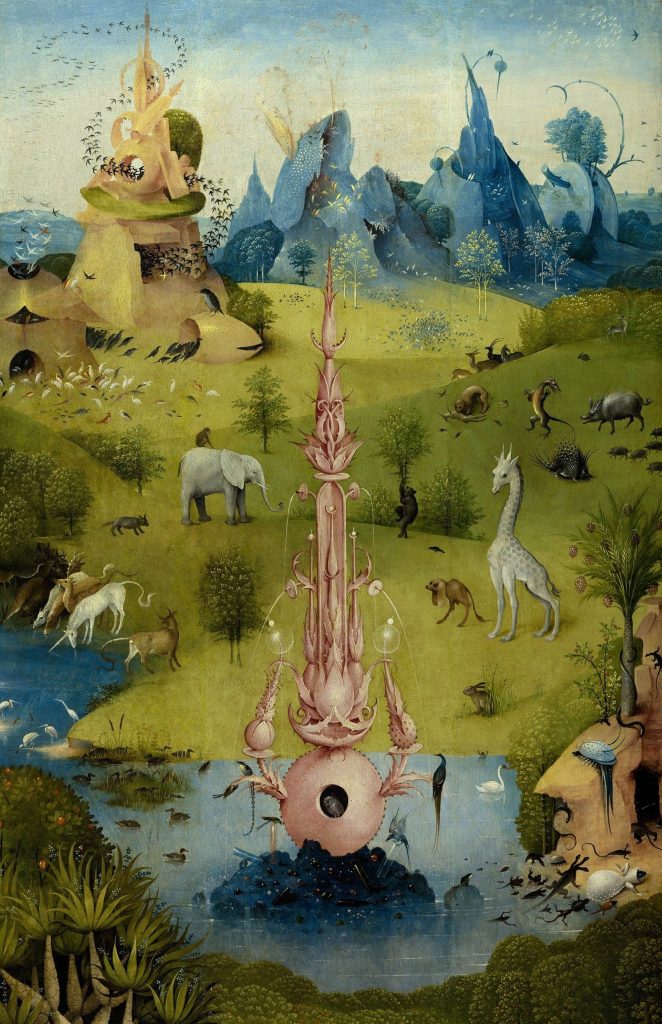
If you doubt the truth of this story (even if it’s not true) then you are deceiving yourself. —Anonymous Biographer of Gilbert the Frog
Gilbert the Frog was hatched somewhere east of a great river in the region now known merely as ‘the Western Desert.’ His birth was unexpected since his parents were distinctly human. What’s more, his stepmother, a birthing person with a uterus, had already birthed about ten birds—all of them clucking and apparently male chickens (although chicken sexing was an art still in its infancy). How these came to be is not really known, although some have suggested that the genes were a throw-back to an Egyptian maidservant who was cast out into the desert with her illegitimate son many years before.
This account is different than the one you may have read in the book of Genesis (chapters 37 to 50). It has never before appeared in print because it was only recently unearthed in an archaeological tour de force; the bits were pieced together and deciphered by a great scholar. And by the way, it has become clear that the early biographer of Gilbert was somewhat unreliable—as was Gilbert himself. In this version of events, Gilbert did not have enough foresight to kill all the rooster boys when he had the chance. If he had done so, history would perhaps have turned out differently. Who knows? There is a special providence in the fall of a chicken.
Animosity was present from the start. Father didn’t take well to the ten cockerels; and no wonder, they turned out to be a bunch of savages. Gilbert turned out to be the favorite, especially after his hind legs developed, and the ten step-brothers grew increasingly jealous of their sibling who at this point was more of a pet than an adolescent with responsibilities. He could hop in and out of a shallow well—something his brothers were unable to do. He could also croak pleasantly enough, but the cockerels were only able to give off piercing cries, which disturbed people in the neighborhood and gave the whole family somewhat of a bad reputation. Later generations would call them ‘roosters from hell.’
One day, a day which set off a concatenation of events with which we are all still living for better or worse, Gilbert’s father built him a beautiful round pond. The pond was shaded by a lush Tamarisk tree whose pink and white flowers and feathery leaves provided a perfect setting for the beginning of such an adventure. You can imagine the reaction of the ten cockerels! The father, whose name I have forgotten, was seemingly unaware that his other offspring were jealous of their young tailless-amphibian-vertebrate brother whose bright skin sported a range of distinct and vivid colors. The father also provided Gilbert with a little colorful cloak so that he could keep warm on cold desert nights. That was the clincher which set in motion a whole raft of problems—for Gilbert and for everyone else—although it may have had a happy ending at some distant time.
To be quite truthful, the post-tadpole-stage Gilbert was a bit of a beastly frog. He had many dreams which he interpreted to anyone who would listen, and which seemed to diminish the importance of his avian step-brothers. It made them angry, and they had low impulse control which didn’t help matters.
You may have heard the story of how they decided to kill him; but because of the intervention of the one whose frontal cortex was slightly more developed (and possibly the only one who hadn’t attended university) they threw him into a pit with slippery sides. Gilbert made several attempts to jump out, but this pit was very deep and he failed miserably, croaking all the time. Being a carnivorous generalist he survived by consuming ants, crickets, beetles, moths and other creepy things; and he bided his time hoping that his dreams might become true. His favorite dream was one in which the ruler of a distant land would take a liking to him and put him on top of a pyramidal-shaped hill to croak at all the passers by.
And then one day a caravan of traveling slavers on their way from Baluchistan to a distant seaport purchased him from his cockerel step-brothers. They winched down a bucket and up came grinning Gilbert full of himself and the bugs which lived in the deep well.
So off they set astride a caravan of camels and donkeys laden with items to trade, trinkets and slaves. The trip was indeed long and arduous. Gilbert himself in his memoirs gives us a brief account of his travels, but we’ve no need to believe all his anecdotes; and of course some professors of Sociology and Gendering Studies and their ilk have made the claim that they don’t believe in truth anyway, and also that cause and effect in the natural order are just an illusion. What we have been able to verify is that Gilbert carried nothing except his own dreams and reputed ability to interpret the dreams of others.
As the caravan approached the Hybrid-Spider Shogunate, Gilbert caught his first glimpse of huge flickering tongues set against a backdrop of sandy outcrops, sparse vegetation and watchtowers. As we mostly now know, such tongues belonged to giant Lizard Men keeping a watch on those who came and on those who went.
The Shogunate was famous for its pyramids, dungeons and hybrid-orchid experimentation labs; this latter technology was later introduced into 19th century London where Dr. Jekyll created killer roosters from hybrid orchids; but that’s another story. Suffice to say that an article at New English Review gives near documentary proof of the emergence of the hybrid rooster/orchid into our world. And this event is not to be taken lightly considering the civilizational destructiveness which has ensued.
Gilbert was amazed at the sight of towering edifices and the wide river flowing down to a reedy sea. There was even a bronze statue of a Lizard Man (or to be more exact the Shogun’s idea of what a Lizard Man looked like, since few had actually seen one of these apparently ubiquitous creatures). But our hero was not yet permitted to explore this exciting new world. His captors quickly sold him on to Mr. Otherpig—worshiped in those parts as one of a series of minor gods, but in fact a mere functionary serving the Hybrid Spiders themselves.
To cut a long story short, the pig’s sow, Mrs. Otherpig, took a fancy to Gilbert and, although her attentions were quickly rebuffed, Gilbert found himself in a deep dark dungeon shackled next to some other prisoners: the butcher, the baker, and the candlestick maker. They had bad dreams, and Gilbert soon told them what to think; his ability to dream about the dreams of others had improved since believing he might one day complete a correspondence course in Dream Psychology.
After a series of mishaps, Gilbert found himself a close confidant of Mr. Otherpig himself. He soon ruled on behalf of this animal who was a lazy pig most of the time. Now, you may think you know what happens next because you have read the Book of Genesis. But this account differs in several important respects; the cockerel step-brothers did not come over to the Shogunate and apologize for their previous bad behavior. And in the meantime, these cockerels had spread their viewpoint by the sword and by fire and rapine until most of the known world was under their claws and beaks.
And this is where we must leave Gilbert whose offspring proliferated. They did two memorable things, at least things that were recorded: they swarmed over and around the river which flowed down to the reedy sea, thus upsetting Mr. Otherpig and possibly the Hybrid Spiders, and then they left the land and settled elsewhere after much wandering led by a descendent of Gilbert named Heston. They were later abused by just about everyone, but especially by the roosters of a later time who were deeply envious of their achievements.
The Hybrid Spiders themselves were never much in evidence, and may have been even less venomous than the Lizard Men. In fact, some scholars have suggested that the Hybrid Spiders never truly existed; their projection onto the backdrop was merely a useful distraction from what was really happening. Other more thoughtful scholars believed they hid themselves successfully awaiting a time when they would need to disclose themselves. But we must all bear in mind that modern roosters and their enablers—the Otherpigs—are very visible and still with us to this day.
Table of Contents
Robert Gear is a Contributing Editor to New English Review who now lives in the American Southwest. He is a retired English teacher and has co-authored with his wife several texts in the field of ESL. He is the author of If In a Wasted Land, a politically incorrect dystopian satire.
Follow NER on Twitter @NERIconoclast









One Response
What a wry mythological mashup, one that connects to your ominous rooster stories, which in fact connect to various books written by experts writing about what is now whimsically called Western Asia. Sufficient, I believe to addle the most addle-pated modern philosophers into silence (a result for which one devoutly hopes).