by M. Anne Avera (February 2026)
Oliver should have listened to Dr. Anderson when he said that driving at night is a task only meant for younger eyes. The dark is damp, foggy, wrapping around the windshield. His beat up Datsun thumps to a dead stop, skidding two or three feet into the black, shuddering like it’s dangling off an unknown precipice. Lit streetlamps up ahead blur with milky cataracts. And for a moment, it’s all okay, some false alarm or waking nightmare. Sundowners.
Then comes the hellish scream. A squeal, really, with abject pain that could only come from a child. That’s horror, the feeling that crawls over him. Someone else is in control, now, ripping the door open as old bones creak to climb through, pounding the asphalt.
This is a street where families live, where they let their kids combine yards to play like old neighborhoods used to do. A place where kids come out to play. There could be a little body under the bumper.
Oliver prays to God that it’s not a little body under the bumper. Night-eyes blink through the black and standing in front of the headlights is Evie. She read to Jan when she was sick and sang Silent Night last year before Christmas service, high and clear soprano making sure there wasn’t a dry eye in the chapel. A sweet girl, really, patient with his wife through all her days of illness and kind to him, had hugged him at the funeral. Now her face warps, hard to see in the headlight glare.
“Are you hurt?” breathless, rasping, looking her over up and down for any cuts, scrapes, blood. She’s clean all over, hand-me-down shorts rolled up to her waist, knobby knees sticking out, in-tact, but she’s sobbing, half-wild; her pink lip juts out and sucks back in, eyes bulging so that the whites gleam. Surely, a child of her age shouldn’t cry like that but then again, after many years lived, perhaps an old man should have his license revoked.
“Are you hurt, Evie?” Oliver takes her in, looks her up and down. She’s heartbroken, poisoned with it. Shaking finger pointed, accusatory.
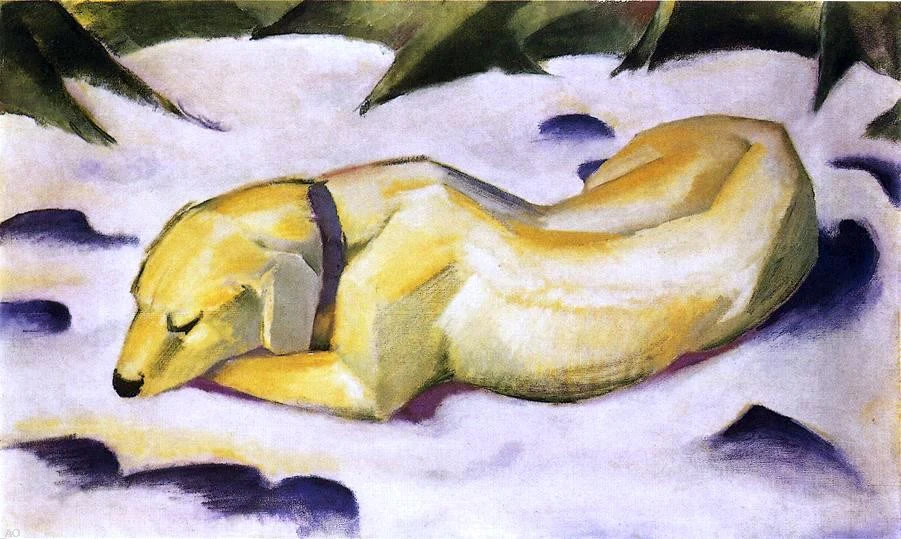
“Gus,” she shudders, but it sounds more like a “Gu-uh-uh-sss.” through the summer wind, bringing in a thunder storm’s calling card. “No-oh-oh,” she cries and the arrow of her peach pink fingernail points to below the wheel, half underneath, half carved into the dirt. A dog, grey in the snout and around the eyes, blonde body still writhing; squealing through labored breath. Christ, he supposes it’s not as bad as hitting a kid. But how sick is it that the dog still lives, still tries to crane his head up to his girl. His bush tail lays flat behind him, gives one thump as if encouraging, as if trying to reach through to whoever is watching, whoever is witnessing its pain. I’ll be okay, it says. I will always be. Lies that we tell our children, but they placate everyone, don’t they?
Brown eyes wobble in their sockets. “You hit Gus,” Evie says through snot lumps. She always leads the little ones to and from their Sunday classes, keeps peppermints in her dress pockets for the mouthy ones during service. The memory is plain, now, plays back in Oliver’s head like a movie. Now, a slam rings from the house so far back from the street the sound feels underwater.
First as a tinny spectre in the orange-yellow porch light and then as the mountain of a man he is, Mr. Smalls marches up, his arms crossed over his chest. He takes Oliver in, the way only another man can, his face warped like this whole ordeal is annoying.
“What seems to be the problem, Mr. Jones?” Like he can’t see the dog writhing in the dirt, or he’s pretending not to. Or maybe the sight of this poor girl and this aching, bent over old man makes him sick to his stomach. Such reminders as these, that time passes on.
“Gu-uhs,” Evie sniffs. Mr. Smalls turns on his daughter. A helpless feeling crests: to try not to watch him fix bear paw hands on her shoulders and grip her, shake her, make her as small as a girl half her age. Her effort only serves to choke each sob up more.
“Stop your crying,” he says. This man, the town disciplinary and one of the favored church elders. Voice like a whip and eyes glazed over.
“You know what I keep saying about playing outside after dark.” He turns back to Oliver and his face stretches, not despondent, but merely bothered. “Tell me how this happened?”
Oliver stammers, licks his bottom lip, tongue jutting out. “I think your dog ran out in the road and I,” he whispers, as if just saying it would make the whole thing real. His Jan was always an animal lover and if she could see the situation now, she’d be right next to Evie, crouching and sobbing. “I guess I just didn’t stop in time.”
“You hit him!”
The accusation isn’t necessarily false, but Smalls whips around anyways, clutches the back of Evie’s neck between his thumb and forefinger, squeezes as though his daughter is some papule or cyst under the skin, driving him to stretch towards the mirror and pierce it, drawing blood. “I said quit!”
“You have my deepest apologies,” he starts. Oliver notes the ugly urge to get back in the car, turn the key and drive away. It snaps through his body, a momentary glimpse of his youth. But he was raised to take care of his business, even in an impossible situation.
“I’ll take care of any vet bills or fees … just let me know what I can do to make it right.” He keeps his mouth open when he’s done speaking, mind working, tossing possibilities back and forth. If Smalls can take the car, they could probably make it to the emergency vet in Verbena in two or so hours. There’s not much time left in Gus’ brown eyes. The lolling of his pale pink tongue says everything, but something—anything—has to make a difference.
“Now, Mr. Oliver,” he croons, his touch still on Evie. Holding her back or holding her down. “There’s no need for all that, things like this happen … living on a country road with a kid who don’t listen to rules.” The last part was said directly in Evie’s face, which spits fire at Oliver, at the car, at Gus’ pain. The dog’s paws twitch, weak.
“I’m sure of that but—”
“He’s not gonna make it to the vet,” Smalls laughs. A friendly nudge to Oliver’s shoulder that rocks his body. Strong man, that man. Terrifying, even to a grownup. “Come on, Oliver, it’s just a dog.”
“He’s hurting! He’s still alive!” Evie butts in. Brave, brave girl. A justice-sense, somewhere in there.
“Shut up while grownups are talking,” he bites back. Then, more civil, “I can just take care of it the humane way. Put him out of his suffering.” Pause, another grip on the girl’s neck. “If you know what I mean.”
Hands wring, muscles taut in the shoulders. Doesn’t seem right. Doesn’t seem like people just put their dogs down themselves. But the animal screams again, a harsh noise that vibrates through the summer-wet air. Poor thing, out here playing fetch, and now in one moment, a metal beast that he cannot even comprehend swipes him through the side. Bloody pool under the treads soaking into the asphalt, shining. Ugly situation. Jan would say that there’s no winners here, only losers, and it’s sensible that Smalls doesn’t want to pay a vet to do what a handgun could take care of in moments, the dog not even knowing what’s coming.
“I suppose if that’s what you feel is best.”
Smalls stalks back to the house, dragging Evie with him. She cries, hard to make out, but he keeps his grip on her neck like a leash, like the control he wields over her is the only thing that matters. On the porch, they squabble while Oliver swats at mosquitos, avoids looking at the dog under the tire. With a burst of sound, Evie screams and parks her bottom on the porch step, her tiny form wavering with arms crossed, her father disappearing into the house. Oliver can’t watch this, but the impossible task is the line between his and Gus’ wide eyes, seeking the in-between, the connection of man and canine. He looks like he knows, this dog. Witnessing human pain react to animal pain, the primal alarm in his head was going off.
Gus sniffs, as if saying, It’s okay. Dog is tool and tools break. It’s okay.
Will there be forgiveness? Can dogs understand fault and culpability and death?
Gravel scrapes when Smalls returns, handgun tucked by his side. “Ought to get this over with and put this boy out of his misery.” Muzzle hits muzzle, then tracks up behind the soft ears, curled like pork rinds.
“Gonna need a new hunting retriever, I suppose,” Smalls idles. Gus whimpers, soft, and twitches two paws, reaching up, still in so much pain.
Something is wrong. The situation isn’t right because Evie’s face is stark in the porch light, white and pink. “You sure you want Evie outside for this?” Oliver asks, though it’s wrong to tell a man how to parent. Can’t be helped. Gotta stick up for what’s right, always what’s right.
“She’s gonna know it one way or another,” he laughs. “Tried to get her to go inside but she caught an attitude. Kids in their emotions. She’ll raise hell as a teenager.” Strange that he thinks that way right now when he’s pressing his gun to Gus’ head, clicking the safety off.
“Might want to cover your ears, Mr. Oliver.” Smalls brings his left hand to the tip of Gus’ nose, pets at it. It must feel like old leather, now. “Good old boy, but we all gotta die one way or another.”
Oliver doesn’t cover his ears. He looks in Gus’ eyes, because they must fully experience this together. He will witness the execution of the culmination that is man’s weaponry. He will put a presence to this pain. Yes, all of it, he feels all of it in one moment. Does a dog even know a gun? Will Gus understand what’s coming to him or feel it at all? Is it worth the time, giving love out into the world to have it swiped away in one moment? Evie’s still sitting in the light, face unknowable. Yes, this is childhood’s end. If the girl has any wonder left in her heart, it’ll be eaten away soon.
A gunshot and a scream from the porch. For one—one very, very long—moment, all the cicadas and crickets quiet down. God takes a breath.
Smalls shakes Oliver’s hand and slaps his shoulder, nearly knocking the older man to his knees. To get into the car and drive home is to say that the situation is finalized, done with, all over and out. Going home to an empty house that hasn’t been nothing but empty for two years and three months and eleven days. The car clicks on, so unfair that there was no damage on his end. No physical mark left by this Gus and this Evie and this death, so unceremonial. He watches Smalls heft up the dog and carry it out into the yard, probably to bury tomorrow when the Earth lights up. And Jan? What would Jan have said about this? About the role that Oliver played in the whole charade?
Stupid notions. There’s nothing else to see in the dim night.
Table of Contents
M. Anne Avera is from Auburn, Alabama. You can find her at writeranneavera.carrd.co.
Follow NER on Twitter @NERIconoclast