by Brian Patrick Bolger (February 2026)
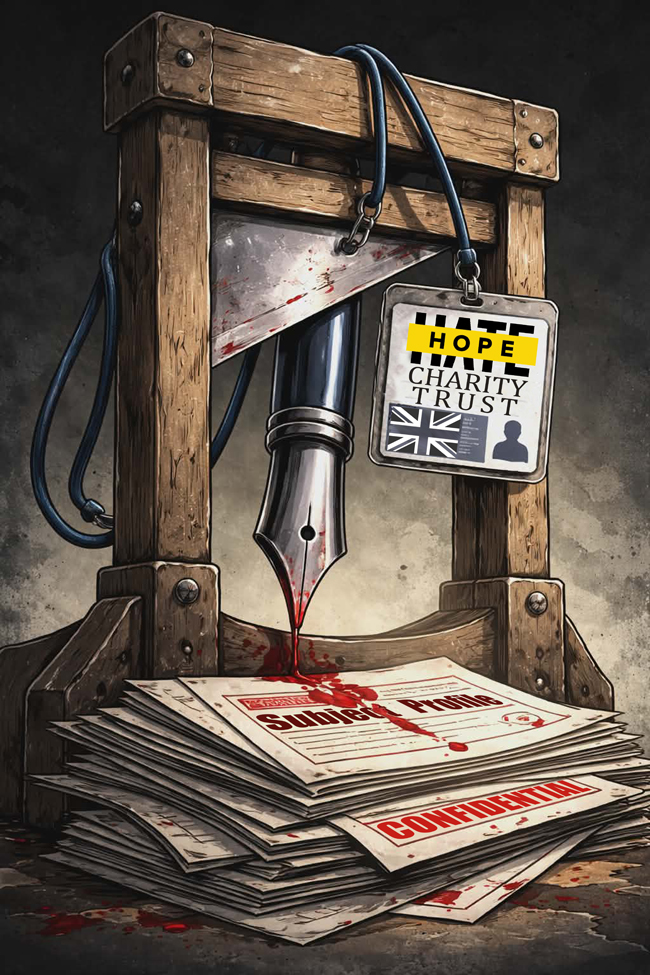
In the aftermath of the French Revolution, when Robespierre was juggling terror and virtue, the Lawyer from Arras described the logic of liberal orthodoxies gone awry. Filled with virtue and righteousness he told the National Convention that:
“The spring of popular government in revolution is at once virtue and terror; virtue, without which terror is fatal; terror, without which virtue is powerless.” [1]
In Britain, from law enforcement, the judiciary and NGOs, a dark curtain has fallen over the country. The public reputation of Hope Not Hate rests on its self-description as an anti-extremist organisation committed to defending communities from hatred and division. Yet a closer examination of its funding, legality and operational methods reveals a far more complex and sinister picture. Its activities, far from strengthening civic liberty, raise unsettling questions about possible illegal activities, investigatory excess, and the erosion of core liberal principles. In fact it goes further to illustrate how ‘Hope Not Hate’ appears to be supported at governmental level.
The starting point is the organisation’s financing and legal status. The ‘Hope Not Hate Charitable Trust’ is registered with the UK Charity Commission, reporting an annual income of £418,237 for 2023, while making a grant of £650,000 to its related operational entity, Hope Not Hate Limited. The Charity Commission’s own register outlines its requirement to remain politically impartial and to act only for charitable purposes[2]. Yet the parallel company, unbound by the same political neutrality obligations, undertakes the organisation’s more overtly partisan research and campaigning work. This structural arrangement has attracted criticism from parliamentary figures who argue that the Trust risks operating as a “shell” to fund political activism indirectly. A relevant discussion in Parliamentary questions has also highlighted the legal concerns. This concern is found in Parliament scrutiny of the organisation.[3]
Further criticism has centred on the organisation’s conduct in public discourse. The Spectator published a pointed critique arguing that Hope Not Hate has become increasingly reliant on sensationalism, petty accusations and exaggerated claims regarding the social-media activity of public figures, thereby distorting democratic debate[4]. Other commentators have accused the group of political selectivity, especially in its decision to scrutinise certain ‘far right’ movements while ignoring others, as well as amplifying reports that align neatly with its own campaigning interests.
Nonetheless, the legal framework governing such conduct is unambiguous. The UK’s Identity Documents Act 2010 makes it a criminal offence to possess or use false identity documents, including passports, with intent to deceive. The Act imposes liability even where deception is undertaken for non-commercial or non-violent purposes. Similarly, the Fraud Act 2006 can apply where a person dishonestly makes a false representation to obtain information or gain entry to a private organisation. Although investigative journalism sometimes deploys subterfuge, there is no general public-interest exemption for using forged identity documents or obtaining official documents under false pretences. Any organisation that engages in or encourages such behaviour risks operating ‘Praeter Legem’ or outside the law.
Serious allegations exist that Hope Not Hate, or associated operatives, have used identity-based subterfuge to infiltrate political or ideological groups. For instance infiltration which has involved identity manipulation or the use of altered or new passport documents. A member of Hope Not Hate, Harry Shukman, spent 2023 infiltrating assorted British “far right” organisations i.e. a social club called the Basket Weavers. The modus operandi is to infiltrate organisations and use any information to then discredit the person i.e. contacting their employer in an attempt to get them sacked. He used his new identity as ‘Christopher Morton’ and was trusted because he possessed a British passport in that name. He was supposedly born at Ploughley in Oxfordshire on 20 April 1992 … Hitler’s birthday. There is no such birth registration; Harold Shukman was born at Ploughley in Oxfordshire on 20 May 1992. He could not have changed his name by deed poll, as one cannot change one’s date of birth. Shukman may have had a fake passport, the possession of which is a serious criminal offence. To navigate the Passport Office in such a way would require the cooperation of people higher up the liberal hierarchy, possibly even MI5.
The bigger issue then is that, hiding behind charitable status, it is operating outside of the law, possibly with the permission of the British state. Yet Boris Johnson’s Covert Human Intelligence Sources (Criminal Conduct) Act 2021, allows intelligence officers and their informants to engage in serious criminal activity, if it is in the interests of justice and the greater good. Britain, as Trump has recently asserted, is reducing its historical legacy and becoming a police state. Britain’s Attorney General, Richard Hermer (KC), the man assigned to investigating abuse of NGO status and criminal activity: is a former volunteer and patron of Searchlight (Hope Not Hate’s precursor) described as an ‘active and dedicated antifascist.’ To bring Hope Not Hate to justice will be a herculean task, also considering that the CPS, Starmer’s former employer, is also a liberal shill, an organisation which turned a blind eye to the Pakistani grooming gangs.
Taken together, these considerations raise a broader question about the proper boundaries of civil-society activism. A group that enjoys charitable status, public influence and significant social legitimacy must act with proportionate restraint and scrupulous respect for the principles of open debate. Instead, Hope Not Hate frequently appears to navigate in the opposite direction: adopting investigatory techniques of uncertain legality, conducting research infused with political partiality, policing speech that falls well short of any recognised threshold of harm, and presenting itself as the arbiter of acceptable political opinion. These tendencies place it squarely at odds with the liberal traditions that underpin a free society.
Nigel Farage accused Hope Not Hate of being “violent and undemocratic” and suggested its activism was an inappropriate form of political action, later withdrawing the specific claim but describing the libel action against him as a ‘complete waste of their donors’ money.’
Conservative MP Jack Rankin wrote to the Charity Commission asserting that Hope Not Hate Limited was a ‘purely political operation with a reported history of fabricating security threats, spreading disinformation and pushing smear campaigns,’ arguing this was incompatible with its charitable obligation to be balanced and non‑partisan. The Charity Commission has not concluded any formal investigation, statutory inquiry, or enforcement action against Hope Not Hate Charitable Trust regarding allegations about its political impartiality or use of charitable funds which, in itself, proves the wide arc of the liberal influence in public bodies. A Spectator critique described Hope Not Hate’s methods as “sinister tactics,” arguing the group’s self‑described “anti‑fascist” framing was misleading and that some investigations targeted mainstream figures (e.g. a media owner’s Twitter likes) in ways that critics characterised as overreach or censorious.
Some commentators have suggested that certain Hope Not Hate initiatives such as dissemination of allegedly misleading data or highly political “state of hate” reports reflect a blending of advocacy with political messaging, which critics argue undermines claims of neutrality. These critiques often appear in political commentary and watchdog discussion.
Hate Speech Laws must be reformed. They are the bread and butter of a legal system which ‘extracts’ funding and righteousness from a biased and anti-democratic state. The truth of Trump’s criticism of Europe is there for all to see. Democracy eroded and reduced to a representative system which is recirculated every 4 years. In a strange twist of irony the AfD in Germany are the only political party in the EU to advocate a system of ‘Direct Democracy’ akin to the Swiss Democratic model. Democracy has turned full circle, and, like in 1984, remembrances of freedom are forgotten and the legal system becomes the weapon of the extractive elites.
Hope Not Hate is only one example of an extractive industry of liberal ‘Charities’ and NGOs. Within Civil Society, hundreds of thousands of European NGOs operate within progressive, social justice, anti‑racism, or human rights‑oriented networks—categories often aligned with broadly left‑of‑centre policy agendas. Individual EU Member States account for very large numbers of non‑profit and NGO entities (e.g., France has an estimated ~1.5 million associations, Germany ~674 000, Czechia ~132 953, Spain ~273 497).
The Human Rights and Democracy Network (HRDN) is an informal grouping of 43 NGOs active at EU level in human rights and democracy advocacy. Solidar is a European social justice network with 60 member organisations across 27 countries promoting social equality and related values. UNITED for Intercultural Action, an anti‑racism and pro‑migration network, coordinates over 560 organisations from 48 European countries. CONCORD Europe, a major European NGO confederation focused on international development issues, represents more than 2 600 NGOs through its member platforms. The European Anti‑Poverty Network (EAPN) comprises 31 national networks of anti‑poverty NGOs in EU‑wide cooperation.
Like ‘Hope Not Hate’ these organisations do not contribute to democracy. They constrain, embalm thought. They echo only the interests of the extractive class of bureaucrats and civil servants, funded by the tax payer. Freedom and Democracy is not calibrated by the number of NGOs operating out of Brussels. Public funding of these organisations must end. Otherwise we are no better than the Committee of Public Safety but, instead of Robespierre, we have the Lawyer from Oxted, Keir Starmer.
____________________________
[1] Robespierre, Speech to the National Convention, 5 February 1794
[2] UK Government, Charity Commission, “Charity Search,” https://register-of-charities.charitycommission.gov.uk/en/charity-search/?p_p_id=uk_gov_ccew_onereg_charitydetails_web_portlet_CharityDetailsPortlet&p_p_lifecycle=0&p_p_state=maximized&p_p_mode=view&_uk_gov_ccew_onereg_charitydetails_web_portlet_CharityDetailsPortlet_regId=1013880&_uk_gov_ccew_onereg_charitydetails_web_portlet_CharityDetailsPortlet_subId=0
[3] UK Parliament, Written Questions, “Detail,” https://questions-statements.parliament.uk/written-questions/detail/2024-10-24/11083/
[4] Spectator, “The Shamelessness of Hope Not Hate,” 24 February 2024
.
Table of Contents
Brian Patrick Bolger has taught International Law and Political Philosophy at Universities in Europe. His articles have appeared in leading magazines such as The Spectator, The Salisbury Review, and journals worldwide in the US, UK, Italy, Canada, and elsewhere. His new book, Nowhere Fast: Democracy and Identity in the Twenty First Century, is published now by Ethics International Press. He is an adviser to several Think Tanks and Corporates on Geopolitical Issues.
Follow NER on Twitter @NERIconoclast









2 Responses
Speaking of hafe and London based…
___
Robert Inlakesh and his work, particularly his associations with media outlets like PressTV, and his stance on various political issues, including his support for Hamas.
Robert Inlakesh is indeed known for his work as a journalist and commentator, particularly in the context of Middle Eastern politics. He has contributed to various media outlets, including PressTV, which is an Iranian state-owned news network. Inlakesh has gained attention for his anti-Israeli ranting “reporting” and expressing support for Arab-Palestinian Islamist groups, including Hamas.
It’s worth noting that his views and affiliations have sparked controversy and criticism, including from those who see his positions as sympathetic to groups labeled as terrorist organizations by some countries, including the United States and the European Union.
PART II of PRESSTV’S ROBERT INLAKESH
Pro-Israel activists confront hate and extremism on the streets of London.
Camera UK, June 3, 2019
[…]
Al Quds propaganda.
The demonstration spends a great deal of time pretending it is something it is not. They paint themselves as a progressive and inclusive crowd. In reality they are even shunned by most UK Muslims. Throughout the introductory speeches, there were constant references to how the counter-protestors were all right-wing extremists. Notice how Robert Inlakesh reporting for Press TV, explains away all opposition by creating a simple combination of the ‘far-right’ and ‘Israelis’:
https://camera-uk.org/2019/06/03/pro-israel-activists-confront-hate-and-extremism-on-the-streets-of-london/
—-
Inlakesh calls any Israeli civilians as “settlers.”
Sharmine Narwani witn Robert Inlakesh wrote on Oct 24, 2023: “dead Israeli troops and settlers.”
—-
Oct 24, 2024, Inlakesh wrote a glorification piece in his TressTV of Genocidal-Hamas’ Yahya Sinwar after he has been eliminated.
—-
Genocidal-Hamas glorifier, Iran Press TV’s Robert Inlakesh very upset if the figure ‘80,000’ massacred by his beloved Islamic Fascist Republic (Jan/2026) and more will turn out to be true. As a racist, he blames only the Jooz.
https://d9ih47qpz1yqsr.archive.ph/DnKoO/cce1a7804e81b6e114020783c6576def61e1f094.jpg