by Antoni Camplese (July 2026)
Jonah awoke and threw on the clothes closest at hand. He didn’t put much store in neat dressing, but it was Ash Wednesday, and it was imperative that he get to the coffee shop before all the fresh doughnuts were gone. He was giving up doughnuts for Lent, and wished to enjoy as many of his favorites as possible before then.
He stepped outside; it was early March, cold and overcast, in the way that only Pittsburgh can be overcast. He pulled his tattered overcoat tighter around him and braved the wind. As he opened the door of the coffee shop, a waft of comfortably warm, sweet, greasy air caressed his face.
His favorite table, the one looking north toward the mill’s steam vent, was already taken. He was very annoyed, for his sloth had cost him his rightful place. He liked to eat breakfast and watch the steam rise in the cold morning air. It seemed to him like the smoke of sinners scorched like thorns cut down and thrown in the fires of Sheol. And to the south, the Duquesne Brewery clock reminded him of the inexorable approach of Judgment. Unfortunately it never showed the right time. He found a small table on the other side; it was a tight squeeze. He was a big man, on the tall side and rather portly, with somewhat wild hair and a great beard, dark and streaked with grey. It was a look that came of talking with God, but also a love of hearty food.
A young waitress with a pierced eyebrow and lush leaves and vines inked on her forearm brought coffee and took his order. “Hi, Jonah—the usual six glazed?”
“Good morning, Madison,” he replied, smacking his lips. “Not the usual—this is an auspicious day—my last indulgence before Lent! Let’s make it four glazed and four with chocolate jimmies. And four pączki with cream filling. That’s it. Any more would be gluttony.”
She returned with a plate stacked with donuts, then leaned over and said in a quiet, confidential tone: “I’ve got something to tell you, Jonah—I’ve decided to keep the baby. I did what you told me and prayed on it, and guess what? I got that scholarship for nursing school. I didn’t think I had a chance, but it came through. Now I can support me and my baby and everything. Thanks so much—it’s like a miracle!”
Jonah was taken aback; he had thought her far too cynical and promiscuous to be saved. She had defiled her body with vile tattoos and piercings, and he remembered how initially she had scoffed at the idea that God could help her. Jonah had only prayed for her to prove her wrong. He was amazed at such bounty, but also perplexed that God had rewarded her folly.
“I can see you’re surprised, too. Well, Jonah, isn’t it great?”
“Well yes… His providence is amazing, isn’t it?” He congratulated her grudgingly, for he could not deny that she had chosen the right course. She wheeled away, almost dancing. Well, he concluded, at least the child had been saved. Still, he resolved not to witness to anyone the rest of the day, lest God reward even more undeserving sinners. It always put him in a bad mood.
However, his thoughts lightened as he returned his attention to the steaming black coffee and glistening doughnuts. Doughnuts were undoubtedly high among God’s creations, he mused, for they were round, suggesting the Eternal: without beginning or end, encompassing nothingness, perpetually keeping the Abyss in check. And though he acknowledged that doughnuts were his weakness, he recognized it as part of God’s plan: were we not stiff-necked and fallible, he reflected, God would have no challenges.
He glanced round the shop and considered the other customers: what a motley bunch of reprobates, unworthy of God’s concern! How they mocked when he mentioned the Lord; some were downright hostile. Then he looked across the cafe at his favorite table and saw a man sitting alone there, glaring at him. His gaze made Jonah shudder, and he immediately looked down at a newspaper, now oily and sugar-crusted, that someone had left on the table. It bore a photo of the King of Nineveh, who ruled cruelly and had committed many atrocities upon his neighbors and even his own people. Jonah felt his face grow hot just thinking about the brutality of the Ninevens. Surely, he thought, the day would come when God would smite them with fire.
A shadow fell across the paper. He looked up and saw the stranger looming over his table. The man was almost seven feet tall, and although it was dry outside, he leaned on a dewy umbrella. Now Jonah understood what had initially disturbed him: the man’s skin was ebony, yet he gazed at him with eyes of unearthly, sapphire blue.
The man said, “Jonah, to whom God has spoken, you are called once more.”
“How do you know my name?” asked Jonah.
“You are Jonah, to whom God has spoken many times. Arise, go to Nineveh, and cry out against its iniquity.”
“Look, tell God I’m sorry, but I got all these doughnuts to eat and it’s almost Lent—”
“Its wickedness has offended God.”
“It offends me too! I’m no fan of the heathens—but why bother? They’re not worth saving.”
“It is God’s desire that all be saved.”
Jonah grew furious at such presumption. “Who are you to speak for the Lord?”
“Call me Penuel, for His face is hidden, and I am but the face that speaks.”
“Nice to meet you. Could I at least finish my doughnuts?”
Penuel took up the plate of doughnuts with one hand and lifted Jonah to his feet just as easily with the other.
“Go now to Nineveh, and you shall partake of God’s holy doughnut when His command is fulfilled.”
***
Jonah returned to his apartment. The door rattled in its frame when he slammed it. He closed the gnarled Venetian blinds as best he could, and switched on the lamp. It had a short, and it flickered and gave him a little jolt.
Jonah was very angry indeed. Why would God send him on such a dangerous and utterly pointless mission? Even if he succeeded, it would be the worst possible outcome. If the Ninevens heeded him and repented, God would forgive them. It seemed to happen with most everyone he talked to. Surely they deserved fire, not forgiveness! He recalled how God had previously sent him on missions that had not gone at all to his liking.
Some years ago, God had sent a different servant, a petite, fairy-like lady, but with the same jewel-like eyes, to give Jonah a message for the President. Jonah was concerned about the tight White House security, but God’s servant had assured him: “Only walk with confidence, and the crowds shall part for you.”
Jonah had been instructed that there would be a party at the White House. He wore a somewhat baggy suit with a crooked tie, and simply shambled in. To his astonishment, the Secret Service agents stared ahead blindly, no doubt assuming him to be another bibulous senator. He wandered through the White House until he found the President in an upstairs bedroom, smoking a Cuban cigar and playing bongos. The President greeted him warmly and offered him a cigar.
Jonah had smoked cigarettes, but never a Cuban cigar. It was very smooth indeed. “These are rolled on the thighs of Cuban women, it’s the tropical heat and the sweat that gives them a special smoothness…” said the President, with a distant glimmer in his eye. Jonah’s thoughts, too, followed the President’s into the alluring curves of Caribbean beaches, when suddenly he remembered his mission. “Ahem,” he began. “I feel it my duty to tell you, sir… You have been weighed and found wanting.”
“What?”
“Your enemies have discovered your weakness, and exposed your sins to the light. There’s no denying it.”
The President looked him in the eye. “Well, I sure appreciate your honesty. My own cabinet is afraid to tell me what you just said. It might be for the best, you know. Just between you and me, I’m tired of all this, enemies sniping at me, paparazzi waiting for me to pick my nose, everyone lining up for favors. Oh, I’ve thought of resigning… giving it all up and retiring … teaching Law at a nice little college, in a nice little town … all those nice little coeds … what do you think?”
“It seems the only honorable course.” He thanked the President for his hospitality, but before he left, he added, “You were right about those cigars.”
The President did indeed repent, as Jonah observed, crassly and publicly, making sure that he was seen on the news leaving church, Bible in hand, and appearing on talk shows with his pastor discussing forgiveness. There were even impeachment proceedings, but the President did not resign. When he read of the President’s acquittal, Jonah was incensed. How could the Lord spare such a deceitful man, he asked himself? He kicked the door. He threw a toaster against the window, crumpling the Venetian blinds. He smacked the lamp, and it flickered and went out—from then on it seemed to hold a vendetta, shorting and shocking him every so often.
This time Jonah was having none of it. He resolved to thwart God’s messenger. He went down to the waterfront and inquired about the destinations of ships docked there. One was headed for Tarshish, which was supposed to be somewhere in the Mediterranean, possibly near Spain. It sounded nice. The President’s comment about Latin curves had left him with a vague yearning for warm climates. He booked a berth on the boat. He packed his things in a duffel bag and headed to the dock.
He hadn’t thought to inspect the ship before signing on, but now he wished he had. It was a dilapidated, rust-streaked Russian freighter. Every hatch rattled, every hinge creaked, and a lifeboat dangled from an all-but-broken winch. He was about to disembark and demand his money back when he saw a very tall black man among the dock workers. He wasn’t sure if it were Penuel, but he quickly ducked into a stairway and hid below deck until the ship was underway.
Despite the ship’s shabby appearance, the meals were hearty. No doughnuts, but every morning brought warm toast and berry jam and strong coffee. He took a mug and sipped while watching the sea from the stern. He stayed clear of the crew though. He had always thought Russians were a devout people, but he found these men drunken, loud, and blasphemous. They annoyed him so much that he sought refuge in his cabin. Unfortunately, it was tiny, and the vent drew in a miasma of bilge, cologne, and cigarette smoke, so he lay on piles of packing quilts in the cargo hold. The decent, honest smell of burlap and oil blotted out the ship’s more vulgar aromas. The further they sailed, the better he felt, and his conviction grew that God would easily find another messenger for His purpose.
Jonah had barely drifted off when he heard voices. He awoke and went to a bulkhead doorway. There he saw a dozen beautiful, scantily clad women sitting at a table, playing cards. One of them looked up and noticed him. Several women bade him sit and play cards with them. He deferred, for gambling was a sure path to damnation. And gambling with scantily clad sirens was even surer. The women laughed raucously, saying a bit of card playing was a small matter, considering they were prostitutes on their way to Majorca.
Jonah huffed and returned to his packing quilts. Here I am, he fumed, trapped with harlots and drunkards on this leaky, stinking freighter! He found it difficult to sleep with all that sin so close. Several restless nights passed as he prayed, but finally he sank into a deep sleep.
Suddenly he was awakened by a great tumult. At first he thought it was more wanton carousing, but he soon made out the cries of men on deck. He scrambled out of his berth; the ship was pitching to and fro so that he could hardly stand. Somewhere above his head, the cargo hatch opened with flashes of lightning. Heavy rain and storm water washed over the deck. It seemed as if the heavens had opened up to storm down their fury upon him.
The crew burst into the hold and began to haul up cargo.
“What’s going on?” asked Jonah.
The first mate said, “Is big storm! Why are you sleep?”
Before he could answer, another asked, “Who you are? Stowaway?”
“No! I have my ticket—” He reached into his pajama pockets and came out empty, then said, “It’s in my cabin!”
“No time for it now!” said the first mate. “Better start to praying. Already ship taking water.”
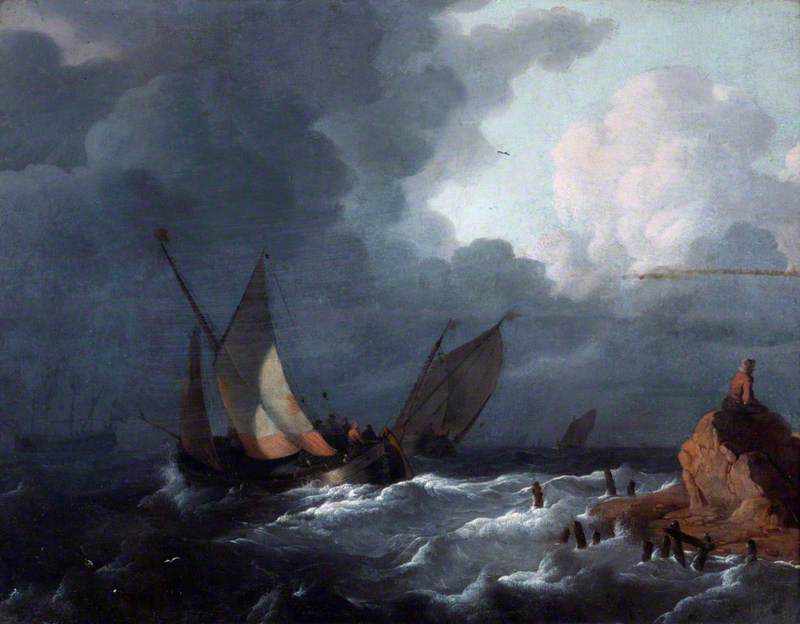
He ran up to the deck with them. Dark grey clouds seemed to swirl down upon them, and the wind screamed past, whipping stinging salt water into their faces. The men were frantically throwing cargo overboard. Jonah knew the real reason for this disaster was his stubborn disobedience.
“Wait, stop—this storm is my fault!” And he explained to the crew what he had done. “If you throw me overboard, God will spare you the anger meant for me.”
“You are crazy. Get below deck!”
But at that, Jonah leaped onto a load of cargo about to be tipped overboard, and went with it into the waves.
Immediately then the winds calmed and the storm abated. The crew looked out into the grey, choppy sea, hoping to find him, but they saw nothing, not even with binoculars. “He can’t survive in that water,” concluded the first mate, and the captain called off the search. All the ship’s hands removed their hats and the women knelt and prayed quietly for the madman’s soul.
***
But God had sent a great fish to swallow Jonah. The fish was not entirely happy about this. The man was bulky and not particularly tasty; he had a cloying aftertaste, as if he habitually rubbed his clothes with grease and sugar. If that weren’t enough, the fish perceived a strange, rambling vibration, which after a time he determined to be the man muttering something about the belly of Sheol, and addressing the Creator in the most abject manner.
The fish grew upset with all this commotion going on inside. Nevertheless it swam on, hoping the problem would soon digest. But it did not. So, unaccustomed as the fish was in deferring to its food, it addressed the man and apologized for eating him, saying that it had only followed its nature, and would appreciate some quiet.
The man was unsympathetic. He railed at the fish in uncouth terms for thwarting the Creator’s will by swallowing His prophet.
The fish protested. In following its nature and swallowing the man, it had acted in direct accordance with the will of its Creator. It would never have occurred to him to diverge from it, nor did it even occur to him to question its Creator the way that men apparently did. The fish asked the man what purpose he thought the Creator had in mind for him.
The man replied that he was to pass judgment on a sinful people and prophesy their destruction.
Very odd, mused the fish. It never judged other creatures; it simply ate them. And, it suggested with humility, simplicity is the purest form of wisdom. For this it received a prolonged stream of abuse, which eventually became unbearable. After all, the fish had a delicate constitution and refined feelings. All that noise and the creature didn’t even taste good. In fact, he was indigestible. Feeling rather ill, the fish made for the nearest shore and vomited out the man upon dry land.
As he lay on the shore, drying out in the hot sun, a shadow suddenly moved over him. Jonah looked up and again saw Penuel, holding a large beach umbrella. He again commanded Jonah: “You have been shown mercy, prophet of God. Now preach that mercy to the people of Nineveh. Be up and on your way!”
***
Jonah arrived at Basrah International Airport in the midafternoon. It had been cold in his home country, but here it was blazingly hot. At least his coat, which had been damp with seawater, finally dried out. The city was sprawling and squalid, surrounded by a barren desert plain.
Feeling thirsty, he went into a tea shop for a glass of tea. It was the only good thing about this place, not cold, but sweet, with a hint of cardamom. An old battered television sat on a table in the corner; a news report showed the armies of several countries massing on Nineveh’s border. They had given the King an ultimatum that he stubbornly defied, and he took heart that this was a sign that God would finally strike down his wicked reign.
Thus encouraged, he was filled with The Holy Spirit, and began to walk the streets, prophesying: “Nineveh, accept God’s mercy and repent of your evil ways!” Old men smoked at the windows and squinted at him; housewives hanging laundry paused to gawk at him; and a parade of giggling children followed and threw scraps of refuse at him. When night fell, he found a thin old mattress and slept under a bridge. He awoke shivering from the cold desert night.
Stretching his aching body, he dreaded the mission before him. The Ninevens had mocked him, indeed mocked God’s very Word, every step of the way. He decided to make a path straight through the city. Perhaps if he went quickly, he could fulfill his mission with the least abuse. He would just give them the minimum warning to repent, though he was sure the city was doomed.
At first he prophesied quietly. He didn’t want any trouble, and he sure didn’t want to attract the attention of the authorities. He tried to ignore the stares and spitting, but then he got annoyed with their insolence, and started shouting: “Yet forty days and Nineveh shall be overthrown!” Unfortunately he attracted even more attention. People mocked and cheered. Children followed him like a parade. Reporters with cameras showed up and recorded him prophesying in the streets.
In the end, it took three days to cross the city on foot. He was exhausted. His legs and feet ached, yet he took solace, knowing that the sinful Ninevens would not repent and would surely be punished. He took up his dirty old mattress and made camp atop a ridge at the outskirts of the city, waiting to witness its destruction.
***
By now Jonah’s message had been broadcast on the news and reached the entire city. Even the King heard it and considered, thinking either this man is completely mad or completely honest, or both. And he’s right, for my sworn enemies are at the gates! Fearing God’s word, he repented and proclaimed that the city, all its people and even the animals, should also repent.
Forty days passed, but nothing unusual happened. He walked down from the ridge and went into town to see what was going on. There he saw a dog wearing a hair shirt and thought, that was odd. Then he saw everyone in the streets, even the animals, wearing sackcloth, with ashes on their faces and dust in their hair, praising God and asking for his mercy.
It seemed God had forgiven Nineveh. Jonah pulled his hair, thumped his head on the ground, put dirt in his mouth and spit it out.
“Lord, is this not what I said would happen?” he wailed. “This is why I fled to Tarshish, that the wicked might not prevail—for you are too merciful and slow to anger. Why do you love sinners yet make me suffer? Take my life from me, O Lord, for it is better for me to die than to live!”
A deep voice behind him asked, “What good does it do you to be angry, Jonah?”
Jonah looked around but saw no one. He shouted, “It pleases me to be angry, angry enough to die!” And with that he kicked down the hut. He fell upon the ground by the pile of refuse and wept. The sun glared down upon him and he fell into a fitful sleep.
He awoke some time later, his lips parched. The desert was as hot as an oven. His skin had turned red and started to blister. He became faint and could hardly move. Now, he thought, he would surely die, but be released from the burden the Lord had set upon him.
But God caused a lush gourd tree to grow and shade him that same day.
Jonah lay delirious under the tree; shards of sunlight shone through the beautiful vines and broad leaves, and dazzled him as he looked up. Dusk brought a cool breeze, and he fell into deep sleep. Jonah dreamed he was on a sunny beach with a cool drink. The breeze blew leaves upon him, and he had the impression that Cuban girls were plucking off the leaves and rolling them into cigars on their smooth thighs. Suddenly the sun was eclipsed as Penuel towered over him, holding a drink with a little umbrella. He regarded the gorgeous sands and the sea of shining beauty and breathed deeply the salty air, as if on vacation himself. He said nothing, only smiled broadly at Jonah.
Jonah awoke in the early morning, covered with leaves. He stood up and was dismayed to see that the lovely tree had died. All its leaves had dropped off, and its fruit had fallen to the ground, but he was still standing in shadow. He turned and saw that a wall had been built behind him. Disoriented, he cursed that he was still alive. Now a voice came from beyond the wall: “You pity this plant, which grew over you in a night, and then perished in another night. Should I not also pity Nineveh, that great city, and all those within it?”
He walked around the structure and found that it was the back wall of a building. He entered and saw menus and posters in his own language as well as that of the Ninevens. It was a cafe built by the army that had occupied Nineveh. He picked up a newspaper and saw that it was Easter Sunday, so he ordered coffee and donuts, and rejoiced. They were decent by his usual standards, but as starved and exhausted as he was, they tasted heavenly.
He took a bag of donuts outside and breathed in the morning air. He just wanted to return to his old life in Pittsburgh. Had his mission not been fulfilled? He walked to the gourd tree, and there, huddled in the ruins of his hut, saw an unshaven, dirty wretch. At first he was filled with indignation that a vagrant had stolen his shady spot, but the man appeared to be praying. Having been in a similarly wretched condition just one night ago, Jonah thought better of him.
He went over and offered the man donuts. The man seemed grateful and blessed Jonah, saying something in broken English about repenting and finding God. Jonah breathed a sigh of relief—at least he had fulfilled his mission, and now set himself to thinking how he would get home.
At that moment military police from the occupying army arrived and arrested the man, identifying him as the King of Nineveh. They interrogated Jonah as well; he told them all about the mission on which the Lord had sent him. They concluded he was a disoriented tourist, and irrelevant to the case. They promptly shipped him out.
On the plane home, Jonah couldn’t help feeling angry with God once more. In his prayers he complained: Why did he have to be coerced and deceived into doing God’s will? Not only had he been blessed by the most evil of men, the King of Nineveh himself, but the bastard had eaten some of his donuts.
He didn’t feel better until about a week after he returned. Finally, he sat at his favorite table in the coffee shop. Steam rising from the mill rose silvery in the heavenly morning light. He sipped his strong hot coffee, and it warmed him inside to know that, after all, the Lord was still hard at work judging sinners.
Someone opened the door for a wholesome looking, redheaded young lady wearing a student nurse’s uniform and pushing a stroller. After being away so long, Jonah was happy to see a familiar face—his former waitress Madison.
“Jonah!” she exclaimed upon noticing him. She parked the stroller by the table and sat down; the baby goggled at him with large blue eyes and gurgled. Madison related all that had happened in her life since he’d been away; she told him: “You know, it’s funny, I just had a dream about you. You were sitting here with that really tall black guy–you know, the one with the umbrella who used to come in. He was talking to you while you read a newspaper. On the front page was the King of Nineveh eating a doughnut, and the tall guy said, ‘His face is hidden, but watches over.’ What do you think it means?”
Table of Contents
Antoni Camplese is a Tech exile now living in the Wilds of Central Pennsylvania. He writes fiction influenced by Italo Calvino, Jorge Luis Borges, Kobo Abe, and Franz Kafka.
Follow NER on Twitter @NERIconoclast